

The short answer: how to clean a cast iron skillet: get the food off without stripping the seasoning, and never let the pan stay wet.
- Clean it while it's warm and rinse with hot water
- Stuck-on food: scrub with kosher salt
- Soap: a little is fine if needed
- Dry it completely and rub in a thin layer of oil
- Next step: Plan it with the Cleaning Schedule ($4.49).
Learning how to clean a cast iron skillet is the key to keeping one for life. Cast iron is inexpensive, holds heat beautifully and gets better with use, but it needs a different kind of care than stainless steel or nonstick pans. The goal is simple: get the food off without stripping the seasoning, and never let the pan stay wet. This guide covers everyday cleaning, stuck-on food, soap, rust and how to re-season a pan.
How to clean a cast iron skillet: the quick version
- Clean it while it's warm, right after cooking.
- Wipe out food and oil with a paper towel or cloth.
- Rinse with hot water and scrub with a chainmail scrubber, stiff brush or kosher salt.
- Use a little soap only if needed, then rinse.
- Dry it completely, on the stove over low heat if you like.
- Rub in a thin layer of oil and put it away.
What seasoning is and why it matters
Seasoning is a thin layer of oil that has been baked onto the pan until it hardens. Virginia Tech food scientist Sean O'Keefe explains that heat makes the oil molecules combine into larger molecules, which forms a protective layer that prevents rust and gives the pan its nonstick surface. "Cast iron is just pure iron," he says, and unlike stainless steel it has no chromium to protect it, so bare cast iron rusts rapidly. Every cleaning step below is about protecting that layer.
Step 1: Clean it right after cooking
University of Maine Cooperative Extension says one of the most important rules is to clean the pan immediately after cooking. Food that sits and dries is much harder to remove, and you will likely lose some seasoning getting it off. Once you're done cooking and the pan is warm but safe to handle, wipe out excess food and oil with a paper towel or cloth.
Never rinse a hot pan under cold water. UMaine warns that the sudden temperature change can warp or crack the pan. Use hot water instead.
Step 2: Rinse and scrub
Rinse the skillet with hot water. To remove stuck pieces, UMaine suggests a towel, a stainless-steel chainmail scrubber, a nonabrasive scrub pad, a soft sponge or a stiff brush. Do not use steel wool or scouring pads, which can strip the seasoning.
Step 3: Deal with stuck-on food
If food is still stuck, UMaine describes three methods:
| Method | How it works |
|---|---|
| Salt | Add a few tablespoons of kosher salt and a few tablespoons of water, then scrub with a nonabrasive brush or towel. |
| Boiling | Bring a little water to a boil in the pan and loosen the bits with a wooden spoon. |
| Soap | Use just a small amount of dish soap, then rinse and dry the pan completely. |
The salt method is the favorite of many cast iron cooks. The coarse salt scrubs without scratching, and you can rinse it straight down the drain.
Can you use soap on cast iron?
This is the most argued-about question in cast iron care, and the experts don't all say the same thing.
- Virginia Tech's O'Keefe says the no-soap rule comes from a time when soap contained lye and could damage seasoning. That doesn't apply to modern soap on a properly seasoned pan, he says, because the polymerized seasoning layer won't wash off. He suggests rinsing with warm water and soap if needed.
- University of Maine Extension says there is no clear consensus, and that a large amount of soap can strip seasoning. If you use soap, use just a little and rinse and dry the pan fully.
- Mississippi State University Extension advises against soap and steel wool and recommends cleaning with water and a towel once the pan has cooled.
The practical answer: a well-seasoned skillet can handle a small amount of dish soap now and then. If your pan is new or the seasoning is thin, stick with hot water, a brush and salt until the seasoning builds up.
Step 4: Dry it completely
Water is what ruins cast iron. After rinsing, dry the skillet thoroughly with a paper towel or cloth. UMaine says it's also fine to put the pan on the stovetop or in the oven until all the moisture has evaporated. Mississippi State's rule is simple: never leave cast iron submerged in water, and always dry it after cleaning.
Step 5: Oil it before you put it away
Once the pan is dry, UMaine suggests setting it on low heat, adding a small amount of neutral oil and spreading it over the inside with a paper towel. Doing this after every use adds to your seasoning layer. O'Keefe gives the same advice: after each use, dry the pan and rub it down with oil to maintain the seasoning. Wipe off any excess, so the surface looks lightly glossy, not wet.
How to get rust off cast iron
Rust happens, usually when a pan wasn't dried fully or was stored somewhere damp. It's almost always fixable. Mississippi State suggests:
- Scrub the rust with kosher salt and a wet towel.
- If it won't budge, soak the rusted area in vinegar for no longer than 15 minutes at a time.
- Check every 15 minutes to see whether the rust flakes off. This can take a while.
- Wash the pan once the rust is gone.
- Dry it and re-season it, because the vinegar and scrubbing remove seasoning along with the rust.
Don't leave cast iron in vinegar for long stretches; short soaks with checks in between are the safer approach.
How to season or re-season a cast iron skillet
Re-season a pan after rust removal, when food starts sticking, or when the surface looks dull and gray. The basic steps are the same from both extension services:
- Wash the pan in warm, soapy water to remove residue.
- Dry it completely, on the stove or in the oven if needed.
- Apply a thin, even layer of oil to the inside and outside with a paper towel, and wipe off the excess.
- Bake it upside down for one hour, with foil or a baking sheet on a lower rack to catch drips.
- Let it cool, then repeat.
| Source | Oven temperature | How many coats |
|---|---|---|
| University of Maine Extension | About 450°F | 3 to 5 times |
| Mississippi State University Extension | 350°F | 3 to 4 times |
| Virginia Tech (O'Keefe) | 450°F | 2 to 3 times |
Baking upside down keeps oil from pooling in the pan, which is what causes sticky spots.
Which oil to use
UMaine recommends a neutral oil with a high smoke point, such as vegetable or canola oil. O'Keefe says to choose an oil with a high polyunsaturated fat content that can form a firm layer, such as soybean or flaxseed oil, and notes that coconut oil would not work as well. Whatever you choose, the thin coat matters more than the brand.
Cast iron do's and don'ts
| Do | Don't |
|---|---|
| Clean it while it's warm | Let food dry in the pan overnight |
| Use hot water, a brush, chainmail or salt | Use steel wool or scouring pads |
| Dry it right away and completely | Soak it or leave it in the sink |
| Oil it lightly after each use | Put it in the dishwasher |
| Preheat it before adding food | Rinse a hot pan under cold water |
O'Keefe also says to preheat cast iron before adding food, since iron heats less evenly than other pans, and to use caution because it holds heat longer. Wood utensils are ideal, he says, but metal is fine as long as you're not digging into the surface.
Cooking acidic foods
You may have heard never to cook tomatoes in cast iron. O'Keefe says this is partly true. A properly seasoned pan can handle acidic foods, but it isn't the best choice for something simmered for a long time, like tomato sauce. For that, he suggests enamel-coated cast iron. A quick pan sauce with a splash of wine or lemon is fine in a well-seasoned skillet.
Storing cast iron
Store your skillet completely dry, with its thin coat of oil, in a dry cabinet or on the stovetop. If you stack pans, put a paper towel between them to protect the surface and absorb any moisture.
Make cast iron care part of your kitchen routine
Cast iron care is really a habit: clean, dry, oil, every time. Writing kitchen jobs down helps the bigger ones happen too. Our Cleaning Schedule ($4.49) is a 9-page printable with daily, weekly and monthly checklists, a seasonal deep clean list and room-by-room checklists, so "check and re-season cast iron" can sit on the seasonal list next to cleaning the oven.
Cast iron is often a family heirloom, passed down with the recipes that were cooked in it. Our Family Recipe Binder ($6.99) has section dividers, four recipe page layouts with room for the family story, 4x6 and 3x5 cards and a conversion chart, so you can keep grandma's cornbread recipe with the skillet it was made in. You can print it or type into the fillable version.
For more kitchen cleaning help, see our deep cleaning checklist.
Your next step
Tonight, after dinner, try the full routine on your skillet: wipe it warm, rinse with hot water, scrub with a little salt, dry it on the stove and rub in a thin coat of oil. If it's rusty or sticky, set aside an afternoon this weekend to re-season it with two or three thin coats.
For other tools and pans around the house, see how to remove rust from metal, with seven methods and a quick guide to which one to use.
Make it easier
Tools for this
Printables
Cleaning Schedule
Daily, weekly, monthly and seasonal lists - plus a family chore chart.

Printables
Family Recipe Binder
Section dividers, four recipe page layouts with room for the family story, 4x6 and 3x5 cards and a conversion chart - print it or type into the fillable version.
Frequently asked questions
What is the best way to clean a cast iron skillet? The best way to clean a cast iron skillet is to clean it right after cooking while it is still warm. Wipe out food and oil, rinse with hot water, scrub stuck bits with a chainmail scrubber, stiff brush or kosher salt, then dry it completely and rub a thin layer of oil over the inside before you put it away.
Can you use soap on a cast iron skillet? Yes, a small amount of modern dish soap is fine on a well-seasoned skillet. Virginia Tech food scientist Sean O'Keefe says the "no soap" rule comes from a time when soap contained lye, and that soap won't wash off a properly polymerized seasoning layer. University of Maine Extension adds a caution: use just a little and rinse and dry well.
How do you clean a cast iron skillet with salt? To clean a cast iron skillet with salt, add a few tablespoons of kosher salt and a few tablespoons of water to the pan, as University of Maine Extension describes. Scrub with a nonabrasive brush or towel to lift stuck-on food, rinse, then dry the skillet completely and wipe a thin layer of oil inside.
How do you get rust off a cast iron skillet? To get rust off cast iron, scrub it with kosher salt and a wet towel first. Mississippi State University Extension says that if the rust still won't come off, soak the rusted area in vinegar for no longer than 15 minutes at a time, checking each time. Once the rust flakes off, wash, dry and re-season the pan.
Can you put a cast iron skillet in the dishwasher? No, you can't put a cast iron skillet in the dishwasher. University of Maine Extension says never to soak cast iron in water or put it in a dishwasher, because that will ruin the seasoning layer and rust the pan. Virginia Tech's O'Keefe agrees that dishwasher concerns are accurate. Wash cast iron by hand and dry it right away.
Can you soak a cast iron skillet? No, do not soak a cast iron skillet. Long soaks let water reach the iron, which rusts quickly. For stuck food, University of Maine Extension suggests boiling a little water in the pan and loosening the bits with a wooden spoon, or scrubbing with kosher salt and water instead.
What should you scrub cast iron with? Scrub cast iron with a stainless-steel chainmail scrubber, a nonabrasive scrub pad, a soft sponge, a stiff brush or kosher salt. University of Maine Extension says never to use abrasive scrubbers like steel wool or scouring pads, because they can remove the seasoning layer.
How do you season a cast iron skillet? You can season a cast iron skillet by washing and fully drying it, rubbing a thin, even layer of oil over the pan inside and out, and baking it upside down for one hour. University of Maine Extension uses about 450°F and repeats 3 to 5 times. Mississippi State uses 350°F and repeats 3 to 4 times.
What oil should you use to season cast iron? Use a neutral oil with a high smoke point, such as vegetable or canola oil, which University of Maine Extension recommends. Virginia Tech's O'Keefe suggests oils high in polyunsaturated fat, such as soybean or flaxseed oil, which form a firm layer, and says coconut oil would not work as well.
Why is my cast iron skillet sticky after seasoning? A sticky skillet usually means too much oil was left on before baking, so it did not fully harden. University of Maine Extension says to aim for a thin layer evenly spread across the pan and to wipe off any excess. Bake it again for an hour, then use thinner coats next time.
Can you cook tomatoes in cast iron? Yes, you can cook tomatoes in cast iron for a short time. Virginia Tech's O'Keefe says a properly seasoned pan can be used with acidic foods, but it is not the best choice for long simmers like tomato sauce. For those, he suggests enamel-coated cast iron instead. Quick acidic dishes in a well-seasoned skillet are fine.
Should you rinse a hot cast iron pan under cold water? No, you shouldn't rinse a hot cast iron pan under cold water. University of Maine Extension says never to rinse hot cast iron under cold water, because the sudden change can warp or crack the pan. Let it cool until it is warm but safe to handle, then rinse it with hot water.
More from HomeBase
You may also like

Printables
Household Binder
Family info, emergency plan, calendars, meals, groceries, cleaning, bills and sitter notes.

Printables
Home Maintenance Log
Monthly, seasonal and annual checklists plus a record of every appliance and repair.

Printables
Home Inventory
Printable pages and a spreadsheet that totals the value of every room.
 Save 48%
Bundles
Home Management Bundle
Household binder, maintenance log, moving planner, cleaning schedule, home inventory and password log.
 Club
Monthly club
Planner & Calendar Club
Anyone who wants a monthly calendar, bill calendar and meal plan ready to print.
Free printable
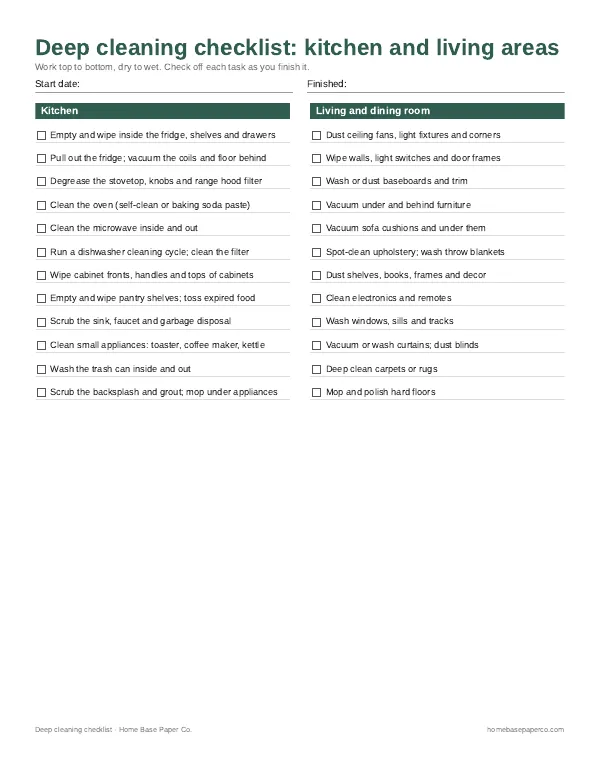
Clean the whole house in order: get the free deep cleaning checklist
A printable room-by-room deep cleaning checklist that tells you what to do first, so nothing gets cleaned twice. You'll also get our weekly HomeBase email with simple cleaning routines and chore ideas the whole family can help with.
Sources
- University of Maine Cooperative Extension: Cast Iron extension.umaine.edu
- Mississippi State University Extension: How to Care for Cast Iron extension.msstate.edu
- Virginia Tech: Food scientist dispels the myths behind cast iron pan use news.vt.edu