

The short answer: a family tree template gives you a simple structure for recording your ancestors: one box per person, with room for names, dates and places. This free printable has 4 pages.
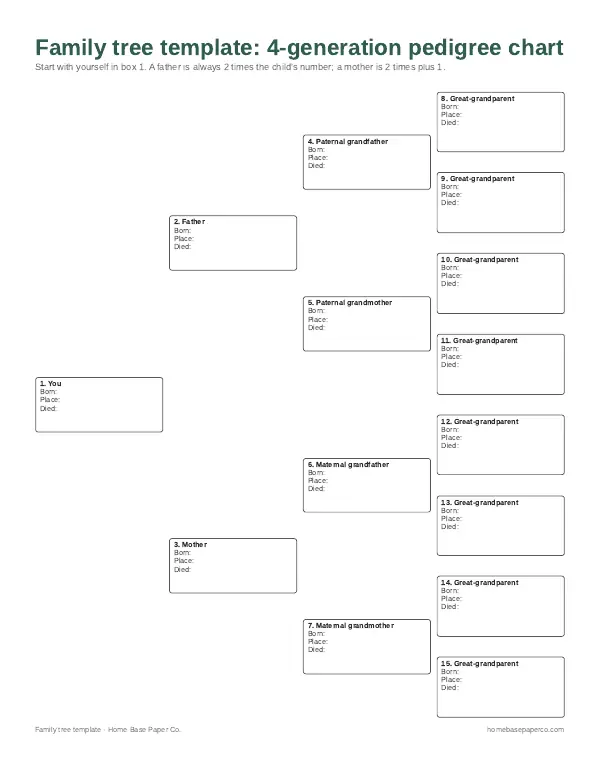
- Page 1: a 4-generation pedigree chart with 15 boxes
- Page 2: a family group sheet; page 3: a research log
- Page 4: a simple tree for kids
- Start with yourself, then add parents and grandparents, noting a source for each fact
- Next step: Get the free family tree template (we email it to you); want more? The Family Recipe Binder is $6.99.
A family tree template gives you a simple structure for recording your ancestors: one box per person, with room for names, dates and places. Our free family tree template below is a 4-page printable PDF with a 4-generation pedigree chart, a family group sheet, a genealogy research log and a simple tree for kids. This guide shows you how to fill it in, where to look for records and how to keep the research organized.
For a personal note to accompany a daughter's birthday keepsake, choose from these birthday wishes for a daughter and add a genuine detail about her.
What's in the free family tree template
| Page | What it is | Best for |
|---|---|---|
| 1. Pedigree chart | 15 boxes covering 4 generations, each with born, place and died lines | Your direct ancestors at a glance |
| 2. Family group sheet | One couple, their parents and up to 7 children, with a source column | Recording a whole family unit |
| 3. Research log | A 12-item records checklist and a search log | Tracking where you have looked |
| 4. Simple family tree | Three generations in large boxes | Kids, school projects and gifts |
Print one pedigree chart to start, and print a new family group sheet for each couple you research.
How to fill out a family tree template, step by step
- Start with yourself. Write your full name, birth date and birthplace in box 1 of the pedigree chart.
- Add your parents. Your father goes in box 2 and your mother in box 3. Use women's maiden names so you can trace their families.
- Add your grandparents. Boxes 4 and 5 are your father's parents; boxes 6 and 7 are your mother's parents.
- Add your great-grandparents. Boxes 8 to 15 hold the eight great-grandparents. Leave a box blank if you do not know the name yet.
- Use a consistent date format. Many genealogists write dates as day, month, year (for example, 4 Jul 1921) to avoid confusion.
- Write places from small to large. Use town, county, state and country, such as "Peoria, Peoria County, Illinois, USA."
- Note your source for each fact. On the family group sheet, the source column is where you record a certificate, census year or relative's memory.
- Extend the chart. When you reach box 8 to 15 on one line, start a new pedigree chart with that ancestor as number 1.
The pedigree chart numbering system
The numbers on a pedigree chart follow a simple rule that makes it easy to find anyone:
| Person | Number | Rule |
|---|---|---|
| You | 1 | Start here |
| Father | 2 | Child's number x 2 |
| Mother | 3 | Child's number x 2 + 1 |
| Father's father | 4 | 2 x 2 |
| Father's mother | 5 | 2 x 2 + 1 |
| Mother's father | 6 | 3 x 2 |
| Mother's mother | 7 | 3 x 2 + 1 |
Every man except you has an even number and every woman has an odd number. If you know someone's number, you can always find their parents.
Start at home: what to gather first
Before you search any database, collect what your family already has. Most trees start with papers in a drawer:
- Birth, marriage and death certificates
- Obituaries and funeral programs
- Family Bibles, which often list births, marriages and deaths
- Letters, diaries and postcards
- Photos with names or dates written on the back
- Military discharge papers and medals
- Naturalization certificates and old passports
- Wedding invitations and baby announcements
Then interview older relatives. Ask where they grew up, their parents' and grandparents' full names, where the family came from, and what they remember about holidays and traditions. Record answers on the research log, and write down who told you each fact. Many families keep these stories and favorite recipes together in a Family Recipe Binder ($6.99), which has a Holidays section and a Family Favorites section for the dishes that come with a story.
Where to find genealogy records
The National Archives' Start Your Genealogy Research page lists the records genealogists use most often: census, military, immigration (ship passenger lists), naturalization and land records. Here is what each can tell you:
| Record type | What it can show | Tip |
|---|---|---|
| Census | Names, ages, birthplaces and relationships in a household | Work backward from the most recent available year |
| Military | Service dates, units, pension applications | Pension files can include family details |
| Immigration | Ship passenger lists and arrival dates | Spellings of names may vary |
| Naturalization | When an ancestor became a citizen, sometimes their hometown | Look for declarations of intention |
| Land records | Where an ancestor lived and owned property | Useful for placing a family in time |
| Vital records | Births, marriages and deaths | Often held by the state or county |
How to use census records
The National Archives census page explains that the first federal population census was taken in 1790 and has been taken every ten years since. Because of a 72-year restriction on access, the most recent year available is 1950, which was released on April 1, 2022. The National Archives has the census schedules from 1790 to 1950, and most have been digitized by its partners.
Family researchers find it most helpful to begin with the most recent census and work backward. Find your grandparents as children in the 1950 or 1940 census, note their parents' names and ages, and then look for those parents ten years earlier. Each census you find gives you clues for the next one.
Keep a research log
A research log saves hours. Page 3 of the template has two parts:
- A records checklist with 12 common record types, from birth certificates to interviews with relatives. Check off each one as you collect it.
- A search log with columns for the date, ancestor, where you looked, what you found and your next step.
Write down searches that found nothing, too. Knowing you already checked a source keeps you from repeating it, and a dead end in one record often suggests where to look next. The National Archives also suggests learning how other researchers solved similar problems when you hit a wall.
Common family tree mistakes to avoid
Even careful researchers run into the same problems. Watch for these as you fill in your family tree template:
- Assuming the same name means the same person. Common names repeat across towns and generations. Confirm with a second detail, such as a spouse's name, birthplace or age.
- Trusting one source for everything. Ages on census records drift, and spellings change from one record to the next. Look for two records that agree before you write a fact in pen.
- Skipping the women. Record maiden names whenever you can. A mother's maiden name opens up a whole new branch of the tree.
- Copying other people's trees without checking. Online trees can be a useful lead, but treat them as hints until you find the record behind each fact.
- Not writing down the source. A year later, you will not remember where a date came from. The source column on the family group sheet exists for this reason.
- Throwing away dead ends. Note what you searched and found nothing in. That information is just as valuable as a match.
How to organize a growing family tree
Once you have more than one page, a little structure keeps the research usable:
| What to set up | How |
|---|---|
| A binder or folder | One section per surname, with pedigree charts at the front |
| Chart numbering | Write "Chart 1," "Chart 2" and note which box each new chart continues from |
| Family group sheets | File them behind the pedigree chart they connect to |
| Copies of documents | Keep copies, not originals, in the binder; store originals somewhere safe |
| A research log per surname | So you can see at a glance what has already been searched |
Review the tree before family gatherings. Bring printed copies and a pen, because relatives often remember a name or date when they see the chart in front of them.
Family tree template ideas for gifts and kids
A filled-in family tree makes a meaningful gift, especially for holidays and reunions:
- Framed tree for grandparents. Fill in the simple version on page 4 and add small photos.
- Reunion activity. Print several pedigree charts and let each branch of the family fill in its section.
- School project. Kids can complete the three-generation tree and interview a grandparent.
- Holiday keepsake. Pair the tree with handwritten family recipes so the stories and the food stay together.
- Baby book page. Add a family tree page to a baby book so the new baby has a record of who came before.
Keep family records together
A family tree is one part of a family's records. If you are already collecting certificates and names, it is a good time to note where important documents are kept. The If Something Happens to Me Binder ($11.99) includes pages for personal information, key contacts, where to find documents and your wishes, so the records you gather are easy for your family to find later.
Download the free family tree template
Use the download box on this page to get the free 4-page PDF. Print the pedigree chart first, fill in what you know, and add a family group sheet for each couple as your research grows.
Make it easier
Tools for this
Printables
Family Recipe Binder
Section dividers, four recipe page layouts with room for the family story, 4x6 and 3x5 cards and a conversion chart - print it or type into the fillable version.
Printables
If Something Happens to Me Binder
Accounts, insurance, bills, contacts, documents and your wishes - so your family isn't left guessing.
Frequently asked questions
What is a family tree template? A family tree template is a ready-made chart with labeled boxes for you, your parents, grandparents and earlier generations. You fill in names, birth and death dates and places. Our free family tree template is a 4-page PDF with a 4-generation pedigree chart, a family group sheet, a research log and a simple tree for kids.
How do I fill out a family tree template? Start with yourself in box 1, then add your father in box 2 and your mother in box 3. Work back one generation at a time, writing full names, maiden names for women, and dates and places of birth, marriage and death. Note where each fact came from so you can check it later.
How many generations should a family tree have? Most beginners start with 4 generations: you, your parents, your 4 grandparents and your 8 great-grandparents, which is 15 people. That fits on one page and is enough to start real research. When a line goes further back, start a new chart with that ancestor in box 1.
What is the numbering system on a pedigree chart? Pedigree charts usually use a simple numbering system. You are number 1. A person's father is always double their number and their mother is double plus one. So your father is 2, your mother is 3, your father's father is 4 and your mother's mother is 7.
What is a family group sheet? A family group sheet records one couple and all of their children on a single page, with dates, places and sources. It complements the pedigree chart, which only shows direct ancestors. Fill out one sheet for each couple on your tree.
Where can I find records for my family tree? You can find records for your family tree at home first and then in the National Archives' most-used collections. The National Archives says the records genealogists use most are census, military, immigration (ship passenger lists), naturalization and land records. Start at home with birth, marriage and death certificates, obituaries, family Bibles and letters, then ask older relatives what they remember, writing names and dates onto the free family tree template on this page as you go.
Which census records can I search? The first federal census was taken in 1790 and every ten years since. Because of a 72-year access restriction, the most recent census available to the public is 1950, which was released on April 1, 2022. The National Archives suggests starting with the most recent census and working backward.
How do I make a family tree for kids? Keep it to three generations: the child, their parents and their grandparents. Let them write names or draw faces in each box and add a photo if you have one. Page 4 of our free family tree template is a simple version designed for kids and school projects.
Should I use a printable or online family tree? Use both if you can: a printable family tree template for sharing and interviewing relatives, and an online tool for searching records. Many people do exactly that. A printable family tree template, such as the free one on this page, is easy to share at family gatherings and to fill in while you interview relatives. Online tools help when you search records. Whatever you use, keep a research log so you know which sources you have already checked; the free template includes one.
How do I record a fact I am not sure about? Record a fact you're not sure about in pencil or mark it with a question mark, and note in the research log where the information came from. Family stories are worth recording, but check them against records such as census entries, certificates or obituaries before treating them as confirmed. The free family tree template on this page includes a research log for exactly those notes.
Is the family tree template really free? Yes, the family tree template is really free. The 4-page family tree template PDF is free for personal use; we email it to you. Print it on US Letter paper, or print extra copies of the pedigree chart and family group sheet as your tree grows.
More from HomeBase
You may also like

Printables
Household Binder
Family info, emergency plan, calendars, meals, groceries, cleaning, bills and sitter notes.
Printables
Cleaning Schedule
Daily, weekly, monthly and seasonal lists - plus a family chore chart.
Printables
Home Maintenance Log
Monthly, seasonal and annual checklists plus a record of every appliance and repair.
Printables
Home Inventory
Printable pages and a spreadsheet that totals the value of every room.
 Club
Monthly club
Planner & Calendar Club
Anyone who wants a monthly calendar, bill calendar and meal plan ready to print.
Free printable
Map four generations of your family
A pedigree chart, family group sheet, research log and a kids' tree. You'll also get our weekly HomeBase email with simple ways to keep family records and important papers in order.
Sources
- Start Your Genealogy Research (National Archives) archives.gov
- Census Records (National Archives) archives.gov