Printables
Home Maintenance Log
Monthly, seasonal and annual checklists plus a record of every appliance and repair.
$5.99Buy

Free tool · slabs, post holes and steps
Work out how much concrete a patio slab, fence post or set of steps needs, in cubic feet, cubic yards and 40, 60 or 80 lb bags, then compare the cost of bags with ready-mix before you head to the store.
Quick answer: a 10 × 10 ft slab 4 inches thick needs 33.3 cubic feet (1.23 cubic yards) of concrete, which is 56 bags of 80 lb mix. With 10% extra for waste, plan on 62 bags. One cubic yard (27 cubic feet) takes 45 of those 80 lb bags.
Every concrete estimate comes down to volume. Work in feet, find cubic feet, then divide by 27 to get cubic yards. There are 27 cubic feet in a cubic yard (3 × 3 × 3), which matches the NIST Guide to the SI conversion factors: a cubic yard is 0.7645549 cubic meters and a cubic foot is 0.02831685 cubic meters. Convert inches to feet by dividing by 12.
According to the Quikrete Concrete Mix data sheet, a 40 lb bag yields about 0.30 cu ft, a 60 lb bag about 0.45 cu ft and an 80 lb bag about 0.60 cu ft. To get the bag count, divide your cubic feet by the yield and round up.
| Bag size | Yield per bag | Bags per cubic yard |
|---|---|---|
| 40 lb | 0.30 cu ft | 90 |
| 60 lb | 0.45 cu ft | 60 |
| 80 lb | 0.60 cu ft | 45 |
Yields vary by product, so check the bag you're buying. Lightweight or high-yield mixes cover more per bag than standard concrete mix.
The math gives a useful rule of thumb. One cubic yard is 45 bags of 80 lb mix, which is 3,600 lb of dry mix to lift, haul and mix. Quikrete's data sheet asks for at least 1 cu ft of mixer capacity for each 80 lb bag mixed at once, and its patio instructions suggest buying or renting a power mixer for larger jobs. Post holes, small pads and a few steps are usually comfortable bag jobs. Once a project gets close to a yard or more, get a ready-mix quote and compare it in the calculator, along with any minimum order or delivery fee the supplier charges.
Concrete is only part of the bill. Add gravel for the base, form boards, stakes, rebar or mesh if you use it, a mixer or tool rental, and delivery. Price each line before you start, put the total in a monthly budget, and if the project is a few months out, set money aside in a sinking fund so it doesn't land on a credit card. Larger repairs fit the same plan; our guide to building an emergency fund covers the surprises. Many outdoor concrete jobs fit into a seasonal home maintenance checklist, and a property maintenance log keeps the date, cost and receipts together. Those records are useful at tax time and when you sell.
After the pour
The Home Maintenance Log keeps every improvement, repair and contractor in one place, so you know what you poured, when and what it cost.
Organizing the whole house? See the Home Management Bundle, $16.99 (instead of $32.94 bought separately).
How much concrete do I need for a 10x10 slab? A 10 × 10 ft slab 4 inches thick needs 33.3 cubic feet, or about 1.23 cubic yards, of concrete. That's 56 bags of 80 lb mix with no extra. Add 10% for spills, uneven ground and form bulges and you need about 36.7 cubic feet (1.36 cubic yards), or 62 bags of 80 lb mix.
How many 80 lb bags of concrete make a yard? It takes 45 bags of 80 lb concrete mix to make one cubic yard. A cubic yard is 27 cubic feet, and Quikrete's data sheet says an 80 lb bag of its Concrete Mix yields about 0.60 cubic feet, so 27 ÷ 0.60 = 45. With 60 lb bags (0.45 cubic feet each) it's 60 bags, and with 40 lb bags (0.30 cubic feet each) it's 90 bags.
How do you calculate concrete in cubic yards? Multiply length × width × thickness, all in feet, to get cubic feet, then divide by 27 to get cubic yards. Convert inches to feet by dividing by 12 first, so a 4-inch slab is 0.333 ft thick. For example, 12 ft × 8 ft × 0.333 ft = 32 cubic feet, and 32 ÷ 27 = 1.19 cubic yards.
How many bags of concrete do I need for a fence post? A 10-inch-wide, 3-foot-deep post hole holds about 1.64 cubic feet, which is 3 bags of 80 lb mix (2.7 bags, rounded up). Quikrete suggests digging the hole about 3 times the post's width and 1/3 of the post's overall height deep, so a 4x4 post that's 9 ft long fits that example. Use the Round column / post hole option above and enter how many holes you're filling.
How thick should a concrete slab be? Quikrete's Concrete Mix is made for pours 2 inches thick or more, and its patio instructions use 2x4 forms, which give a slab about 3 1/2 inches thick over a compacted gravel base. Heavier loads call for thicker concrete, and for footings or anything load-bearing, check your local building code before you buy.
Is it cheaper to use bags or ready-mix concrete? It depends on your local prices, so compare both in the calculator: enter the price you're quoted for an 80 lb bag and for a cubic yard of ready-mix. Because one cubic yard takes 45 bags of 80 lb mix, multiply your bag price by 45 to compare it directly with the per-yard price. Ask the ready-mix supplier about minimum orders and delivery fees, which can change the answer on small jobs.
How much extra concrete should I order? This calculator adds 10% by default, a common starting cushion for spills, a slightly uneven base and forms that bow out. Raise it if your ground is rough or you're pouring by hand for the first time. Running short in the middle of a pour is a bigger problem than having a bag or two left over.
How many cubic feet are in a cubic yard? There are 27 cubic feet in a cubic yard, because a yard is 3 feet and 3 × 3 × 3 = 27. NIST's conversion factors confirm it: a cubic yard is 0.7645549 cubic meters and a cubic foot is 0.02831685 cubic meters, and 0.7645549 ÷ 0.02831685 = 27.
How much does a cubic yard of concrete weigh? A cubic yard of Quikrete Concrete Mix weighs roughly 3,780 lb once mixed. The data sheet lists a unit weight of about 140 lb per cubic foot, and 140 × 27 = 3,780. That's why moving and mixing 45 bags by hand is a big day's work.
How long before I can walk on new concrete? Start curing as soon as the surface is finished and keep it going for 5 days in warm weather (70 °F or higher) or 7 days when it's 50 to 70 °F, per Quikrete's data sheet. For a set post, the same sheet says to wait 24 hours before putting any strain on it. Protect fresh concrete from freezing for the first 48 hours.
Free printable
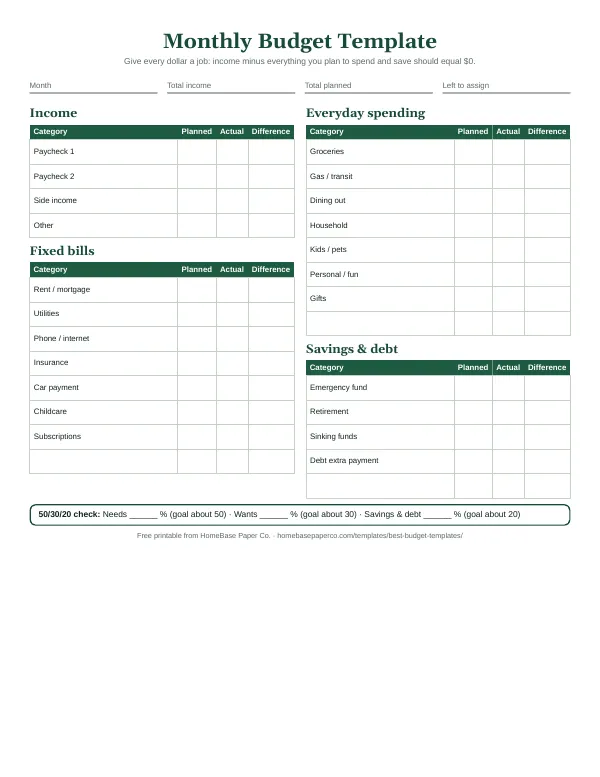
A printable zero-based monthly budget: income, bills, everyday spending and savings on one page, with a planned vs. actual column. You'll also get our weekly HomeBase email with simple budgeting and bill-paying tips.
Home projects
Printables
Monthly, seasonal and annual checklists plus a record of every appliance and repair.
 Save 48%
Bundles
Household binder, maintenance log, moving planner, cleaning schedule, home inventory and password log.
Printables
Twelve undated pages you can print every month: budget, bills, spending, savings and debt.