

The short answer: to build an emergency fund, figure out what one bare-bones month costs you, set a small starter goal, open a separate savings account and move a fixed amount there automatically every payday.
- Starter fund: $500 to $1,000 covers many single surprises
- Full fund: usually three to six months of essential costs
- Send windfalls straight in and refill the fund after you use it
- Not for predictable bills like car registration; those belong in a sinking fund
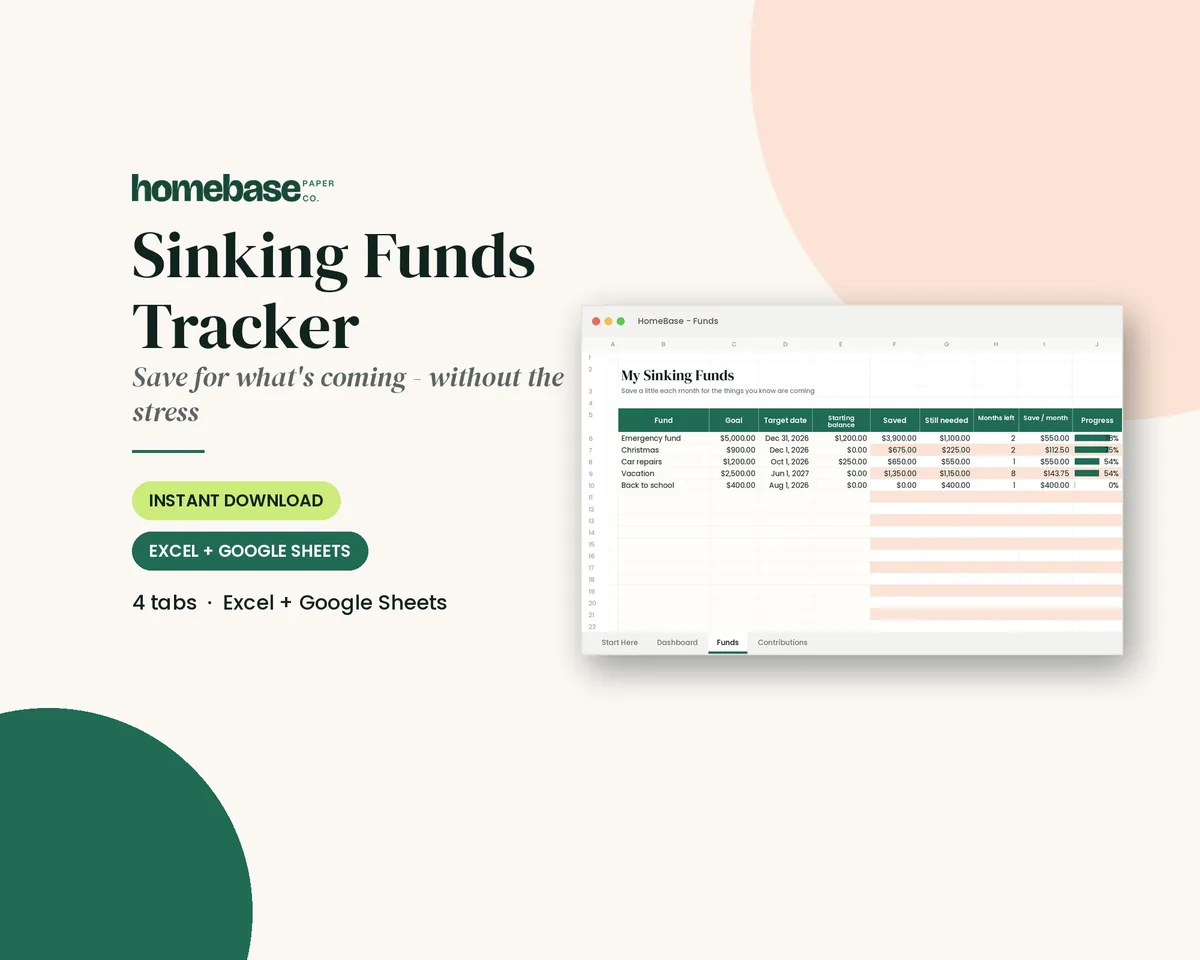
- Next step: Plan it with the Sinking Funds Tracker ($4.99).
How to build an emergency fund: figure out what one bare-bones month costs you, set a small starter goal first, open a separate savings account, and move a fixed amount there automatically every payday. Then send part of every windfall in, track your progress and refill the fund after you use it. A starter fund of $500 to $1,000 covers many single surprises. A full fund is usually three to six months of essential costs.
That's the whole method. The hard part is doing it on a real budget, so this guide gives you the numbers: what counts as an emergency, how much to aim for, where to keep the money, how long it takes at different savings rates, and what to do when the fund gets used. If you like seeing the math done for you, the Sinking Funds Tracker ($4.99, Excel and Google Sheets) works out the monthly amount for any goal and target date and shows when your emergency fund is ready.
A lot of money advice assumes you already have a savings cushion. Most families I know are building one from scratch, a little at a time. Slow progress is still progress, and a fund you can pause and restart beats a perfect plan you quit in February.
What is an emergency fund?
An emergency fund is cash you set aside only for surprises you can't skip. The Consumer Financial Protection Bureau's guide to building an emergency fund describes it as a cash reserve for unplanned expenses or financial emergencies, such as car repairs, home repairs, medical bills or a loss of income.
These surprises are common. In the Federal Reserve's report on the economic well-being of U.S. households in 2025, 59% of adults had at least one major unexpected expense in the prior 12 months. The most common was a major vehicle repair or replacement (30% of adults), followed by a major house or appliance repair (22%) and major medical expenses (21%). The same report found that 63% of adults would cover a hypothetical $400 emergency with cash or its equivalent.
The simplest test is three questions: Is it unexpected? Is it necessary? Is it urgent? If the answer to all three is yes, it's an emergency.
| Expense | Emergency fund? | Better home for it |
|---|---|---|
| Job loss or a big drop in hours | Yes | Emergency fund |
| Car repair you need to get to work | Yes | Emergency fund |
| Medical bill insurance didn't cover | Yes | Emergency fund |
| Broken furnace or water heater | Yes | Emergency fund |
| Car registration or insurance renewal | No, it's predictable | A sinking fund |
| Christmas gifts and holiday travel | No, it's on the calendar | A holiday sinking fund |
| A sale on something you want | No | A savings goal or your monthly budget |
| A new phone because yours is old | Usually no | A sinking fund |
Predictable costs that only show up once or twice a year are the main reason emergency funds get drained. Our sinking funds guide shows how to save for those separately, so your emergency money stays for real emergencies.
How much should you have in an emergency fund?
How much you need depends on your situation. The CFPB suggests thinking about the most common unexpected expenses you've had in the past and what they cost. Most plans use two levels:
- Starter fund: a flat amount, often $500 to $2,500, that covers one surprise bill without a credit card.
- Full fund: three to six months of essential expenses. That means the costs you'd still pay if your income stopped, not your whole current budget.
Wondering how your cash compares? Our average savings by age guide breaks down the Federal Reserve's 2025 numbers.
Start by adding up one essential month. Here's a hypothetical example:
| Essential cost (hypothetical) | Monthly amount |
|---|---|
| Rent | $1,450 |
| Utilities, phone and internet | $320 |
| Groceries | $650 |
| Insurance | $280 |
| Gas and transportation | $250 |
| Minimum debt payments | $250 |
| Essential month | $3,200 |
Now multiply. For this hypothetical family, the targets look like this:
| Level | Formula | Target |
|---|---|---|
| Starter | Flat amount | $1,000 |
| One month | 1 × essential month | $3,200 |
| Three months | 3 × essential month | $9,600 |
| Six months | 6 × essential month | $19,200 |
Where you land between three and six months depends on how steady your income is:
| Your situation | A common target |
|---|---|
| Two steady incomes, few dependents | About 3 months |
| One steady income for the whole household | About 6 months |
| Commission, tips, freelance or seasonal pay | 6 months or more |
| Job feels shaky, or your field is slow to rehire | Lean toward 6+ months |
| High-deductible health plan | Add your deductible on top |
You may also see an informal rule of thumb called the 3-6-9 rule, which some people use to nudge the target higher as income gets less predictable. It isn't official guidance from any agency, so treat it as a loose starting point, not a requirement. Any amount you save makes the next surprise smaller.
How to build an emergency fund in 7 steps
- Write down your essential month. Use the table above and your last two bank statements. Be honest about groceries and gas, because those are the numbers people guess low.
- Pick a starter goal you can reach in a few months. $1,000 is a common first target. If that feels far away, start with $500. Use an emergency fund tracker to track your progress and break the bigger goal into milestones you color in.
- Open a separate account. Keep the money out of checking so you don't spend it by accident. Give it a plain nickname like "Emergency only." The section below compares your options.
- Automate it on payday. The CFPB says setting up automatic recurring transfers is often one of the easiest ways to save. If your employer allows it, ask about splitting your direct deposit between checking and savings. Then the money never lands where you'd spend it. This is pay yourself first in practice.
- Find the monthly amount. Look for money in three places: one cut, one bill you can renegotiate and one small extra income source (see the table below).
- Send windfalls straight in. The CFPB points out that a tax refund can be one of the largest checks many Americans get all year, and that cash gifts from a holiday or birthday can help too. A rule like "half of every windfall" keeps it simple.
- Track it and celebrate milestones. Update the balance every payday. The CFPB notes that watching your progress can give you the encouragement to keep going. When you hit a milestone, mark it, then set the next one.
Here's where a hypothetical household might find $150 to $250 a month:
| Where the money comes from | Hypothetical monthly amount |
|---|---|
| Pause one streaming service and one app subscription | $25 |
| Cook one more dinner at home each week | $60 |
| Call your car or renters insurer to compare quotes | $20–$40 |
| Bring lunch to work two days a week | $40 |
| Sell one item you no longer use each month | $25–$75 |
| Total | $170–$240 |
How long does it take to build an emergency fund?
It takes as long as your monthly amount allows. That's fine. Here's the math, before interest:
| Monthly savings | $1,000 starter | $3,200 (1 month) | $9,600 (3 months) |
|---|---|---|---|
| $50 | 20 months | 64 months | 192 months |
| $100 | 10 months | 32 months | 96 months |
| $250 | 4 months | 13 months | 39 months |
| $500 | 2 months | 7 months | 20 months |
Those bigger numbers can look discouraging. Remember two things. First, windfalls shorten every line on this table. Second, you don't need the full amount to get the benefit. Even one month of essentials turns a lot of emergencies into inconveniences.
A savings challenge can give the starter fund a quick boost. The 100 Envelope Savings Challenge ($3.99) adds $5,050 when you finish the classic version, and it also includes a half-size challenge and a 52-week challenge. The classic 52-week savings challenge adds up to $1,378, almost exactly a starter fund. Our 100 envelope vs. 52-week comparison helps you choose. To fill a starter fund in weeks rather than months, follow our 30-day save-money-fast plan.
Where to keep your emergency fund
The CFPB says your emergency fund should be safe, accessible and somewhere you won't be tempted to spend it on non-emergencies. A bank or credit union account is generally one of the safest choices. The FDIC says deposits are automatically insured to at least $250,000 at each FDIC-insured bank. Credit unions have a parallel system: the NCUA says its Share Insurance Fund insures individual accounts at federally insured credit unions up to $250,000, and a member's interest in all joint accounts combined up to $250,000. Members get that coverage automatically when they join a federally insured credit union.
| Option | Access | Good for |
|---|---|---|
| High-yield savings account | 1–3 business days to transfer | The main home for most emergency funds |
| Regular savings at your own bank | Same day to checking | Your starter fund, if speed matters most |
| Money market account | Fast, sometimes with checks | Bigger funds, if the minimums fit you |
| Checking account | Instant | Not ideal, because it's too easy to spend |
| Certificate of deposit (CD) | Locked until maturity, penalty to break early | Only the part above 3 months, if at all |
| A little cash at home | Instant | A small amount for a power outage, never the whole fund |
| Stocks or crypto | Value can drop right when you need it | Not an emergency fund |
The CFPB also warns that cash kept at home can be stolen, lost or destroyed.
For most families, a split works well: the starter amount in savings at your everyday bank for same-day access, and the rest in a high-yield account. Our guide to what is a high-yield savings account explains how they work. If you've never opened one, start with what is a savings account.
Emergency fund or debt payoff: which comes first?
Most plans do both, in order. Build a small starter fund first. Then put extra money toward high-interest debt. After that, grow the fund to three to six months. The CFPB explains why the starter fund comes first: without savings, a surprise can turn into credit card debt or a loan, and interest and fees can make the original bill much bigger.
| Your situation (hypothetical) | A sensible order |
|---|---|
| No savings, credit card debt | $1,000 starter, then debt, then the full fund |
| Starter fund done, 24% APR card | Extra money to the card, keep the starter fund intact |
| Only low-interest debt, like a car loan at 4% | Build the full fund while paying minimums |
| Debt-free | Go straight to 3–6 months |
The Dave Ramsey baby steps use this same shape. Our financial order of operations guide adds retirement matches and other steps if you want the full sequence.
Building an emergency fund on a tight or irregular income
If you're living paycheck to paycheck, a full fund can feel impossible. Start smaller:
- Save a fixed tiny amount. $10 a paycheck is a habit. The amount can grow later.
- Fix your bill timing first. The CFPB suggests asking creditors to move due dates and using weeks with more money to put a little extra into savings. The Paycheck Budget Spreadsheet ($5.99) shows which paycheck pays each bill, so you can spot those roomier weeks ahead of time.
- Save a percentage when pay varies. If your income changes week to week, save a set percentage of every deposit instead of a dollar amount. Our guide to budgeting with irregular income shows how to plan around a low-month baseline. For more on this topic, see our saving money guides.
- Aim higher once it's going. People with uneven pay usually need a bigger fund, not a smaller one.
For more help, see our guide to living paycheck to paycheck.
A starter emergency fund is one of the most common short-term financial goals, and our guide has 80 more examples you can set this year.
When to use your emergency fund and how to refill it
Set your rules before you need them, then stay consistent. The CFPB's advice is simple: don't be afraid to use the fund if you need it, and if you spend it down, work to build it back up.
When you use it:
- Pay the emergency from the fund, not a card. That's what the money is for.
- Write down the date, amount and reason. Over a year, those notes show patterns. If "car repair" keeps showing up, start a car sinking fund.
- Restart the automatic transfer right away. If you can, raise it a little until you're back to your old balance.
- Pause extra debt payments until the starter amount is back. Keep paying minimums.
A holiday-to-January emergency fund plan
The end of the year is a good time to start, because the money questions all come at once. Here's a calendar that works:
| When | What to do |
|---|---|
| November | Set a holiday budget so December doesn't touch your emergency savings. Our holiday budget guide walks through it. |
| December | Send half of any cash gifts or year-end bonus to the fund. |
| Late December | Add up your essential month and write your starter goal. |
| January | Open the account and set the payday transfer. Pair it with a new year budget. |
| February–April | Plan where your tax refund goes before it arrives. |
The Budget Planner Printable ($5.99, a 12-page US Letter PDF) has a Money Goals for the Year page and a Savings Tracker page, so your emergency fund goal sits right next to your monthly budget. Like every HomeBase planner, you can start it in any month.
Common emergency fund mistakes
- Keeping it in checking. It slowly turns into spending money.
- Investing it. A market dip can shrink the fund right when you lose a job.
- Using it for predictable costs. Holidays and car registration need their own sinking funds.
- Waiting until you can save a lot. Small, repeatable steps build the habit.
- Never updating the target. If rent goes up, your essential month goes up too.
- Feeling guilty when you use it. Using it means it worked. Refill it and keep going.
If you want the whole money picture in one download, the Ultimate Budget Bundle ($19.99, instead of $46.42 bought separately) includes the Sinking Funds Tracker, the Paycheck Budget Spreadsheet, the Budget Planner Printable and five more budget tools. You can also browse all budget spreadsheets and printables, or compare our bundles.
Not sure how much a month costs you? Our guide shows how to figure out your monthly living expenses so you can set your emergency fund target.
Keep the emergency fund liquid. Money you will not need for a set term can be compared with CD rates using FDIC national averages.
Make it easier
Tools for this

Spreadsheets
Sinking Funds Tracker
It does the math: how much to set aside each month to hit every goal on time.
 Starter pick
Printables
100 Envelope Savings Challenge
Classic, half and 52-week challenges to print, plus a spreadsheet that tracks every envelope and tells you how much to save each week.

Printables
Budget Planner Printable
Twelve undated pages you can print every month: budget, bills, spending, savings and debt.
Frequently asked questions
What is an emergency fund? The Sinking Funds Tracker ($4.99, Excel and Google Sheets) keeps your emergency fund separate from your other savings goals and shows when it's ready. An emergency fund is cash set aside only for surprises you can't skip, like a car repair, a medical bill, a broken appliance or a loss of income. It isn't for predictable costs such as holidays or car registration, which belong in sinking funds.
How much should I have in an emergency fund? The Budget Planner Printable ($5.99) has a Money Goals for the Year page where you can write your essential month and your emergency fund target. Most plans start with a starter fund of $500 to $1,000, then build to three to six months of essential expenses. Aim for the higher end if your household has one income or your pay is irregular.
How do I start an emergency fund with no money? The 100 Envelope Savings Challenge ($3.99) turns your first deposits into a game, with classic, half-size and 52-week versions plus a tracker spreadsheet. Start with a tiny fixed amount, even $10 a paycheck, set it to move automatically on payday, and send part of any windfall, like a tax refund or cash gift, straight to savings.
Where should I keep my emergency fund? The Sinking Funds Tracker ($4.99) logs every deposit and withdrawal, so you can see your emergency fund balance no matter which bank holds it. Most people keep the fund in a separate savings or high-yield savings account at an FDIC-insured bank or a federally insured credit union. That keeps it safe, reachable in a day or two and out of your everyday spending.
Is $10,000 a good emergency fund? The Budget Planner Printable ($5.99) helps you check that number against your real essential month instead of guessing. $10,000 is a strong emergency fund for many households. For a family whose essential month costs about $3,200 (a hypothetical figure), it covers roughly three months. If your essential costs are higher or your income is uncertain, you may want more.
What is the 3-6-9 rule for emergency funds? The Sinking Funds Tracker ($4.99) works out how much to save each month to reach a three-, six- or nine-month target by the date you choose. The 3-6-9 rule is an informal rule of thumb some people use, not official guidance. The idea is simply to save more months of essential expenses as your income gets less steady, so use it as a loose starting point and pick the target that fits your own job and household.
Should I pay off debt or build an emergency fund first? The Ultimate Budget Bundle ($19.99 instead of $46.42) includes the Debt Payoff Planner and the Sinking Funds Tracker, so you can plan both goals in one place. Most plans build a small starter fund first, then put extra money toward high-interest debt, then grow the fund to three to six months. The starter fund keeps a surprise from adding new card debt.
How long does it take to build an emergency fund? The Sinking Funds Tracker ($4.99) shows the months left and the amount to save per month for every goal. At $100 a month, a $1,000 starter fund takes 10 months, and at $250 a month it takes 4 months, before interest. Sending windfalls like tax refunds to the fund shortens the timeline a lot.
What counts as an emergency? The Budget Planner Printable ($5.99) includes a Sinking Funds page for the predictable costs that shouldn't come out of your emergency fund. A true emergency is unexpected, necessary and urgent. Job loss, a car repair you need to get to work, an uncovered medical bill or a broken furnace count. A sale, holiday gifts or a planned upgrade don't.
What is the difference between an emergency fund and savings? The Sinking Funds Tracker ($4.99) tracks up to 20 savings goals side by side, so your emergency fund never gets mixed in with vacation money. An emergency fund is for unexpected, necessary costs. Regular savings or sinking funds are for things you can plan, like holidays, a new couch or car registration.
Should my emergency fund be in a high-yield savings account? The Sinking Funds Tracker ($4.99) logs every deposit, including interest, wherever the account lives. A high-yield savings account is a good home for most of an emergency fund because it's insured at FDIC-insured banks, earns more than regular savings and still lets you transfer money out in a day or two.
How do I build an emergency fund on an irregular income? The Paycheck Budget Spreadsheet ($5.99) maps each bill to the paycheck before it's due, so you can see roomier pay periods coming. With irregular pay, save a set percentage of every deposit instead of a fixed dollar amount, put more aside in high-earning months and aim for a larger fund, often six months or more.
How do I rebuild my emergency fund after using it? The Sinking Funds Tracker ($4.99) has a deposit and withdrawal log, so you can see exactly how much to replace after an emergency. Restart your automatic transfer right away, raise it a little if you can, pause extra debt payments until the starter amount is back and send your next windfall to the fund.
Can I use a savings challenge to build an emergency fund? The 100 Envelope Savings Challenge ($3.99) adds $5,050 when you finish the classic version, which is a solid starter fund for many families. Savings challenges work well because they make each deposit small and visible. The classic 52-week challenge adds up to $1,378, close to a $1,000 starter goal with a little extra.
More from HomeBase
You may also like

Spreadsheets
Bill Tracker Spreadsheet
Bills due in 3 days or less light up red, so nothing slips through.

Spreadsheets
Zero-Based Budget Spreadsheet
The 'Left to budget' counter turns green when every dollar has a job.

Spreadsheets
Annual Budget Spreadsheet
See exactly where your money goes every month - without complicated software.

Spreadsheets
Debt Payoff Planner
Pick snowball or avalanche, add any extra payment, and get your debt-free month instantly.
 Club
Monthly club
Money Club
Anyone who wants a clear plan for the month's bills, holiday spending and savings.
Free printable
Give every dollar a job: get the free monthly budget template
A printable zero-based monthly budget: income, bills, everyday spending and savings on one page, with a planned vs. actual column. You'll also get our weekly HomeBase email with simple budgeting and bill-paying tips.

Sources
- An essential guide to building an emergency fund (Consumer Financial Protection Bureau) consumerfinance.gov
- Report on the Economic Well-Being of U.S. Households in 2025 (Federal Reserve Board) federalreserve.gov
- Deposit Insurance (FDIC) fdic.gov
- Share Insurance Coverage (National Credit Union Administration) ncua.gov