

The short answer: a high-yield savings account pays a much higher interest rate than the national average, often several times more, and is mostly offered by online banks and credit unions.
- National average savings rate: 0.38% (FDIC, Oct 2026)
- At an insured bank, it's protected by FDIC insurance
- Best for an emergency fund and short-term goals
- Pros, cons and HYSA vs. money market vs. CD
- Next step: Plan it with the Sinking Funds Tracker ($4.99).
A high-yield savings account is a savings account that pays a much higher interest rate than the national average, often several times more. Most are offered by online banks and credit unions. Your money stays easy to reach, earns more while it waits, and at an insured bank is protected by FDIC insurance. A high-yield savings account (HYSA) is a natural home for an emergency fund and short-term savings goals. Below: how it works, what rates mean, the pros and cons, and how it compares to other accounts, using figures from the FDIC's national rates. Try our compound interest calculator to compare rates over time.
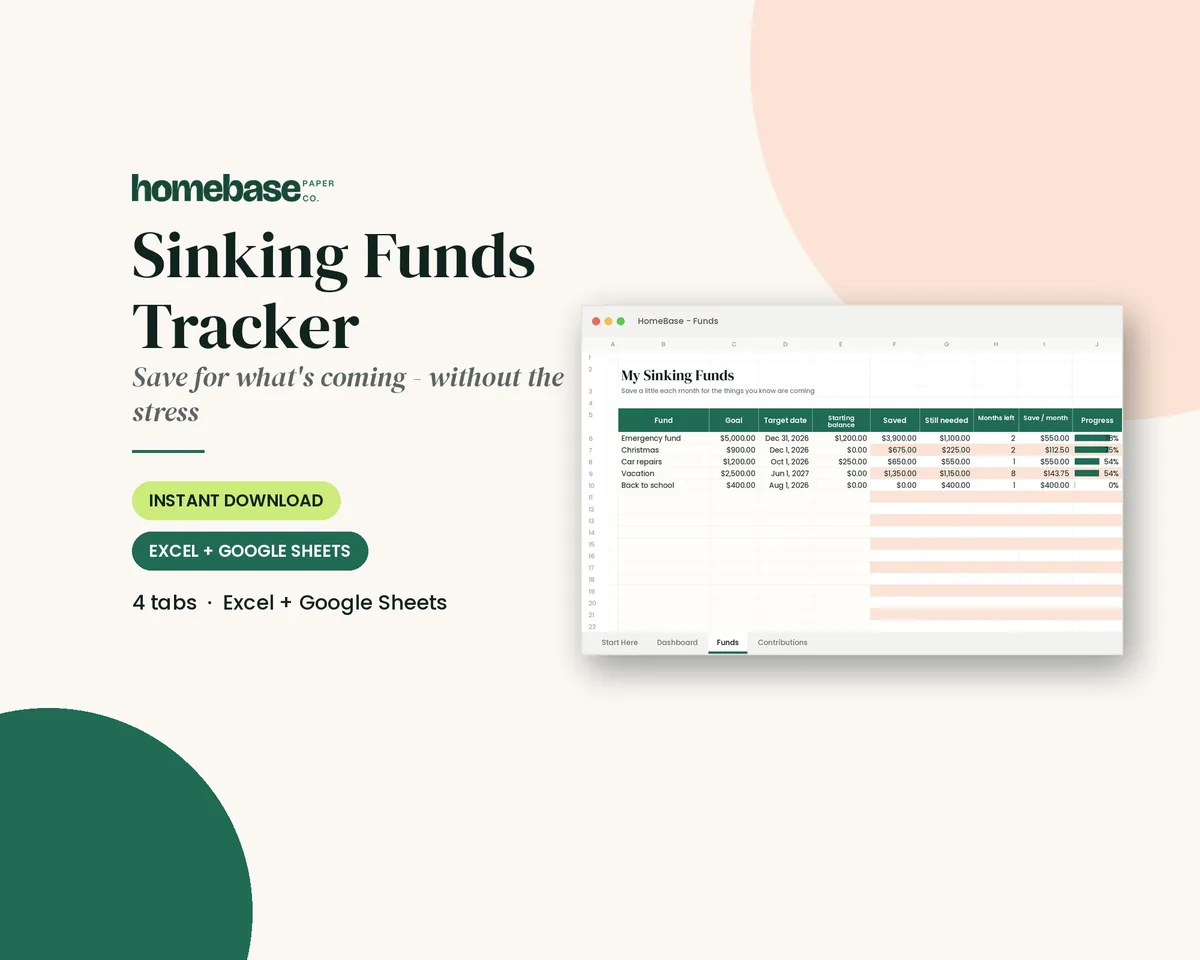
A high-yield account works best with a plan for what the money is for. Our Sinking Funds Tracker ($4.99) tracks up to 20 savings goals, shows the monthly amount needed for each one, has progress bars and a deposit and withdrawal log, and includes an emergency fund ready to fill in. One HYSA can hold all of those goals while the tracker shows how much belongs to each.
How a high-yield savings account works
For the basics first, see our guide on what is a savings account, including how it differs from a checking account and withdrawal limits.
- You open the account, usually online, and link it to your checking account.
- You deposit money by transfer, direct deposit or mobile check deposit.
- The bank pays interest. Interest usually compounds daily or monthly and is paid monthly, so interest earns interest.
- The rate is variable. The bank can raise or lower it, often following Federal Reserve rate changes.
- You withdraw when needed. Transfers to an outside checking account often take one to three business days.
The rate is shown as an APY, or annual percentage yield, which includes compounding. Use APY to compare accounts.
High-yield savings vs regular savings: what the numbers mean
The FDIC publishes national average rates each month. In October 2026, its national rates table showed:
| Account type | National average rate (FDIC, Oct 2026) |
|---|---|
| Savings | 0.38% |
| Money market | 0.63% |
| Interest checking | 0.07% |
| 12-month CD | 1.76% |
High-yield accounts pay well above the 0.38% savings average. Here is what that difference means on a $10,000 balance over one year, compounded monthly. The higher rates are examples, not quotes from any bank:
| Rate (APY) | Interest in one year on $10,000 |
|---|---|
| 0.38% (national average) | about $38 |
| 3.00% | about $300 |
| 4.00% | about $400 |
The gap grows with your balance. On a $20,000 emergency fund, moving from the national average to a 4% account adds about $700 a year in interest.
Is a high-yield savings account safe?
Yes, when the bank is insured. The FDIC explains in its deposit insurance guide that coverage is $250,000 per depositor, per insured bank, for each account ownership category. Single accounts, joint accounts and certain retirement accounts are separate categories, so a couple can be covered for more. FDIC insurance covers deposits such as savings, checking, money market deposit accounts and CDs. It does not cover stocks, bonds, mutual funds or crypto, even if you buy them through a bank.
Credit unions have similar coverage from the NCUA. The NCUA's share insurance page explains that deposits at federally insured credit unions are insured up to $250,000 per member, per ownership category.
Some apps and fintech companies are not banks. They hold your money at a partner bank, so check which bank and confirm it is insured.
Pros and cons of a high-yield savings account
| Pros | Cons |
|---|---|
| Earns far more than a typical savings account | Rate is variable and can drop |
| Money stays available | Transfers can take 1 to 3 business days |
| FDIC or NCUA insured up to the limit | Some accounts have minimums or tiered rates |
| Many have no monthly fees | Interest is taxable income |
| Easy to automate | Returns trail long-term investing |
What to use a high-yield savings account for
- Emergency fund. Three to six months of essential expenses is a common goal. Keeping it in a separate account makes it less tempting to spend.
- Sinking funds. Car repairs, insurance premiums, holidays, vacations and annual bills. Set a monthly amount for each.
- Big purchases in 1 to 3 years, such as a home down payment or a car.
- Irregular income buffer for freelancers and commission workers.
Money for retirement 20 or 30 years away usually belongs in a 401(k), IRA or other investment account, where long-term growth matters more than easy access. The rule of 72 shows why: at 4% money doubles in about 18 years, at a 7% return in about 10. Our guide on how to save for retirement covers how much to save and which accounts to use.
Who should and should not use a high-yield savings account
A HYSA suits almost anyone who keeps savings in a standard account at a big bank. It is especially useful if you are building an emergency fund for the first time, saving for a goal within three years, paid irregularly and need a cash buffer, or saving for yearly costs such as holidays, insurance premiums and car registration. Our guide on how to start an emergency fund covers how much to save and where to keep it.
It is less useful if you carry high-interest credit card debt. A card charging 20% or more costs far more than any savings account earns, so keep a small starter emergency fund and put extra money toward the debt first. It is also not the place for money you will not touch for decades, where retirement accounts usually fit better.
HYSA vs money market vs CD
| Feature | High-yield savings | Money market account | CD |
|---|---|---|---|
| Rate | Variable | Variable | Fixed for the term |
| Access | Anytime (transfer) | Anytime; may include checks or debit card | Penalty for early withdrawal |
| Insurance | FDIC/NCUA | FDIC/NCUA | FDIC/NCUA |
| Best for | Emergency fund, sinking funds | Savers who want check access | Money you will not need for the term |
If you want a government-backed option outside the bank, savings bonds trade access for a rate set by Treasury: you cannot cash one in the first 12 months. A money market account is a bank deposit account. A money market fund is an investment and is not FDIC insured, so read the account name carefully.
Example: building an emergency fund in a high-yield savings account
Say your essential monthly costs, meaning rent, utilities, groceries, insurance, transportation and minimum debt payments, add up to $3,000. A three-month emergency fund is $9,000. Here is how a simple plan might look:
- Start with a starter goal of $1,000. Many people reach it in a few months by saving $250 a paycheck and adding a tax refund or a bonus.
- Automate the rest. At $400 a month, the full $9,000 takes about 20 months, a little less once interest is added.
- Use split direct deposit if your employer offers it, so the savings never touch your checking account.
- Refill it after you use it. An emergency fund is meant to be spent on emergencies. Pause other goals and rebuild it after a big repair or medical bill.
At a rate of 4.00% APY, a $9,000 balance earns about $360 a year, which covers a small car repair or part of an insurance deductible on its own. At the 0.38% national average, the same balance earns about $34.
Common high-yield savings account mistakes
- Leaving it in a 0.01% account at your main bank. Many big banks still pay close to nothing on standard savings. Moving the money takes one afternoon.
- Chasing every rate change. Switching banks for a 0.10% difference is rarely worth the effort. Check twice a year instead.
- Keeping everything in one pile. Without labels, holiday money and emergency money blur together and get spent. Use buckets or a tracker so each dollar has a job.
- Treating it as an investment account. A HYSA is for safety and access. Long-term money needs growth.
- Going over the insurance limit. If you hold more than $250,000 at one bank in one ownership category, spread it out or use different categories.
- Forgetting the transfer delay. Keep a small cushion in checking so a one-to-three-day transfer is never a problem.
How to choose a high-yield savings account
- Confirm insurance. Look for FDIC or NCUA membership.
- Compare APY, and check whether the rate applies to all balances.
- Check fees and minimums. The best accounts have no monthly fee.
- Look at transfer speed and limits. How many withdrawals a month, and how long transfers take.
- Check the app and customer service. You want to reach a person when needed.
- Watch for teaser rates. A promotional rate that drops after three months may not be the best deal.
How to make the most of a high-yield savings account
- Automate it. Set a transfer for payday, even $25 or $50.
- Name your goals. Many banks let you create buckets inside one account. If not, use a tracker to split one balance across goals.
- Check the rate twice a year. If your bank falls behind, moving is usually easy.
- Plan for taxes. You will get a Form 1099-INT if you earn $10 or more.
To see where your savings fit in your overall budget, our Annual Budget Spreadsheet ($6.99) has 12 monthly tabs with planned vs actual columns and a yearly dashboard, so you can add a savings line every month. The Ultimate Budget Bundle ($19.99, $46.42 if bought separately) includes both the budget spreadsheet and the Sinking Funds Tracker along with six other planners. For more on building the fund itself, see our emergency fund tracker guide and our guide to sinking funds.
Saving for goals more than five years away? Learn how to start investing with low-cost funds.
Curious how interest on interest adds up? Our guide to what compound interest is shows the formula with simple examples. Comparing locked-in yields next? Read our guide to best cd rates using FDIC national averages.
Make it easier
Tools for this

Spreadsheets
Sinking Funds Tracker
It does the math: how much to set aside each month to hit every goal on time.

Spreadsheets
Annual Budget Spreadsheet
See exactly where your money goes every month - without complicated software.
 Save 57%
Bundles
Ultimate Budget Bundle
All 6 spreadsheets + both printable planners - for less than half the price of buying them separately.
Frequently asked questions
What is a high-yield savings account? A high-yield savings account is a savings account that pays a much higher interest rate than the national average. They are most often offered by online banks and credit unions with lower costs. Your money stays liquid, and at an insured bank it is protected by FDIC insurance up to the limit.
How does a high-yield savings account work? You deposit money, and the bank pays interest, usually compounded daily or monthly and paid monthly. The rate is variable, so it can rise or fall with the market. You can withdraw when you need to, though some banks limit the number of withdrawals or transfers each month.
Is a high-yield savings account safe? Yes, if the bank is FDIC insured or the credit union is NCUA insured. Deposits are covered up to $250,000 per depositor, per insured bank, per ownership category. Check the bank's insurance with the FDIC's BankFind tool before you open an account.
What is a good interest rate for a high-yield savings account? Compare any rate to the national average. The FDIC's national savings rate was 0.38% in October 2026, so a high-yield account usually pays several times that. Rates change often, so compare current offers and read the terms for minimum balances or tiered rates.
Are high-yield savings accounts worth it? Yes, usually, for emergency funds and short-term goals. Money in a high-yield savings account earns more than in a typical savings account while staying available. For example, $10,000 at 0.38% earns about $38 a year, while at 4.00% APY it earns about $400 a year.
What is the downside of a high-yield savings account? The rate is variable and can drop. Some accounts have minimum balances, monthly fees or withdrawal limits. Transfers to your checking account at another bank can take one to three business days. Interest earned is taxable income, and returns are lower than long-term investments.
Is HYSA interest taxable? Yes, HYSA interest is taxable. Interest from a high-yield savings account (HYSA) is taxed as ordinary income in the year it is paid. Banks typically send a Form 1099-INT if you earn $10 or more in interest. Set aside part of the interest if you expect to owe at tax time.
How much should I keep in a high-yield savings account? Keep your emergency fund, often three to six months of essential expenses, plus money for goals in the next one to three years, such as a car, a vacation or holiday gifts. That's what many people keep in a high-yield savings account. Money for retirement decades away usually belongs in investment accounts instead. The Sinking Funds Tracker tracks each of those goals separately.
High-yield savings account vs money market account: what is the difference? Both are insured deposit accounts with variable rates. A money market account may include checks or a debit card and sometimes needs a higher balance. A high-yield savings account usually has no check-writing. Compare rates and fees, since either can work for an emergency fund.
High-yield savings account vs CD: which is better? A CD locks in a rate for a set term, such as 12 months, with a penalty for early withdrawal. A high-yield savings account lets you withdraw anytime, but the rate can change. Use a HYSA for your emergency fund and a CD for money you are sure you will not need before it matures.
Can you lose money in a high-yield savings account? You can't lose money in a high-yield savings account from market swings. The balance does not go down like stocks can, and deposits are insured to the limit. You can lose ground if fees are charged or if inflation runs higher than your interest rate, so avoid accounts with monthly fees.
How do I open a high-yield savings account? Compare rates, fees and minimums, confirm FDIC or NCUA insurance, then apply online with your ID, Social Security number and a linked checking account. Most accounts open in minutes. Set up an automatic transfer on payday so the account grows without effort.
More from HomeBase
You may also like

Printables
Budget Planner Printable
Twelve undated pages you can print every month: budget, bills, spending, savings and debt.

Spreadsheets
Bill Tracker Spreadsheet
Bills due in 3 days or less light up red, so nothing slips through.

Spreadsheets
Paycheck Budget Spreadsheet
Enter your bills once. The sheet tells you which paycheck pays each one, all year.

Spreadsheets
Zero-Based Budget Spreadsheet
The 'Left to budget' counter turns green when every dollar has a job.
 Club
Monthly club
Money Club
Anyone who wants a clear plan for the month's bills, holiday spending and savings.
Free printable
Give every dollar a job: get the free monthly budget template
A printable zero-based monthly budget: income, bills, everyday spending and savings on one page, with a planned vs. actual column. You'll also get our weekly HomeBase email with simple budgeting and bill-paying tips.

Sources
- National Rates and Rate Caps (FDIC) fdic.gov
- Understanding Deposit Insurance (FDIC) fdic.gov
- Share Insurance (NCUA) mycreditunion.gov