


The short answer: to calculate net worth, add up everything you own, add up everything you owe, and subtract: Assets − Liabilities = Net Worth. The answer can be positive or negative, and both are fine as a starting point.
- Use today's values: what your home and car would sell for and current account balances
- Count debts at the full payoff balance on every loan and card
- Leave out everyday belongings and money you don't have yet
- Track it every quarter with a 10-minute routine
- Next step: Plan it with the Debt Payoff Planner ($6.99).
To calculate net worth, add up everything you own (your assets), add up everything you owe (your liabilities), and subtract what you owe from what you own. Assets − Liabilities = Net Worth. Use today's values: what your home and car would sell for, the current balance in each account, and the full payoff balance on every loan and card. The answer can be positive or negative, and both are fine as a starting point.
For the debt side of the formula, our Debt Payoff Planner keeps up to 10 debts in one sheet with a payoff month for each and your debt-free date.
That's the whole formula. The hard part is knowing what to count, what value to use and what to do with the number once you have it. This guide walks you through four steps, two complete examples, the brand-new 2025 Federal Reserve numbers by age, and a simple routine to grow your net worth every quarter. Every dollar amount in the examples is made up to show the math, so swap in your own.
What net worth actually tells you
Your net worth is a snapshot of your whole financial picture on one day. A budget shows where your money goes each month. Net worth shows whether all of those months are adding up to something.
Investor.gov, the SEC's investor education site, calls this a "net worth statement" and explains it plainly in Figure Out Your Finances: list what you own on one side, what you owe on the other, and subtract. If what you own is bigger, your net worth is positive. If what you owe is bigger, it's negative.
Two things net worth is not:
- It isn't income. A big paycheck with big debts can mean a low net worth. Income matters for a different number, your debt to income ratio, which lenders use.
- It isn't your worth as a person. I grew up in Detroit in a working family that rebuilt after 2008. I learned early that a number on paper can drop through no fault of your own, and that steady steps bring it back. Net worth is a progress check, not a grade.
Step 1: List your assets at today's value
An asset is anything you own that has money value. Gather your latest statements and write each one down with its current value, not what you paid.
| Asset type | Examples | What value to use |
|---|---|---|
| Cash | Checking, savings, money market, CDs, cash at home | Today's balance |
| Savings goals | Emergency fund, sinking funds | Today's balance |
| Retirement accounts | 401(k), 403(b), IRA, Roth IRA | Latest statement balance |
| Other investments | Brokerage account, HSA investments, savings bonds | Latest statement balance |
| Home and other property | House, condo, land, rental property | A realistic sale price (be conservative) |
| Vehicles | Cars, trucks, motorcycles, RVs | What it would sell for today |
| Valuable personal property | Fine jewelry, a real collection | A cautious resale value, or leave it out |
| Money owed to you | A loan a relative is actually repaying | Only if it's really being repaid |
A few valuation rules keep your number honest:
- Use market value, not purchase price. A car you bought for $28,000 that would sell for $14,000 goes in at $14,000.
- Be conservative with your home. Online estimates can run high. Pick a value you'd be comfortable seeing on a real offer, and use the same method each time.
- Leave out everyday belongings. Furniture, clothes and electronics usually sell for little. Counting them only inflates the number.
- Don't count money you don't have yet, like an expected tax refund, a bonus or an inheritance.
The Michigan Department of Insurance and Financial Services has a free assets, liabilities and net worth worksheet that groups assets the same way: cash accounts, personal-use assets like your home and cars, and investments. It also reminds you to date the sheet, which matters more than it sounds. Net worth is always "as of" a day.
Step 2: List every debt at its full balance
A liability is any money you still owe. This is where most people make the biggest mistake: they write down the monthly payment instead of the balance. Net worth uses the full payoff balance today.
| Debt type | Where to find the balance |
|---|---|
| Mortgage and home equity loan | Monthly mortgage statement or the lender's website (principal balance) |
| Car loans | Loan statement or app (payoff amount) |
| Student loans | Your loan servicer's account page |
| Credit cards | Current balance, not just the minimum due |
| Personal loans and buy now, pay later plans | Remaining balance on each |
| Medical bills and payment plans | Remaining balance |
| Taxes you owe | Any balance due you haven't paid yet |
| Money you owe family or friends | Only if you truly plan to repay it |
If you have more than two or three debts, this is the moment to put them all in one list. The Debt Payoff Planner ($6.99) holds up to 10 debts with their balances, switches between snowball and avalanche, and shows each debt's payoff month and your debt-free date. At every net worth check, you copy the balances from one place instead of logging into six websites.
Step 3: Subtract and write down the date
Add each column, then subtract:
Applying for a loan? Lenders may ask for the same numbers on a personal financial statement, which adds income and contingent liabilities. Our guide has a free template.
Total assets − Total liabilities = Net worth (as of today's date)
Write the date next to the answer. You'll compare it to the next one.
Step 4: Read the number, then pick one move
A single net worth number doesn't tell you much. The real value comes from two follow-up questions:
- What's my biggest debt, and what's it costing me? High-interest card debt usually drags net worth down the fastest.
- How much of my assets could I actually use in an emergency? If almost everything is in your home and retirement account, a small cash cushion may be your next goal.
Then choose one move for the next three months. Just one.
Example 1: A homeowner family
Here's a made-up family that owns a home, has two cars and is paying off a few debts.
| Assets | Value | Liabilities | Balance |
|---|---|---|---|
| Checking | $2,400 | Mortgage | $198,000 |
| Savings (emergency fund) | $6,000 | Car loan | $9,200 |
| 401(k) | $48,000 | Credit cards | $4,300 |
| Home (conservative value) | $260,000 | Student loan | $18,500 |
| Car 1 | $14,000 | ||
| Car 2 | $6,500 | ||
| Total assets | $336,900 | Total liabilities | $230,000 |
$336,900 − $230,000 = $106,900 net worth.
Look closer and the picture gets more useful. Home equity is $260,000 − $198,000 = $62,000, so more than half of this family's net worth is tied up in the house. Without the home and mortgage, their net worth is $44,900. Their cash, checking plus savings, is $8,400, while they owe $4,300 on cards. Paying off the cards would turn a debt that keeps growing with interest into money that stays theirs.
Example 2: A young renter with student loans
Now a made-up renter a few years out of school.
| Assets | Value | Liabilities | Balance |
|---|---|---|---|
| Checking | $1,100 | Student loans | $31,000 |
| Savings | $1,500 | Car loan | $5,600 |
| 401(k) | $3,200 | Credit card | $2,400 |
| Car | $7,000 | ||
| Total assets | $12,800 | Total liabilities | $39,000 |
$12,800 − $39,000 = −$26,200 net worth.
That's a negative number, and it's very common. Investor.gov says not to be discouraged by a negative net worth, because following a financial plan can turn it positive. For this renter, the plan might be: build savings to one month of expenses, clear the $2,400 card, then put extra toward the loans. If you're in this spot, budgeting for young adults and how to build credit are good next reads.
Liquid net worth: the "could I get to it?" number
Some people track a second figure called liquid net worth. It looks only at assets you could turn into cash quickly without a sale or big penalties, like checking, savings and money market accounts. Definitions vary, but a common version subtracts your debts from those liquid assets.
In Example 1, liquid assets are $8,400. Subtract the $4,300 card balance and the family has about $4,100 of truly flexible money. That's why an emergency fund tracker matters even when total net worth looks healthy.
Net worth by age: new 2025 Federal Reserve numbers
The Federal Reserve released its 2025 Survey of Consumer Finances in October 2026. Its report, Changes in U.S. Family Finances from 2022 to 2025, puts median family net worth at $215,900 and mean (average) net worth at about $1.24 million. The median is the better comparison for most households, because a small number of very wealthy families pull the average way up.
In your late 20s? Our guide to how much money should I have saved by 30 covers the one-year-salary rule, emergency fund targets and what people under 35 really have. For cash and retirement account balances rather than net worth, see savings by age.
| Age of reference person | Median net worth (2025) | Mean net worth (2025) |
|---|---|---|
| Under 35 | $33,000 | $135,400 |
| 35–44 | $155,600 | $681,900 |
| 45–54 | $253,700 | $1,244,500 |
| 55–64 | $411,900 | $1,878,000 |
| 65–74 | $431,300 | $1,897,600 |
| 75 or older | $504,900 | $1,962,200 |
| All families | $215,900 | $1,241,500 |
Figures are in 2025 dollars, per family (a single person or a couple), grouped by the age of the survey's reference person.
The same table shows how much homeownership shapes the number: median net worth was $458,900 for families who own their home and $10,600 for renters. The report also found that median net worth for families under 35 fell 23 percent from 2022, to $33,000.
Use these numbers for context, not pressure. Your own trend line, quarter over quarter, tells you far more than any national median.
Track it every quarter (a 10-minute routine)
Once your first list exists, updating it takes about ten minutes. Pick four dates, like the first weekend of January, April, July and October, and update only the balances.
| Date | Total assets | Total liabilities | Net worth | Change |
|---|---|---|---|---|
| January | $336,900 | $230,000 | $106,900 | Start |
| April | $339,700 | $226,100 | $113,600 | +$6,700 |
| July | $341,200 | $222,400 | $118,800 | +$5,200 |
| October | $343,500 | $218,900 | $124,600 | +$5,800 |
(This continues Example 1 with made-up numbers.)
Keep the method the same every time: same home value source, same accounts, same rules. If you change how you value the house, note it, or the "change" column won't mean much. Investor.gov suggests updating your net worth statement at least every year, and the year-end check fits nicely into an end-of-year financial checklist.
What to use for tracking
None of our templates has a dedicated net worth tab, and you don't need one. A plain two-column list works. What makes the routine fast is having your balances already organized:
- Debts: the Debt Payoff Planner ($6.99) keeps every balance, payoff month and your debt-free date in one place. You can also try the free debt payoff calculator.
- Savings: the Sinking Funds Tracker ($4.99) tracks up to 20 savings goals, including your emergency fund, with progress bars, a deposit and withdrawal log and a savings dashboard.
- On paper: the Budget Planner Printable ($5.99) includes Money Goals for the Year, a Savings Tracker, a Debt Payoff Tracker and an Annual Summary, where you can write each year's net worth.
- Everything at once: the Ultimate Budget Bundle ($19.99, instead of $46.42 bought separately) includes all six budget spreadsheets plus the Budget Planner Printable and the Bill Tracker Printable. See every set on our bundles page.
All of our spreadsheets work in Excel and Google Sheets; browse them in Spreadsheets.

How to increase your net worth
Net worth goes up in only two ways: you own more, or you owe less. These moves do the heavy lifting:
- Pay off high-interest debt first. Every dollar you pay on a card charging 24% is like earning 24% with no risk. Compare the two main methods in debt snowball vs. avalanche, or follow the full plan in how to get out of debt.
- Save before you spend. Automatic transfers on payday add to your assets without relying on willpower. Pay yourself first explains how to set it up.
- Capture any employer retirement match. If your job offers a match, contributing enough to get it is one of the fastest ways to grow assets.
- Avoid new debt on things that lose value. A new car loan can lower your net worth the day you drive off, because the car drops in value faster than the loan shrinks.
- Give every big goal a deadline. Turn "save more" into a dollar amount and date with how to set financial goals. Saving for a down payment? See how to save for a house.
I put myself through Oakland University the long way, and it taught me that slow progress is still progress. Net worth works the same way. A few hundred dollars a quarter, kept up for years, adds up to a different life.
Common net worth mistakes
- Using monthly payments instead of balances. A $1,500 mortgage payment isn't a $1,500 debt.
- Using what you paid for the car or house. Always use today's realistic value.
- Forgetting small debts. Store cards, buy now, pay later plans and medical payment plans all count.
- Counting your stuff. Leave furniture and clothes out.
- Changing methods between checks. Consistency matters more than precision.
- Checking daily. Investment and home values swing. Quarterly shows the real trend.
Net worth for couples
If you share finances, calculate one household net worth with everything you both own and owe. If you keep money separate, you can still make one combined sheet with a column for each person, which helps when you plan big goals together. Either way, do it together, without blame. Debt one person brought into the relationship is now a household project, and you'll both feel better seeing it shrink.
Your next step
Set a timer for 30 minutes today. List your assets, list your debts at full balance, subtract, and write down the date. That first number is your starting line. If you want a simple place to plan the season's spending while you're at it, our free Holiday Budget Starter Kit is 3 US Letter pages, emailed after you join our list.
Make it easier
Tools for this

Spreadsheets
Debt Payoff Planner
Pick snowball or avalanche, add any extra payment, and get your debt-free month instantly.

Spreadsheets
Sinking Funds Tracker
It does the math: how much to set aside each month to hit every goal on time.

Printables
Budget Planner Printable
Twelve undated pages you can print every month: budget, bills, spending, savings and debt.
Frequently asked questions
How do you calculate net worth? Net worth is total assets minus total liabilities. Add up what you own at today's value (cash, savings, retirement and investment accounts, your home and vehicles at what they'd sell for), add up every debt at its current payoff balance, and subtract the debts from the assets. The result can be positive or negative.
What is the net worth formula? The net worth formula is: Assets − Liabilities = Net Worth. Assets are things you own that have money value. Liabilities are the full balances you still owe, not your monthly payments. If you own $150,000 and owe $110,000, your net worth is $40,000.
What's the easiest way to keep my debt balances current for a net worth check? The Debt Payoff Planner ($6.99) keeps every debt balance in one place: it holds up to 10 debts, switches between snowball and avalanche, and shows each debt's payoff month and your debt-free date. When you update your net worth, copy the current balances from it into your liabilities column instead of hunting through statements.
Should I include my house in my net worth? Yes, include your home at a realistic market value and include the full mortgage balance as a debt. What really counts is your equity, the value minus the mortgage. Many people also track a second number without the home, because you can't spend home equity without selling or borrowing against it.
Do I include my car in my net worth? Yes, include your car at what it would sell for today, not what you paid, and list the full loan balance as a debt. Cars lose value every year, so update the value at each check. A car with a loan bigger than its value lowers your net worth.
Do retirement accounts count toward net worth? Yes, 401(k), 403(b) and IRA balances count as assets. Some people also note that withdrawals from pre-tax accounts will be taxed, so the spendable value is lower than the statement shows. For a simple personal check, use the statement balance and stay consistent each time.
What is liquid net worth? Liquid net worth is the part of your wealth you could turn into cash quickly without big penalties or a sale, like checking, savings and money market accounts. Definitions vary, but a common version subtracts your debts from those liquid assets. Your home and most retirement accounts are left out.
Is a negative net worth bad? No, a negative net worth isn't bad in itself; it's common, especially early in adult life, and it's a starting point, not a grade. Investor.gov says not to be discouraged by a negative net worth, because following a financial plan can turn it positive. Student loans and car loans are the usual reasons. Track the trend: a number that rises every quarter means your plan is working, and the Debt Payoff Planner shows the debt side shrinking.
What is the median net worth by age? According to the Federal Reserve's 2025 Survey of Consumer Finances, median family net worth was $33,000 for families under 35, $155,600 for ages 35–44, $253,700 for ages 45–54, $411,900 for ages 55–64, $431,300 for ages 65–74 and $504,900 for 75 and older. These are family figures in 2025 dollars, grouped by the age of the survey's reference person.
How often should I calculate my net worth? Calculating your net worth once a quarter works well for most households, and once a year is the minimum. Investor.gov suggests updating your net worth statement every year. Monthly checks can feel discouraging because home and investment values move around; quarterly shows a clearer trend.
How do I track savings balances between net worth checks? The Sinking Funds Tracker ($4.99) tracks up to 20 savings goals, including your emergency fund, with progress bars, a deposit and withdrawal log and a savings dashboard. At each net worth check, those balances drop straight into the cash side of your assets.
Can I track net worth on paper? Yes, a sheet of paper with two columns, assets and debts, is all you need. The Budget Planner Printable ($5.99) adds the pages that feed it: a Savings Tracker, a Debt Payoff Tracker, Money Goals for the Year and an Annual Summary, in US Letter and A4. Write your net worth on the Annual Summary each year so you can see the change.
How can I increase my net worth? You raise net worth two ways: grow what you own or shrink what you owe. Paying down debt, saving automatically, contributing to a retirement plan and avoiding new loans on things that lose value all move the number up. Paying down a 24% credit card is one of the surest ways to do it.
Do I count furniture, clothes and jewelry? Usually leave everyday belongings out, because they'd sell for very little. Only list personal property with a real resale value you could get, like a valuable piece of jewelry or a collection, and use a cautious number. Leaving them out keeps your net worth honest.
More from HomeBase
You may also like

Spreadsheets
Bill Tracker Spreadsheet
Bills due in 3 days or less light up red, so nothing slips through.

Spreadsheets
Paycheck Budget Spreadsheet
Enter your bills once. The sheet tells you which paycheck pays each one, all year.

Spreadsheets
Zero-Based Budget Spreadsheet
The 'Left to budget' counter turns green when every dollar has a job.

Spreadsheets
Annual Budget Spreadsheet
See exactly where your money goes every month - without complicated software.
 Club
Monthly club
Money Club
Anyone who wants a clear plan for the month's bills, holiday spending and savings.
Free printable
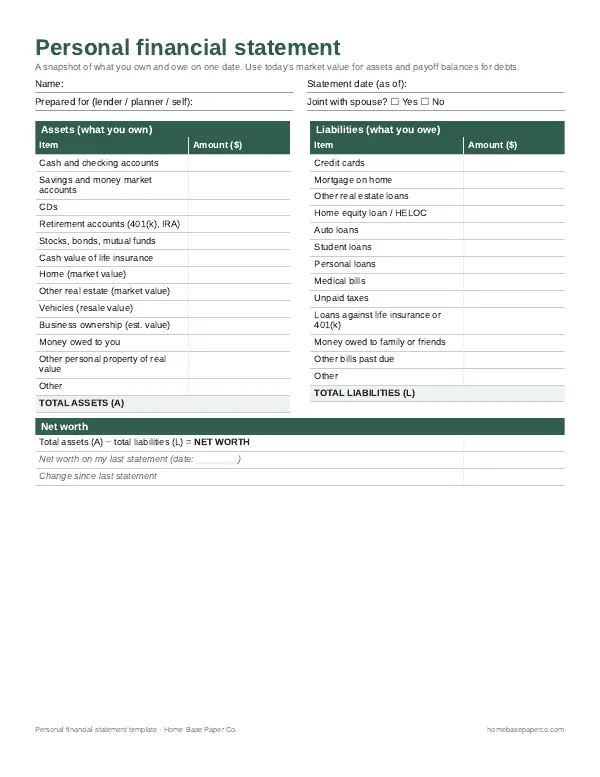
See your net worth on one page
Assets, liabilities, income and a net worth box. You'll also get our weekly HomeBase email with simple budgeting and bill-paying tips.
Sources
- Changes in U.S. Family Finances from 2022 to 2025: Evidence from the Survey of Consumer Finances (Federal Reserve Board) federalreserve.gov
- Figure Out Your Finances (Investor.gov, U.S. Securities and Exchange Commission) investor.gov
- Assets, Liabilities and Net Worth Worksheet (Michigan Department of Insurance and Financial Services) michigan.gov