

The short answer: Learning how to save for a house starts with one number: how much cash you need on closing day. That figure includes the down payment, closing costs and a cushion for moving and repairs.
This guide walks you through 10 steps, from setting the goal to tracking every deposit, with a simple table showing what different down payments cost on a typical home.
Step 1: Figure out how much house you can afford
Start with the monthly payment, not the price. Add up your take-home pay and your current debts. A comfortable housing payment leaves room for savings, bills and life. The CFPB's Owning a Home tools explain how lenders look at income, debts and credit, and they walk you through loan options step by step. Our guide on how to calculate your debt-to-income ratio shows the math lenders use.
Step 2: Choose your down payment target
You don't always need 20% down. Here's what common down payments look like on a $300,000 home:
| Down payment | Amount on $300,000 | Common with |
|---|---|---|
| 0% | $0 | VA and USDA loans (if you qualify) |
| 3% | $9,000 | Some conventional first-time buyer loans |
| 3.5% | $10,500 | FHA loans with a qualifying credit score |
| 5% | $15,000 | Conventional loans |
| 10% | $30,000 | Conventional loans |
| 20% | $60,000 | Conventional loans without mortgage insurance |
A bigger down payment lowers your loan and monthly payment. On a conventional loan, putting down less than 20% usually adds private mortgage insurance. A smaller down payment gets you in sooner but costs more each month. Once you have a mortgage, a mortgage escrow account usually collects property taxes and homeowners insurance with your payment. Before you settle on a target, compare first-time home buyer programs, since FHA, VA, USDA and down payment assistance can lower what you need to save. If you are considering alternatives to buying immediately, review the costs and risks of rent-to-own homes before signing an agreement.
Step 3: Add closing costs and moving money
Closing costs often run 2% to 5% of the home price. On a $300,000 home that's roughly $6,000 to $15,000. Your lender's Loan Estimate lists the real figures. Also budget for:
Plan for the home inspection too. Our free home inspection checklist lists what to look at and which extra inspections to consider.
- Moving truck or movers
- Utility deposits and setup fees
- A home inspection before you buy
- Basic furniture, tools and supplies
- First-month repairs
Step 4: Keep an emergency fund separate
Don't drain your emergency fund for the down payment. New homeowners face surprise costs, like a broken water heater. The CFPB's guide to building an emergency fund suggests saving a little at a time and keeping the money easy to reach. Keep this fund in its own account, separate from your house savings.
Step 5: Set a monthly savings goal
Divide your total by the number of months until you want to buy. For example:
- $20,000 in 2 years: about $834 a month
- $20,000 in 3 years: about $556 a month
- $30,000 in 3 years: about $834 a month
- $30,000 in 5 years: $500 a month
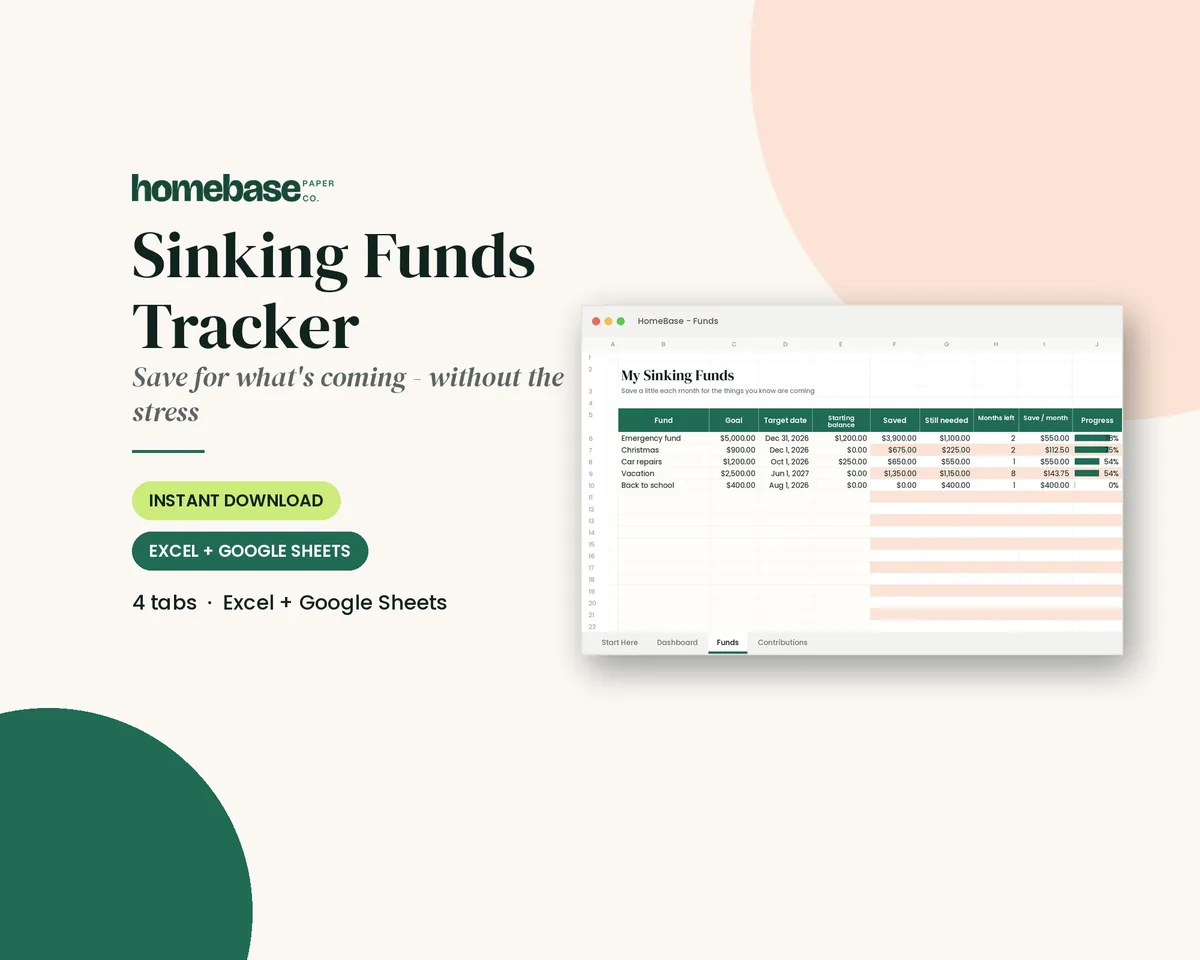
If the number looks too big, stretch the timeline or lower the price range. The Sinking Funds Tracker does this math for you, and it updates as your deposits come in. It's built for exactly this kind of goal.
Step 6: Build a budget that makes room
Write down every expense for one month. Then look for the big three: housing, transportation and food. Small cuts across many categories often beat one painful cut. A 70-20-10 budget or a zero-based budget can both work. The Budget Planner Printable gives you monthly pages for income, bills and savings.
Step 7: Automate your savings
Set up an automatic transfer to your house fund the day after payday. Money you never see is money you don't spend. Name the account something like "Our House" so it feels real. If you get paid irregularly, save a percentage of each check instead of a fixed amount.
Step 8: Put the money in the right place
Down payment savings should be safe and easy to reach. Good options include:
- High-yield savings account for flexibility.
- Money market account for slightly higher rates with check access.
- Short-term CDs if you know your buying date.
Keep the money at a bank covered by FDIC insurance. The FDIC explains that deposits are insured up to $250,000 per depositor, per insured bank, for each ownership category. Avoid stocks for money you'll need in the next few years.
Step 9: Boost savings with windfalls and challenges
Tax refunds, bonuses, raises and side income can speed things up. Decide in advance that a set share goes to the house fund. Savings challenges help too. The 100 Envelope Savings Challenge saves $5,050 over 100 envelopes, which can cover a chunk of closing costs. Our savings challenge ideas compare popular options.
Step 10: Look for help and track your progress
Many states and cities offer first-time buyer and down payment assistance. Your state housing finance agency is the place to start. A HUD-approved housing counselor can also review your plan. Family gifts are often allowed too, with a signed gift letter for your lender.
Track your progress every month. A savings goal tracker shows how close you are and keeps you motivated. Seeing that bar move is half the fun.
Common mistakes to avoid
- Saving only for the down payment and forgetting closing costs.
- Using the emergency fund and starting homeownership with no cushion.
- Opening new credit cards or loans right before you apply for a mortgage.
- Keeping savings in investments that can drop in value.
- Not shopping around with more than one lender.
Make your house goal visible
Saving for a house takes months or years. Clear goals, automatic transfers and simple tracking make it manageable. Start with the number, build the habit and check in each month. For more ideas on how to set financial goals, see our step-by-step guide.
Before comparing homes, use the mortgage payment calculator to separate principal and interest from the taxes, insurance and other housing costs you need to budget.
Make it easier
Tools for this

Spreadsheets
Sinking Funds Tracker
It does the math: how much to set aside each month to hit every goal on time.
 Starter pick
Printables
100 Envelope Savings Challenge
Classic, half and 52-week challenges to print, plus a spreadsheet that tracks every envelope and tells you how much to save each week.

Printables
Budget Planner Printable
Twelve undated pages you can print every month: budget, bills, spending, savings and debt.
Frequently asked questions
How much should I save for a house? Plan for three things: the down payment, closing costs and a cash cushion. Down payments range from 0% on some VA and USDA loans to 3% to 20% on conventional loans. Closing costs often add 2% to 5% of the price, and you'll want an emergency fund after you move in.
Do I need 20% down to buy a house? No, you don't need 20% down to buy a house. Many buyers put down less than 20%. Some conventional loans allow 3% down, FHA loans allow 3.5% with a qualifying credit score, and VA and USDA loans can require nothing down. A smaller down payment usually means a bigger loan, a higher monthly payment and mortgage insurance.
How long does it take to save for a house? Saving for a house takes your goal divided by your monthly savings: for example, saving $500 a month reaches $15,000 in 30 months, while $1,000 a month gets there in 15. How long it takes depends on your target and how much you can set aside each month. Divide your total goal by your monthly savings to estimate the number of months, then adjust; the Sinking Funds Tracker works out the monthly amount needed to hit a date.
Where should I keep my house down payment savings? Keep down payment money somewhere safe and easy to reach, such as a high-yield savings account, a money market account or short-term CDs at an FDIC-insured bank. Avoid putting money you need within a few years into stocks, because a market drop could shrink your savings right before you buy.
What are closing costs when buying a house? Closing costs are the fees you pay to finalize the mortgage and the purchase. They can include lender fees, the appraisal, title insurance, recording fees and prepaid taxes and insurance. Your lender's Loan Estimate lists them, and many buyers budget 2% to 5% of the home price.
How do I save for a house on a low income? Start with a written budget so you know exactly where money goes, then automate even a small transfer every payday. Look into first-time buyer and down payment assistance programs from your state or local housing agency, and consider loans with low down payments. Small, steady amounts add up.
Can family give me money for a down payment? Yes, many loan programs allow gift money from family for a down payment. Lenders usually ask for a gift letter stating the money doesn't need to be repaid, plus records showing the transfer. Talk to your lender early so the gift is documented the way they need it.
Should I pay off debt or save for a house first? Pay off high-interest credit card debt first, and save for a house while paying lower-interest debt on schedule. High-interest credit card debt usually makes sense to pay down first, because it costs more than savings earn and it raises your debt-to-income ratio, which lenders review. Lower-interest debt can often be paid on schedule while you save for a house at the same time. The right order depends on your debt.
What is a sinking fund for a house? A sinking fund is money you set aside each month for a specific future cost. For a house, you might keep separate sinking funds for the down payment, closing costs, moving and first-year repairs. Tracking each one separately shows exactly how close you are to buying, and what's left to save.
How much should I keep in savings after buying a house? Keep an emergency fund after closing, because new homeowners often face surprise repairs. Many people aim for three to six months of essential expenses. Don't drain every dollar into the down payment; a slightly smaller down payment with a healthy cushion is often the safer choice.
More from HomeBase
You may also like

Spreadsheets
Bill Tracker Spreadsheet
Bills due in 3 days or less light up red, so nothing slips through.

Spreadsheets
Paycheck Budget Spreadsheet
Enter your bills once. The sheet tells you which paycheck pays each one, all year.

Spreadsheets
Zero-Based Budget Spreadsheet
The 'Left to budget' counter turns green when every dollar has a job.
 Save 57%
Bundles
Ultimate Budget Bundle
All 6 spreadsheets + both printable planners - for less than half the price of buying them separately.
 Club
Monthly club
Money Club
Anyone who wants a clear plan for the month's bills, holiday spending and savings.
Free printable
Give every dollar a job: get the free monthly budget template
A printable zero-based monthly budget: income, bills, everyday spending and savings on one page, with a planned vs. actual column. You'll also get our weekly HomeBase email with simple budgeting and bill-paying tips.

Sources
- CFPB: Owning a home consumerfinance.gov
- CFPB: An essential guide to building an emergency fund consumerfinance.gov
- FDIC: Deposit insurance fdic.gov