

The short answer: a savings challenge turns saving into a game with simple rules, a finish line and a tracker you color in.
- 52-week challenge: $1,378
- 100 envelope challenge: $5,050
- 365-day penny challenge: $667.95
- 10 ideas with weekly costs
- Next step: Plan it with the 100 Envelope Savings Challenge ($3.99).
Our picks for savings challenge
 Starter pick
Printables
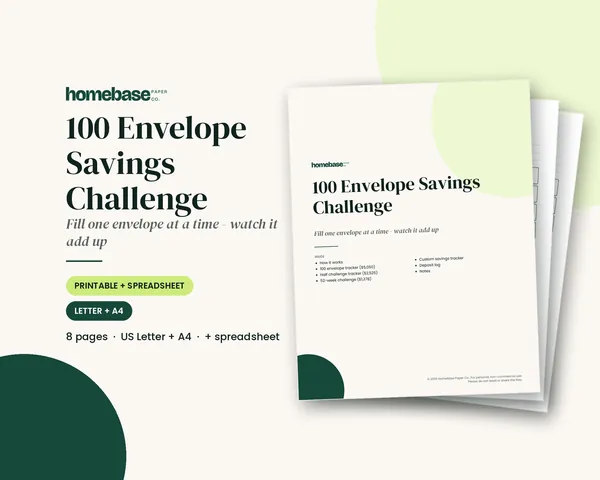
100 Envelope Savings Challenge
Classic, half and 52-week challenges to print, plus a spreadsheet that tracks every envelope and tells you how much to save each week.
Spreadsheets
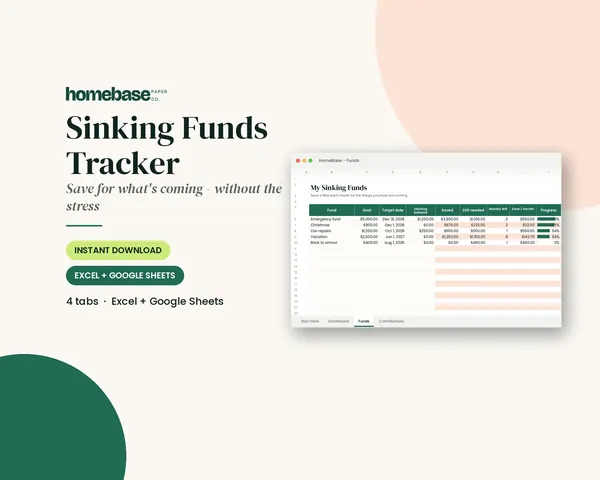
Sinking Funds Tracker
It does the math: how much to set aside each month to hit every goal on time.
Printables
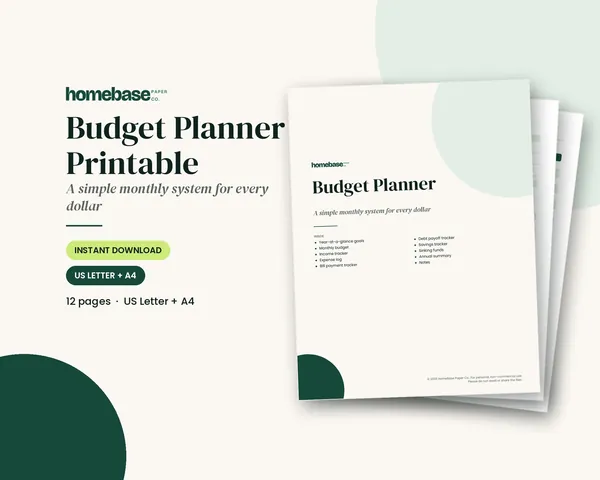
Budget Planner Printable
Twelve undated pages you can print every month: budget, bills, spending, savings and debt.
 Save 57%
Bundles
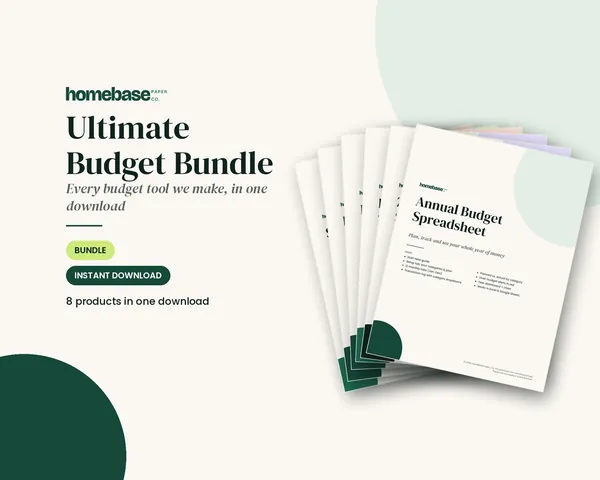
Ultimate Budget Bundle
All 6 spreadsheets + both printable planners - for less than half the price of buying them separately.
A savings challenge turns saving into a game with simple rules, a finish line and a tracker you color in. Below are 10 savings challenge ideas with the real totals and what each one costs per week, so you can pick one that fits your paycheck, plus tips for sticking with it and the printable trackers we make. For a bigger target, here's how to save $10,000 in a year.
Our 100 Envelope Savings Challenge includes the classic, half and 52-week challenges to print, plus a spreadsheet that tracks your progress.
10 savings challenge ideas compared
| Challenge | How it works | Total saved | Weekly cost |
|---|---|---|---|
| 52-week challenge | Save $1 in week 1, up to $52 in week 52 | $1,378 | $1 to $52 (avg. $26.50) |
| Reverse 52-week | Start at $52, count down to $1 | $1,378 | Hardest weeks first |
| 100 envelope challenge | Fill envelopes numbered $1 to $100 | $5,050 | Avg. ~$97 a week over a year |
| Half envelope challenge | 100 envelopes at smaller amounts | $2,525 | Avg. ~$49 a week over a year |
| 365-day penny challenge | Save 1 cent on day 1, up to $3.65 on day 365 | $667.95 | About $12.85 |
| Paycheck challenge | Save a fixed amount every biweekly paycheck | $20 x 26 = $520; $50 x 26 = $1,300 | $10 to $25 |
| 26-week challenge | Save $1 in week 1, up to $26 in week 26 | $351 | $1 to $26 (avg. $13.50) |
| 25-cent daily challenge | Set aside 25 cents every day for a year | $91.25 | $1.75 |
| $5 bill challenge | Save every $5 bill you get as change | Varies | Varies |
| No-spend challenge | Skip non-essential spending for a set time | What you didn't spend | n/a |
The weekly figures are averages. With the envelope challenges, you pull a random envelope, so some weeks cost $3 and some cost $90.
How to choose a savings challenge
- Know your weekly limit. Look at your budget and find what you can save without missing bills. If that's $15 a week, the 52-week challenge's $52 weeks will be hard, so try the penny or paycheck challenge.
- Pick a goal and a date. "Emergency fund by June" works better than "save more."
- Match the challenge to your pay. Paid biweekly? A paycheck challenge lines up with payday. Irregular income? Envelopes let you save more in good weeks.
- Plan around December. The classic 52-week challenge ends with $50+ weeks right at the holidays. The reverse version, or starting in a different month, avoids that.
The 52-week challenge
The best-known savings challenge. You save $1 more each week and end with $1,378. It's easy to start and builds slowly, which is why so many people try it. Want to see how it compares with envelopes? Our 100 envelope challenge vs 52 week challenge comparison lays it out side by side.
Want the full chart and every variation? Our 52 week savings challenge guide has the week-by-week table, the reverse version and a biweekly plan.
The 100 envelope challenge
Number 100 envelopes, shuffle them and fill one each time you save. All 100 add up to $5,050. It's the biggest total of the common challenges, and the random draw keeps it interesting. If $5,050 is too much, the half version totals $2,525.
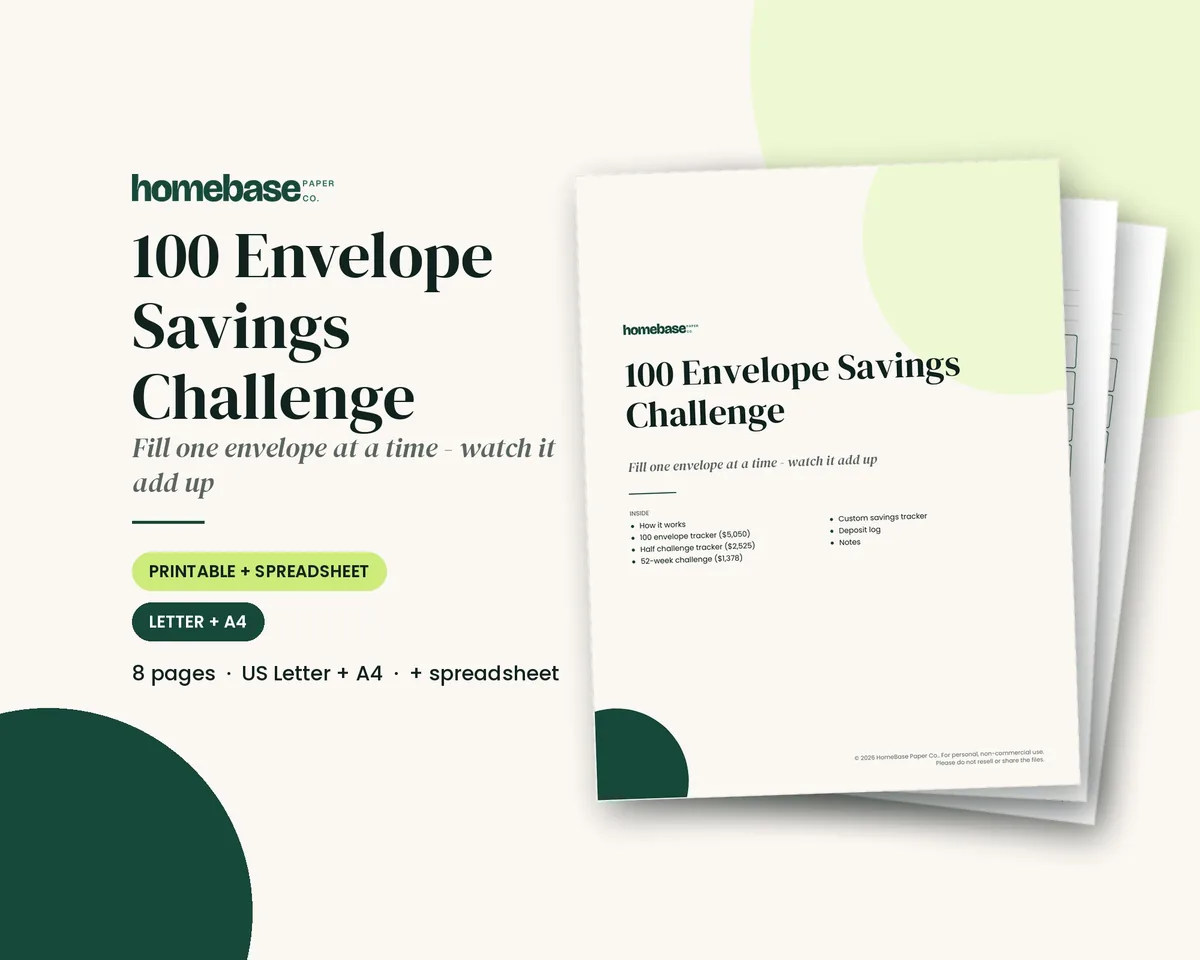
Our 100 Envelope Challenge printable ($3.99) includes the classic 100 envelope chart, the half envelope challenge, the 52-week savings challenge, a custom savings tracker, a deposit log, notes and an Excel / Google Sheets version that adds up your progress for you.
The penny, paycheck and $5 bill challenges
Our full guide to the penny challenge has a free 365-day chart and month-by-month totals.
- 365-day penny challenge: 1 cent on day 1, 2 cents on day 2, up to $3.65 on day 365. Total: $667.95. Start at the high end in January if you want the big days out of the way.
- Paycheck challenge: a fixed amount every payday, set up as an automatic transfer. $50 every two weeks is $1,300 a year.
- $5 bill challenge: every $5 bill you get goes in a jar. Great for people who still use some cash.
The no-spend challenge
A no-spend challenge saves money by cutting spending instead of setting aside a fixed amount. Pick a week or a month, list what still counts as essential and move what you would have spent into savings. Our no spend challenge guide has the rules and a tracker. A no-buy challenge runs longer, from a week to a year, with a short list of approved needs.
Tips for finishing a savings challenge
If your energy fades halfway through, read our guide to savings motivation, with 12 ways to keep going and how to restart after a setback.
- Automate it if you can. A weekly transfer to savings does the work for you.
- Move cash to the bank. Envelopes are a great tracker, but cash at home is easy to spend. Deposit weekly into a savings account.
- Make it visible. A tracker on the fridge, colored in each week, keeps you going.
- Missed a week? Keep going. Double up later or just carry on.
- Name the goal. Write it at the top of the tracker. For more on this topic, see our money saving challenges hub.
Where the money should go
A savings challenge is a great way to start an emergency fund. The CFPB's guide to building an emergency fund explains why even a small cushion helps. Saving for several things at once, like Christmas, car repairs and a vacation? Split the money into sinking funds. Our sinking funds guide explains how, and the Sinking Funds Tracker spreadsheet ($4.99) tracks up to 20 goals with the monthly amount needed for each one. To track a single goal on paper, see our savings tracker page.
Keep challenge savings in an insured account. At an FDIC-insured bank, savings accounts are covered up to $250,000 per depositor, per bank, for each account ownership category. Our guide on what is a savings account explains FDIC and NCUA coverage and how to open one.
Using a challenge to build a down payment? Read our guide on how to save for a house before you pick an account and a target.
Build it into your budget
The challenge works best when it's a line in your budget, not an afterthought. The Budget Planner printable ($5.99) has room for savings goals each month, and the Ultimate Budget Bundle ($19.99, $46.42 if bought separately) includes six budget spreadsheets (with the Sinking Funds Tracker) and two printables.
Saving for the holidays? See how to save money for Christmas, even if it's close.
Make saving a game you can finish
Classic, half and 52-week challenges to print, plus a spreadsheet that tracks every envelope and tells you how much to save each week.
$3.99 · Instant download. Print at home or fill it in on screen. Or browse the full Budget & Money collection.
Frequently asked questions
What is a savings challenge? A savings challenge is a set of rules for saving a little money on a schedule, such as $1 more each week or one numbered envelope at a time, until you reach a set total. The structure and the tracker make saving feel like a game, which helps many people keep going.
Which savings challenge saves the most money? Of the common challenges, the 100 envelope challenge saves the most: $5,050 if you fill every envelope from $1 to $100. The 52-week challenge saves $1,378, and the 365-day penny challenge saves $667.95.
Which savings challenge is easiest? The 365-day penny challenge and a small fixed paycheck challenge are the easiest because the amounts stay small. If you're new to saving, start with one of those and move to a bigger challenge once the habit sticks.
How does the 52-week savings challenge work? You save $1 in week 1, $2 in week 2 and so on, up to $52 in week 52, for a total of $1,378. The reverse version starts at $52 and counts down, which puts the hardest weeks at the start of the year instead of in December.
How does the 100 envelope challenge work? You number 100 envelopes from 1 to 100, shuffle them, and each time you save you pull one and put that many dollars in it. Fill all 100 and you've saved $5,050. A half version with smaller amounts totals $2,525.
How much do I need each week for the 100 envelope challenge? You need roughly $97 a week on average if you spread the 100 envelope challenge over a year with two envelopes a week, or about $50.50 a day over 100 days. The amount depends on your timeline. Many people pick envelopes as cash allows rather than on a fixed schedule.
Should I keep savings challenge money in cash? Usually not: envelopes are fun to fill, but cash at home can be lost or spent. Many people use the envelopes as a tracker and move the money to a savings account each week. Accounts at an FDIC-insured bank are insured up to the legal limit.
Can I do a savings challenge with a low income? Yes, you can do a savings challenge with a low income. Pick a challenge with small amounts, like the penny challenge or $10 per paycheck, or stretch a bigger challenge over a longer time. The goal is a steady habit, not the biggest total.
What should I save for with a savings challenge? Common goals are an emergency fund, Christmas, a vacation, car repairs or a down payment. Giving the challenge a clear goal and a date makes it easier to stick with.
What if I miss a week? Just pick up where you left off, or double up the next week if you can. The tracker should show what's done, not punish what isn't.
Can couples or families do a savings challenge together? Yes, couples and families can do a savings challenge together. Split the envelopes or weeks between partners, or let kids fill the small amounts. A shared tracker on the fridge keeps everyone involved.
Is there a printable savings challenge tracker? Yes, the HomeBase 100 Envelope Savings Challenge is a printable savings challenge tracker. Our 100 Envelope Savings Challenge printable includes the 100 envelope, half envelope and 52-week challenges, a custom savings tracker, a deposit log and an Excel / Google Sheets version.
What are the most popular savings challenges? The most popular savings challenges are the 52-week challenge, which saves $1,378 in a year, the 100 envelope challenge, which saves $5,050, the 365-day penny challenge, the paycheck challenge and the no-spend challenge. The table above compares all eight by total saved and weekly cost.
Free printable
Give every dollar a job: get the free monthly budget template
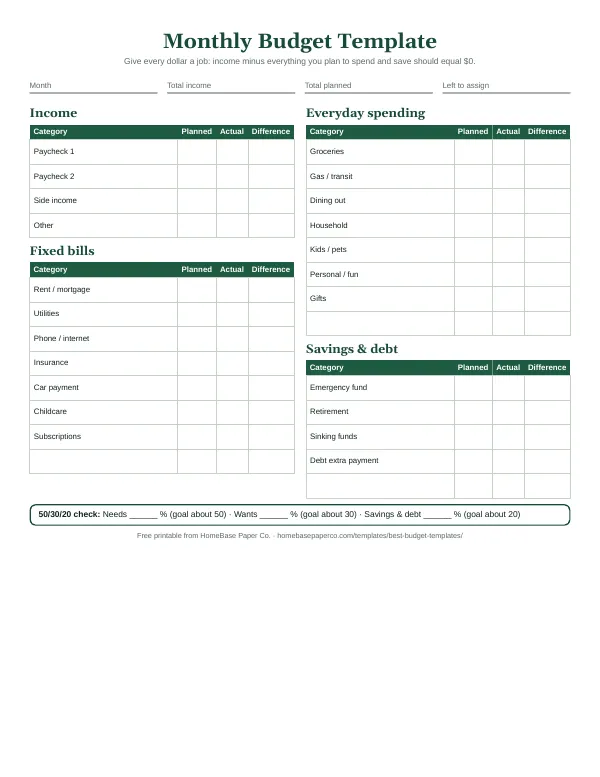
A printable zero-based monthly budget: income, bills, everyday spending and savings on one page, with a planned vs. actual column. You'll also get our weekly HomeBase email with simple budgeting and bill-paying tips.
Sources
- CFPB: An essential guide to building an emergency fund consumerfinance.gov
- FDIC: Understanding Deposit Insurance fdic.gov