

The short answer: the Federal Reserve's 2025 data shows a typical family under 35 has about $5,000 in checking and savings, rising to about $10,000 at ages 55 to 64. Compare yourself to the median, not the average.
- Median cash by age: $5,000 under 35, $6,800 at 35–44, $9,400 at 45–54, $10,000 at 55–64
- Retirement accounts: a median of $21,000 under 35 to $239,000 at 55 to 64, among families that have one
- Check yours in 15 minutes: total cash, total retirement accounts, list monthly essentials
- Behind? Stop the leaks first and build a $1,000 starter fund
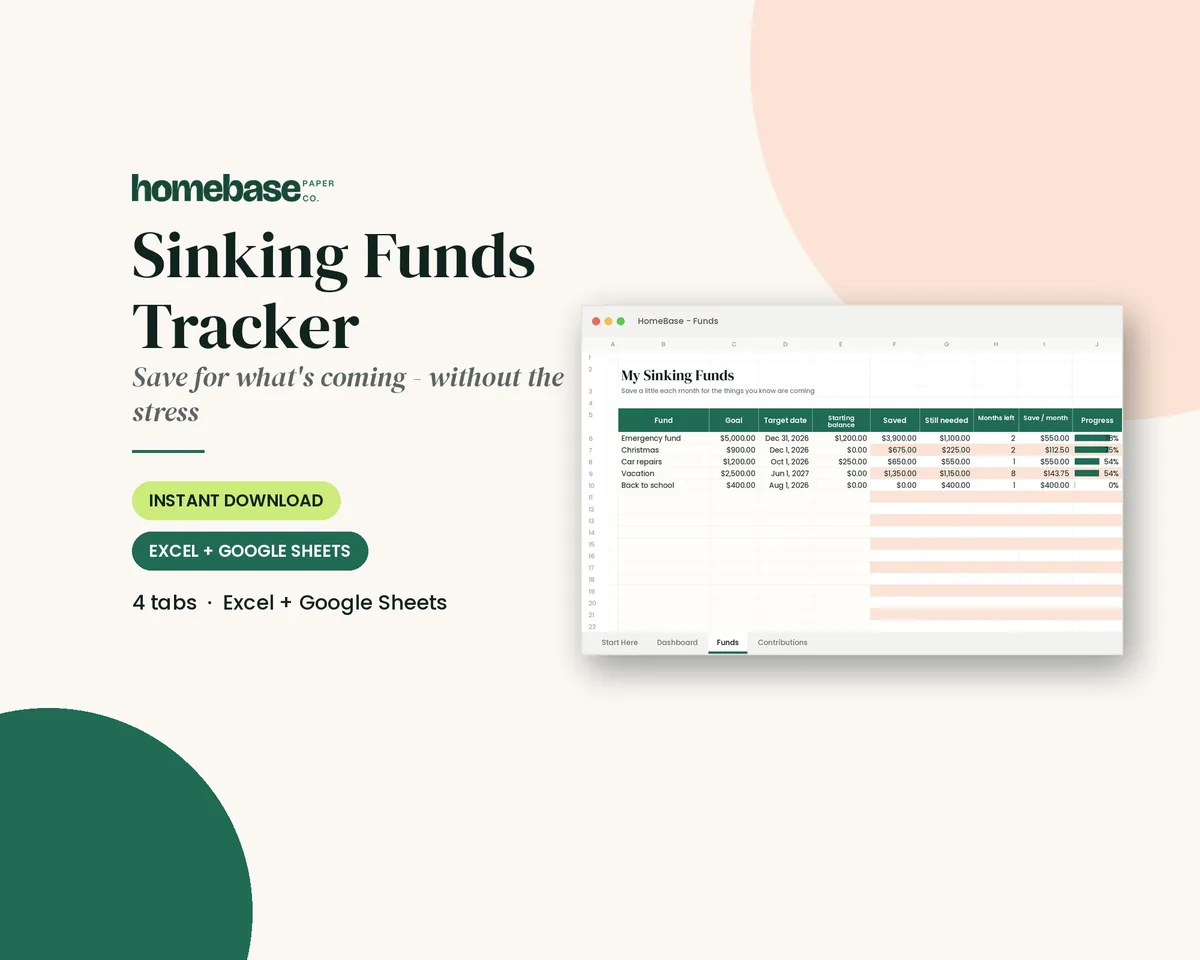
- Next step: Plan it with the Sinking Funds Tracker ($4.99).
What are the average savings by age in America? The Federal Reserve's newest data, for 2025, shows a typical family headed by someone under 35 has about $5,000 in checking and savings. That rises to about $10,000 for families aged 55 to 64. Retirement accounts grow much faster, from a median of $21,000 under 35 to $239,000 at 55 to 64, among families that have one.
Those are the real numbers. Below you'll find the full tables for every age group, why the "average" is so much higher than the "typical" figure, simple targets to aim for at each age, and a step-by-step way to compare yourself without the stress. Every dollar amount in the target tables is an example, so plug in your own pay and bills.
Average savings by age: the 2025 Federal Reserve tables
The best source on what families really hold is the Federal Reserve's Survey of Consumer Finances. It runs every three years, and the 2025 results are the newest available. The detailed SCF tables break the numbers out by the age of the person who heads the family.
Cash savings by age (checking, savings and money market accounts)
The survey calls these "transaction accounts." They include checking, savings, money market and call accounts and prepaid cards. Almost every family has one, so these figures cover nearly everyone.
| Age | Median balance | Average (mean) balance |
|---|---|---|
| Under 35 | $5,000 | $20,500 |
| 35–44 | $6,800 | $40,800 |
| 45–54 | $9,400 | $62,800 |
| 55–64 | $10,000 | $90,600 |
| 65–74 | $10,000 | $79,100 |
| 75 and older | $14,000 | $97,200 |
| All families | $8,200 | $62,900 |
Figures are per family (a single person or a couple) in 2025 dollars, among families that hold the account.
Retirement savings by age (401(k), 403(b), IRA and similar)
These are account-type retirement plans, the kind you or your employer pay into. Not everyone has one, so the first column matters as much as the balances.
| Age | Families with a retirement account | Median balance (holders) | Average balance (holders) |
|---|---|---|---|
| Under 35 | 48.8% | $21,000 | $48,400 |
| 35–44 | 59.6% | $61,200 | $182,400 |
| 45–54 | 63.0% | $133,000 | $415,800 |
| 55–64 | 63.1% | $239,000 | $670,200 |
| 65–74 | 49.0% | $257,000 | $767,600 |
| 75 and older | 44.6% | $257,000 | $798,700 |
| All families | 54.9% | $106,000 | $451,100 |
The share with an account drops after 65 because many retirees roll money out or draw it down. Traditional pensions aren't included in these balances, so a family with a pension may have more security than its account balance shows.
Average vs. median: which number should you compare yourself to?
Use the median. It's the middle family: half have more, half have less. The average adds up every balance and divides by the number of families, so a small group of very wealthy households pulls it way up.
Look at the under-35 row. The average cash balance is about $20,500, but the median is $5,000. That gap tells you most young families sit far below the average. If you compare yourself to the average, you'll almost always feel behind, even when you're doing better than most people your age.
Here's a quick way to read the tables:
- Find your age row. The survey groups families by the age of the person who heads the household.
- Compare to the median, not the average. The median is the "typical family" number.
- Check both tables. Cash and retirement savings do different jobs, so measure each one on its own.
- Remember it's per family. A couple's combined balance counts as one family, so a single person shouldn't measure against a two-income household.
How much should you have saved at each age?
National numbers tell you what's normal. They don't tell you what's enough. For that, most planners use two simple targets: an emergency fund based on your bills and a retirement balance based on your salary.
Emergency fund target: three to six months of essentials
Essentials are the bills you'd still pay if you lost your income tomorrow: housing, utilities, groceries, insurance, transportation and minimum debt payments. Your target doesn't change much with age. It changes with your bills.
| Monthly essentials (example) | 3-month target | 6-month target |
|---|---|---|
| $2,000 | $6,000 | $12,000 |
| $3,000 | $9,000 | $18,000 |
| $4,000 | $12,000 | $24,000 |
| $5,000 | $15,000 | $30,000 |
Aim closer to six months if your income is uneven, you're the only earner or you have kids at home. Three months can work for two steady incomes. Our full guide to how to build an emergency fund walks through where to keep it and how to refill it.
Retirement target: a multiple of your salary
A widely used rule of thumb ties retirement savings to your yearly pay. It assumes you save about 15% of income, including any employer match, from your 20s onward.
| By age | Retirement savings target | On a $60,000 salary (example) |
|---|---|---|
| 30 | 1× salary | $60,000 |
| 40 | 3× salary | $180,000 |
| 50 | 6× salary | $360,000 |
| 60 | 8× salary | $480,000 |
| 67 | 10× salary | $600,000 |
Put these next to the Fed's medians and you'll see a gap. The median under-35 holder has $21,000, and the median 55-to-64 holder has $239,000. Many families are behind the rule of thumb. That's not a reason to panic. It's a reason to know your own number and pick one next step.
Savings by age: what each decade usually looks like
In your 20s
This is the decade of first jobs, student loans and learning to budget. The goal isn't a big balance. It's building the habit. Start with a $1,000 starter emergency fund, then get every dollar of your employer's retirement match. If you're just starting out, our budget for young adults guide covers the basics.
In your 30s
Weddings, first homes, kids and childcare often land here, and cash savings get squeezed. The 2025 median for families aged 35 to 44 was only $6,800 in cash. Protect your emergency fund by saving for big costs separately, in sinking funds. For a single-age benchmark with a catch-up plan, see how much money should I have saved by 30.
In your 40s
Income often rises, and so do expenses. Families aged 45 to 54 had a median retirement balance of $133,000 among holders. This is a good decade to raise your savings rate with each raise, pay off high-interest debt for good and check that your emergency fund still matches your current bills.
In your 50s
These are often peak earning and peak saving years. The IRS lets workers 50 and older make extra catch-up contributions. For 2026, the 401(k) deferral limit is $24,500, plus up to $8,000 in catch-up contributions at 50 or older. Workers aged 60 to 63 can add up to $11,250 instead.
In your 60s and beyond
The focus shifts from building savings to making them last. Cash savings matter again here, because a cash cushion means you don't have to sell investments in a down market to pay a surprise bill. Median cash balances in the Fed data rise to $14,000 for families 75 and older.
How to check your own savings by age in 15 minutes
Comparing yourself to a national table is only useful if you know your own numbers. Here's a short routine you can do tonight.
- Total your cash. Add checking, savings, money market and CD balances. Leave out money already promised to a bill this month.
- Total your retirement accounts. Add your 401(k), 403(b), IRA and Roth IRA balances. Include vested employer contributions.
- List your monthly essentials. Housing, utilities, groceries, insurance, transportation and minimum debt payments.
- Do the two math checks. Divide your cash by your monthly essentials to get "months covered." Divide your retirement savings by your yearly salary to get your salary multiple.
- Compare to the targets and the medians. Note where you're ahead, where you're behind and by how much.
- Pick one next step. Choose only one: a bigger automatic transfer, the full employer match or a debt payoff plan.
Write your numbers down with today's date and redo this every three months. Your own trend line matters far more than any national median. If you want the full picture, including what you owe, add a quarterly check of how to calculate net worth.
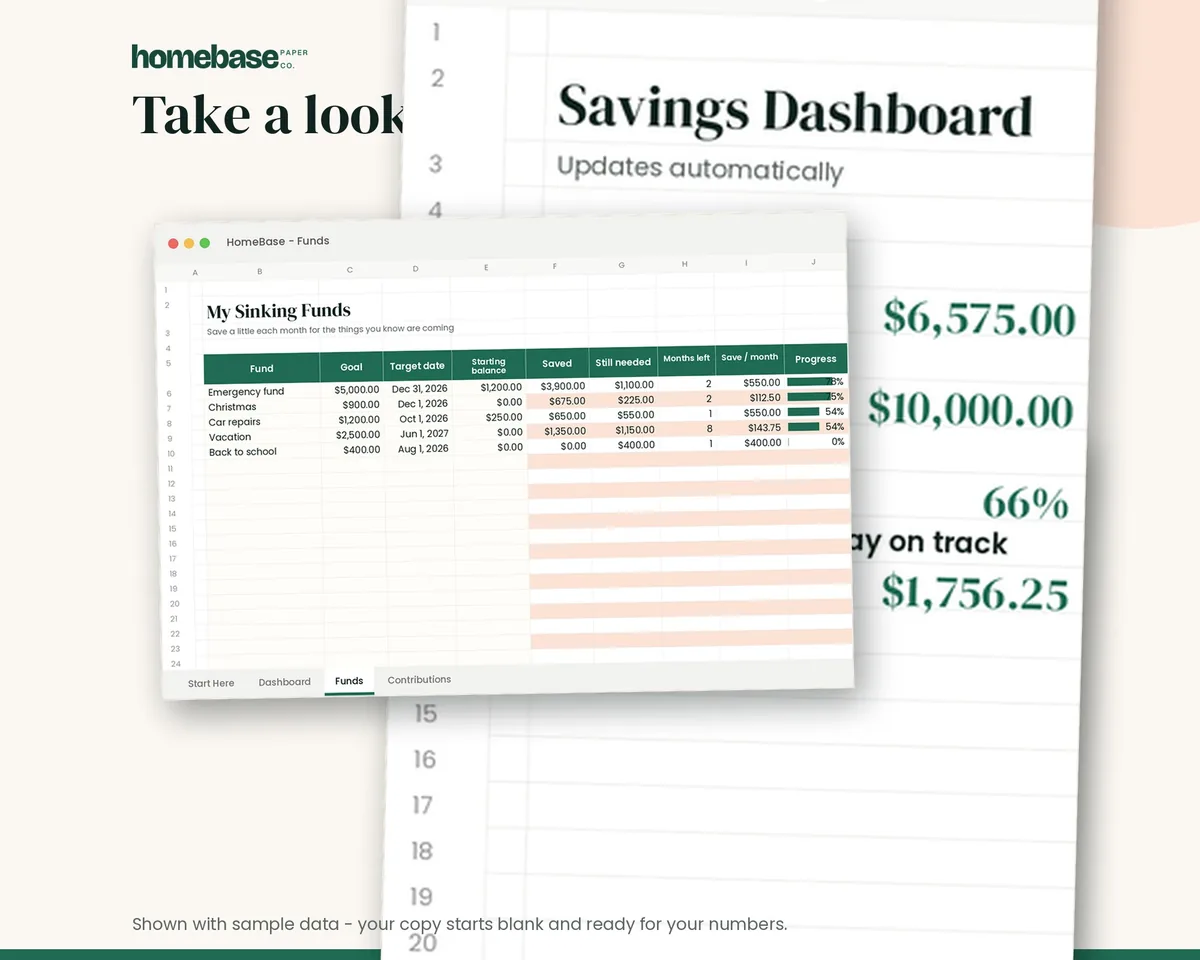
The Sinking Funds Tracker ($4.99) makes step 6 simple. It tracks up to 20 savings goals, including your emergency fund, and shows the monthly amount needed to hit each one by its date. It has a deposit and withdrawal log, progress bars and a savings dashboard, and it works in Excel and Google Sheets. You can find it with our other budget spreadsheets.
How starting age changes the math
Time does more of the work than the amount you save. Here's what steady monthly saving could grow to by age 65 at an example 5% yearly return, compounded monthly. Real returns go up and down, so treat these as illustrations, not promises.
| Start saving at | $300 a month by 65 | $500 a month by 65 |
|---|---|---|
| 25 | $457,800 | $763,000 |
| 35 | $249,700 | $416,100 |
| 45 | $123,300 | $205,500 |
| 55 | $46,600 | $77,600 |
Starting at 25 instead of 35 nearly doubles the result on the same monthly amount. If you're starting later, the answer isn't guilt. It's a higher savings rate, catch-up contributions after 50 and fewer high-interest payments eating your income. You can test your own numbers in our compound interest calculator. For a quick estimate without a calculator, the rule of 72 shows how many years money takes to double at a given return.
How to catch up if you're behind for your age
Being below the median is common. Here's an order of steps that works at almost any age.
- Stop the leaks first. List every debt and its rate. Credit card interest above 20% grows faster than savings can.
- Build a $1,000 starter fund. A small cushion keeps one bad week from going onto a credit card.
- Get the full employer match. It's part of your pay. Leaving it unclaimed is leaving money behind.
- Automate on payday. Move savings out the day you're paid, before you can spend it. Our guide to how much of my paycheck should I save helps you pick a percentage.
- Raise your rate by 1% at a time. Small steps every few months add up without a painful budget cut.
- Save half of every raise and windfall. Tax refunds, bonuses and raises are the easiest money to save, because you never got used to spending it.
Slow progress is still progress. Moving from zero months of savings to one month is a real win, even if the national tables still look far away.
Where to keep savings at each stage
Where you keep money matters as much as how much you keep.
| Money for | Where it usually goes | Why |
|---|---|---|
| Emergency fund | High-yield savings or money market account | Quick access, earns interest, no market risk |
| Goals in 1–3 years | Savings account, CDs or sinking funds | Stable value when you need it |
| Retirement | 401(k), 403(b), IRA or Roth IRA | Tax benefits and long-term growth |
If your cash still sits in a checking account, a high-yield savings account is an easy upgrade.
The Paycheck Budget Spreadsheet ($5.99) helps you find the money to save in the first place. Enter your bills once, and it shows which paycheck pays each one, for weekly, biweekly or monthly pay. That way you can see what's left to move into savings each payday. The Ultimate Budget Bundle ($19.99, regularly $46.42 if you buy the eight items separately) includes both spreadsheets, plus the Debt Payoff Planner and more.
Your next step
Find your age row in the tables above and compare your cash and retirement balances to the median, not the average. Then work out your months of essentials covered and your salary multiple. Pick one action from the catch-up list and set it up this week. Where you start matters far less than what you do next. If you want a second opinion on your plan, start with these questions to ask a financial advisor before you hire one.
Behind where you want to be? Here is how to save for retirement at any age, with the 2026 contribution limits.
Make it easier
Tools for this

Spreadsheets
Sinking Funds Tracker
It does the math: how much to set aside each month to hit every goal on time.

Spreadsheets
Paycheck Budget Spreadsheet
Enter your bills once. The sheet tells you which paycheck pays each one, all year.
 Save 57%
Bundles
Ultimate Budget Bundle
All 6 spreadsheets + both printable planners - for less than half the price of buying them separately.
Frequently asked questions
What are the average savings by age in the US? The average savings by age, measured as the typical (median) family cash balance, runs from about $5,000 under 35 to $14,000 at 75 and older, according to the Federal Reserve's 2025 Survey of Consumer Finances. The mean is much higher, from $20,500 to $97,200, because a few very wealthy families pull the average up.
How much does the average 30-year-old have in savings? A typical family headed by someone under 35 has about $5,000 in checking and savings, based on 2025 Federal Reserve data. Among those with a retirement account, the median balance is $21,000. Our guide to how much money you should have saved by 30 covers the 1× salary target and a catch-up plan.
What is the average retirement savings by age? Median retirement account balances among holders are $21,000 under 35, $61,200 at 35 to 44, $133,000 at 45 to 54 and $239,000 at 55 to 64 in the 2025 Fed survey. Only about half to two-thirds of families in each age group have a retirement account at all.
What is the average 401(k) balance by age? The Fed groups 401(k)s with IRAs and other account-type plans, and the median combined balance ranges from $21,000 under 35 to $257,000 at 65 and older among holders. Your own plan provider's statement is the best way to see where your 401(k) stands.
Should I compare myself to the average or the median? Compare yourself to the median, because it shows the middle family instead of a number skewed by the very wealthy. Under 35, the average cash balance is about four times the median, so the average makes almost everyone feel behind.
How much should I have saved by 40? A common rule of thumb is about 3× your yearly salary in retirement savings by 40, plus an emergency fund of three to six months of essentials. On a $60,000 salary, that's about $180,000 for retirement. The HomeBase Sinking Funds Tracker shows the monthly amount needed to reach your emergency fund goal on time.
How much should I have saved by 50? A widely used benchmark is about 6× your salary in retirement savings by 50. If you're behind, the IRS allows an extra $8,000 in 401(k) catch-up contributions at 50 or older in 2026, on top of the $24,500 regular limit.
How much should I have in my emergency fund at my age? Your emergency fund depends on your bills, not your age, and three to six months of essentials is the usual target. If your essentials are $3,000 a month, aim for $9,000 to $18,000. The HomeBase Sinking Funds Tracker keeps your emergency fund next to your other savings goals so you can see progress at a glance.
Is $10,000 in savings good? Yes, $10,000 in cash savings is right around the median for families aged 55 to 64 and above the median for every younger group in the 2025 Fed data. Whether it's enough depends on your monthly essentials, so divide it by your bills to see how many months it covers.
What percent of Americans have a retirement account? About 54.9% of US families had an account-type retirement plan in 2025, according to the Federal Reserve. The share peaks near 63% for families aged 45 to 64 and is 48.8% for families under 35.
Why do savings drop after 65? Retirement balances level off after 65 because many retirees start withdrawing money, and the share of families holding an account falls to about 49% at 65 to 74. Median cash balances, though, stay steady or rise, reaching $14,000 for families 75 and older.
How can I catch up on savings if I'm behind for my age? Start with a $1,000 starter fund, get your full employer match, then raise your savings rate by 1% every few months and save half of every raise. The HomeBase Paycheck Budget Spreadsheet shows which paycheck pays each bill, so you can see what's left to save each payday.
What counts as savings in these numbers? The Fed's cash savings figures include checking, savings, money market and call accounts and prepaid cards, while retirement figures cover 401(k)s, IRAs and similar account-type plans. Traditional pensions, home equity and brokerage accounts are counted separately.
Are these savings numbers per person or per household? These savings numbers are per family, meaning a single adult or a couple living together, grouped by the age of the family head. A single person should keep that in mind when comparing to a household with two incomes.
What's the easiest way to track savings goals by age? The easiest way is to write down your cash, retirement balance and monthly essentials every three months and watch the trend. The HomeBase Sinking Funds Tracker ($4.99) does the math for up to 20 goals, and the Ultimate Budget Bundle ($19.99) pairs it with five more budget spreadsheets and two printable planners.
More from HomeBase
You may also like

Printables
Budget Planner Printable
Twelve undated pages you can print every month: budget, bills, spending, savings and debt.

Spreadsheets
Bill Tracker Spreadsheet
Bills due in 3 days or less light up red, so nothing slips through.

Spreadsheets
Zero-Based Budget Spreadsheet
The 'Left to budget' counter turns green when every dollar has a job.

Spreadsheets
Annual Budget Spreadsheet
See exactly where your money goes every month - without complicated software.
 Club
Monthly club
Money Club
Anyone who wants a clear plan for the month's bills, holiday spending and savings.
Free printable
Give every dollar a job: get the free monthly budget template
A printable zero-based monthly budget: income, bills, everyday spending and savings on one page, with a planned vs. actual column. You'll also get our weekly HomeBase email with simple budgeting and bill-paying tips.

Sources
- Changes in U.S. Family Finances from 2022 to 2025 (Federal Reserve) federalreserve.gov
- Survey of Consumer Finances (Federal Reserve) federalreserve.gov
- 401(k) and profit-sharing plan contribution limits (IRS) irs.gov