

The short answer: if you want one number, aim for 20% of your take-home pay, the savings share in the 50/30/20 budget: 50% to needs, 30% to wants and 20% to savings and extra debt payments.
- Starting out or tight budget: 5% to 10% of each paycheck, plus a $500 to $1,000 starter emergency fund
- Standard target: 20% of take-home pay; on a $2,000 paycheck that's $400
- Catching up or big goals: 25% or more, especially if you started saving for retirement late
- Split it between an emergency fund, retirement and sinking funds, put it on autopilot and raise it over time
- Next step: Plan it with the Sinking Funds Tracker ($4.99).
How much of my paycheck should I save? If you want one number, aim for 20% of your take-home pay, the savings share in the popular 50/30/20 budget. But one number doesn't fit everyone. If you're starting from zero, 20% might feel impossible, and that's okay. The better answer is to save something from every paycheck, put it on autopilot, and raise it over time. This guide shows what each percentage looks like in dollars, how to split it between goals and how to find the money.
To split each paycheck's savings between goals, our Sinking Funds Tracker tracks up to 20 savings goals and works out the monthly amount needed to hit each date, with progress bars.
What different savings rates look like per paycheck
Here's what each percentage means for common take-home paychecks:
| Take-home paycheck | 5% | 10% | 15% | 20% |
|---|---|---|---|---|
| $1,000 | $50 | $100 | $150 | $200 |
| $1,500 | $75 | $150 | $225 | $300 |
| $2,000 | $100 | $200 | $300 | $400 |
| $2,500 | $125 | $250 | $375 | $500 |
| $3,000 | $150 | $300 | $450 | $600 |
If you're paid every two weeks, multiply by 26 for the year. Saving 10% of a $2,000 biweekly paycheck is $5,200 a year.
Why saving from every paycheck matters
The Federal Reserve's survey of household finances in 2025 found 63% of adults would cover a $400 emergency with cash or its equivalent, and 55% had an emergency fund that would cover three months of expenses. That leaves a big group with no cushion when the car breaks down or a medical bill arrives. And 59% of adults had a major unexpected expense in the past year. Saving a set amount from every paycheck is how you get into the group that can handle it.
How to split your savings between goals
Not all savings are the same. Think of three buckets:
Bucket 1: Emergency fund
This comes first. Aim for a starter $500 to $1,000, then build toward three months of essential expenses. Until the starter fund is done, it can take most of your savings.
Bucket 2: Retirement
If your employer matches 401(k) contributions, contribute at least enough to get the full match, even while you build your emergency fund. It's part of your pay. The IRS sets the 2026 limit on salary deferrals to a 401(k) at $24,500, so there's plenty of room. Many planners suggest saving about 15% of gross pay for retirement over your career, including the employer match. The full table of 401k contribution limits 2026 is in that guide, including catch-up amounts.
Bucket 3: Sinking funds and goals
These are known costs: car repairs, insurance premiums, holidays, travel, a down payment. Divide each goal by the number of paychecks until you need it. Our guide to sinking funds walks through it.
A sample split at 20%
Say you take home $2,500 every two weeks and save 20%, or $500 per paycheck:
| Bucket | Per paycheck | Per year |
|---|---|---|
| Emergency fund | $200 | $5,200 |
| Retirement (on top of 401(k) match) | $150 | $3,900 |
| Sinking funds (car, holidays, travel) | $150 | $3,900 |
| Total | $500 | $13,000 |
Once the emergency fund reaches three months of expenses, its $200 can move to retirement or a bigger goal.
How savings grow over time
Small amounts add up faster than you'd expect when they earn interest. Here's what monthly savings could grow to at a 5% annual return, compounded monthly. These are illustrations, not promises; actual returns vary. You can try your own numbers with the Investor.gov compound interest calculator. Try your own numbers in our compound interest calculator.
| Saved each month | 5 years | 10 years | 20 years | 30 years |
|---|---|---|---|---|
| $100 | $6,801 | $15,528 | $41,103 | $83,226 |
| $250 | $17,002 | $38,821 | $102,758 | $208,065 |
| $500 | $34,003 | $77,641 | $205,517 | $416,129 |
Starting earlier matters more than starting bigger. $250 a month for 30 years grows to more than $500 a month for 20 years.
How to find the money to save
Pay yourself first
Set an automatic transfer to savings for payday, before you pay bills or spend. Our guide to pay yourself first explains why this works better than saving what's left.
Raise your rate by 1% at a time
If you're saving 5%, go to 6% next month and 7% the month after. You'll barely notice each step.
Save half of every raise
When your pay goes up, move half of the increase to savings right away.
Use the extra paychecks
If you're paid every two weeks, two months each year have three paychecks. If your budget runs on two checks a month, those extra checks can go almost entirely to savings.
Make it a challenge
Some people save more when it feels like a game. Our 100 Envelope Savings Challenge ($3.99) includes 100 Envelope, Half Envelope, 52-Week and Custom Savings Tracker pages plus a deposit log, as an 8-page PDF with an xlsx version.
Gross pay or take-home pay?
You'll see savings advice in both. The 50/30/20 budget uses take-home pay, the amount that lands in your account. Retirement rules of thumb, like 15%, usually use gross pay, before taxes and deductions. Neither is wrong; just be consistent. A simple way to measure your real savings rate:
- Add up everything you saved last month: retirement contributions taken from your paycheck, any employer match, and transfers to savings.
- Divide by your gross monthly pay.
- Multiply by 100.
If you contributed $300 to a 401(k), your employer added $150 and you moved $250 to savings on $5,000 gross pay, your savings rate is ($300 + $150 + $250) ÷ $5,000 = 14%.
If you're asking how much of my income should I save, rather than how much per paycheck, the same percentages apply to your monthly take-home pay. For more on this topic, see our saving money hub.
How much to save at each stage
The right percentage shifts as life changes:
- First job: get the full employer match, build the starter emergency fund and save 10% to 15% total if you can. Our guide on how much money you should have saved by 30 has benchmarks.
- Paying off debt: keep the match and a small buffer, and send most extra money to high-interest balances. Once they're gone, move those payments into savings.
- Saving for a home: add a down payment sinking fund on top of retirement, which may push you to 25% for a few years.
- Raising kids: childcare can squeeze savings. Keep retirement going, even at a lower rate, and use sinking funds for back-to-school, holidays and activities.
- Catching up in your 40s and 50s: aim for 20% or more, and use catch-up contributions once you're eligible.
Where to keep each bucket
Keep your emergency fund in a separate savings account you can reach in a day or two, ideally a high-yield savings account so it earns more. Keep retirement money in your 401(k) or IRA. Sinking funds can sit in labeled savings accounts or one account tracked by goal.
When to save less for a while
- You have high-interest credit card debt. Keep a small emergency fund and your employer match, then put extra money on the card. Interest over 20% grows faster than your savings. Here's the fastest way to pay off credit card debt.
- You're behind on bills. Catch up first so late fees and penalties don't cost more than you'd save.
- Your income just dropped. Lower your rate temporarily, but keep a small automatic transfer so the habit stays.
If every dollar is already spoken for, start with our steps for living paycheck to paycheck before you set a percentage. Our guide on how to live below your means covers the longer-term habits.
Plan every paycheck
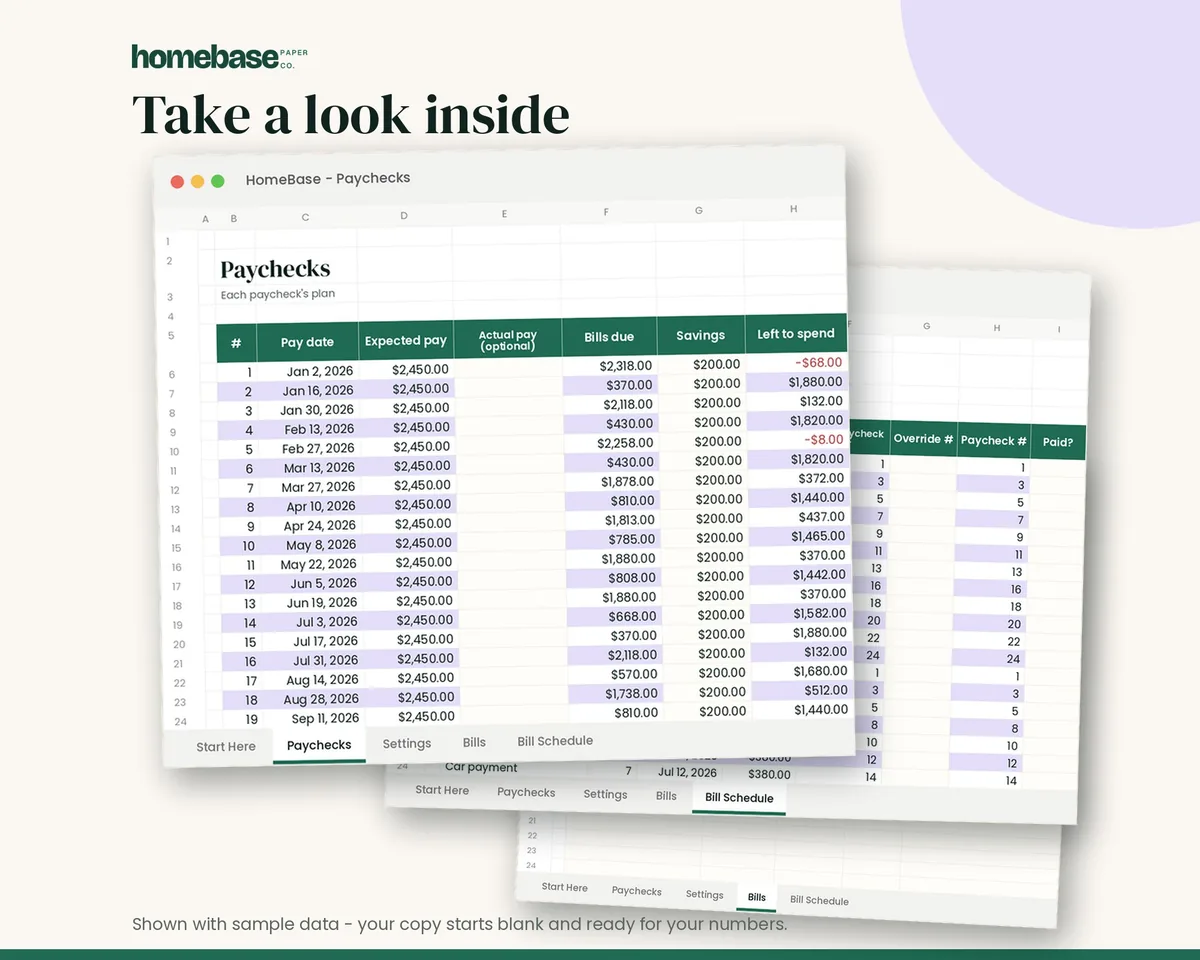
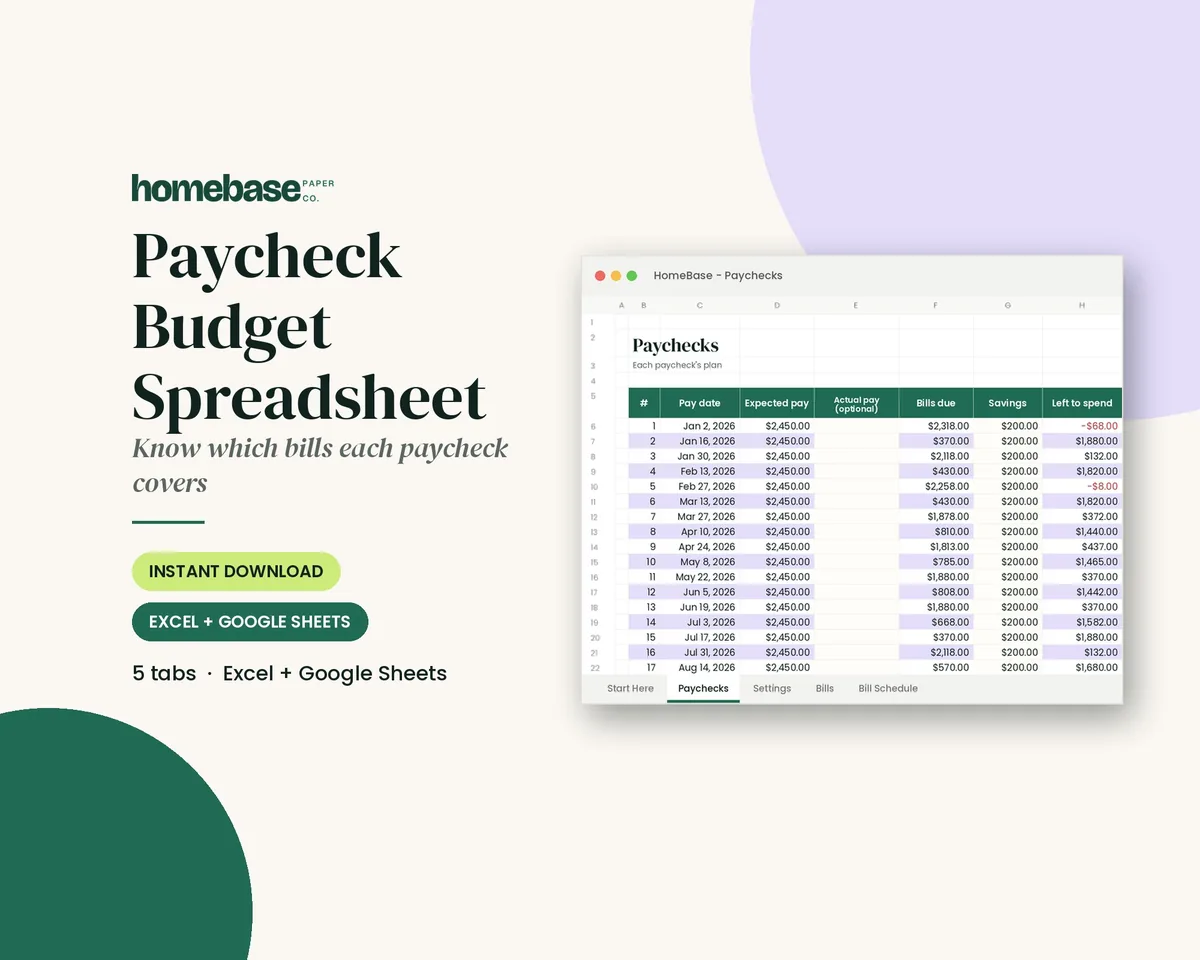
The easiest way to answer "how much can I save?" is to see each paycheck's bills first. Our Paycheck Budget Spreadsheet ($5.99) handles weekly, biweekly, semi-monthly or monthly pay, lists your pay dates for the year and assigns each bill to the paycheck that covers it. You see the left-to-spend amount for each check, so you can set a savings amount you'll actually keep. If you are counting on a lower mortgage payment to free up savings, compare mortgage refinance costs before changing the amount you set aside.
The Sinking Funds Tracker ($4.99) tracks up to 20 goals, including your emergency fund. It shows the monthly amount needed to hit each one by its date and logs deposits and withdrawals with progress bars and a dashboard.
The Ultimate Budget Bundle ($19.99) includes both, plus annual, zero-based, debt payoff and bill tracker spreadsheets and two printables. That's $46.42 if bought separately.
Your next step
Pick a percentage you can start this payday, even if it's 5%. Set the automatic transfer, then put a reminder on your calendar to raise it by 1% in three months. When you get a raise, pay off a debt or finish a sinking fund goal, move that money into savings too. A year from now, you'll likely be saving far more than you thought you could, without feeling the squeeze, because each step was small.
Saving protects you from short setbacks, while disability insurance is designed to replace part of your paycheck during a long illness or injury.
Once you have a monthly amount, the retirement calculator shows what that saving could grow to by the age you plan to stop working.
Make it easier
Tools for this

Spreadsheets
Paycheck Budget Spreadsheet
Enter your bills once. The sheet tells you which paycheck pays each one, all year.

Spreadsheets
Sinking Funds Tracker
It does the math: how much to set aside each month to hit every goal on time.
 Starter pick
Printables
100 Envelope Savings Challenge
Classic, half and 52-week challenges to print, plus a spreadsheet that tracks every envelope and tells you how much to save each week.
Frequently asked questions
How much of my paycheck should I save? A common target is to save about 20% of your take-home paycheck, as in the 50/30/20 budget. If 20% is out of reach, start with 5% to 10% and raise it by 1% every few months. Saving something from every paycheck matters more than the exact percentage at first.
Is saving 10% of my paycheck enough? Saving 10% of your paycheck usually isn't enough on its own. Saving 10% of your paycheck is a solid start and better than most people manage, but it may not be enough on its own for retirement if you start late. Many planners suggest 15% of gross pay for retirement alone, including any employer match, plus separate emergency savings.
How much should I save each month? How much you should save each month depends on your income and goals, but 20% of take-home pay is a common target. On $4,000 a month take-home, that is $800. Split it between an emergency fund, retirement and sinking funds for known expenses.
Should I save a percentage or a fixed amount? Saving a percentage of each paycheck works well because your savings grow automatically when you get a raise. A fixed dollar amount is easier to plan if your pay is steady. Many people do both: a set amount to savings and a percentage to retirement through payroll.
How much of my paycheck should go to an emergency fund? Put as much of your paycheck toward an emergency fund as you can until you have a starter $500 to $1,000, often 5% to 10% of each check. After that, keep saving until you have about three months of expenses, then shift more money to retirement and other goals.
Does the 401(k) count toward the 20%? Yes, your 401(k) contributions count toward saving 20%, even though they come out before your paycheck lands. Add your pre-tax retirement contributions to what you move to savings from your take-home pay to see your true savings rate.
How much can I put in a 401(k) in 2026? You can defer up to $24,500 of your salary into a 401(k) in 2026, according to the IRS. People 50 and older can add catch-up contributions on top of that. Most people save far below the limit, so the real question is how much you can afford each paycheck.
How much should I save if I live paycheck to paycheck? If you live paycheck to paycheck, save whatever small amount you can make automatic, even $10 or $25 per check. Build a $500 starter buffer first, then raise the amount whenever you pay off a bill or get a raise. The habit is the first goal.
Should I save or pay off debt first? Build a small emergency fund first, then focus extra money on high-interest debt while still getting any employer retirement match. Paying off a card charging over 20% is a guaranteed return that savings accounts cannot match.
How much of a bonus or raise should I save? A good rule is to save at least half of any bonus or raise. If you move half of each raise to savings before you get used to spending it, your savings rate climbs every year without your budget feeling tighter.
What if I am paid every two weeks? If you are paid every two weeks, set a savings amount per paycheck and let the two extra paychecks each year go mostly to savings or debt. Because most budgets are monthly, those third paychecks in two months of the year are a natural savings boost.
Where should I keep the money I save from my paycheck? Keep short-term savings from your paycheck in a separate high-yield savings account, so it earns interest and is out of sight. Long-term retirement savings belong in a 401(k), IRA or similar account. Sinking funds can live in labeled savings accounts.
More from HomeBase
You may also like

Printables
Budget Planner Printable
Twelve undated pages you can print every month: budget, bills, spending, savings and debt.

Spreadsheets
Bill Tracker Spreadsheet
Bills due in 3 days or less light up red, so nothing slips through.

Spreadsheets
Zero-Based Budget Spreadsheet
The 'Left to budget' counter turns green when every dollar has a job.

Spreadsheets
Annual Budget Spreadsheet
See exactly where your money goes every month - without complicated software.
 Club
Monthly club
Money Club
Anyone who wants a clear plan for the month's bills, holiday spending and savings.
Free printable
Give every dollar a job: get the free monthly budget template
A printable zero-based monthly budget: income, bills, everyday spending and savings on one page, with a planned vs. actual column. You'll also get our weekly HomeBase email with simple budgeting and bill-paying tips.
