

The short answer: to budget as a couple, put both incomes and every shared bill on one page, choose joint, separate or hybrid accounts, agree on a fair way to split shared costs, give each of you some no-questions money and check in once a month.
- First money talk: use an agenda, no judgment on the past, facts on paper
- Ways to split: 50/50, proportional, assigned bills or all pooled
- Sinking funds for shared goals and irregular costs
- Monthly money date to keep it going
- Next step: Plan it with the Zero-Based Budget Spreadsheet ($6.99).
To budget as a couple, put both incomes and every shared bill on one page, choose how you'll hold the money (joint, separate or a hybrid of both), agree on a fair way to split shared costs, give each of you some no-questions spending money, and then check in together once a month. That's the whole method. The rest of this guide walks through each step with tables, a worked proportional-split example, and the scripts that make money talks shorter and kinder.
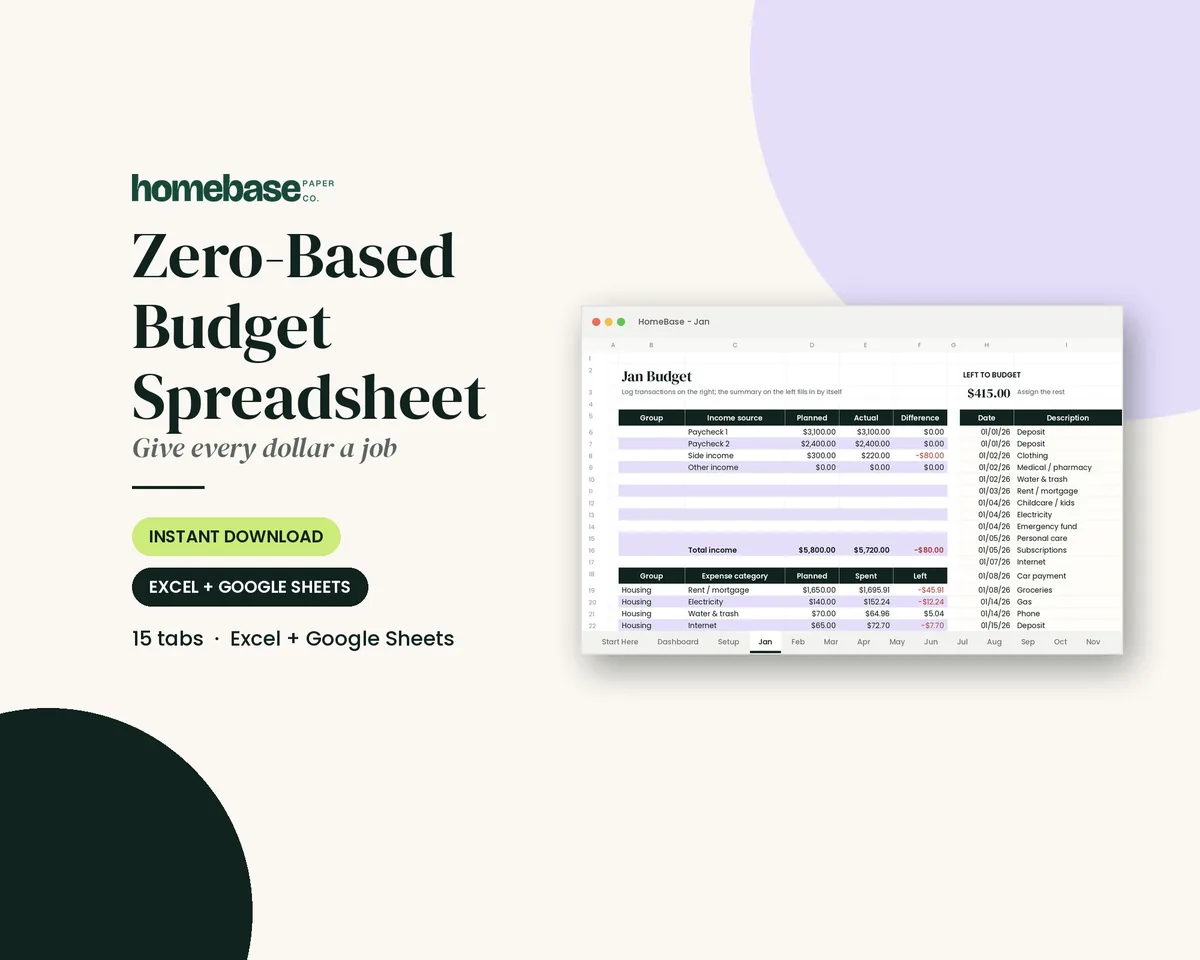
To keep it all on one page, the Zero-Based Budget Spreadsheet ($6.99) works in Excel and Google Sheets, and its 'Left to budget' counter turns green when every shared dollar has a job.
I'm Malaysia, and I run HomeBase Paper Co. with my husband, Raheim. I also grew up as the oldest of three in Detroit, the one my family leaned on to keep everything coordinated. So I care less about which budgeting method is "best" and more about whether two people can actually keep it going. A couple's budget only works if both of you can see it, both of you agreed to it, and neither of you dreads the monthly check-in.
If your plan covers children, childcare or shared family expenses, follow how to create a family budget for a complete household example and payday check.
Before turning every conversation into a money meeting, use these questions about shared routines and plans to understand what each person wants from time together.
Step 1: Have the first money talk (with an agenda)
Before you open a spreadsheet, have one honest conversation. The FDIC's guide to sharing finances says it plainly: each partner should disclose their income, expenses and ability to pay, and you should talk about how accounts, budgets, credit and debt will be managed. It also notes that money is a sensitive topic and a frequent source of stress, which is exactly why an agenda helps.
The Consumer Financial Protection Bureau's Discussing money productively tool suggests setting goals for the conversation, sharing an agenda ahead of time, sticking to the topic, keeping your tone neutral or positive, and recapping each person's next steps at the end. Here's a version built for couples:
| Agenda item | What to bring | Time |
|---|---|---|
| 1. Why we're doing this | One sentence each: what you want money to do for you | 5 min |
| 2. Income | Last two pay stubs or deposit amounts for each of you | 5 min |
| 3. Bills and debts | Rent or mortgage, utilities, insurance, car, cards, loans | 10 min |
| 4. Savings and goals | Emergency fund, big purchases, travel, retirement | 10 min |
| 5. One decision | Pick how you'll split shared bills (see Step 4) | 5 min |
| 6. Recap | Who does what by when, and the date of your next check-in | 5 min |
Two ground rules keep this first talk from turning into a fight:
- No judgment on the past. Debt or a spending habit from before you were a couple is information, not an accusation. The CFPB tool specifically advises against bringing up old disagreements; set another time for those.
- Facts on paper. Write the numbers down as you go. Arguments tend to live in fuzzy memories, and written numbers settle a lot of them.
Step 2: List both incomes and every shared expense
Now build the picture. The CFPB's couples financial prep handout recommends starting with an inventory of your household finances: income, expenses, debt and investments. It also asks whether each of you knows where paychecks are deposited, what payments go out, and when bills are due and how they're paid. If one of you couldn't answer those questions today, that's your first gap to close. A fixed expenses list helps you catch every shared bill.
Use take-home pay (what actually lands in the bank), not salary. Then sort expenses into three buckets:
| Bucket | Examples | Who usually pays |
|---|---|---|
| Shared fixed | Rent or mortgage, utilities, internet, insurance, groceries | Both, using your split |
| Shared goals | Emergency fund, vacation fund, car replacement, holidays | Both, using your split |
| Personal | Your own phone, hobbies, clothes, gifts for each other, debts from before | Each person on their own |
That last row matters. Deciding up front which costs are "ours" and which are "mine" removes most of the everyday friction. If you're not sure where a category belongs, our household budget categories guide is a good place to sort them.
Date night can fit any budget; our fun date ideas include free and under-$20 dates for couples who are saving.
Step 3: Choose joint, separate or hybrid accounts
There's no single right way to hold the money. The FDIC guide lists the options as individual accounts, joint accounts, or a combination of both, and suggests deciding which account pays the recurring bills and which holds savings. Here's how the three common setups compare:
| Setup | How it works | Works well when | Watch out for |
|---|---|---|---|
| Joint (all in) | Both paychecks go into one shared checking account; everything is paid from it | You have similar spending styles and want one simple view | Less personal privacy; one person's overspending hits both |
| Separate | Each keeps their own accounts; you split shared bills by transfer or by assigning bills | You're newer as a couple, have very different incomes, or bring big individual debts | Harder to see the whole picture; easy for "who paid what" to drift |
| Hybrid (yours, mine, ours) | Each keeps a personal account; both deposit an agreed amount into a joint account for shared bills and goals | You want teamwork on shared costs and freedom on personal ones | Needs a clear rule for how much each person deposits |
The hybrid is the middle ground: shared bills stay transparent, and nobody needs permission to buy a coffee.
Know what a joint account means before you open one. Per the FDIC, each co-owner of a joint deposit account has equal rights to make withdrawals, and either one can close the account and withdraw 100% of the funds without the other. Deposit insurance for joint accounts is $250,000 per co-owner at the same bank, and each person's individual accounts are insured separately from the joint one. The FDIC's Your Insured Deposits brochure explains that all co-owners must be living people with equal withdrawal rights for an account to count as a joint account. Equal access is the point of a joint account, so open one only with someone you trust with all of it.
The same FDIC guide adds a caution on credit: if you add a partner as a user on your credit card or cosign their loan, you're still responsible for the balance if they can't pay. Talk about that before you share any credit.
Step 4: Pick a fair way to split shared costs
Once you know your shared total, decide how to divide it. The FDIC guide names three approaches: combine everything, split responsibility by assigning bills, or use an income-based percentage, where a partner who brings in sixty percent of the income pays sixty percent of the bills. Here's how they compare:
| Method | How it works | Feels fair when | Downside |
|---|---|---|---|
| 50/50 | Each pays half of every shared cost | Incomes are close | Can squeeze the lower earner hard |
| Proportional | Each pays the same percentage of their income | Incomes differ | Takes a little math each time pay changes |
| Assigned bills | One pays rent, the other pays utilities and groceries | You both like simple ownership | Totals can drift out of balance |
| All pooled | Everything goes in one pot; no split at all | You've fully combined finances | Needs high trust and agreed personal allowances |
Worked example: a proportional split
Say Partner A takes home $4,200 a month and Partner B takes home $2,800. Together that's $7,000. Your shared fixed costs and shared goals add up to $4,000 a month.
| Partner A | Partner B | Total | |
|---|---|---|---|
| Take-home pay | $4,200 | $2,800 | $7,000 |
| Share of household income | 60% | 40% | 100% |
| Contribution to shared $4,000 | $2,400 | $1,600 | $4,000 |
| Left for personal costs and savings | $1,800 | $1,200 | $3,000 |
| Shared cost as % of own pay | 57% | 57% |
Both partners give up the same 57% of their pay, so the lower earner isn't stretched thinner. Compare a 50/50 split: each would pay $2,000, which is about 48% of Partner A's pay but about 71% of Partner B's. That gap is the main reason to consider a proportional split when you earn different amounts.
To set it up:
- Add your two take-home amounts.
- Divide each person's pay by the total to get their percentage.
- Multiply your shared total by each percentage.
- Set each contribution as an automatic transfer on payday.
- Recalculate whenever either income changes.
Step 5: Build one shared budget you both can see
Now give every shared dollar a job. A zero-based budget works especially well for couples, because "left to budget = $0" is a goal you can check together in seconds. If you prefer percentages, the 50/30/20 budget gives you a quick starting split you can refine.
If you'd rather share the budget on your phones, compare the best budgeting apps; Monarch, for one, is built for couples who want a shared view of every account.
For apps built for two, including options for separate finances, see our picks for the best budget app for couples.
What matters most is that you both look at the same numbers. Our Zero-Based Budget Spreadsheet ($6.99) has separate income rows (Paycheck 1 and Paycheck 2 in the sample), 12 monthly tabs, a transaction log with dropdowns, planned vs. spent vs. left columns, and a "Left to budget" counter that turns green when every dollar has a job. It works in Excel and Google Sheets, so you can keep one household copy that you both open. If you'd rather share an app, our budget app comparison lines up the main options side by side.
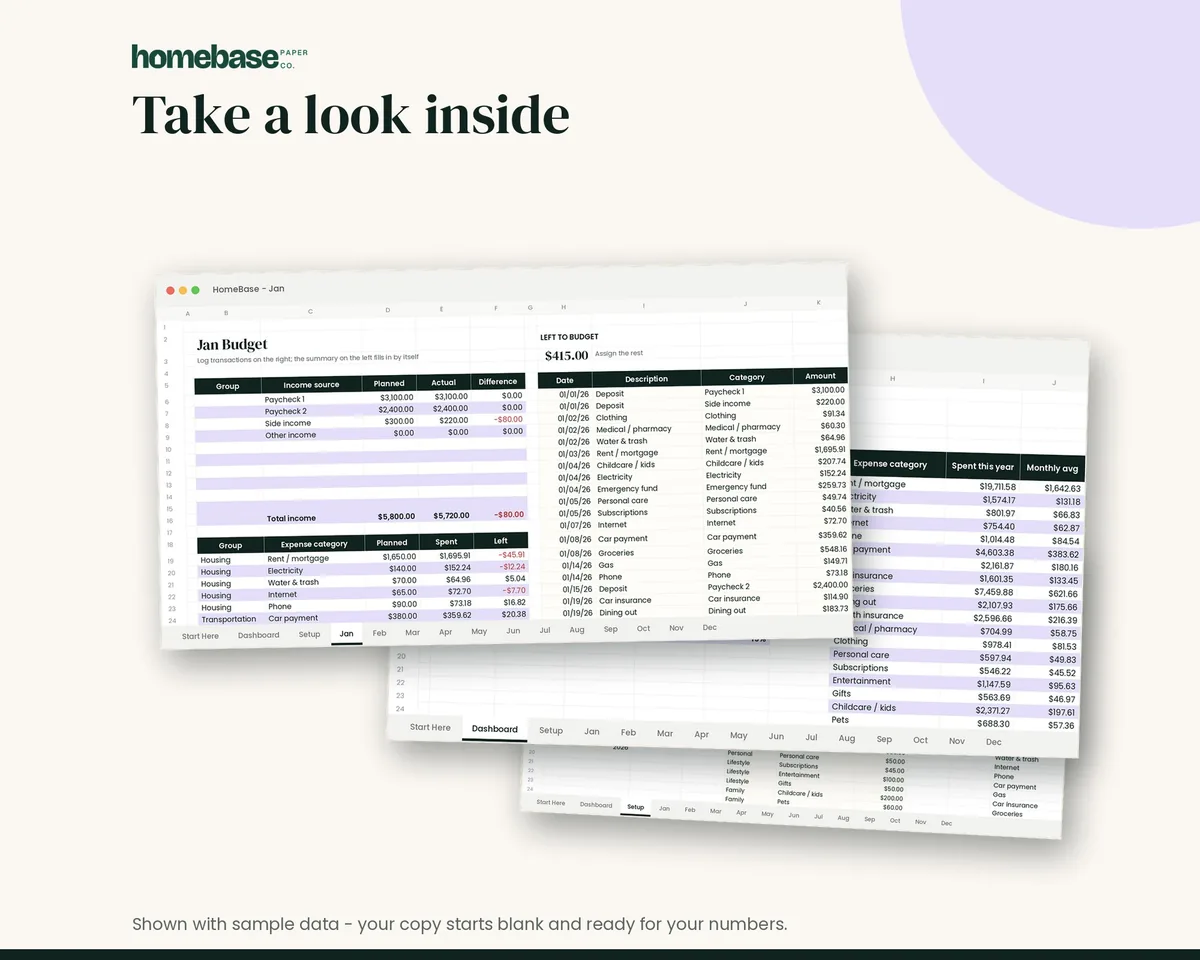
If one of you thinks better on paper, the Budget Planner Printable ($5.99) is a 12-page undated PDF with pages for the monthly budget, income, expenses, bills, debt, savings and sinking funds, so you can print a fresh set every month. You can keep the spreadsheet as the record and print the monthly page for the fridge. You can compare all of our templates on the Spreadsheets page.
Step 6: Give each person "no-questions" money
This is the step couples skip and then regret. Agree on a fixed personal amount for each of you every month, money that's yours to spend with no explanation and no commentary. It can come from what's left after your shared contribution, or be its own line in a fully joint budget.
A few ways to set it:
- Equal amounts. Simple, and it feels fair in a pooled budget.
- Proportional amounts. If you use a proportional split, personal money naturally follows income.
- A "check with me" limit. Agree on a dollar amount (for example, $100) above which any single purchase gets a quick conversation first. Pick a number that fits your budget, and write it down.
Personal money protects the relationship as much as the budget. It means a hobby purchase or a gift for your partner doesn't need a vote.
Step 7: Plan shared goals and irregular costs with sinking funds
Big shared costs, like car repairs, holidays, travel or an annual insurance premium, are what usually break a couple's budget. The fix is a sinking fund: divide each future cost by the months until it's due and save that much every month.
| Shared goal | Target | Months away | Monthly amount |
|---|---|---|---|
| Emergency fund top-up | $1,800 | 12 | $150 |
| Holiday gifts and travel | $900 | 6 | $150 |
| Car maintenance | $600 | 12 | $50 |
| Anniversary dinner | $240 | 8 | $30 |
| Total | $380 |
That $380 becomes part of your shared total in Step 4, so each partner funds it in proportion. Our Sinking Funds Tracker ($4.99) does this math for up to 20 goals, shows progress bars, and logs deposits and withdrawals, so you both can see how close you are.
If either of you carries debt, decide whether it's a shared goal or a personal one, then pick a payoff order together. Our guide to debt snowball vs. avalanche helps you choose.
Keep it going: the monthly money date
A budget you set once and never revisit drifts within a few months. A short monthly check-in keeps you both in the loop. Our family budget meeting agenda is a 30-minute plan that works for two people as well as for a whole household: start with a win, review last month, look ahead, check goals, make one decision.
Some habits that help:
- Same day every month, ideally a few days before the new month starts.
- Both people drive. Swap who runs the meeting, so one person isn't the "budget police."
- Update shared access. The CFPB handout recommends keeping a secure list of accounts and making sure both of you can get into online accounts, so the less involved partner can step in if needed.
- Plan for the unexpected. The same handout suggests deciding who will manage finances if one of you gets sick, and considering a durable power of attorney.
- Celebrate progress. A paid-off card or a full sinking fund deserves a small, budgeted treat.
Common couple budgeting mistakes (and fixes)
| Mistake | Why it hurts | Fix |
|---|---|---|
| One person does all the money work | The other loses touch and can't step in | Both attend the monthly check-in; swap tasks |
| Splitting 50/50 on very different incomes | The lower earner falls behind on savings | Use a proportional split |
| No personal money | Every purchase becomes a debate | Set a fixed monthly amount each |
| Budgeting from salary, not take-home pay | The plan is short every month | Use deposit amounts only |
| Forgetting irregular costs | Holidays and repairs blow up the plan | Add sinking funds to the shared total |
| Hiding debt or purchases | Breaks trust faster than the dollars do | Full disclosure in the first talk, no judgment |
Quick start: your first week as a budgeting couple
For the rest of the household money system, our family budgeting guide collects every method in one place.
- Day 1: Schedule a 45-minute money talk and share the agenda above.
- Day 2: Each gathers pay stubs, bills and debt balances.
- Day 3: Hold the talk; decide joint, separate or hybrid.
- Day 4: Calculate your split and set up automatic transfers.
- Day 5: Fill in your shared budget and personal money amounts.
- Day 6: List three shared sinking funds and their monthly amounts.
- Day 7: Put your monthly check-in on both calendars.
If you'd rather get every tool at once, the Ultimate Budget Bundle ($19.99, $46.42 if bought separately) includes the Zero-Based Budget Spreadsheet, Sinking Funds Tracker, Debt Payoff Planner, Paycheck Budget Spreadsheet, Annual Budget Spreadsheet, Bill Tracker Spreadsheet, Budget Planner Printable and Bill Tracker Printable. See all our sets on the Bundles page.
New to budgeting altogether? Start with budgeting for beginners, and if one of you is freelance or paid on commission, read how to budget with irregular income before you set your split.
The best couple's budget is the one you both open, both agreed to, and both keep coming back to. Start with one honest conversation this week, and let the numbers do the rest.
Make it easier
Tools for this

Spreadsheets
Zero-Based Budget Spreadsheet
The 'Left to budget' counter turns green when every dollar has a job.

Spreadsheets
Sinking Funds Tracker
It does the math: how much to set aside each month to hit every goal on time.
 Save 57%
Bundles
Ultimate Budget Bundle
All 6 spreadsheets + both printable planners - for less than half the price of buying them separately.
Frequently asked questions
How do you budget as a couple? To budget as a couple, list both take-home incomes and every shared cost, choose joint, separate or hybrid accounts, agree on a split, give each person personal money, and check in monthly. A shared tool like the Zero-Based Budget Spreadsheet ($6.99) keeps both of you looking at the same numbers, with a 'Left to budget' counter that turns green when every dollar has a job.
What is the fairest way for couples to split bills? A proportional split is usually the fairest when incomes differ, because each partner pays the same percentage of their own pay. If one of you earns 60% of the household income, that person covers 60% of shared bills. The FDIC describes this income-based approach in its guide to sharing finances. When incomes are close, 50/50 is simpler and works fine.
Should married couples have a joint bank account? A joint account makes shared bills simple, but it isn't required. Couples can use joint, separate or hybrid accounts. Know that each co-owner of a joint account has equal withdrawal rights and can withdraw the full balance or close the account without the other, according to the FDIC. A common middle ground is a hybrid: a joint account for shared bills plus a personal account each.
What is the yours, mine and ours budget method? The yours, mine and ours method gives each partner a personal account and adds one joint account for shared bills and goals. Each of you deposits an agreed amount, often a proportional share, into the joint account on payday. The Zero-Based Budget Spreadsheet ($6.99) can track the 'ours' account, with separate income rows for each paycheck.
How do you calculate a proportional split? Add both take-home incomes, divide each person's pay by the total to get a percentage, then multiply your shared costs by each percentage. For example, $4,200 and $2,800 make $7,000, so the split is 60/40; on $4,000 of shared costs, that's $2,400 and $1,600. Recalculate whenever either income changes.
How much personal spending money should each partner get? Each partner should get a fixed personal amount that fits your budget, spent with no explanation needed. There's no universal number. You can use equal amounts or make them proportional to income, and you can also agree on a 'check with me' limit, so any single purchase above it gets a quick conversation first.
How often should couples review their budget? A monthly money date of about 30 minutes is enough for most couples, with a quick weekly glance if money is tight. Hold it a few days before the new month starts. Our free family budget meeting agenda gives you a five-step routine: start with a win, review last month, look ahead, check goals, and make one decision.
What should couples talk about before combining finances? Talk through income, regular bills, debts, credit, savings and goals before you combine anything. The FDIC recommends that each partner disclose their income, expenses and ability to pay, and that you understand what is on each other's credit report. Decide which account pays recurring bills and where savings will live.
How do couples budget when one partner earns much more? When one partner earns much more, a proportional split keeps shared costs fair, since both give up the same share of their pay. In our worked example, both partners spend 57% of take-home pay on shared costs, compared with 48% and 71% under a 50/50 split. Give both partners personal money so the lower earner keeps some independence.
How should couples handle debt from before they met? Decide together whether each debt is a shared goal or stays personal, then agree on a payoff plan. There's no single right answer; what matters is that it's disclosed and written into the budget. The Debt Payoff Planner, included in the Ultimate Budget Bundle ($19.99), tracks balances and payoff order, and our snowball vs. avalanche guide helps you pick a method.
What is the best budget template for couples? The best budget template for couples is one you can both open and update. The Zero-Based Budget Spreadsheet ($6.99) works in Excel and Google Sheets, with separate income rows, 12 monthly tabs and planned vs. spent vs. left columns. If one of you prefers paper, the Budget Planner Printable ($5.99) is a 12-page undated PDF you can print every month.
How do couples save for shared goals like a vacation? Couples save for shared goals with sinking funds: divide the goal by the months until you need it and save that amount monthly. A $900 holiday fund six months away needs $150 a month. The Sinking Funds Tracker ($4.99) does this math for up to 20 goals and shows progress bars you can both see.
How do you stop fighting about money as a couple? Use the same short agenda every time, focus on the plan ahead instead of past mistakes, and end with one decision and clear next steps. The CFPB's money conversation tool recommends sharing an agenda in advance, keeping your tone neutral or positive, sticking to the topic and recapping who does what. Personal money also cuts down on everyday debates.
Should couples share passwords to financial accounts? Both partners should be able to reach the household's financial accounts if something happens. The CFPB suggests keeping a secure list of account information and making sure both of you can access online accounts. The Password & Accounts Log ($3.99) is a printable place to record them, kept somewhere safe.
Do unmarried couples budget differently? Unmarried couples can use the same steps, but may prefer to keep more money separate and use a hybrid or proportional setup. The FDIC's sharing-finances guide applies to anyone moving in with a partner, not only spouses. Before opening a joint account or cosigning, remember that each co-owner can withdraw the full balance, and a cosigner is responsible for the debt.
Is a couples budget spreadsheet better than an app? A spreadsheet gives you a one-time cost and full control over your categories, while an app automates bank syncing for a recurring fee. The Zero-Based Budget Spreadsheet is a one-time $6.99 with no subscription. If you're weighing options, our comparison of budgeting apps covers the subscription tools.
What is the first step in budgeting as a couple? Put both take-home incomes and every shared bill on one page. Once you can both see the numbers, decide how you will hold the money and split shared costs.
More from HomeBase
You may also like

Spreadsheets
Bill Tracker Spreadsheet
Bills due in 3 days or less light up red, so nothing slips through.

Spreadsheets
Paycheck Budget Spreadsheet
Enter your bills once. The sheet tells you which paycheck pays each one, all year.

Spreadsheets
Annual Budget Spreadsheet
See exactly where your money goes every month - without complicated software.

Spreadsheets
Debt Payoff Planner
Pick snowball or avalanche, add any extra payment, and get your debt-free month instantly.
 Club
Monthly club
Money Club
Anyone who wants a clear plan for the month's bills, holiday spending and savings.
Free printable
Give every dollar a job: get the free monthly budget template
A printable zero-based monthly budget: income, bills, everyday spending and savings on one page, with a planned vs. actual column. You'll also get our weekly HomeBase email with simple budgeting and bill-paying tips.

Sources
- Saying "I Do" to Sharing Finances (FDIC) fdic.gov
- Your Insured Deposits (FDIC) fdic.gov
- Discussing money productively (CFPB) files.consumerfinance.gov
- Couples financial prep handout (CFPB) files.consumerfinance.gov