

The short answer: fixed expenses are costs that stay the same, or nearly the same, every month, like rent, a car payment, insurance and subscriptions. They show how much of your income is already spoken for.
- Fixed vs. variable: rent and insurance stay the same; groceries, gas and dining out change with use
- Budget for them: list every one, convert periodic costs to monthly, add them up and subtract from take-home pay
- Match due dates to paydays and set up autopay
- 25 examples and ways to lower them are below
- Next step: Plan it with the Bill Tracker Spreadsheet ($4.99).
Fixed expenses, often called fixed monthly expenses, are the costs that stay the same, or nearly the same, every month, like rent, a car payment, insurance and subscriptions. Knowing your fixed expenses is the first step in any budget, because they show how much of your income is already spoken for before you buy a single grocery.
Want a fixed expenses list that keeps itself current? The Bill Tracker Spreadsheet ($4.99) tracks every bill's due date and payment in Excel or Google Sheets.
This guide explains the definition, gives 25 fixed expenses examples you can use as a checklist, compares fixed and variable expenses, and shows how to budget for and lower your fixed costs. New to budgeting? Start with budgeting for beginners.
Fixed expense definition: what counts as fixed
A fixed expense is a regular cost with a set amount, usually because you've signed a contract or agreed to a plan. You pay it whether or not you use it much that month. Fixed expenses are predictable, which makes them easy to plan for, but they are also harder to change quickly.
The opposite is a variable expense: a cost that changes with how much you use or buy, such as groceries, gas or dining out.
25 examples of fixed expenses
Housing
- Rent
- Mortgage payment
- HOA or condo fees
- Renters or homeowners insurance
- Property tax (often paid yearly or through your mortgage)
Transportation
- Car loan or lease payment
- Car insurance
- Public transit pass
- Parking permit
- Annual vehicle registration
Insurance and health
- Health insurance premium
- Life insurance premium
- Disability insurance premium (see our guide to disability insurance)
- Dental or vision insurance
Debt payments
- Student loan payment
- Personal loan payment
- A planned credit card payoff amount
Family
- Childcare or daycare tuition
- Child support or alimony
- School tuition
Bills and subscriptions
- Phone plan
- Internet
- Streaming services
- Gym membership
- Software or app subscriptions
Fixed vs. variable expenses
For the other half of the budget, our guide to variable expenses has 30 examples, typical household costs and a 5-step way to budget them.
| Fixed expenses | Variable expenses | |
|---|---|---|
| Amount | Same every period | Changes with use |
| Examples | Rent, insurance, car payment | Groceries, gas, dining out |
| Predictability | High | Lower |
| How to cut | Renegotiate, switch, refinance | Spend less day to day |
| Speed of change | Slow (contracts) | Fast |
Some costs sit in between. Utilities like electricity change with the season, so they're usually variable, though a budget billing plan can make them fixed. Our guide to budget categories shows where each type of cost belongs.
What are variable expenses?
Variable expenses are costs that change from month to month based on how much you use or buy. Common examples of variable expenses are groceries, gas, dining out, entertainment, clothing, household supplies, gifts and most utilities. Because you control them day to day, variable expenses are usually the fastest place to free up money when a month runs tight.
| Variable expense | Why it changes | Easy way to budget it |
|---|---|---|
| Groceries | Prices, household size, meals at home | A weekly number and a list |
| Gas | Miles driven, fuel prices | Average your last three months |
| Utilities | Season and usage | Use the highest recent month |
| Dining out and takeout | Choice | A set monthly amount |
| Clothing and household items | Need and timing | A small monthly sinking fund |
A good rule of thumb is to budget fixed expenses first, then give variable expenses a realistic limit based on your last few months of spending, not your best month.
Periodic fixed expenses: the ones that sneak up on you
Some fixed costs come once or twice a year: car registration, insurance paid every six months, property tax, annual subscriptions and memberships. They're easy to forget because they're not on your monthly statement.
The fix is simple: add up every periodic expense, divide by 12, and save that much each month in a sinking fund. When the bill arrives, the money is already there. A sinking fund tracker works out the monthly amount for each one.
Fixed monthly expenses worksheet: a worked example
Here is what a fixed monthly expenses list looks like once periodic bills are converted to a monthly amount. The figures are an illustrative one-car household, not national averages; swap in your own numbers from your statements.
| Fixed expense | How it is billed | Monthly amount |
|---|---|---|
| Rent | $1,450 a month | $1,450 |
| Car payment | $410 a month | $410 |
| Car insurance | $1,080 a year | $90 |
| Renters insurance | $180 a year | $15 |
| Phone plan | $85 a month | $85 |
| Internet | $60 a month | $60 |
| Student loan | $220 a month | $220 |
| Streaming subscriptions | $35 a month | $35 |
| Gym membership | $40 a month | $40 |
| Car registration | $120 a year | $10 |
| Total fixed monthly expenses | $2,415 |
On a take-home pay of $4,800 a month, $2,415 in fixed expenses is about 50% of income, right at the needs share in the 50/30/20 guideline below, before groceries, gas and utilities. The three yearly bills add only $115 a month, but forgetting them is how a $1,080 insurance renewal turns into a credit card balance. Set that $115 aside each month in a sinking fund so the yearly bills are already paid for when they arrive.
Traceable fixed expenses in business accounting
You may also see "traceable fixed expenses" in a business or accounting class. A traceable fixed expense is a fixed cost that exists only because of one segment of a business, such as one store, department or product line, and would go away if that segment closed: for example, the salary of a manager who runs only that store. A common fixed expense is shared across segments, like headquarters rent, and stays even if one segment is dropped. Household budgets do not need that split, but the idea is similar: a car payment is "traceable" to owning the car and ends when you sell it.
How much of your income should go to fixed expenses?
There's no perfect number. The popular 50/30/20 budget suggests about 50% of after-tax income for needs, a group that includes most fixed expenses along with essentials like groceries and utilities. If fixed costs alone take more than half your take-home pay, the rest of the budget will feel tight. Housing and transportation are usually the biggest fixed costs, so they matter most. Use how much rent can I afford to check housing.
How to budget for fixed expenses
- List every fixed expense with the amount and due date. Check bank and card statements for the last three months so nothing is missed.
- Convert periodic costs to monthly by dividing yearly amounts by 12.
- Add them up. This is your monthly fixed cost total.
- Subtract from take-home pay. What's left covers variable expenses, savings and debt payoff.
- Match due dates to paydays. If several big bills land before one payday, ask to move a due date, or use a paycheck budget planner.
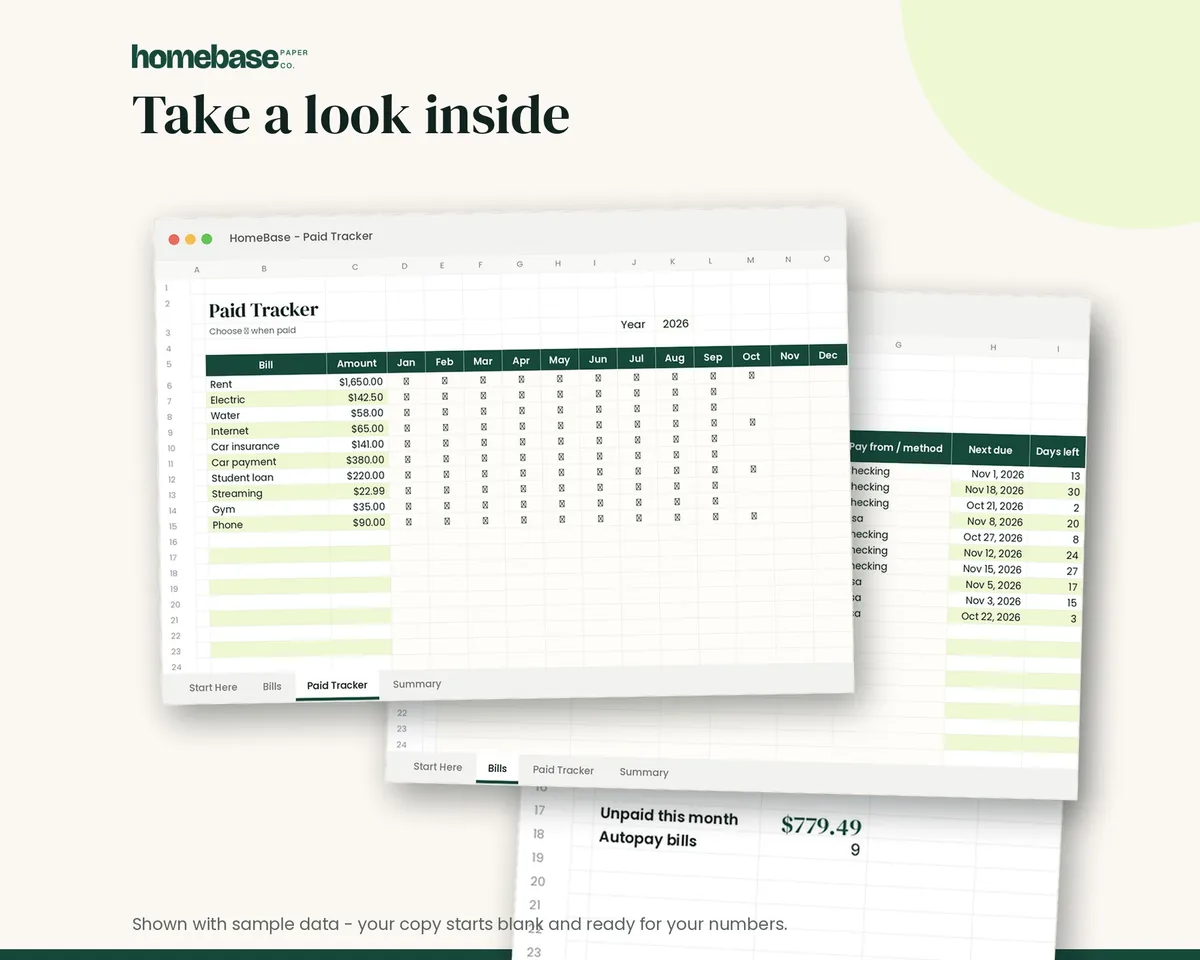
- Set up autopay for bills that never change, and keep a bill tracker so you know what's coming.
- Review once a year. Prices for insurance, internet and subscriptions often creep up at renewal.
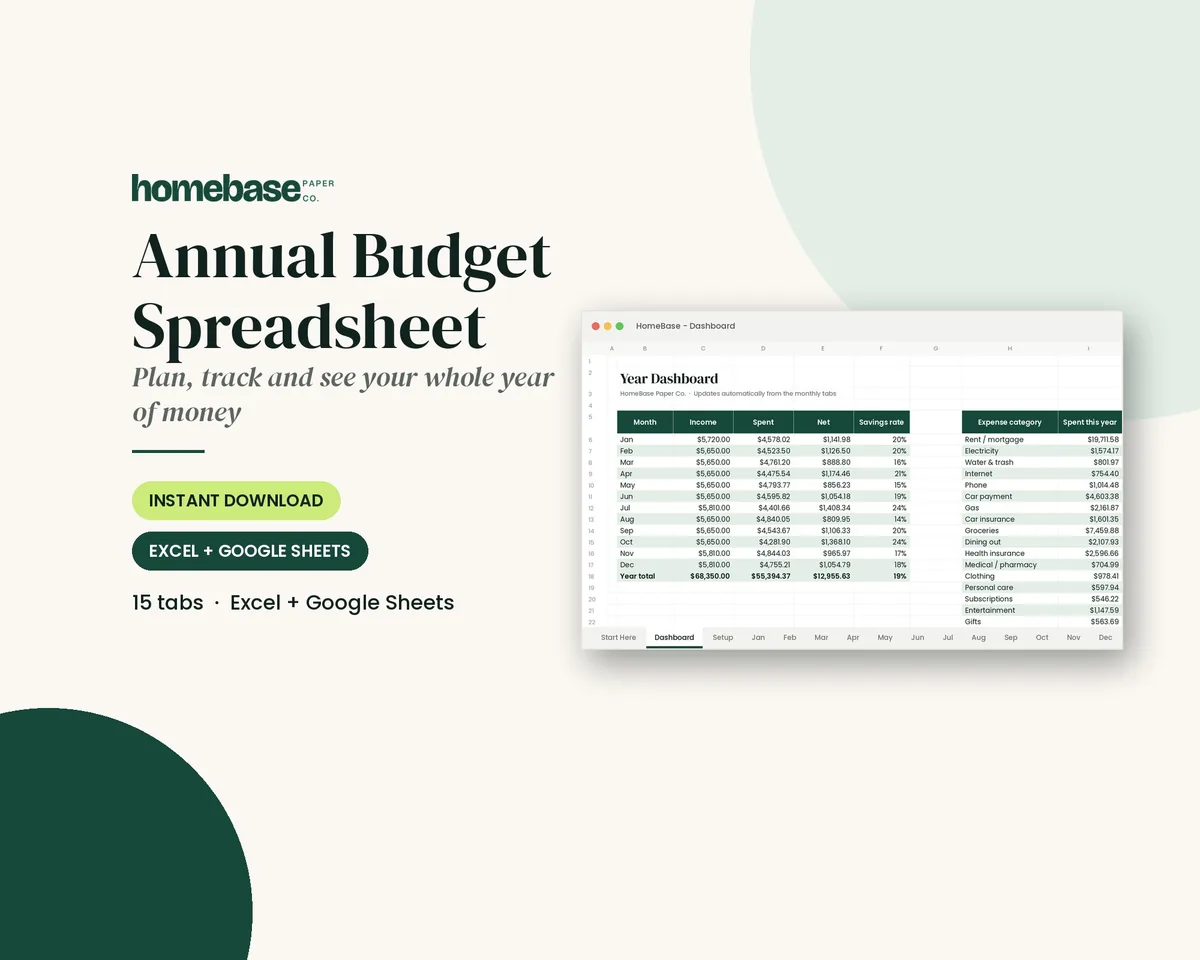
The Annual Budget Spreadsheet ($6.99) works in Excel and Google Sheets, with a setup tab for your categories and plan and 12 monthly tabs showing planned vs. actual by category, so fixed costs are entered once and checked every month, and the Bill Tracker Spreadsheet ($4.99) tracks due dates and payments. Prefer paper? The Budget Planner Printable ($5.99) has monthly budget and bill pages. If you want every dollar assigned, see the Zero-Based Budget Spreadsheet ($6.99) and our guide to zero-based budgeting.
What fixed expenses look like in a typical household
The Bureau of Labor Statistics Consumer Expenditure Surveys show housing is the largest share of spending for most U.S. households, followed by transportation and food. That lines up with what most people find when they list their fixed costs: rent or mortgage first, then a car payment and insurance.
Winter bills climbing? Here's how to lower your heating bill without being cold.
Use that as a quick gut check. If your housing alone takes half your take-home pay, the rest of the budget will always feel tight, no matter how carefully you shop for groceries. That doesn't mean you have to move tomorrow. It means housing is the line to look at first at your next lease renewal or refinance window.
A few more ways to make fixed expenses easier to live with:
- Line up due dates with paydays. Many lenders and utilities let you pick a due date. Moving a bill a week later can stop the scramble at the end of the month.
- Keep one list of every fixed bill. Write the amount, due date and how it's paid. It takes ten minutes and you'll spot forgotten subscriptions right away.
- Build a small buffer. Even $100 in checking covers a bill that posts a day early. The CFPB's guide to building an emergency fund has simple ways to start one.
How to lower your fixed expenses
Cutting a fixed cost once saves money every month after. Places to look:
- Insurance. Compare quotes every year or two and ask about bundling or raising a deductible you could afford to pay.
- Phone and internet. Call to ask for a better rate, or switch to a lower plan or a different carrier.
- Subscriptions. Cancel anything you haven't used in a month.
- Loans. Refinancing can lower a payment when rates or your credit have improved; compare total cost including fees.
- Housing and cars. Bigger changes, but worth considering when a lease or loan ends.
More ideas are in how to lower monthly bills and needs vs. wants, which helps decide which fixed costs are worth keeping. For the rest of the money picture, see our personal finance basics hub.
Not sure how big your fixed costs should be? Our budget percentages guide shows a typical share of take-home pay for each category.
Fixed and variable costs add up to your total living expenses; see our guide to living expenses for the average U.S. budget by category.
Make it easier
Tools for this

Spreadsheets
Annual Budget Spreadsheet
See exactly where your money goes every month - without complicated software.

Spreadsheets
Bill Tracker Spreadsheet
Bills due in 3 days or less light up red, so nothing slips through.

Printables
Budget Planner Printable
Twelve undated pages you can print every month: budget, bills, spending, savings and debt.
Frequently asked questions
What are fixed expenses? Fixed expenses are costs that stay the same, or nearly the same, every month and that you've usually committed to in advance, such as rent or a mortgage payment, a car payment, insurance premiums, loan payments and subscriptions. Because they're predictable, they're the first thing to list when you build a budget.
What are examples of fixed expenses? Common fixed expenses include rent or mortgage, car loan or lease payments, student loan payments, health, auto, home or renters and life insurance premiums, childcare or tuition, phone plans, internet, streaming and other subscriptions, gym memberships, HOA dues, and set monthly savings or debt payments. Property tax is fixed too, even if you pay it once or twice a year.
What is the difference between fixed and variable expenses? Fixed expenses stay the same each month, like rent or a car payment. Variable expenses change based on how much you use or buy, like groceries, gas, dining out, clothing and entertainment. Fixed costs are harder to change quickly, while variable costs are where most people find room to cut in the short term.
Are utilities fixed or variable expenses? Most utilities, such as electricity, gas and water, are variable expenses because the bill changes with usage and season. Some people treat them as fixed by enrolling in a budget billing plan that charges a set amount each month. Internet and phone plans are usually fixed.
Are groceries a fixed expense? No, groceries are not a fixed expense. Groceries are a variable expense because the amount changes from month to month. They are an essential expense, though, so many budgets treat them as a need and set a firm monthly limit, even though the actual spending varies.
What percentage of income should go to fixed expenses? About 50% of after-tax income or less is a common guide for fixed expenses, because the popular 50/30/20 budget suggests about 50% of take-home pay for needs, which include most fixed expenses plus essentials like groceries and utilities. There's no single right number, but if your fixed costs alone take more than half of your take-home pay, your budget will feel tight, and housing or transportation is usually the place to look first.
Is a credit card payment a fixed expense? Usually no, a credit card payment is treated as a variable expense, because the minimum payment changes with your balance. If you're paying down a card on a set payoff plan, for example the same $200 every month, you can list that planned payment as a fixed expense in your budget.
What are periodic fixed expenses? Periodic fixed expenses are predictable costs that don't come monthly, such as annual car registration, insurance paid every six months, property tax, yearly subscriptions and memberships. Divide each by 12 and save that amount every month in a sinking fund so the bill is covered when it comes.
How can I lower my fixed expenses? Shop your insurance every year or two, ask about bundling discounts, cancel subscriptions you don't use, negotiate or switch your phone and internet plans, refinance high-interest loans if it saves money after fees, and consider housing or car choices when a lease or loan ends. Small cuts to fixed costs repeat every month, so they add up quickly.
Are fixed expenses the same as needs? Fixed expenses are not exactly the same as needs. Many fixed expenses are needs, like rent and insurance, but some are wants, like streaming services or a gym membership. And some needs, like groceries and gas, are variable. Sorting expenses both ways, fixed or variable and need or want, gives the clearest picture of your budget.
How do I track fixed expenses? Track fixed expenses by listing every one with its amount and due date, then putting the due dates on a calendar or bill tracker such as the Bill Tracker Spreadsheet. Set up autopay where it helps, and check the list each month in case a price went up. A spreadsheet makes it easy to see your total fixed costs and how much is left for everything else.
What are variable expenses? Variable expenses are costs that go up or down each month depending on how much you use or buy, such as groceries, gas, dining out, entertainment, clothing and most utilities. They are harder to predict than fixed expenses, so budget them using an average of your last three months and track them weekly.
What are examples of variable expenses? Common examples of variable expenses include groceries, gasoline, restaurant meals and takeout, entertainment, clothing, haircuts, household supplies, gifts, electricity and water bills, and medical copays. Anything whose amount depends on your choices or usage that month is usually a variable expense rather than a fixed one.
Is car insurance a fixed expense? Yes, car insurance is a fixed expense. Car insurance is a fixed expense because the premium is set for the policy term, usually six or twelve months. If you pay it in one lump sum, treat it as a periodic fixed expense and save for it monthly.
More from HomeBase
You may also like

Spreadsheets
Sinking Funds Tracker
It does the math: how much to set aside each month to hit every goal on time.

Spreadsheets
Paycheck Budget Spreadsheet
Enter your bills once. The sheet tells you which paycheck pays each one, all year.
 Save 57%
Bundles
Ultimate Budget Bundle
All 6 spreadsheets + both printable planners - for less than half the price of buying them separately.

Spreadsheets
Debt Payoff Planner
Pick snowball or avalanche, add any extra payment, and get your debt-free month instantly.
 Club
Monthly club
Money Club
Anyone who wants a clear plan for the month's bills, holiday spending and savings.
Free printable
Give every dollar a job: get the free monthly budget template
A printable zero-based monthly budget: income, bills, everyday spending and savings on one page, with a planned vs. actual column. You'll also get our weekly HomeBase email with simple budgeting and bill-paying tips.
