

The short answer: how much rent can I afford? Keep rent at or below 30% of your gross monthly income, the same number a landlord's "40x rule" gives. On $50,000 a year, that's about $1,250 a month.
- 40x rule: yearly gross income ÷ 40
- 3x rule: gross monthly income ÷ 3
- Needs test: rent plus all other needs at or under 50% of take-home pay
- Hidden move-in costs and a 6-step budget test are below
- Next step: Plan it with the Paycheck Budget Spreadsheet ($5.99).
To figure out how much rent you can afford, start with the most common rule: keep rent at or below 30% of your gross (before-tax) monthly income. That's the same number a landlord gets with the "40x rule," which asks for a yearly income of at least 40 times the monthly rent. On $50,000 a year, that works out to about $1,250 a month. Then test that number against your real take-home budget. If rent plus your other must-pay bills eats more than about half of your take-home pay, or leaves nothing for savings, aim lower.
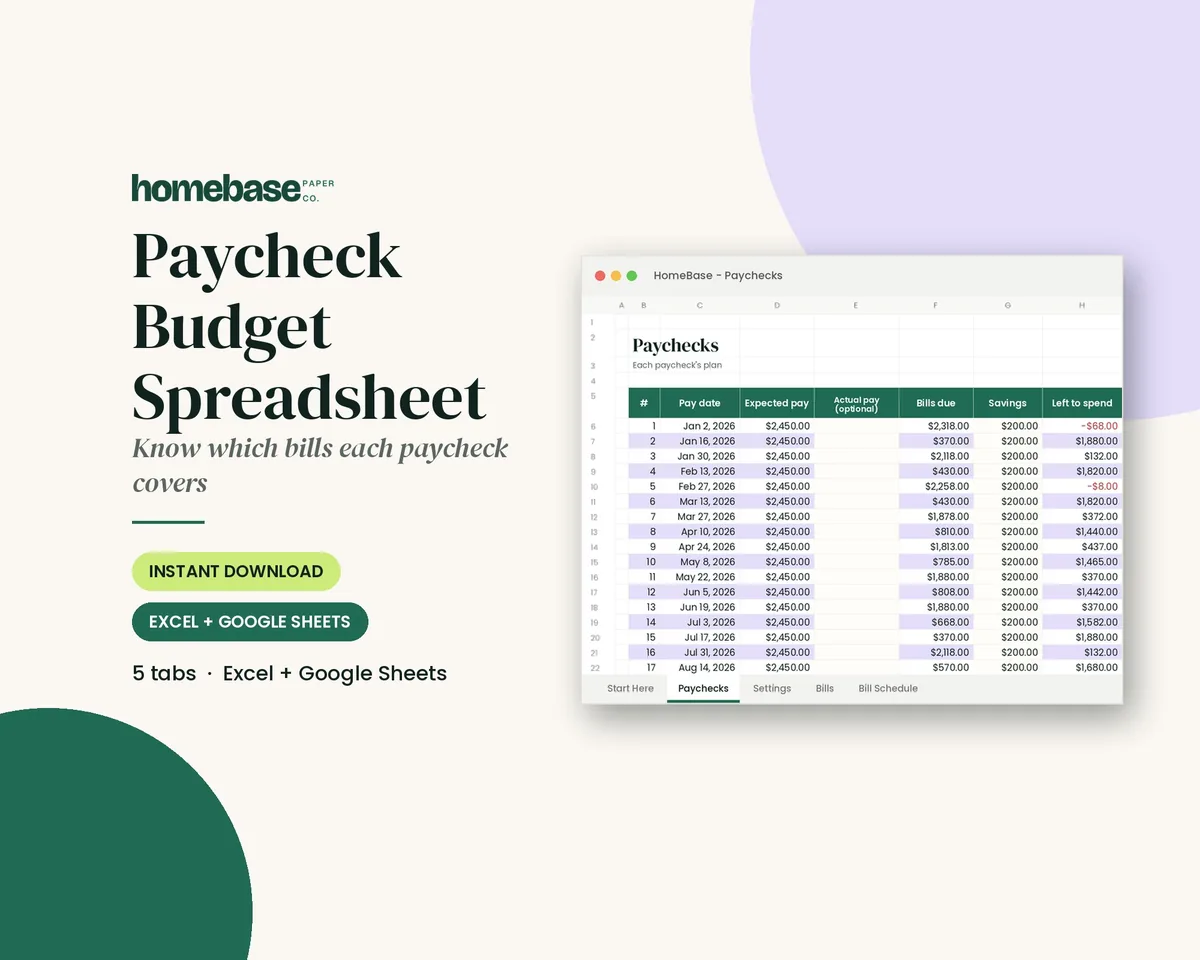
Once you pick a rent, our Paycheck Budget Spreadsheet lets you enter your bills once and shows which paycheck pays each one, all year.
Below you'll find the rules side by side, tables by salary and hourly wage, a budget test and the move-in costs people forget. Every dollar amount is an example to show the math, so swap in your own numbers.
The 3 rent affordability rules, side by side
The 30% and 40x rules tell you what a landlord will likely accept. The 50/30/20 needs test tells you what's comfortable.
The 30% and 3x rules start from your gross monthly income, which is your pay before taxes and deductions.
Landlords and lenders may also check your debt payments against income. Here's how to calculate debt to income ratio with examples.
| Rule | How to calculate it | Based on | Best for |
|---|---|---|---|
| 30% rule | Gross monthly income × 0.30 | Pre-tax pay | A quick ceiling while you browse listings |
| 40x rule | Yearly gross income ÷ 40 | Pre-tax pay | Knowing whether you'll pass a landlord's income check |
| 3x rule | Gross monthly income ÷ 3 | Pre-tax pay | Landlords who ask for "3 times the rent" |
| 50/30/20 needs test | Rent + all other needs ≤ 50% of take-home pay | After-tax pay | Making sure rent leaves room for bills, savings and fun |
The 30% rule
The 30% rule comes from federal housing policy, not from a bank or a blogger. The Congressional Research Service explains that federal housing programs typically treat housing as affordable if it costs no more than 30% of income, and households paying more are called "cost burdened." Those paying more than half are "severely cost burdened." The same report traces the standard back to the old idea of "a week's wages for a month's rent," with the federal cap moving from 25% of income in 1969 to 30% in the early 1980s. Buying instead? Mortgage lenders use a different test, the 28/36 rule.
Two things to know before you lean on it:
- It's measured against gross income, and for renters it counts rent plus utilities. If your utilities aren't included, your rent alone should sit a little under 30%.
- It's a rule of thumb, not a guarantee. The CRS report points out that a flat 30% doesn't account for child care, transportation or health costs, which vary a lot from one household to the next.
You're not alone if 30% feels impossible. The same CRS analysis of Census data found that 49.4% of renter households were cost burdened in 2024, and 26.2% were severely cost burdened.
The 40x rule (and the 3x rule)
Many landlords and property managers screen applicants with an income multiple. Under the 40x rule, your yearly gross income should be at least 40 times the monthly rent. For a $1,500 apartment, that's $60,000 a year.
Here's the useful part: the 40x rule is the 30% rule in disguise. Dividing your yearly income by 40 gives exactly the same number as taking 30% of your monthly income. So if you've done the 30% math, you already know whether you'll clear a 40x screen.
Some landlords use "3 times the rent" in monthly terms instead. That's a bit looser (about 33% of gross income), so it approves a slightly higher rent. Always ask which rule the landlord uses and whether they count a roommate's or co-signer's income.
The 50/30/20 needs test
The 50/30/20 budget splits take-home pay into 50% for needs, 30% for wants and 20% for savings and extra debt payments. Rent is a need, so it shares that 50% with utilities, groceries, insurance, transportation and minimum debt payments.
It's the strictest test because it uses after-tax pay and counts everything else you must pay. A rent that passes the 30% rule can still fail here if you have a car payment and student loans. If you're shopping for one, our guide to how much car payment you can afford sizes it against your pay.
To use these rules as a quick rent calculator, multiply your gross monthly income by 0.30, or divide your yearly income by 40. Both give the same rent ceiling, which you then test against your real budget below.
How much rent can I afford by salary?
This table uses gross income, the number landlords check. The 30% column is also the 40x answer.
| Yearly income | Monthly gross | 25% (cautious) | 30% rule / 40x rule | 3x rule (stretch) |
|---|---|---|---|---|
| $30,000 | $2,500 | $625 | $750 | $833 |
| $40,000 | $3,333 | $833 | $1,000 | $1,111 |
| $50,000 | $4,167 | $1,042 | $1,250 | $1,389 |
| $60,000 | $5,000 | $1,250 | $1,500 | $1,667 |
| $75,000 | $6,250 | $1,563 | $1,875 | $2,083 |
| $100,000 | $8,333 | $2,083 | $2,500 | $2,778 |
| $120,000 | $10,000 | $2,500 | $3,000 | $3,333 |
Use the 25% column if you carry debt or your utilities aren't included. Treat the 3x column as an upper limit, not a target.
By hourly wage
Hourly workers can convert pay to a yearly figure with simple math: a full-time schedule of 40 hours a week for 52 weeks is 2,080 hours.
| Hourly wage (full time) | Yearly gross | 30% rule / 40x rule |
|---|---|---|
| $15 | $31,200 | $780 |
| $18 | $37,440 | $936 |
| $20 | $41,600 | $1,040 |
| $25 | $52,000 | $1,300 |
| $30 | $62,400 | $1,560 |
| $40 | $83,200 | $2,080 |
If your hours change week to week, use your lowest normal month, not your best one. Our guide to budgeting with irregular income shows how to set a baseline.
Income you need for a specific rent
Found a place you love? Flip the math. Multiply the rent by 40 to see the yearly income most landlords want.
| Monthly rent | Income needed (40x) | Monthly gross needed |
|---|---|---|
| $1,000 | $40,000 | $3,333 |
| $1,200 | $48,000 | $4,000 |
| $1,500 | $60,000 | $5,000 |
| $1,800 | $72,000 | $6,000 |
| $2,000 | $80,000 | $6,667 |
| $2,500 | $100,000 | $8,333 |
How to figure out the rent you can actually afford in 6 steps
The rules give you a ceiling. These steps give you your number.
1. Find your real take-home pay
Use the net pay on your pay stub, not your salary. If you're paid every two weeks, multiply one check by 26 and divide by 12 to get a true monthly figure. Our biweekly budget template guide walks through the math and the "three-paycheck months."
2. Run the 30% check on gross pay
Multiply your gross monthly income by 0.30. This is your landlord ceiling. Write it down and don't go above it without a very good reason.
3. List every other need
Add up everything you must pay every month besides rent: utilities, renter's insurance, groceries, transportation, phone, insurance premiums, child care and minimum debt payments. If you're not sure what belongs, our list of budget categories is a good checklist.
4. Check your debt load
Landlords may look at your debts too. The Consumer Financial Protection Bureau defines your debt-to-income ratio as all of your monthly debt payments divided by your gross monthly income. The higher that ratio, the less room you have for rent. If debt is squeezing you, the 25% column above is the safer target, and our debt snowball vs. avalanche guide can help you shrink it.
5. Run the needs test
Take 50% of your take-home pay and subtract your other needs. What's left is your comfortable rent under 50/30/20.
6. Pick a number between "comfortable" and "ceiling"
Your best rent usually lands between the needs-test number (comfortable) and the 30% number (ceiling). The closer to the comfortable end, the more you save.
Worked example: a $54,000 salary
Here's how the steps play out for one example renter. The numbers are made up to show the math.
| Item | Example amount |
|---|---|
| Yearly gross income | $54,000 |
| Monthly gross | $4,500 |
| Monthly take-home (from the pay stub) | $3,600 |
| 30% rule / 40x ceiling ($4,500 × 0.30) | $1,350 |
| Other needs: utilities $150, renter's insurance $15, groceries $400, transportation $250, phone $60, minimum debt payment $125 | $1,000 |
| 50% of take-home ($3,600 × 0.50) | $1,800 |
| Comfortable rent under the needs test ($1,800 − $1,000) | $800 |
So this renter's range is $800 to $1,350. Here's what three rents in that range would do to the rest of the budget:
| Monthly rent | Needs as % of take-home | Left for wants and savings |
|---|---|---|
| $800 | 50% | $1,800 |
| $1,100 | 58% | $1,500 |
| $1,350 | 65% | $1,250 |
At $1,100, this renter could still send $360 (10%) to savings every month and have $1,140 for everything else. At $1,350, the budget works, but there's far less room for a car repair or a rent increase. That's the trade-off you're really choosing when you pick an apartment.
Hidden move-in costs to budget for
The rent is only part of what it costs to move in. Plan for these before you sign, so the first month doesn't land on a credit card.
| Cost | When you pay it | Example on a $1,200 rent |
|---|---|---|
| Application fees | With each application | $50 × 2 applications = $100 |
| First month's rent | At signing or move-in | $1,200 |
| Security deposit | At signing | $1,200 |
| Admin or move-in fee | At signing | $150 |
| Pet deposit or fee | At signing, if you have a pet | $0–$300 |
| Renter's insurance | Before move-in | $15 |
| Utility setup or deposits | Before move-in | $100 |
| Truck or movers | Moving day | $300 |
| First-week basics (cleaning supplies, groceries, shower curtain) | First week | $250 |
| Example total | $3,315 (before any pet costs) |
In this example, moving in costs almost three times the monthly rent. Deposit limits and fee rules vary by state and city, so check your local rules and read the lease for every fee before you sign. Once you have the keys, our guide to what you need for your first apartment helps you set up without overspending.
Also budget for monthly extras: parking, pet rent, amenity fees, internet and laundry. A cheaper rent with paid parking and no in-unit laundry can cost more than the "pricier" place down the street.
Our moving checklist covers the full to-do list, and a home inventory list makes choosing renter's insurance coverage much easier.
Protect your deposit money
Upfront costs add up fast, so pay them only once you've confirmed the listing. Pay with a method you can trace, not a wire transfer, gift card or cryptocurrency, since money sent those ways is hard to get back. Rent far below the going rate in the area is worth a closer look, and you can hold back your Social Security number until you've decided to rent the place. See the place in person (or send someone you trust) before you pay anything.
How to fit rent into your monthly budget
Once you've signed, make rent the easiest bill you pay.
- Assign rent to a specific paycheck. If rent is due on the 1st and you're paid on the 15th and the 30th, the check on the 30th covers rent. Set that money aside the day it lands.
- Pay yourself first, right after rent. Move a set amount to savings on payday, before the spending money. Our guide to paying yourself first shows how to automate it.
- Start a sinking fund for renewal time. Leases come up for renewal, and rents can go up. Saving a small amount every month in a sinking fund means a higher renewal rate or a future move won't wreck your budget.
- Trim the other needs. Rent is fixed for the lease, but utilities, phone and insurance often aren't. Our list of ways to lower your monthly bills can free up room.
- Review it monthly. A ten-minute monthly check catches problems early. A monthly budget template is enough to start.
Splitting rent with a partner or roommate
Two incomes change the math. Many landlords will add incomes together for the 40x check, but ask first. Inside the home, you can split rent 50/50 or in proportion to income. For example, if one person earns $60,000 and the other $40,000, a $1,800 rent split by income would be $1,080 and $720. Our guide to budgeting as a couple covers joint and separate accounts.
When to break the rules (and when not to)
The 30% rule is a starting point. Sometimes going a little higher makes sense:
- You'll save on transportation. The CRS report gives the example that a renter paying a bit more to live within walking distance of work isn't necessarily worse off than one paying less but commuting farther.
- You have no debt and a strong emergency fund.
- Your income is rising soon, with a signed offer or a scheduled raise, not just a hope.
Stay at or under the rules when your income is uneven, you carry high-interest debt, you have no emergency savings, or the move-in costs would come from a credit card.
Why the right number is the one you can keep paying
The right rent isn't the biggest number a landlord will approve. It's the one you can keep paying in a hard month, with room left for savings and the people and plans you care about. Treat the 30% rule and the 40x rule as screening tools, then test the number against your real budget.
Plan your rent with the Paycheck Budget Spreadsheet
The Paycheck Budget Spreadsheet ($5.99) answers the question that matters after you sign: which paycheck pays the rent? It works in Excel and Google Sheets and:
- handles weekly, biweekly, semi-monthly or monthly pay and calculates your pay dates for the year
- lets you enter rent and every other bill once and schedules all 12 months
- assigns each bill to the right paycheck automatically, with an override if you want to change it
- shows what's left to spend from each paycheck, with paid checkmarks
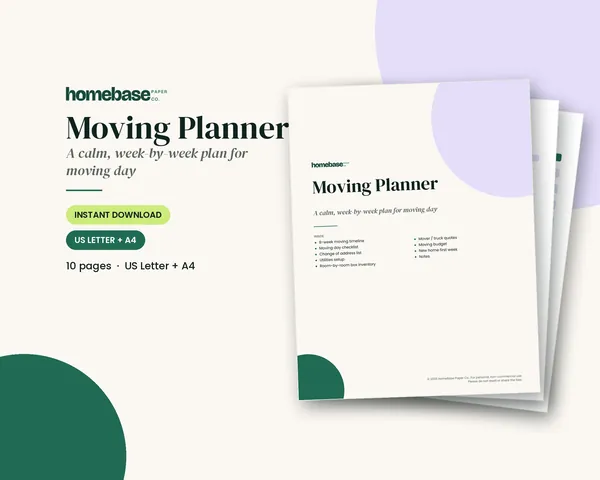
Moving soon? The Moving Planner ($5.99) is a printable with a moving timeline, a moving budget page, utilities setup and a first-week checklist. Prefer paper for the monthly budget too? The Budget Planner Printable ($5.99) has twelve undated pages for budget, bills, spending, savings and debt.
Want everything? The Ultimate Budget Bundle ($19.99, $46.42 if bought separately) includes the Paycheck Budget Spreadsheet, the Budget Planner Printable and six more budget tools. Browse every template in Spreadsheets, the paper versions in Printables, or all sets in Bundles.
Moving close to the holidays? Our free Holiday Budget Starter Kit is 3 US Letter pages, emailed after you join our list, so gifts and travel don't compete with your deposit.
When you total up housing costs, include renters insurance alongside rent, utilities and parking so the full monthly cost fits your budget.
Make it easier
Tools for this

Spreadsheets
Paycheck Budget Spreadsheet
Enter your bills once. The sheet tells you which paycheck pays each one, all year.

Printables
Budget Planner Printable
Twelve undated pages you can print every month: budget, bills, spending, savings and debt.
Frequently asked questions
How much rent can I afford? Most people can afford rent of about 30% of their gross monthly income, which is the same as a yearly income of 40 times the rent. On $50,000 a year, that's about $1,250 a month. Then check it against your take-home budget: if rent plus your other must-pay bills takes more than about half of your take-home pay, aim lower.
What is the 30% rule for rent? The 30% rule says to spend no more than 30% of your gross monthly income on housing. It comes from federal housing policy, which treats households paying more than 30% of income as cost burdened. For renters, that 30% is meant to cover rent plus utilities, so if utilities aren't included, keep rent a little lower.
What is the 40x rent rule? The 40x rule is a landlord screen that asks for a yearly gross income of at least 40 times the monthly rent. A $1,500 apartment needs $60,000 a year. Dividing yearly income by 40 gives exactly the same answer as the 30% rule, so if you pass one, you pass the other.
How much rent can I afford on $50,000 a year? You can afford about $1,250 a month in rent on $50,000 a year, according to both the 30% rule and the 40x rule. A cautious 25% target is about $1,042, and a landlord using the 3x rule may approve up to about $1,389. If you carry debt or your utilities aren't included, aim for the lower end.
How much rent can I afford on $60,000 a year? On $60,000 a year, you can afford about $1,500 a month under the 30% rule or the 40x rule. A cautious 25% target is $1,250. Check the number against your take-home budget before you sign, especially if you have a car payment or student loans.
How much rent can I afford making $20 an hour? At $20 an hour full time, you earn about $41,600 a year, so the 30% rule suggests rent of about $1,040 a month. That assumes 40 hours a week for 52 weeks. If your hours vary, use your lowest normal month instead of your best one.
Should rent be 30% of gross or net income? Use gross income for the 30% rule, and check net income too. The 30% rule and landlord screens use gross income, the pay before taxes. Your budget, though, runs on take-home pay, so also check that rent plus your other needs fits within about half of your take-home pay. If the two checks disagree, the lower number is the safer one.
How do I fit rent into my monthly budget? Assign rent to the specific paycheck that comes before the due date and set that money aside the day it arrives. The Paycheck Budget Spreadsheet ($5.99) does this for you: enter rent and your bills once, and it assigns each bill to the right paycheck all year and shows what's left to spend from each one.
What costs should I budget for besides rent when moving? Budget for application fees, the first month's rent, a security deposit, any admin or pet fees, renter's insurance, utility setup, movers or a truck and first-week basics. The Moving Planner ($5.99) includes a moving budget page and a utilities setup page so nothing gets missed. In this guide's example, move-in costs about three times the monthly rent.
How much should I save before renting an apartment? Save at least two to three times the monthly rent before you add moving and setup costs, plus a small emergency cushion. That covers your move-in costs, which often include the first month's rent and a security deposit. Add up your own list, including movers and setup, and save toward it monthly; the Moving Planner has a moving budget page for that list.
Do landlords look at debt when I apply? Many landlords check your credit and may consider your debts along with your income. The CFPB defines your debt-to-income ratio as your monthly debt payments divided by your gross monthly income, and a high ratio leaves less room for rent. If you carry a lot of debt, target 25% of gross income instead of 30%.
Is it OK to spend more than 30% of my income on rent? Sometimes, if you have no high-interest debt, solid emergency savings and the higher rent saves you money elsewhere, like on a commute. Stay at or under 30% if your income is uneven, you have no savings or the move-in costs would go on a credit card. Nearly half of renter households paid more than 30% in 2024, so you're not alone if it's tight.
How do I split rent with a roommate or partner? You can split rent evenly or in proportion to each person's income. For example, if one person earns $60,000 and the other earns $40,000, a $1,800 rent split by income is $1,080 and $720. Ask the landlord whether they'll combine both incomes for their income check.
Is a spreadsheet or a printable better for planning rent? Either works; pick the one you'll keep using. The Paycheck Budget Spreadsheet ($5.99) does the math and works in Excel and Google Sheets, while the Budget Planner Printable ($5.99) gives you twelve undated paper pages for budget, bills, spending, savings and debt. The Ultimate Budget Bundle ($19.99) includes both plus six more tools that cost $46.42 bought separately.
More from HomeBase
You may also like

Spreadsheets
Bill Tracker Spreadsheet
Bills due in 3 days or less light up red, so nothing slips through.

Spreadsheets
Sinking Funds Tracker
It does the math: how much to set aside each month to hit every goal on time.

Spreadsheets
Zero-Based Budget Spreadsheet
The 'Left to budget' counter turns green when every dollar has a job.

Spreadsheets
Annual Budget Spreadsheet
See exactly where your money goes every month - without complicated software.
 Club
Monthly club
Money Club
Anyone who wants a clear plan for the month's bills, holiday spending and savings.
Free printable
Give every dollar a job: get the free monthly budget template
A printable zero-based monthly budget: income, bills, everyday spending and savings on one page, with a planned vs. actual column. You'll also get our weekly HomeBase email with simple budgeting and bill-paying tips.

Sources
- Housing Cost Burdens in 2024: In Brief (Congressional Research Service) congress.gov
- What is a debt-to-income ratio? (CFPB) consumerfinance.gov