


The short answer: how long to pay off credit card debt comes down to three numbers: what you owe, your interest rate and how much you pay each month.
- $3,000 at $100 a month: 44 months
- $5,000 at $200 a month: 34 months
- $10,000 at $100 a month: never
- Rule of thumb: $38 a month for every $1,000 you owe
- Next step: Plan it with the Debt Payoff Planner ($6.99).
How long it takes to pay off a credit card comes down to three numbers: what you owe, your interest rate and how much you pay each month. Change any one and the timeline moves by months or even years. The tables below show how long to pay off credit card debt at common balances and payments, so you can find your row, see your payoff month and decide what payment gets you out fastest without wrecking the rest of your budget.
To get your own payoff month instead of a table row, our Debt Payoff Planner handles up to 10 debts with a snowball or avalanche switch, an extra payment and a debt-free date.
The quick answer
At a 22% APR, which is close to today's average for accounts that pay interest, here's roughly how long it takes:
- $1,000 at $100 a month: about 12 months
- $3,000 at $200 a month: about 18 months
- $5,000 at $200 a month: about 34 months
- $10,000 at $300 a month: about 52 months
If you only make the minimum payment, the same $5,000 can take around 16 years. That gap is why the payment you choose matters more than almost anything else.
Why 22%? What credit cards charge right now
The Federal Reserve's G.19 consumer credit release reports average credit card rates every quarter. For August 2026, it put the average at 21.19% across all accounts and 22.36% for accounts that were charged interest. Those are the people carrying a balance, so we use 22% in the tables. Your rate could be higher or lower. Find the purchase APR on your statement and adjust using the rule of thumb further down.
To see how your balance compares, see average credit card debt from the Federal Reserve's 2025 survey.
How long to pay off a credit card: payoff table by balance
All numbers assume 22% APR, no new charges and the same payment every month. Months are rounded up and interest is rounded to the nearest dollar. New to the term? Here's what APR is and how it differs from an interest rate.
| Balance | $100/month | $150/month | $200/month | $300/month | $500/month |
|---|---|---|---|---|---|
| $1,000 | 12 months ($115) | 8 months ($77) | 6 months ($59) | 4 months ($42) | 3 months ($28) |
| $3,000 | 44 months ($1,395) | 26 months ($771) | 18 months ($541) | 12 months ($345) | 7 months ($208) |
| $5,000 | 137 months ($8,678) | 52 months ($2,798) | 34 months ($1,750) | 21 months ($1,022) | 12 months ($574) |
| $10,000 | never | never | 137 months ($17,356) | 52 months ($5,596) | 26 months ($2,571) |
Two things jump out. First, a small bump in your payment makes a huge difference near the bottom of the range. Going from $100 to $150 a month on $5,000 cuts the time from over 11 years to about 4 and a half years and saves almost $5,900 in interest. Second, "never" is real. At 22%, a $10,000 balance builds about $183 of interest in the first month. Any payment below that, and the balance keeps growing.
The minimum payment trap
Minimum payments are designed to keep your account current, not to pay off the debt. Many cards set the minimum at about 1% of the balance plus that month's interest, with a floor such as $35. As the balance falls, the minimum falls with it, so you pay off less and less each month.
Here's what that looks like at 22% APR with that kind of minimum:
| Balance | Time with minimum payments | Interest paid |
|---|---|---|
| $3,000 | about 12 years | about $4,000 |
| $5,000 | about 16 years | about $7,670 |
| $10,000 | about 22 years | about $16,840 |
Card issuers have to show you this. Since the Credit CARD Act rules took effect, your statement has a "Minimum Payment Warning" box. The Federal Reserve's guide to the credit card rules uses an example of a $3,000 balance at 14.4%: minimum payments would take about 11 years and cost $4,745 in total, while $103 a month would clear it in 3 years for $3,712, a savings of $1,033. The CFPB explains that these estimates assume you make no new purchases, so any new spending pushes the date back.
Action step: find that box on your latest statement and write down both numbers, the minimum-payment payoff time and the 36-month payment. That's your starting point.
How your interest rate changes the timeline
If your APR isn't 22%, here's how the same $5,000 balance at $200 a month plays out:
| APR | Months to pay off | Interest paid |
|---|---|---|
| 18% | 32 | $1,314 |
| 22% | 34 | $1,750 |
| 26% | 37 | $2,280 |
A higher rate adds a few months and a few hundred dollars at this payment level. At lower payments, the rate matters much more, because more of each payment goes to interest. That's why a lower rate, through a balance transfer or by calling your issuer and asking, is worth chasing if your payment is tight.
A rule of thumb for the 3-year payment
At 22% APR, it takes about $38 a month for every $1,000 you owe to clear a card in 36 months. So:
- $2,000 balance: about $76 a month
- $5,000 balance: about $191 a month
- $8,000 balance: about $306 a month
For 24 months, use about $52 per $1,000. For 12 months, use about $94 per $1,000. If you'd like the exact number for your own card, plug your balance and APR into our free debt payoff calculator.
Does a balance transfer shorten the timeline?
A 0% balance transfer can cut the time a lot, because every dollar you pay goes to the balance instead of interest. The math is simple: add the transfer fee (often 3% to 5%) to the balance, then divide by the number of intro months. A $5,000 balance with a 3% fee becomes $5,150. Over an 18-month intro period, that's about $286 a month to finish before the rate jumps. If you can't make that payment, the transfer still helps, but plan for the regular APR on whatever is left when the intro ends. Don't run up the old card again once it hits zero. Our guide on what is a balance transfer walks through the fee with a worked example.
How to pay off your credit card faster
1. Stop adding to the balance
Every table here assumes no new charges. Move the card out of your wallet and remove it from shopping apps and browser autofill. Use a debit card or cash for day-to-day spending while you pay it down.
2. Pick a fixed payment, not the minimum
Choose a payment from the table that you can make every month and set it up as an automatic payment. A fixed payment keeps the same pressure on the balance even as it shrinks. That's the opposite of a minimum payment.
3. Match payments to your paychecks
If you're paid every two weeks, pay half your target on each payday. It lines up with your cash flow, lowers your average daily balance a little sooner and means one paycheck never has to carry the whole bill. Our Paycheck Budget Spreadsheet ($5.99) maps every bill to the paycheck that covers it, so you can see what's left to put toward the card.
4. Pick one card to attack
With more than one card, pay the minimum on all of them and send every extra dollar to one. Choose the highest APR to save the most interest, or the smallest balance for a quick win. Our guide to debt snowball vs. avalanche walks through both methods with examples.
5. Roll freed-up payments forward
When one card is paid off, add its whole payment to the next card. That's how payments snowball and the timeline shrinks fast toward the end.
6. Ask for a lower rate
Call the number on the back of your card, mention your on-time payments and ask whether they can lower your APR. It doesn't always work, but a few points off can save hundreds of dollars on a large balance.
7. Put windfalls to work
Tax refunds, bonuses, gifts and money from selling things can come off the balance in one go. A $1,000 lump sum on a $5,000 card at $200 a month cuts about 8 months off the timeline.
See your exact payoff month
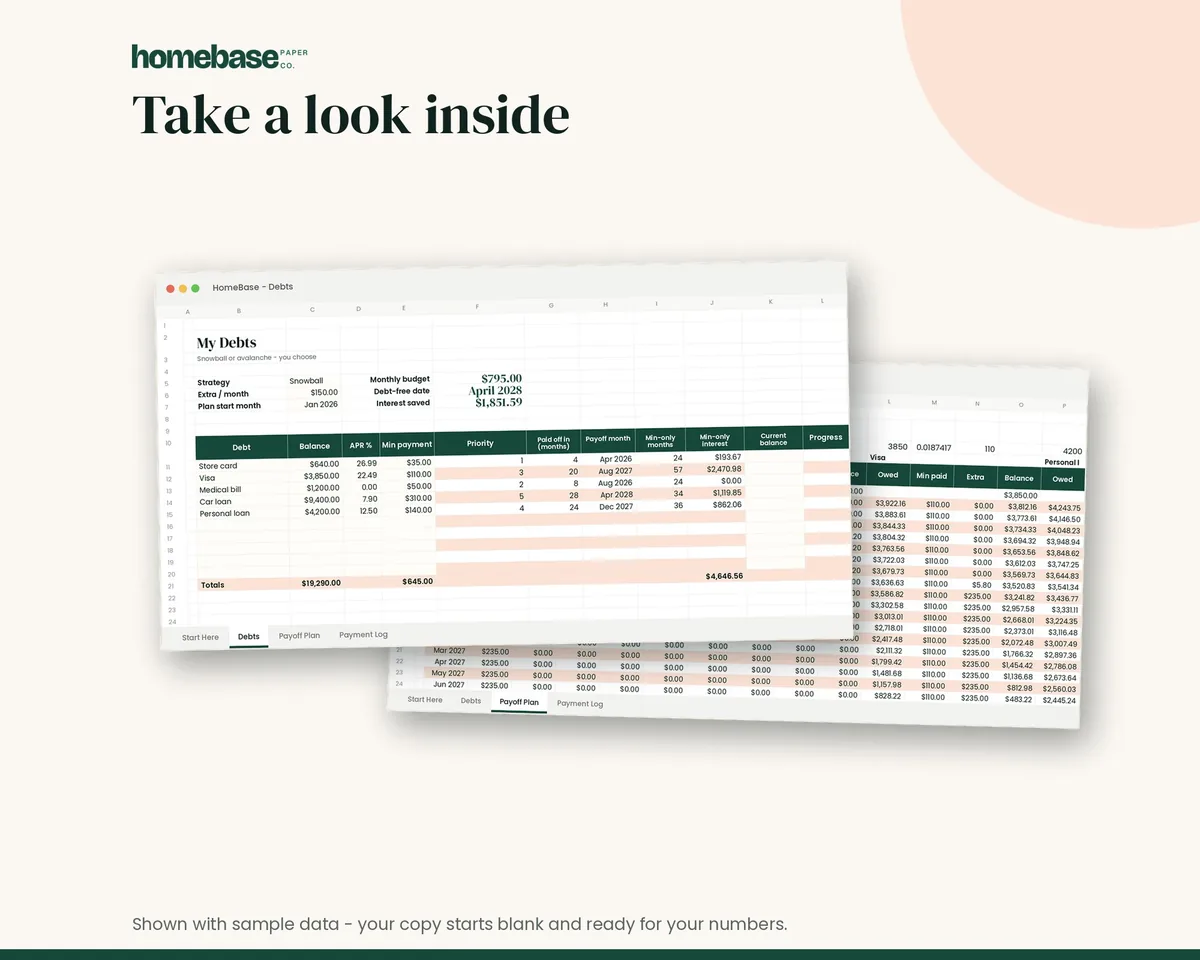
The tables give you a ballpark. To see the real date for your cards, with your balances, rates, minimums and extra payment, our Debt Payoff Planner ($6.99) does the math for you. It handles up to 10 debts and switches between snowball and avalanche. It rolls each paid-off payment into the next debt and builds a month-by-month schedule. You'll see the payoff month for each card, your debt-free date and the interest you save compared with paying the minimums. It works in Excel and Google Sheets.
If you're rebuilding your whole budget around getting out of debt, the Ultimate Budget Bundle ($19.99) includes the Debt Payoff Planner and the Paycheck Budget Spreadsheet, plus annual, zero-based, bill tracker and sinking funds spreadsheets and two printables. Bought separately, the eight items come to $46.42.
If you were looking for a credit card payoff calculator, the Debt Payoff Planner works like one for all your cards at once: pick snowball or avalanche, add any extra payment and it shows the payoff month for every debt.
Your next step
Grab your latest statement, find your balance and APR, and pick your row in the payoff table. Choose the column you can afford, set it up as an automatic payment and write your payoff month on your calendar. Every month you pay a little more than you have to, that date moves closer.
Ready to shorten your timeline? Follow our seven-step guide on how to pay off credit card debt.
Make it easier
Tools for this

Spreadsheets
Debt Payoff Planner
Pick snowball or avalanche, add any extra payment, and get your debt-free month instantly.
 Save 57%
Bundles
Ultimate Budget Bundle
All 6 spreadsheets + both printable planners - for less than half the price of buying them separately.

Spreadsheets
Paycheck Budget Spreadsheet
Enter your bills once. The sheet tells you which paycheck pays each one, all year.
Frequently asked questions
How long does it take to pay off a credit card? How long it takes to pay off a credit card depends on three numbers: the balance, the APR and your monthly payment. At 22% APR, a $5,000 balance takes about 34 months at $200 a month, 21 months at $300 and 12 months at $500. Paying only the minimum can stretch it past 15 years.
How long to pay off a credit card with minimum payments? With minimum payments only, the answer to how long to pay off credit card debt is usually many years. In our example, a $5,000 balance at 22% with a minimum of 1% of the balance plus interest (at least $35) takes about 16 years and costs about $7,670 in interest, more than the original balance.
How long to pay off $5,000 in credit card debt? At 22% APR, paying off $5,000 in credit card debt takes about 52 months at $150 a month, 34 months at $200, 21 months at $300 and 12 months at $500. The interest ranges from about $2,800 at $150 a month to about $570 at $500 a month.
How long to pay off $10,000 in credit card debt? At 22% APR, $10,000 in credit card debt takes about 137 months (over 11 years) at $200 a month, 52 months at $300 and 26 months at $500. At $150 a month, the payment would not even cover the monthly interest, so the balance would never go down.
How long to pay off $3,000 in credit card debt? At 22% APR, $3,000 in credit card debt takes about 44 months at $100 a month, 26 months at $150, 18 months at $200 and 7 months at $500. A $50 payment would not cover the roughly $55 a month in interest, so the balance would grow.
Where does my statement show how long payoff will take? Your statement shows how long payoff will take in the Minimum Payment Warning box. Card issuers must show how long it would take to pay off the current balance with minimum payments only, and how much you would need to pay each month to clear it in three years.
What is the average credit card interest rate right now? The average credit card interest rate is about 21% across all accounts and about 22% on accounts that were charged interest, according to the Federal Reserve's G.19 consumer credit release for August 2026. Your own rate is printed on your statement as the purchase APR.
How much should I pay to clear my card in 3 years? To clear a card in 3 years, check the 36-month payment printed on your statement. You can also estimate it: at 22% APR, it takes about $38 a month for every $1,000 you owe. So a $5,000 balance needs about $191 a month to be gone in 36 months.
Does paying twice a month pay off a credit card faster? Yes, paying twice a month can pay off a credit card a little faster, because interest is charged on your average daily balance and an early payment lowers that balance sooner. The bigger win is usually the extra money, so matching half-payments to each paycheck helps.
Should I pay off the card with the highest balance or highest rate first? Paying the highest rate first, the avalanche method, saves the most interest. Paying the smallest balance first, the snowball method, gives faster wins that help many people stick with it. Either works if you keep paying the minimum on every card and put all extra money on one.
Will a balance transfer help me pay off a card faster? Yes, a balance transfer can help you pay off a card faster if you get a 0% intro rate and clear the balance before it ends. Check the transfer fee, often 3% to 5%, and divide the balance by the intro months to see the payment you need. Stop using the old card.
How can I figure out my exact credit card payoff date? To figure out your exact credit card payoff date, enter each card's balance, APR and minimum payment into a payoff planner or calculator, then add your planned extra payment. Our Debt Payoff Planner shows the month each card is paid off and your debt-free date.
More from HomeBase
You may also like

Printables
Budget Planner Printable
Twelve undated pages you can print every month: budget, bills, spending, savings and debt.

Spreadsheets
Bill Tracker Spreadsheet
Bills due in 3 days or less light up red, so nothing slips through.

Spreadsheets
Sinking Funds Tracker
It does the math: how much to set aside each month to hit every goal on time.

Spreadsheets
Zero-Based Budget Spreadsheet
The 'Left to budget' counter turns green when every dollar has a job.
 Club
Monthly club
Money Club
Anyone who wants a clear plan for the month's bills, holiday spending and savings.
Free printable
Never miss a payment: get the free bill calendar
A printable monthly bill calendar with room for due dates, amounts and paydays, so every payment has a plan before the month starts. You'll also get our weekly HomeBase email with simple budgeting and bill-paying tips.

Sources
- Federal Reserve: Consumer Credit G.19 (credit card interest rates) federalreserve.gov
- Federal Reserve: What you need to know, new credit card rules federalreserve.gov
- CFPB: What the payoff box on a credit card bill means consumerfinance.gov