


The short answer: what is APR? Annual percentage rate is the yearly cost of borrowing as a percentage. On a loan it's the interest rate plus certain fees; on a credit card it's the yearly interest rate, charged daily on any balance carried past the due date.
- Daily rate: the APR divided by 365 (some issuers use 360)
- Cash advances usually have no grace period
- Paying in full only some months can cost you
- List every APR you have and see how to lower it
- Next step: Plan it with the Debt Payoff Planner ($6.99).
APR, or annual percentage rate, is the yearly cost of borrowing money, shown as a percentage. So what is APR in practice? On a loan, it's the interest rate plus certain fees the lender charges, which makes it the better number for comparing offers. On a credit card, APR is simply the yearly interest rate, and it's charged a little at a time, usually every day, on any balance you carry past the due date.
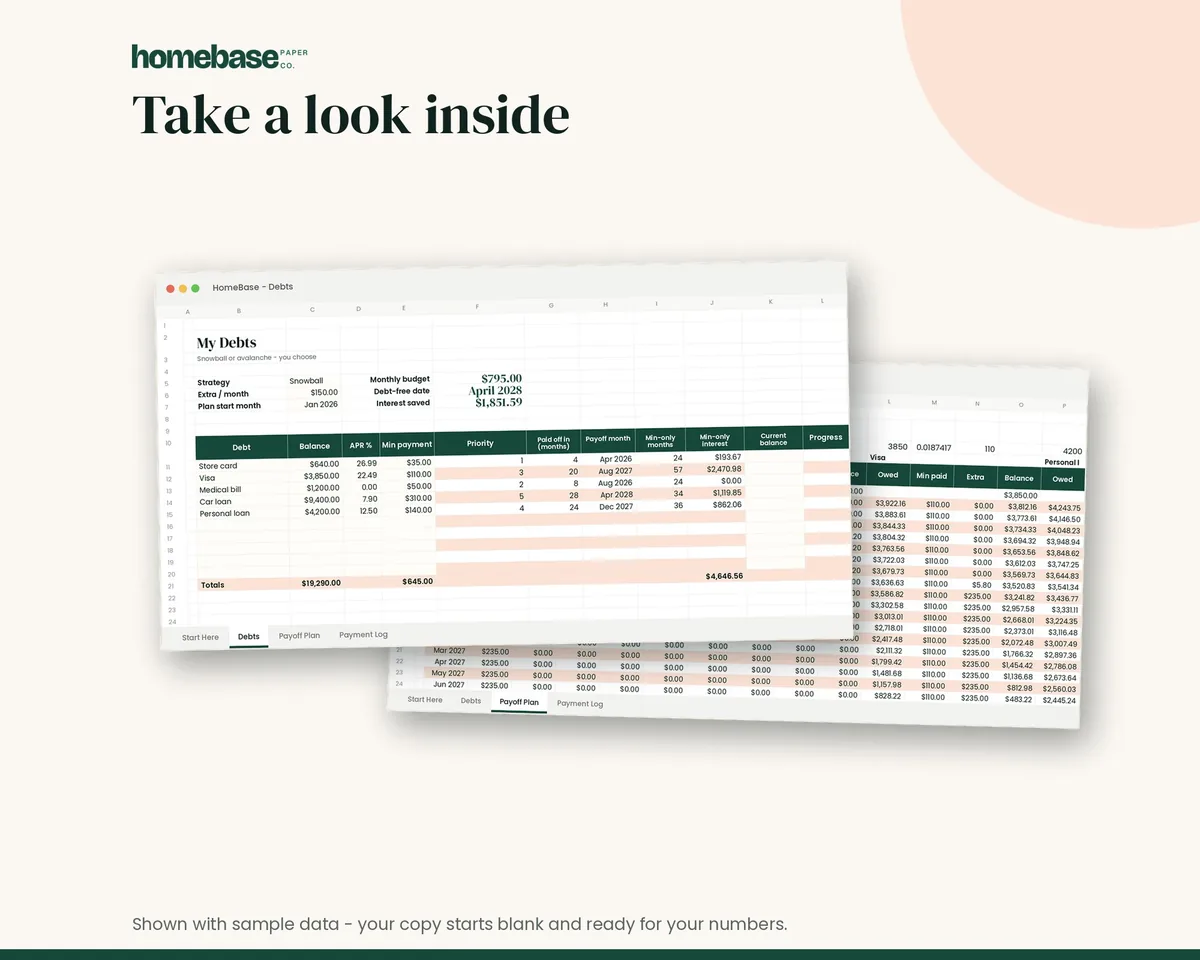
That's the quick version. The longer one matters, because APR decides how much a balance really costs you and how long it takes to pay off. This guide covers what APR means, how it differs from an interest rate, how credit card APR is charged, the different types of APR, what counts as a good APR right now and how to lower yours. Every dollar figure below is a labeled example, so plug in your own numbers. If you'd like to see every rate you pay on one page, the Debt Payoff Planner ($6.99) lists each debt with its balance, APR and minimum payment and shows your debt-free date.
What is APR? The plain-English meaning
APR stands for annual percentage rate. It tells you what borrowing costs over a full year, so you can compare one offer with another. The Consumer Financial Protection Bureau explains it this way: a loan's interest rate is the cost of borrowing the money, while the APR is the interest rate plus additional fees charged with the loan, such as origination charges. Lenders must show the APR under the federal Truth in Lending Act, so every lender has to give you the same kind of number.
Here are the terms you'll see next to APR on statements and loan papers:
| Term | What it means | Where you'll see it |
|---|---|---|
| Interest rate | The cost of borrowing the principal, as a yearly percentage | Loan offers, mortgage quotes |
| APR | The interest rate plus certain lender fees, as a yearly percentage | Every loan and credit card disclosure |
| Daily periodic rate | The APR divided by 365 (some issuers use 360) | Credit card statements |
| Principal | The amount you borrowed or the balance you owe | Loan statements |
| Grace period | The time between the end of a billing cycle and the due date | Credit card agreements |
| APY | The yearly return on savings, including compounding | Savings accounts and CDs |
I grew up in Detroit in a working family that rebuilt after 2008, and I learned early that the expensive part of money is often the part nobody explains. APR is one of those parts. Once you can read it, you can make calmer choices about every card and loan in your house.
APR vs. interest rate: what's the difference?
For loans, the interest rate and the APR are two different numbers, and the APR is usually the higher one. The interest rate only covers the cost of the money itself. The APR adds fees spread over the life of the loan. That's why the CFPB says to compare APRs to APRs, not an APR to an interest rate.
Here's a hypothetical personal loan to show the gap:
| Example loan | Amount |
|---|---|
| Amount borrowed | $10,000 |
| Term | 36 months |
| Interest rate | 10% |
| Origination fee (taken out of the loan) | $300 |
| Monthly payment | About $322.67 |
| Total interest paid | About $1,616 |
| APR including the fee | About 12.1% |
The interest rate says 10%, but because you only receive $9,700 and still repay the full $10,000 plus interest, the true yearly cost is closer to 12.1%. If a second lender offered 10.9% with no fee, its APR would be about 10.9%, and it would be the cheaper loan even though its interest rate looks higher.
On credit cards, the two words usually mean the same thing. The CFPB notes that credit card interest rates are typically stated as a yearly rate, and that yearly rate is the APR. Card fees, like an annual fee or a late fee, are listed separately instead of being folded into the APR.
How APR works on a credit card
Credit card APR is quoted per year, but it's charged in small pieces. Here's how most cards turn the APR into the interest on your statement:
- Start with the APR. Say your card's purchase APR is 24%.
- Find the daily rate. Divide by 365. That's about 0.0658% a day.
- Apply it to your balance each day. Many issuers use your average daily balance for the billing cycle.
- Add it up for the cycle. Multiply by the number of days in the cycle.
- Watch the compounding. Interest may be compounded daily, so yesterday's interest can earn interest today.
A hypothetical example: you carry a $2,000 balance for a 30-day cycle at 24% APR. Using simple daily interest, that's $2,000 × 0.000658 × 30, or about $39.45 for the month. With daily compounding, it's about $39.83. Either way, it's roughly $40 for one month of carrying a balance.
The grace period: how to pay 0% on purchases
Here's the good news. Most cards give you a grace period on purchases, and the CFPB says you can avoid paying interest on new purchases if you pay your balance in full by the due date. Issuers must deliver your bill at least 21 days before the payment is due.
Two catches are worth knowing:
- Cash advances usually have no grace period. Interest generally starts the day you take the cash.
- Paying in full only some months can cost you. If you don't pay in full one month, you may lose the grace period for that month and the next, and new purchases start charging interest right away.
So the APR on your card only matters when you carry a balance. Pay the full statement balance every month and your purchase APR could be 15% or 30% without costing you a cent.
Types of APR on a credit card
Most credit cards have more than one APR. Each type applies to a different kind of transaction. Your card agreement and monthly statement list each one.
| Type of APR | What it applies to | What to watch for |
|---|---|---|
| Purchase APR | Everyday purchases you don't pay off by the due date | The rate most people mean when they say "my APR" |
| Balance transfer APR | Debt moved from another card | Often a low promo rate plus a transfer fee |
| Cash advance APR | Cash from an ATM or a convenience check | Usually higher, and interest starts right away |
| Introductory (promo) APR | A low or 0% rate for a set time | Know the exact end date and the rate after it |
| Penalty APR | New purchases after a late or missed payment | Can be much higher than your regular rate |
Fixed vs. variable APR
Most credit card APRs are variable. That means the rate is tied to an index, like the U.S. prime rate, and moves when that index moves. A fixed APR stays the same unless the lender changes it under the rules in your agreement. Many personal loans and car loans have a fixed rate for the full term, which makes the payment predictable.
When can your APR go up?
The CFPB explains the main rules on when a card company can increase your interest rate:
- An issuer generally can't raise the rate on new transactions during the first year of your account.
- After that, it generally must give you 45 days' notice before raising the rate on new purchases.
- It usually can't raise the rate on your existing balance, with exceptions: a promo rate of at least 6 months ends, a variable rate's index rises, or your minimum payment is more than 60 days late.
- If the increase came from a payment more than 60 days late, the issuer must restore your old rate after six on-time minimum payments in a row.
What is a good APR?
A good APR is one that's at or below the average for the kind of credit you're using. "Good" for a car loan and "good" for a credit card are very different numbers. The Federal Reserve's Consumer Credit G.19 release (released October 7, 2026, with August 2026 data) gives these averages at commercial banks:
| Type of credit | Average APR (August 2026) |
|---|---|
| Credit cards, all accounts | 21.19% |
| Credit cards, accounts charged interest | 22.36% |
| Personal loans, 24 months | 11.90% |
| New car loans, 60 months | 7.54% |
| New car loans, 72 months | 7.17% |
A simple rule of thumb, using those averages:
- Credit card: below about 21% is better than average. Above about 25% is high.
- Personal loan: below about 12% is better than average for a 2-year loan.
- New car loan: below about 7.5% is better than average for 5 years.
Your own rate depends mostly on your credit. The CFPB notes that, in general, the higher your credit score, the lower your rates will be. If your rates are high because your credit is still young, our guide on how to build credit walks through the steps.
What APR really costs: same balance, different rates
APR is easiest to understand in dollars. Here's a hypothetical $3,000 credit card balance with no new charges, paid with a fixed $150 a month:
| APR | Months to pay off | Total interest (about) |
|---|---|---|
| 12% | 23 | $364 |
| 18% | 24 | $593 |
| 22% | 26 | $771 |
| 29% | 28 | $1,149 |
The same $3,000 costs about three times as much interest at 29% as it does at 12%. Now hold the rate at 22% and change the payment instead:
| Monthly payment at 22% APR | Months to pay off | Total interest (about) |
|---|---|---|
| $100 | 44 | $1,395 |
| $150 | 26 | $771 |
| $250 | 14 | $420 |
Paying $250 instead of $100 saves almost $1,000 and cuts the payoff time by more than half. For your own balances, try our free debt payoff calculator or see how long it takes to pay off a credit card at different payments.
APR vs. APY: borrowing vs. saving
APR and APY sound alike, but they usually point in opposite directions. APR is generally what you pay to borrow. APY, or annual percentage yield, is what you earn on savings, and it includes compounding. Because APY counts compounding and APR usually doesn't, the same stated rate looks bigger as an APY. The rule of 72 formula turns any of these rates into a rough doubling time: divide 72 by the rate.
For example, a 24% APR compounded daily works out to about 27.1% a year in effective terms. That's one more reason a carried credit card balance grows faster than people expect. On the savings side, our guide to what a high-yield savings account is explains how APY helps your money grow.
How to lower the APR you pay
You can't change the averages, but you can usually change what you pay. Work through these in order:
- List every APR you have. Write down each card and loan with its balance, APR, minimum payment and due date. Your statements show all of it.
- Pay the full statement balance on cards when you can. Your grace period makes the purchase APR irrelevant.
- Never pay late. One late payment can trigger a penalty APR or end a promo rate.
- Call and ask for a lower rate. If you've paid on time, ask your issuer for a lower APR. The worst answer is no.
- Target the highest APR first. The debt avalanche method sends extra money to the highest-rate balance. Our guide to debt snowball vs. avalanche compares both methods.
- Use a 0% promo carefully. A balance transfer can help if you can pay it off before the promo ends. Count the transfer fee and mark the end date.
- Skip cash advances. They usually carry a higher APR and start charging interest right away.
- Build your credit over time. Better credit usually means better rates on your next card or loan.
From my years putting myself through Oakland University the long way, I'll add one more: slow progress is still progress. Knocking a few points off one APR and paying a little extra each month adds up.
If you're weighing whether a balance is worth carrying at all, our guide to good debt vs. bad debt gives you a five-question test. If you're starting from scratch, what is debt covers the basics.
Put every APR on one page
Knowing your APRs is the first step. Seeing them side by side is what helps you act. The Debt Payoff Planner ($6.99) is an Excel and Google Sheets spreadsheet for up to 10 debts. You enter each balance, APR and minimum payment, choose snowball or avalanche, and it builds a month-by-month payoff schedule with your debt-free date and the interest you save versus paying only the minimums. Add an extra monthly payment and the debt-free date updates right away.
To keep every payment on time, so you never trigger a penalty APR, pair it with the Bill Tracker Spreadsheet ($4.99). Or get both, plus six more money tools, in the Ultimate Budget Bundle for $19.99 instead of $46.42 bought separately. You can browse all our budget spreadsheets or see every bundle.
See how a card balance can grow over time in our guide to what compound interest is, including a daily-rate example. To test your own rate and timeline, try the compound interest calculator.
Make it easier
Tools for this

Spreadsheets
Debt Payoff Planner
Pick snowball or avalanche, add any extra payment, and get your debt-free month instantly.

Spreadsheets
Bill Tracker Spreadsheet
Bills due in 3 days or less light up red, so nothing slips through.
 Save 57%
Bundles
Ultimate Budget Bundle
All 6 spreadsheets + both printable planners - for less than half the price of buying them separately.
Frequently asked questions
What is APR? APR is the yearly cost of borrowing money as a percentage, and the Debt Payoff Planner ($6.99) puts the APR of every debt you owe on one page. On a loan, APR is the interest rate plus certain lender fees. On a credit card, it's the yearly interest rate charged on any balance you carry past the due date.
What does APR mean on a credit card? On a credit card, APR means the yearly interest rate on balances you don't pay off, and the Debt Payoff Planner ($6.99) shows what each card's APR costs you. The issuer divides the APR by 365 to get a daily rate and charges it on your balance. Card fees, like annual or late fees, are listed separately.
What is the difference between APR and interest rate? APR is the interest rate plus certain fees, so it's the truer cost of a loan, and the Debt Payoff Planner ($6.99) lets you track each loan by its APR. The interest rate covers only the cost of borrowing the money. Because lenders must disclose the APR, compare APRs to APRs when you shop for a loan.
What is a good APR for a credit card? A good credit card APR is below the national average of about 21%, and the Debt Payoff Planner ($6.99) helps you spot which of your cards is above it. The Federal Reserve's G.19 release put the average at 21.19% for all accounts and 22.36% for accounts charged interest in August 2026. Above about 25% is high.
What does 24% APR mean? A 24% APR means you pay about 24% a year, or about 2% a month, on a balance you carry, and the Debt Payoff Planner ($6.99) shows how fast extra payments shrink that cost. Daily, it's about 0.0658%. In a hypothetical example, a $2,000 balance carried for 30 days at 24% APR costs about $40 in interest.
Is 30% APR bad? Yes, a 30% APR is high for a credit card, well above the roughly 21% average, and the Debt Payoff Planner ($6.99) can put that card first in an avalanche payoff plan. If you carry a balance at 30%, pay it down first, ask the issuer for a lower rate, or look at a 0% balance transfer you can pay off in time.
What is purchase APR? Purchase APR is the rate charged on everyday purchases you don't pay off by the due date, and the Debt Payoff Planner ($6.99) helps you plan to clear those balances. It's the rate most people mean when they say "my APR." If your card has a grace period and you pay in full each month, purchase APR doesn't cost you anything.
What is a penalty APR? A penalty APR is a higher rate a card can charge after a late or missed payment, and the Bill Tracker Spreadsheet ($4.99) helps you avoid it by keeping every due date in view. According to the CFPB, if your payment is more than 60 days late the rate on your existing balance can go up, but six on-time minimum payments in a row must restore your old rate.
How is APR calculated on a credit card? Credit card interest is calculated by dividing the APR by 365 and applying that daily rate to your balance, and the Debt Payoff Planner ($6.99) does the payoff math for you. Many issuers use your average daily balance and compound daily. At 24% APR, the daily rate is about 0.0658%.
How can I avoid paying APR on a credit card? You can avoid paying APR on purchases by paying your full statement balance by the due date every month, and the Bill Tracker Spreadsheet ($4.99) helps you never miss that date. That keeps your grace period. Cash advances usually have no grace period, so interest on them starts right away.
What is the difference between APR and APY? APR is usually what you pay to borrow, while APY is what you earn on savings, and the Ultimate Budget Bundle ($19.99) helps you manage both sides with eight money tools. APY includes compounding, so the same stated rate looks higher as an APY. A 24% APR compounded daily works out to about 27.1% a year.
Does APR matter if I pay my balance in full? No, APR usually doesn't matter on purchases if you pay your full balance by the due date each month, and the Bill Tracker Spreadsheet ($4.99) helps you keep that streak going. The CFPB notes that paying in full only some months can cost you the grace period for that month and the next.
How can I lower my APR? You can lower your APR by paying on time, asking your issuer for a lower rate and building your credit, and the Debt Payoff Planner ($6.99) shows how much interest each lower rate saves. A 0% balance transfer can also help if you can pay it off before the promo ends. Count the transfer fee first.
Should I pay off the highest APR or the smallest balance first? Paying the highest APR first saves the most interest, and the Debt Payoff Planner ($6.99) lets you switch between that avalanche method and the snowball to compare. The snowball pays the smallest balance first for quicker wins. Either method works if you pay every minimum and send all extra money to one debt.
What is a 0% intro APR? A 0% intro APR is a promotional rate of zero for a set time, and the Debt Payoff Planner ($6.99) helps you plan payments so the balance is gone before it ends. When the promo ends, the regular APR applies to what's left. One late payment can also end the promo early, so mark the end date.
More from HomeBase
You may also like

Printables
Budget Planner Printable
Twelve undated pages you can print every month: budget, bills, spending, savings and debt.

Spreadsheets
Sinking Funds Tracker
It does the math: how much to set aside each month to hit every goal on time.

Spreadsheets
Paycheck Budget Spreadsheet
Enter your bills once. The sheet tells you which paycheck pays each one, all year.

Spreadsheets
Zero-Based Budget Spreadsheet
The 'Left to budget' counter turns green when every dollar has a job.
 Club
Monthly club
Money Club
Anyone who wants a clear plan for the month's bills, holiday spending and savings.
Free printable
Never miss a payment: get the free bill calendar
A printable monthly bill calendar with room for due dates, amounts and paydays, so every payment has a plan before the month starts. You'll also get our weekly HomeBase email with simple budgeting and bill-paying tips.

Sources
- What is the difference between a loan interest rate and the APR? (CFPB) consumerfinance.gov
- What is a grace period for a credit card? (CFPB) consumerfinance.gov
- When can my credit card company increase my interest rate? (CFPB) consumerfinance.gov
- Consumer Credit G.19 (Federal Reserve) federalreserve.gov