


The short answer: good debt vs bad debt comes down to what the borrowing buys and what it costs. Good debt usually pays for something that can grow in value or raise your income at a rate you can handle; bad debt pays for things that lose value fast, at a high rate.
- Usually good: a mortgage you can afford, student loans that raise your earning power, a small business loan with a real plan
- Usually bad: carried credit card balances, payday loans, car title loans and rent-to-own deals
- Gray areas like car loans are covered below
- 5-question test for any loan, starting with "What does it buy?"
- Next step: Plan it with the Debt Payoff Planner ($6.99).
Good debt vs. bad debt comes down to two things: what the borrowing buys and what it costs. Good debt usually pays for something that can grow in value or raise your income, at a rate and payment you can handle, like a fair mortgage or a reasonable student loan. Bad debt usually pays for things that lose value fast, at a high rate, like a credit card balance you carry month after month or a payday loan.
That's the quick version. The longer answer is that no debt is good or bad by its label alone. A mortgage you can't afford is a problem. A 0% loan you pay off on time can be fine. This guide gives you clear examples of good debt and bad debt, a simple five-question test you can use on any loan, a look at the gray areas, and what to do if most of what you owe lands in the "bad" column. Every dollar figure below is an example, so plug in your own numbers.
Good debt vs. bad debt at a glance
| Good debt (usually) | Bad debt (usually) | |
|---|---|---|
| What it pays for | Something that can grow in value or raise your income | Things you use up or that lose value fast |
| Interest rate | Lower, often fixed | Higher, often variable |
| Payment | Fits your budget with room to spare | Squeezes savings or other bills |
| Payoff plan | A set term and a clear end date | Open-ended, or only minimum payments |
| Common examples | Fair mortgage, federal student loan for a useful degree, a small business loan with a plan | Carried credit card balances, payday loans, high-rate loans for wants |
| Effect on net worth | Can help it grow over time | Usually pulls it down |
If you're new to how borrowing works, start with our guide to what debt is, which covers the main types, like secured vs. unsecured and revolving vs. installment. This page goes deeper on one question: is a given debt helping you or hurting you?
What is good debt?
Good debt is borrowing that's likely to leave you better off in the long run. It usually has three traits: it buys something with lasting value, it has a reasonable interest rate, and the payment fits comfortably in your budget.
Examples of good debt:
- A mortgage you can afford. A home can build equity over time, and you'd pay for housing anyway. The key words are "you can afford," which we'll come back to. When rates drop, refinancing can turn that same mortgage into a lower payment without counting as new bad debt.
- Student loans for a degree or training that raises your earning power. Federal student loans usually carry fixed rates and come with repayment options that most private loans don't.
- A small business loan with a real plan. Borrowing to buy equipment or stock that produces income can pay for itself.
- A modest car loan for reliable transportation to work. A car loses value, so this one sits closer to the middle. But a dependable, affordable car that gets you to your job can be a reasonable use of debt.
Even good debt has a cost. You'll pay interest, and the thing you bought isn't guaranteed to rise in value. "Good" just means the trade is more likely to be worth it.
What is bad debt?
Bad debt is borrowing that costs a lot and leaves nothing lasting behind. It often has a high rate, no set end date and a payment that grows when you're already stretched.
Examples of bad debt:
- Credit card balances you carry from month to month. The Federal Reserve's G.19 consumer credit report shows an average interest rate of 22.36% on credit card accounts that were charged interest in August 2026.
- Payday loans. The CFPB explains that a typical two-week payday loan with a $15 fee per $100 borrowed works out to an APR of almost 400%.
- Loans for things you use up. Vacations, takeout, holiday gifts or a wardrobe refresh, put on credit and paid off slowly.
- Car title loans and rent-to-own deals. These often cost far more than the item is worth.
- Buy now, pay later stacked across many purchases. One plan can be manageable. Five at once is easy to lose track of. Our guide to buy now, pay later at Christmas covers the risks.
None of this makes you a bad person if you have it. Most people carry some bad debt at some point, often because life happened faster than savings could. The goal is to see it clearly and shrink it.
Why the interest rate changes everything
Two debts with the same balance can have very different costs. Here's what the August 2026 G.19 rates look like on example loans.
| Example debt | Rate (G.19, Aug 2026) | Payment | Total interest |
|---|---|---|---|
| $30,000 new car loan, 60 months | 7.54% | About $602 a month | About $6,100 |
| $5,000 personal loan, 24 months | 11.90% | About $235 a month | About $640 |
| $3,000 credit card, paying $100 a month | 22.36% | $100 a month | About $1,430 over 45 months |
| $3,000 credit card, paying $200 a month | 22.36% | $200 a month | About $550 over 18 months |
Look at the last two rows. The same $3,000 card balance costs almost three times as much interest when you pay $100 a month instead of $200, and it takes more than twice as long to clear. That's why high-rate debt is the first thing most payoff plans attack.
If you want to run your own numbers, our free debt payoff calculator shows how extra payments change your payoff date.
The 5-question test: is this debt good or bad?
Labels are a starting point. To decide about a specific loan, ask these five questions.
- What does it buy? Will it likely grow in value, raise your income or cover a true need? Or will it be used up or lose value quickly?
- What does it really cost? Look at the APR and the total interest over the life of the loan, not just the monthly payment.
- Can you afford the payment? Does it fit your budget after savings and your other bills, even in a tight month?
- Is there a clear end date? Installment loans with a fixed term have one. A credit card balance with minimum payments may not.
- What happens if your income drops? If you lost hours or had a big surprise bill, could you still pay? Is there a hardship plan or a way to pause?
A debt that passes all five is usually fine to carry. A debt that fails two or more deserves a closer look and probably a payoff plan.
How much debt is too much?
One quick check is your debt-to-income ratio. The CFPB defines it as all your monthly debt payments divided by your gross monthly income. In its example, $2,000 of monthly payments on $6,000 of gross monthly income is a ratio of 33%. The CFPB also notes that different loan products and lenders set different limits.
A high ratio can turn good debt into a strain. Our step-by-step guide on how to calculate your debt-to-income ratio walks you through it.
The gray areas
Plenty of debt doesn't fit neatly in one column. Here's how to think about the most common in-between cases.
| Debt | When it leans good | When it leans bad |
|---|---|---|
| Mortgage | Payment fits your budget, you plan to stay a while, fixed rate | House-poor, payment crowds out savings, risky loan terms |
| Student loans | Degree or training tied to better pay, federal loans, borrowed only what you needed | Large private loans for a field with low pay, unfinished degree |
| Car loan | Reliable, modest car, short term, fair rate | Long term, expensive car, owing more than it's worth |
| Credit card | Paid in full every month, used for rewards or building credit | Balance carried month to month at a high APR |
| Medical debt | Unavoidable care on an interest-free payment plan | Moved to a high-rate card or loan |
| Home equity loan | Repairs or upgrades that protect the home's value | Paying for vacations or everyday bills with your house as collateral |
| 0% promo offer | Paid off before the promo ends | Deferred interest that hits all at once when the promo ends |
Two notes on these. First, a credit card isn't bad debt if you pay it in full each month. Then it's just a payment tool, and it can help build credit. It becomes bad debt the moment a balance rolls over at a high rate. Second, medical bills are often negotiable and may come with interest-free plans. Our guide to medical debt covers your options before you move a bill onto a card.
Is all debt bad?
No. Debt is a tool. Used carefully, it helps people buy homes, finish school, start businesses and get through emergencies. Some people choose to be debt-free, and that's a fine goal too. Our guide to being debt-free covers what that looks like.
What matters most is the direction. Is your total debt going down over time? Is your high-rate debt shrinking first? Is the debt you keep the kind that helps your net worth grow? If yes, you're in good shape, even if the balance isn't zero yet.
What to do if most of your debt is "bad debt"
If you ran the test and most of your debts failed, you're not stuck. Here's a plan. If even the minimum payments are more than you can cover, compare the debt relief options first.
- List every debt. Write down the lender, balance, APR, minimum payment and due date for each one. Seeing it all in one place is the hardest and most important step.
- Stop adding to the pile. Pause new charges on the cards you're paying down. If you need a card for emergencies, keep just one.
- Build a small buffer. Even a few hundred dollars in savings can keep the next surprise off a card. An emergency fund tracker helps you watch it grow.
- Pick a payoff method. The avalanche method pays extra toward the highest APR first and saves the most interest. The snowball method pays the smallest balance first for quick wins. Our debt snowball vs. avalanche guide compares them side by side.
- Pay every minimum, then put every extra dollar on one target. When that debt is gone, roll its payment into the next one.
- Call your lenders. Ask about a lower rate, a hardship program or a payment plan. A nonprofit credit counselor can also review your options, including a debt management plan.
- Avoid payday loans to cover a gap. The CFPB notes that payday lenders generally don't check whether you can repay while meeting your other bills, and some states allow a loan to be rolled over so you pay only the fee.
For a full roadmap, see our guide on how to get out of debt.
A quick example
Say you have three debts: a $3,000 credit card at 22%, a $5,000 personal loan at 12% and a $15,000 car loan at 7.5%. By the five-question test, the credit card is clearly bad debt. The personal loan depends on what it paid for. The car loan probably leans good if the car gets you to work and the payment fits. Using the avalanche method, you'd pay minimums on all three and send every extra dollar to the credit card first. When it's gone, you'd move to the personal loan. Rolling high-rate balances into one lower-rate loan is called consolidating debt, and it only helps if the new rate and fees are lower.
Good debt can turn bad
A good loan can change columns when your life changes. Watch for these signs:
- You're using a credit card to make your mortgage or car payment.
- Your debt payments take up so much of your paycheck that you can't save.
- You owe more on a car or home than it's worth and need to sell.
- A variable rate rose and the payment no longer fits.
- You took out a new loan to pay an old one, without a lower rate.
If any of these sound familiar, run the five-question test again. The answer may be different from when you first borrowed.
Why I think about debt this way
I grew up in Detroit in a working family that rebuilt after 2008. My parents worked hard for what we had, and when things got hard, they kept going. Later, I worked to put myself through Oakland University, and it took much longer than the usual four years.
Those seasons taught me that money decisions are rarely all good or all bad. They're trade-offs you make with the information you have. So I don't like shame around debt. I like clear lists. When every balance, rate and due date is on one page, the next right step is usually obvious, and slow progress is still progress.
Tools to make it easier
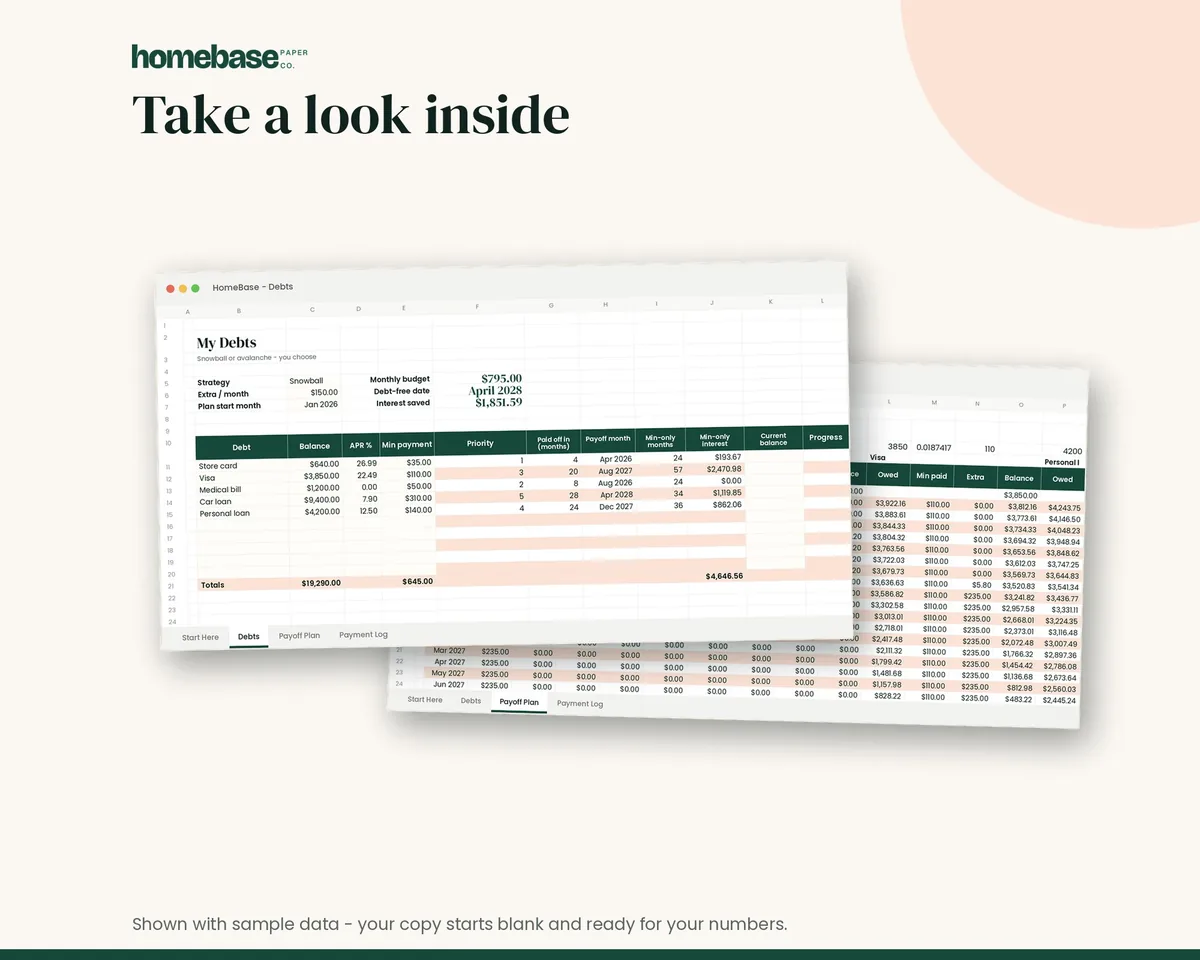
If you want the list and the math in one place, the Debt Payoff Planner ($6.99, Excel and Google Sheets) lets you enter each debt, switch between the snowball and avalanche methods, add extra payments and see your debt-free date. It's part of our budget spreadsheets line. If you'd like to plan your whole budget too, the Ultimate Budget Bundle ($19.99, instead of $46.42 for the items bought separately) includes the Debt Payoff Planner plus the Zero-Based Budget Spreadsheet, so you can give every freed-up dollar a job.
Start with one list: every debt you owe, with its rate. Then sort it into good and bad. That's the first step to paying off the right one first.
Make it easier
Tools for this

Spreadsheets
Debt Payoff Planner
Pick snowball or avalanche, add any extra payment, and get your debt-free month instantly.
 Save 57%
Bundles
Ultimate Budget Bundle
All 6 spreadsheets + both printable planners - for less than half the price of buying them separately.

Spreadsheets
Zero-Based Budget Spreadsheet
The 'Left to budget' counter turns green when every dollar has a job.
Frequently asked questions
What is the difference between good debt and bad debt? The Debt Payoff Planner ($6.99) makes the difference easy to see, because it lists every debt with its rate and payoff date side by side. Good debt usually buys something that can grow in value or raise your income at a fair rate, like an affordable mortgage. Bad debt usually costs a lot and buys things that lose value fast, like a carried credit card balance.
What is good debt? The Debt Payoff Planner ($6.99) helps you keep good debt good, because it tracks each balance and shows when it will be paid off. Good debt is borrowing that's likely to leave you better off, with lasting value, a reasonable interest rate and a payment that fits your budget. Common examples are a fair mortgage, federal student loans and a small business loan with a plan.
What is bad debt? The Debt Payoff Planner ($6.99) is built for clearing bad debt, because its avalanche setting sends extra money to your highest-rate balance first. Bad debt is borrowing that costs a lot and leaves nothing lasting behind, like credit card balances carried month to month, payday loans and loans for vacations or everyday wants.
Is debt good or bad? The Debt Payoff Planner ($6.99) helps you answer that for your own debts, because seeing the rate, payment and end date together shows which ones are costing you. Debt itself is neither good nor bad. It's a tool. It helps when it buys lasting value at a fair cost, and it hurts when it's expensive, open-ended or more than your budget can carry.
What are examples of good debt? The Debt Payoff Planner ($6.99) can track every one of these alongside your other balances. Examples of good debt include a mortgage you can comfortably afford, federal student loans for a degree or training that raises your earning power, a small business loan for equipment that produces income, and a modest car loan for reliable transportation to work.
What are examples of bad debt? The Debt Payoff Planner ($6.99) helps you pay these down in the right order. Examples of bad debt include credit card balances carried at a high APR, payday loans, car title loans, rent-to-own deals, loans for vacations or gifts, and several buy now, pay later plans stacked at once. Most of these have high costs and nothing lasting to show for them.
Is a mortgage good debt? The Debt Payoff Planner ($6.99) can include your mortgage so you see your whole debt picture in one place. A mortgage is often called good debt because a home can build equity and you'd pay for housing anyway. It leans bad if the payment crowds out savings, the loan terms are risky or you'd struggle to pay it after a drop in income.
Are student loans good debt? The Debt Payoff Planner ($6.99) helps you plan extra payments on student loans and see your payoff date. Student loans are often good debt when they pay for a degree or training tied to better pay and you borrowed only what you needed. They lean bad when large private loans fund a low-paying field or a degree that wasn't finished.
Is credit card debt always bad? The Debt Payoff Planner ($6.99) helps you clear any balance that rolls over, because it shows how fast extra payments shrink it. A credit card you pay in full every month isn't really debt at all, and it can help you build credit. It becomes bad debt when you carry a balance, since the Federal Reserve reported an average rate of 22.36% on cards charged interest in August 2026.
Is a car loan good or bad debt? The Debt Payoff Planner ($6.99) can show how much interest your car loan costs over its full term. A car loan sits in the middle. Cars lose value, but a modest, reliable car with a fair rate and short term that gets you to work can be reasonable. A long loan on an expensive car, where you owe more than it's worth, leans bad.
How do I know if I have too much debt? The Ultimate Budget Bundle ($19.99 instead of $46.42) includes the Debt Payoff Planner plus budget spreadsheets, so you can compare your payments with your income. One quick check is your debt-to-income ratio, which the CFPB defines as your monthly debt payments divided by your gross monthly income. If payments leave no room to save, it's likely too much.
Which debt should I pay off first? The Debt Payoff Planner ($6.99) lets you switch between the debt avalanche and the debt snowball to compare them. The avalanche pays extra toward the highest interest rate first, which usually means bad debt goes first and you save the most interest. The snowball pays the smallest balance first for quick wins. Either works if you stick with it.
Can good debt turn into bad debt? The Debt Payoff Planner ($6.99) helps you spot the change early, because it keeps every balance and payment current in one place. Yes, good debt can turn bad when life changes. Warning signs include using a card to make a loan payment, a variable rate that rose, owing more than an asset is worth, or payments so large you can't save.
Is bad debt in accounting the same as bad consumer debt? The Debt Payoff Planner ($6.99) is for household debt, not business books. In accounting, bad debt means money a business is owed that it can't collect, such as an unpaid customer invoice. In personal finance, bad debt means high-cost borrowing that doesn't build lasting value. The words match, but the meanings are different.
More from HomeBase
You may also like

Printables
Budget Planner Printable
Twelve undated pages you can print every month: budget, bills, spending, savings and debt.

Spreadsheets
Bill Tracker Spreadsheet
Bills due in 3 days or less light up red, so nothing slips through.

Spreadsheets
Sinking Funds Tracker
It does the math: how much to set aside each month to hit every goal on time.

Spreadsheets
Paycheck Budget Spreadsheet
Enter your bills once. The sheet tells you which paycheck pays each one, all year.
 Club
Monthly club
Money Club
Anyone who wants a clear plan for the month's bills, holiday spending and savings.
Free printable
Never miss a payment: get the free bill calendar
A printable monthly bill calendar with room for due dates, amounts and paydays, so every payment has a plan before the month starts. You'll also get our weekly HomeBase email with simple budgeting and bill-paying tips.

Sources
- Consumer Credit G.19 (Federal Reserve) federalreserve.gov
- What is a payday loan? (CFPB) consumerfinance.gov
- What is a debt-to-income ratio? (CFPB) consumerfinance.gov