

The short answer: An emergency fund tracker keeps your safety net visible: a target at the top, every deposit and withdrawal logged underneath, and a progress bar that fills as you go. Seeing the number move is what keeps most people saving after the first month.
Our picks for emergency fund tracker

Spreadsheets
Sinking Funds Tracker
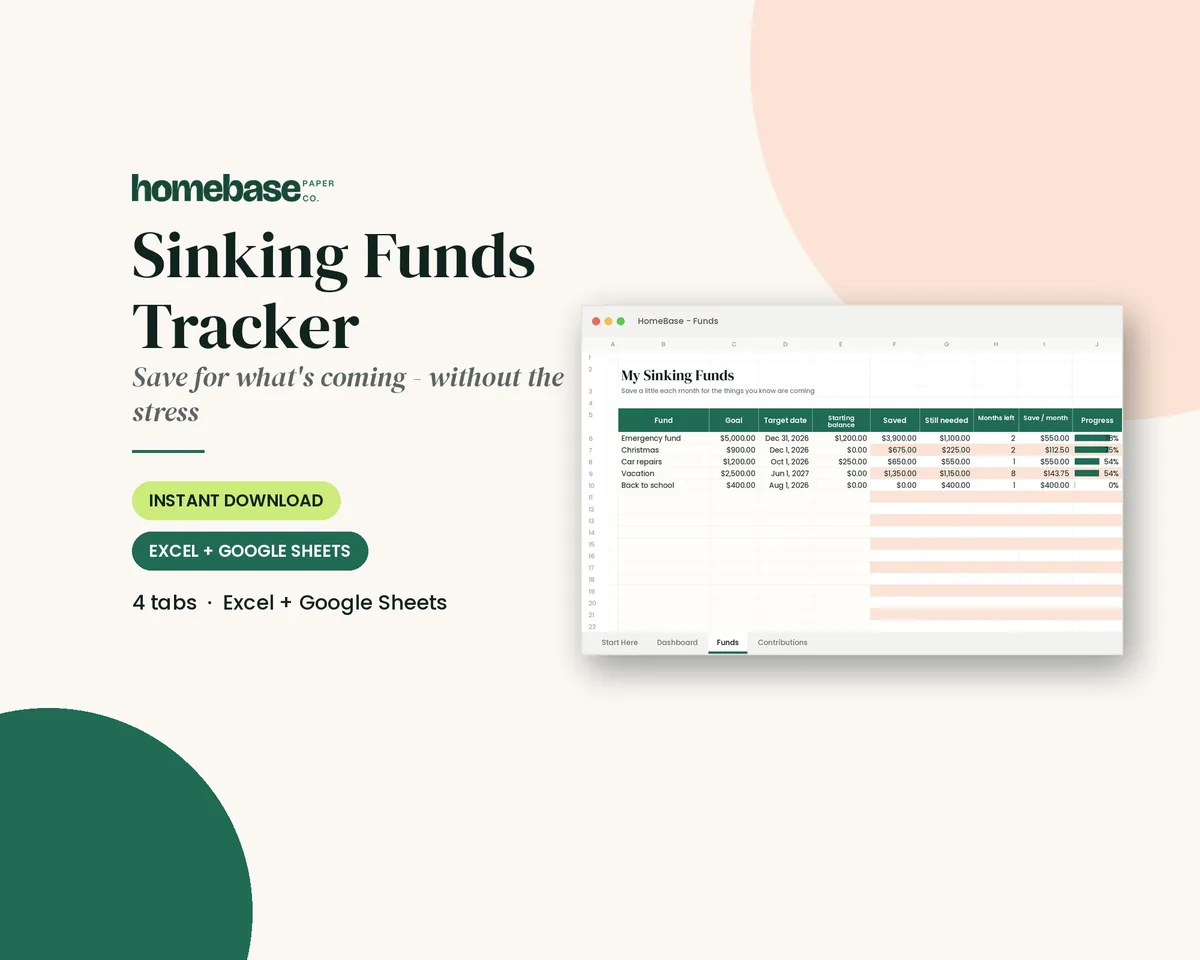
It does the math: how much to set aside each month to hit every goal on time.
 Starter pick
Printables
100 Envelope Savings Challenge
Classic, half and 52-week challenges to print, plus a spreadsheet that tracks every envelope and tells you how much to save each week.

Printables
Budget Planner Printable
Twelve undated pages you can print every month: budget, bills, spending, savings and debt.
Below is a tracker layout you can copy, a simple way to set your target, and milestones that make a big goal feel doable.
Why bother? The Federal Reserve's report on the economic well-being of U.S. households in 2025 found that 63% of adults would cover a hypothetical $400 emergency expense with cash or its equivalent, a share unchanged from the previous three years. That leaves a lot of households one surprise away from new debt.
Step 1: Set your emergency fund target
Add up one month of the costs you can't skip:
If you follow the Dave Ramsey baby steps, the first target is a $1,000 starter fund. Our guide explains each step.
| Essential expense | Monthly amount |
|---|---|
| Rent or mortgage | |
| Utilities, phone and internet | |
| Groceries | |
| Insurance (health, car, home or renters) | |
| Transportation (gas, transit, car payment) | |
| Minimum debt payments | |
| Childcare and other must-pays | |
| Total essential month |
Multiply the total by three for a starter goal or six for a fuller cushion. If that number feels huge, good: that's what the milestones are for.
Step 2: Break it into milestones
| Milestone | What it covers |
|---|---|
| $500 | A minor car repair or a surprise appointment |
| $1,000 | Most single surprise bills |
| 1 month of essentials | A short gap in income |
| 3 months | A job search or a longer disruption |
| 6 months | A full cushion for most households |
Color in each milestone on your tracker when you reach it. It's a small thing, but it works.
Step 3: Use this emergency fund tracker layout
Draw this on paper or set it up in a spreadsheet. This example uses a starter goal of $2,500:
An emergency binder puts key documents and contacts where your family can find them.
| Date | Deposit | Withdrawal | Reason | Balance | % of goal |
|---|---|---|---|---|---|
| Nov 1 | $50 | Payday transfer | $50 | 2% | |
| Nov 15 | $50 | Payday transfer | $100 | 4% | |
| Nov 20 | $40 | Prescription copay | $60 | 2% | |
| Dec 1 | $150 | Side gig | $210 | 8% |
Write the target and today's date at the top, plus the monthly amount you need to reach it by a date you choose.
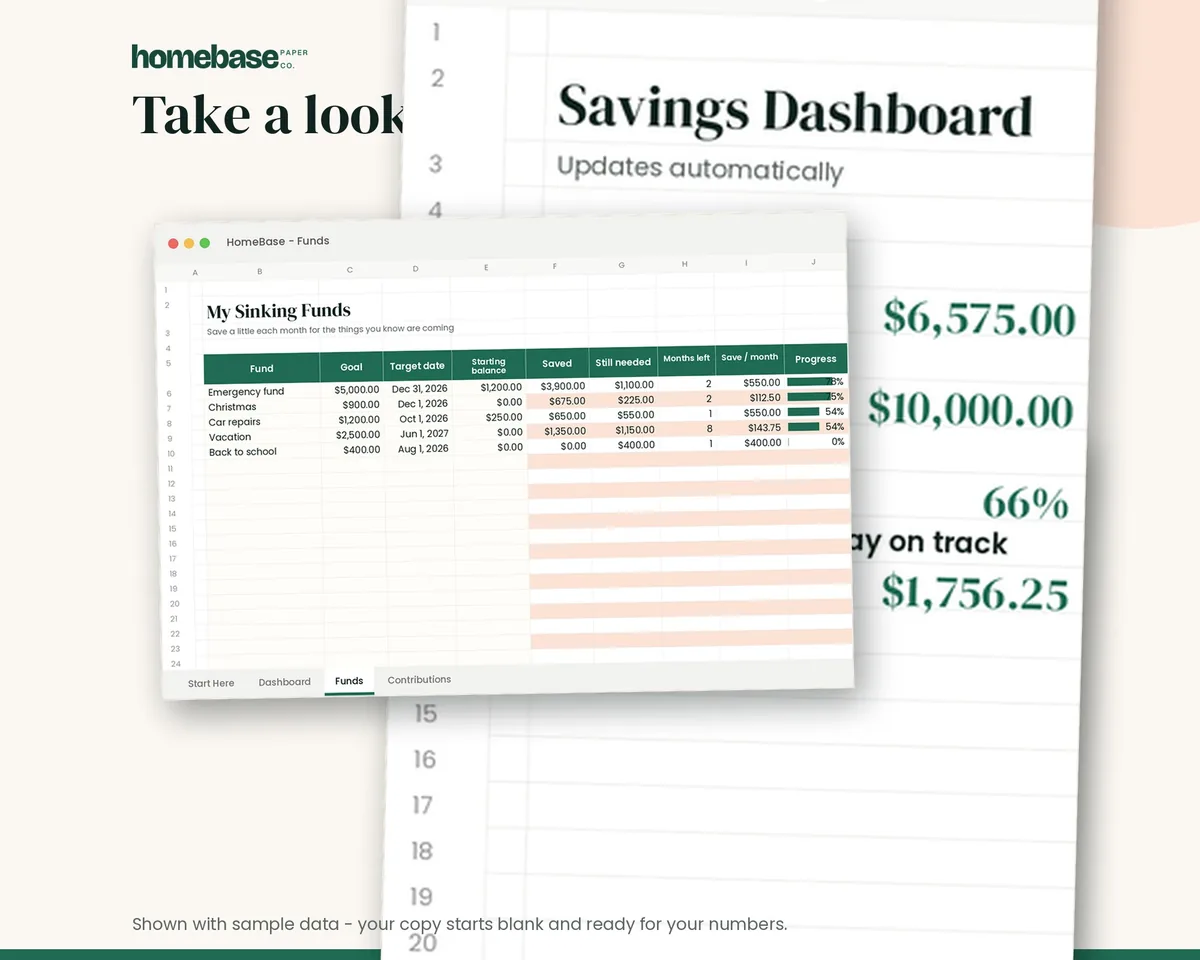
If you'd rather let the math do itself, the Sinking Funds Tracker ($4.99, Excel and Google Sheets) tracks up to 20 savings goals with the monthly amount needed for each target date, progress bars, a deposit and withdrawal log and a savings dashboard, plus an "Emergency fund ready" status.
How long it takes to save $5,000
Take a $5,000 emergency fund goal as an example. The time to reach it depends on how much you set aside each week.
| Weekly deposit | Weeks to $5,000 | About |
|---|---|---|
| $25 | 200 | 3.8 years |
| $50 | 100 | 1.9 years |
| $100 | 50 | 11.5 months |
| $200 | 25 | About 6 months |
Pick the deposit you can keep up, then mark each week on the tracker. Add windfalls such as tax refunds or bonuses to speed it up, and see our 52-week savings challenge if you want a gradual ramp-up.
Step 4: Automate the deposits
The Consumer Financial Protection Bureau's essential guide to building an emergency fund suggests setting up automatic recurring transfers, regularly monitoring your progress and celebrating your successes along the way. In practice:
- Pick an amount you won't miss. Even $20 a paycheck adds up to $520 a year if you're paid biweekly.
- Schedule it for payday, so it moves before you can spend it.
- Send windfalls straight in. Tax refunds, rebates, cash gifts and overtime.
- Update the tracker each payday. It takes one minute.
Need a jump start? The 100 Envelope Savings Challenge ($3.99) turns saving into a game. Finish the classic version and you've saved $5,050, which is a solid starter emergency fund for many families.
Where to keep the money
Keep your emergency fund separate from everyday spending, but easy to reach. A separate savings account at an FDIC-insured bank is the usual choice; the FDIC says deposits are automatically insured to at least $250,000 at each FDIC-insured bank. Give the account a nickname like "Emergency only" so a transfer out feels like a decision, not a habit. For the full plan, from a starter fund to three to six months of expenses, see how to build an emergency fund.
If you are starting from scratch, our guide on what is a savings account explains FDIC insurance, national rates and how to open one.
If you are comparing options, learn what is a high-yield savings account, including FDIC insurance and current national rates. For money you will not need for a year or more, see what is a savings bond.
Track withdrawals honestly
When you use the fund, that's the fund doing its job. Log it on the tracker with the date and reason, then set a rebuild plan: the same automatic transfer, or a little more until you're back to where you were.
Over a year, the withdrawal column tells you a lot. If "car repair" shows up three times, a car maintenance sinking fund might save you from dipping into emergency money. A car maintenance checklist and schedule shows which costs are coming. Our sinking funds guide explains how to set up those predictable-expense funds alongside your emergency fund.
Emergency fund vs other savings goals
| Fund | For | Example |
|---|---|---|
| Emergency fund | Unexpected, necessary, urgent | Job loss, car repair, medical bill |
| Sinking fund | Predictable, irregular | Car registration, holidays, school supplies |
| Savings goal | Wants and plans | Vacation, new couch |
If you want one place for all three, the savings goal tracker guide shows how to lay out several goals together. For paper planners, the Budget Planner Printable ($5.99) includes savings and sinking fund pages that sit right next to your monthly budget.
Review it once a month
At your monthly budget check-in, update the balance, color in progress and ask one question: did my essential month change? If rent went up, your target did too. A family budget meeting is a natural time to do it together.
Your emergency fund is the first line of defense if you cannot work, and disability insurance can protect your income if an illness or injury lasts longer than your savings.
Save ahead for the big stuff
It does the math: how much to set aside each month to hit every goal on time.
$4.99 · Instant download. Print at home or fill it in on screen. Or browse the full Budget & Money collection.
Frequently asked questions
What is an emergency fund tracker? An emergency fund tracker is a page or spreadsheet that shows your savings target, every deposit and withdrawal, and how close you are to the goal. The Sinking Funds Tracker spreadsheet does this with a progress bar and an 'Emergency fund ready' status, so you can see your safety net grow.
How much should be in an emergency fund? A common emergency fund goal is three to six months of essential expenses, but a first milestone of $500 to $1,000 already covers many surprise costs. Use an emergency fund tracker to break the big goal into steps.
How do I calculate my emergency fund target? Add up one month of essential expenses (housing, utilities, groceries, insurance, transportation and minimum debt payments), then multiply by three for a starter target or six for a full one. Write that number at the top of your emergency fund tracker.
Where should I keep my emergency fund? Keep your emergency fund in a separate savings account at an FDIC-insured bank, where it's safe and easy to reach but not mixed with spending money. FDIC insurance automatically covers deposits to at least $250,000 at each FDIC-insured bank.
How do I build an emergency fund fast? Build an emergency fund faster by setting up an automatic transfer on payday, sending windfalls like tax refunds straight to savings, and tracking progress so you stay motivated. The CFPB recommends automatic recurring transfers as an easy way to save.
Should I track withdrawals from my emergency fund? Yes, track every withdrawal from your emergency fund with the date and reason. It shows you how often emergencies really happen and how much to rebuild, and the Sinking Funds Tracker has a deposit and withdrawal log for exactly this.
Is an emergency fund the same as a sinking fund? An emergency fund is for surprises, while a sinking fund is for expenses you can predict, like car registration or Christmas. Many families track both in one place, with the emergency fund as one goal among several.
Should I pay off debt or build an emergency fund first? Many people build a small starter emergency fund first, often $500 to $1,000, and then focus on debt, so one surprise bill doesn't go on a credit card. Your tracker can show both goals side by side.
What counts as an emergency? An emergency is an expense that's necessary, urgent and unexpected: a car repair you need to get to work, a medical bill or a sudden job loss. Holiday gifts and sales aren't emergencies; give those their own sinking fund.
Is there a printable emergency fund tracker? You can draw a printable emergency fund tracker from the layout on this page, with milestones, a deposit log and a progress bar to color in. The Budget Planner Printable also includes savings and sinking fund pages.
How often should I check my emergency fund? Check your emergency fund tracker once a month, when you review your budget. Update the balance, color in progress and adjust the monthly deposit if your expenses changed.
How long does it take to save $5,000 for an emergency fund? Saving $5,000 for an emergency fund takes 50 weeks at $100 a week, 100 weeks at $50 a week or 25 weeks at $200 a week. Pick a weekly amount you can keep up, track each deposit, and add any bonus or refund to shorten the timeline.
Free printable
Give every dollar a job: get the free monthly budget template
A printable zero-based monthly budget: income, bills, everyday spending and savings on one page, with a planned vs. actual column. You'll also get our weekly HomeBase email with simple budgeting and bill-paying tips.

Sources
- Report on the economic well-being of U.S. households in 2025 federalreserve.gov
- Essential guide to building an emergency fund consumerfinance.gov
- FDIC-insured bank fdic.gov