

The short answer: a savings account is a bank or credit union account made for money you want to keep, not spend. It pays interest and keeps savings separate from everyday checking.
- Insured up to at least $250,000 at an FDIC-insured bank or NCUA-insured credit union
- At 0.38% (avg. savings), $10,000 earns $38 in a year
- At 4.00%, it earns $400
- Watch for monthly maintenance fees and withdrawal limits
- Next step: Plan it with the Sinking Funds Tracker ($4.99).
What is a savings account? It is a bank or credit union account made for money you want to keep, not spend. A savings account pays interest, keeps your savings separate from your everyday checking, and is insured up to at least $250,000 at an FDIC-insured bank or NCUA-insured credit union. Below we explain how does a savings account work, the difference between checking and savings account types, how interest adds up, what fees and limits to watch for and how to choose and open one. Our compound interest calculator shows how monthly deposits and interest add up.
What is a savings account, in plain terms?
A savings account is a deposit account. You put money in, the bank holds it and pays you interest for the use of it, and you can take it back out when you need it. Unlike an investment account, the balance does not go up and down with the stock market. Unlike a checking account, it is not built for daily spending.
Most people use a savings account for three jobs:
- An emergency fund for job loss, car repairs or medical bills.
- Short-term goals like a vacation, a new laptop or Christmas.
- A buffer between paychecks so a large bill does not overdraw checking.
How does a savings account work?
Here is the life of a dollar in a savings account.
- You deposit money by transfer from checking, direct deposit, mobile check deposit, cash at a branch or an ATM.
- The bank pays interest. Interest is usually calculated daily on your balance and credited once a month.
- Interest compounds. Next month you earn interest on your deposits plus last month's interest. The annual percentage yield (APY) shows the yearly return including compounding.
- You withdraw when needed. Most people move money back to checking online, then spend it from there.
- Your deposits are insured. If the bank fails, insured deposits are covered by the FDIC, or the NCUA at a credit union.
How much interest you could earn
Rates vary a lot from bank to bank. The FDIC's national rates put the average savings account at 0.38% as of October 19, 2026, and the average interest checking account at 0.07%. Online and high-yield accounts often pay far more. Here is what $5,000 earns in a year at different APYs.
| APY | Interest on $5,000 in one year | Interest on $10,000 in one year |
|---|---|---|
| 0.07% (avg. interest checking) | $3.50 | $7 |
| 0.38% (avg. savings) | $19 | $38 |
| 2.00% | $100 | $200 |
| 4.00% | $200 | $400 |
Rates on savings accounts are variable, so the bank can change them at any time. Compare the APY, not just the advertised "rate."
The difference between checking and savings account types
Checking and savings work best together. Checking handles the money that flows in and out each week. Savings holds the money you are keeping.
| Feature | Checking account | Savings account |
|---|---|---|
| Main purpose | Everyday spending and bills | Holding money for goals and emergencies |
| Interest | Little or none (avg. 0.07% for interest checking) | Higher (avg. 0.38%, more at many online banks) |
| Debit card | Yes | Usually no |
| Bill pay and checks | Yes | Rarely |
| Withdrawal limits | Unlimited | Often limited by the bank |
| FDIC or NCUA insurance | Yes | Yes |
| Best for | Paychecks, rent, groceries | Emergency fund, sinking funds |
A simple setup is to have your paycheck land in checking and an automatic transfer move a set amount to savings each payday.
Savings account vs. money market vs. CD rates
The same FDIC table shows how the average rate changes with the type of account. These are national averages as of October 19, 2026; individual banks pay more or less.
| Account | FDIC national average rate | Access to your money |
|---|---|---|
| Interest checking | 0.07% | Anytime |
| Savings | 0.38% | Anytime, bank may limit withdrawals |
| Money market | 0.63% | Anytime, often with checks or a card |
| 12-month CD | 1.76% | Locked for 12 months, penalty to withdraw early |
| 60-month CD | 1.41% | Locked for 5 years |
A savings account is the right home for money you might need on short notice. Money you are sure you will not touch for a year or more may earn more in a CD or in I bonds and EE savings bonds, which are locked for at least a year, but an emergency fund should stay where you can reach it quickly.
A simple way to organize your savings
Many people keep one savings account and track goals inside it. Others open separate accounts or named buckets. Either way works, as long as you know how much belongs to each goal. Here is an example for a family saving $400 a month.
| Savings goal | Target | Monthly amount | Months to goal |
|---|---|---|---|
| Emergency fund | $3,000 | $200 | 15 |
| Car repairs and registration | $900 | $75 | 12 |
| Christmas and birthdays | $1,000 | $85 | About 12 |
| Annual insurance premium | $480 | $40 | 12 |
| Total | $5,380 | $400 |
When a goal comes due, you spend that money without guilt, because it was saved for exactly that.
Is a savings account safe?
At an insured institution, yes. The FDIC insures deposits up to at least $250,000 per depositor at each insured bank, and checking, savings, money market deposit accounts and CDs are all covered. You do not need to apply; coverage is automatic when you open an account at an insured bank. Credit unions have the same protection through the NCUA's Share Insurance Fund, which covers individual accounts up to $250,000.
The risk with a savings account is not losing your deposit. It is earning so little interest that inflation erodes what the money can buy. That is why comparing rates matters.
Savings account withdrawal limits and fees
Older articles often say you can make only six withdrawals a month. That was a federal rule called Regulation D. In April 2020 the Federal Reserve deleted the six-per-month limit on convenient transfers from savings deposits. Banks are now allowed to drop the limit, but many still set their own limit or charge an excess-withdrawal fee.
Watch for these common costs:
- Monthly maintenance fees, often waived with a minimum balance or a recurring transfer.
- Excess withdrawal fees if you go over the bank's monthly limit.
- Minimum balance rules that lower your rate or add a fee when you dip below.
- Paper statement fees at some banks.
Types of savings accounts
| Type | How it works | Good for |
|---|---|---|
| Traditional savings | Branch bank account, low rate, easy access | Keeping savings next to your checking |
| High-yield savings | Usually online, much higher rate | Emergency fund and large goals |
| Money market account | Savings with check-writing or a card, tiered rates | Larger balances needing some access |
| Certificate of deposit (CD) | Fixed rate for a set term, penalty to withdraw early | Money you will not touch for months or years |
| Kids' or custodial savings | Owned with a parent or guardian | Teaching kids to save |
For more on the higher-rate option, read what is a high-yield savings account.
How to open a savings account
- Compare APY, fees and minimums at two or three banks or credit unions, including at least one online bank.
- Check insurance. Confirm the bank is FDIC-insured or the credit union is NCUA-insured.
- Gather your details: photo ID, Social Security number or ITIN, address and date of birth.
- Apply online or at a branch.
- Fund the account with an opening deposit or a transfer from checking.
- Automate it. Set a recurring transfer for each payday, even a small one.
Give every savings dollar a job
A savings account works best when you know what each dollar is for. These tools help.
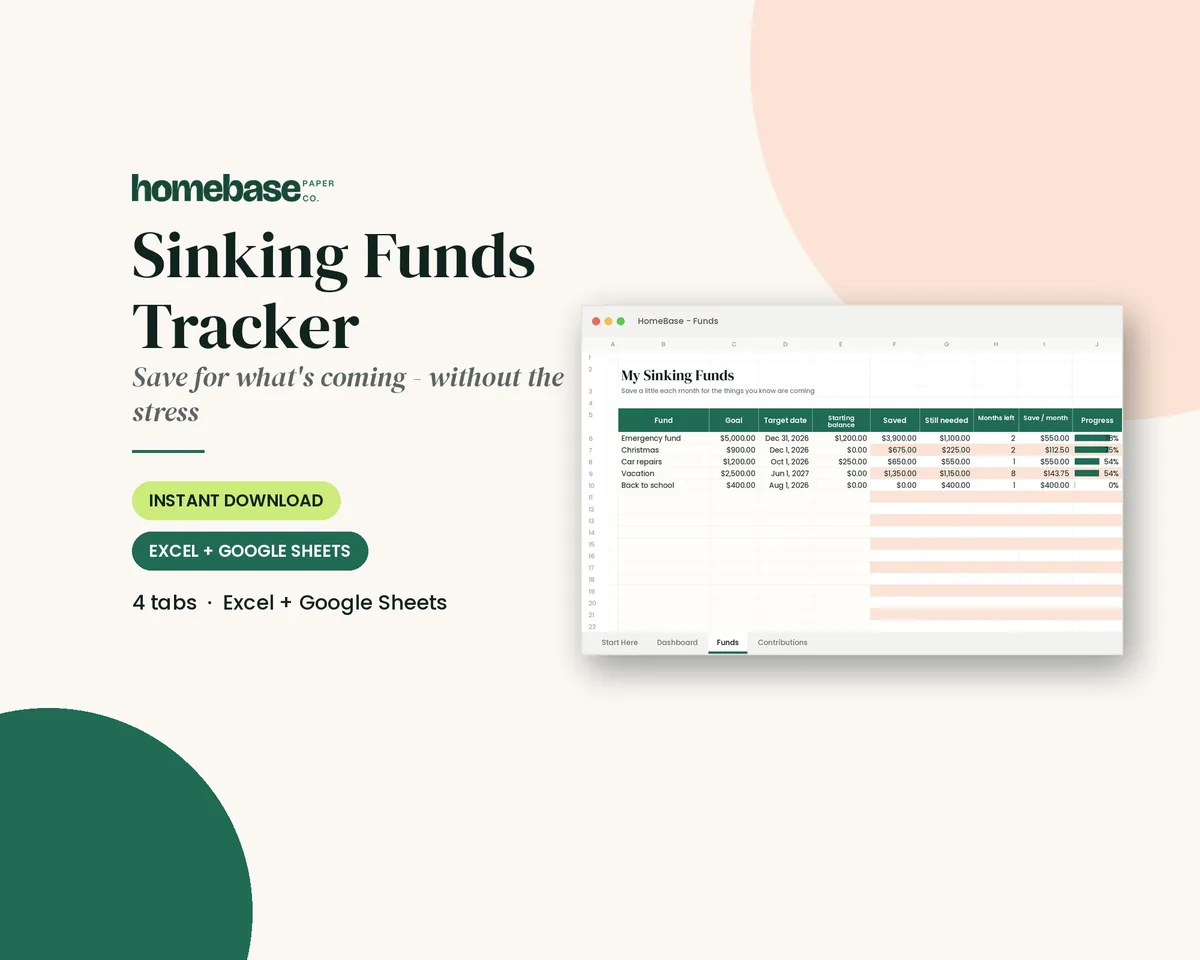
- Sinking Funds Tracker ($4.99): tracks up to 20 savings goals, works out the monthly amount needed to hit each date, and shows progress bars, a deposit and withdrawal log and a savings dashboard. It works in Excel and Google Sheets and is ready for an emergency fund.
- 100 Envelope Savings Challenge ($3.99): the classic, half and 52-week challenges to print, plus a spreadsheet that tracks every envelope and shows how much to save each week.
To set targets, see our savings goal tracker and emergency fund tracker guides, or try a savings challenge to build the habit.
Want to see how your savings grow? Our guide to what compound interest is compares simple and compound interest side by side. When you are ready to lock a rate for a set term, compare cd rates.
Saving for a child's long-term future? See our guide to investing for kids for accounts that can grow faster than savings.
Make it easier
Tools for this

Spreadsheets
Sinking Funds Tracker
It does the math: how much to set aside each month to hit every goal on time.
 Starter pick
Printables
100 Envelope Savings Challenge
Classic, half and 52-week challenges to print, plus a spreadsheet that tracks every envelope and tells you how much to save each week.
Frequently asked questions
What is a savings account? A savings account is a bank or credit union deposit account built for holding money you do not plan to spend right away. It pays interest, keeps your money separate from everyday spending and, at an insured institution, is protected up to at least $250,000 by the FDIC or NCUA.
How does a savings account work? You deposit money, the bank pays you interest on the balance, and you can withdraw or transfer it when you need it. Interest is usually compounded daily or monthly and credited monthly. You move money in and out online, by app, at a branch or by transfer from checking.
What is the difference between checking and savings account? The difference between checking and savings account types is purpose. Checking is for spending, with a debit card, bill pay and unlimited transactions, and usually little or no interest. Savings is for holding money, pays more interest and often limits or discourages frequent withdrawals.
Is money in a savings account safe? Yes, money in a savings account is safe at an insured bank or credit union. The FDIC insures deposits up to at least $250,000 per depositor at each insured bank, and coverage is automatic. The NCUA gives credit union members the same $250,000 standard coverage. You do not lose insured money if the institution fails.
How much interest does a savings account pay? A savings account pays anywhere from the national average of 0.38% (the FDIC's figure as of October 19, 2026) to several times that at many online and high-yield banks. The rate depends on the bank. At 0.38%, $5,000 earns about $19 a year; at a 4.00% APY it would earn about $200.
How many withdrawals can I make from a savings account? Federal rules no longer cap savings withdrawals, though your bank may set its own limit. In April 2020 the Federal Reserve deleted the six-per-month limit on convenient transfers from savings deposits. Many banks still set their own limit or charge a fee for extra withdrawals, so check your account terms.
Do I pay taxes on savings account interest? Yes, you pay taxes on savings account interest. Interest from a savings account counts as taxable income in the year it is credited. Banks usually send Form 1099-INT if you earned $10 or more in interest. You report the interest on your tax return even if you did not get a form.
How much money should I keep in savings? A common goal is an emergency fund of three to six months of essential expenses, built up in steps. Start with $500 to $1,000 for small surprises, then grow it. Money for planned costs, like holidays or car repairs, can sit in separate savings goals or sinking funds.
What do I need to open a savings account? To open a savings account you typically need a government-issued photo ID, your Social Security number or ITIN, your address and date of birth and an opening deposit, which may be as low as $0 to $25. Online banks let you apply in a few minutes and fund the account by transfer.
Can a savings account lose money? No, not from market swings: an insured savings account does not lose value from market swings, because it is not an investment. Your balance can shrink only from withdrawals or fees, such as a monthly maintenance fee when you fall below a minimum balance. Inflation can reduce what your money buys if your rate is low.
What is a high-yield savings account? A high-yield savings account is a savings account that pays a much higher rate than the national average, usually at an online bank or credit union. It works the same way and has the same deposit insurance. The main tradeoff is fewer or no branches and rates that can change at any time.
Should I have more than one savings account? Yes, more than one savings account can help, and many people have one. A separate account for the emergency fund keeps it from blending into vacation or holiday money. Some banks let you create several named savings buckets inside one account, which gives the same benefit without extra accounts to manage.
More from HomeBase
You may also like

Printables
Budget Planner Printable
Twelve undated pages you can print every month: budget, bills, spending, savings and debt.

Spreadsheets
Bill Tracker Spreadsheet
Bills due in 3 days or less light up red, so nothing slips through.

Spreadsheets
Paycheck Budget Spreadsheet
Enter your bills once. The sheet tells you which paycheck pays each one, all year.

Spreadsheets
Zero-Based Budget Spreadsheet
The 'Left to budget' counter turns green when every dollar has a job.
 Club
Monthly club
Money Club
Anyone who wants a clear plan for the month's bills, holiday spending and savings.
Free printable
Give every dollar a job: get the free monthly budget template
A printable zero-based monthly budget: income, bills, everyday spending and savings on one page, with a planned vs. actual column. You'll also get our weekly HomeBase email with simple budgeting and bill-paying tips.
