


The short answer: what is compound interest? It's interest you earn on interest: each round is calculated on the bigger total, so money grows faster the longer you leave it alone. On debt, it works against you.
- Formula: A = P × (1 + r/n)^(n × t)
- Biggest factor: time, so starting early wins
- Pay off high-interest debt first
- Build a starter emergency fund
- Next step: Plan it with the Debt Payoff Planner ($6.99).
What is compound interest? Compound interest is interest you earn on interest. Each time interest is added to your balance, the next round of interest is calculated on the bigger total, so your money grows faster every year you leave it alone. It works for you in savings and investments, and against you on debt like credit cards, where unpaid interest gets added to what you owe.
Here's the simplest example. Put $1,000 in an account that pays 5% a year, compounded once a year. After year one you have $1,050. In year two you earn 5% on $1,050, not $1,000, so you finish with $1,102.50. That extra $2.50 is interest on your interest. It looks tiny at first, but over 30 years the same $1,000 grows to about $4,322 with no new deposits.
This guide explains compound interest in plain English: the formula, simple interest vs. compound interest, why compounding frequency matters, how time and steady deposits change the picture, and how compounding makes debt more expensive. I'm Malaysia, a Detroit-raised mom and the oldest of three, and I build budget spreadsheets for families. I think of a budget as stewardship, and understanding compound interest is one of the best ways to take care of what you've been given.
Compound interest explained in one minute
The U.S. Securities and Exchange Commission's investor education site puts it simply: compound interest is "the interest you earn on interest". Three things control how much it does for you (or costs you):
- The rate: a higher interest rate grows the balance faster.
- The time: compounding is slow at the start and speeds up later, so years matter more than anything else.
- How often it compounds: daily or monthly compounding adds interest to the balance more often than yearly compounding.
A fourth factor, regular deposits, isn't part of the math of compounding itself, but it's what turns a small balance into a big one. Every new dollar starts compounding the day it lands.
The compound interest formula
You don't need to calculate this by hand, but seeing the formula makes the idea click.
A = P × (1 + r/n)^(n × t)
| Letter | Meaning | Example |
|---|---|---|
| A | Amount at the end | What you'll have |
| P | Principal (starting amount) | $1,000 |
| r | Annual interest rate as a decimal | 5% = 0.05 |
| n | Times interest compounds per year | 12 for monthly |
| t | Number of years | 10 |
Plug in the example: $1,000 × (1 + 0.05/12)^(12 × 10) = about $1,647. You earned about $647 in interest, and roughly $147 of that came from interest on interest.
How to calculate compound interest, step by step
- Write down your starting balance, the annual rate and how often the account compounds.
- Divide the annual rate by the number of compounding periods. For 5% monthly, that's 0.05 ÷ 12 = 0.004167.
- Add 1 to that number: 1.004167.
- Raise it to the total number of periods. For 10 years monthly, that's 120 periods.
- Multiply by your starting balance. The result is your ending balance.
- Subtract the starting balance to see how much interest you earned.
Or skip the math and use our free compound interest calculator, which shows the growth year by year.
Simple interest vs. compound interest
Simple interest is paid only on the original amount. Compound interest is paid on the original amount plus all the interest that's already been added. In the first year or two, the difference is small. Over decades, it's huge.
Here's $1,000 at 5% with no new deposits:
| Years | Simple interest | Compounded yearly | Compounded monthly |
|---|---|---|---|
| 1 | $1,050 | $1,050 | $1,051 |
| 5 | $1,250 | $1,276 | $1,283 |
| 10 | $1,500 | $1,629 | $1,647 |
| 20 | $2,000 | $2,653 | $2,713 |
| 30 | $2,500 | $4,322 | $4,468 |
With simple interest, you earn the same $50 every year. With compounding, each year's interest is larger than the last. By year 30, compounding has earned you about $1,800 to $2,000 more than simple interest on the very same deposit.
Where you'll see each one:
- Simple interest: many car loans, some personal loans and some short-term loans charge simple interest on the balance you still owe.
- Compound interest: savings accounts, money market accounts, CDs, retirement and investment accounts (through reinvested earnings), and credit cards.
Does compounding frequency matter?
Yes, but less than people think. The more often interest compounds, the more you earn, because interest joins the balance sooner. Look at $1,000 at 5% for 10 years:
- Compounded yearly: about $1,629
- Compounded monthly: about $1,647
- Compounded daily: about $1,649
Going from yearly to monthly helps a little. Going from monthly to daily barely moves the number. The rate itself and the number of years matter far more.
This is also why savings accounts advertise APY (annual percentage yield). APY includes the effect of compounding, so a 5% rate compounded monthly works out to about a 5.12% APY. When you compare savings accounts, compare APYs. Our guide to what APR means explains how APR and APY differ.
Time is the biggest factor: why starting early wins
Compounding is slow, then fast. The first few years feel like nothing is happening. Later, the interest on your interest starts doing most of the work. That's why starting early, even with small amounts, usually beats starting later with bigger ones.
Here's what saving $100 a month looks like at a 5% return, compounded monthly. These are illustrations, not promises; real returns change.
| Years of saving $100/month | Total you deposited | Ending balance at 5% | Growth from interest |
|---|---|---|---|
| 10 | $12,000 | about $15,528 | about $3,528 |
| 20 | $24,000 | about $41,103 | about $17,103 |
| 30 | $36,000 | about $83,226 | about $47,226 |
| 40 | $48,000 | about $152,602 | about $104,602 |
Notice that doubling the time from 20 to 40 years doubles your deposits, but the ending balance grows almost four times. That's compounding at work. If you want a quick way to estimate how long money takes to double, the rule of 72 divides 72 by your interest rate.
The rate matters too. The FDIC's national rates table showed an average savings account rate of 0.38% in its October 2026 update, while 12-month CDs averaged 1.76%. At 0.38%, $1,000 earns less than $4 a year. If your emergency fund sits in an account that pays almost nothing, it's worth comparing options.
How compound interest works against you on debt
Compounding doesn't care whose side it's on. On a credit card, unpaid interest is added to your balance, and next month's interest is charged on that bigger balance.
The Consumer Financial Protection Bureau explains that many card issuers use a daily periodic rate: your APR divided by 360 or 365. Interest is figured on each day's balance and added to it, so it compounds daily.
Here's an example with a $2,000 balance at 24% APR:
- Daily rate: 24% ÷ 365 = about 0.0658% per day
- Interest after 30 days with daily compounding: about $39.83
- If you made no payments and no new charges for a full year, the balance would grow by about $542, an effective rate of about 27%
Real cards require minimum payments, so your numbers will be different. The lesson is the same: compound interest on debt grows quietly. Paying more than the minimum, and paying the highest-rate balance first, cuts the interest you'll pay. Our guides on how to pay off credit card debt and debt snowball vs. avalanche walk through both strategies.
How to make compound interest work for your family
You don't need a lot of money to use compounding. You need a plan you can repeat. ABA work taught me that big changes come from small, repeatable steps, and money works the same way.
- Pay off high-interest debt first. Earning 5% while paying 24% on a card goes backward.
- Build a starter emergency fund. Our guide to building an emergency fund explains where to keep it so it earns something.
- Automate a small monthly deposit. Even $25 or $50 a month starts the clock.
- Choose accounts by APY. For savings, compare APY, fees and minimums.
- Leave the interest alone. Withdrawing interest turns compound interest back into simple interest.
- Increase deposits when income grows. Raises, tax refunds and paid-off debts are perfect moments.
- Check in once a year. Look at what you saved, what you earned and what you still owe.
Curious how your savings compare? See average savings by age. For younger savers, our guide on teaching kids about money has age-by-age ideas, and compound interest is a great lesson for them.
Compound interest examples in everyday life
Compounding shows up in more places than a savings account. A few common ones:
- Savings and money market accounts: interest is usually compounded daily or monthly and credited monthly. The APY tells you the real yearly return.
- Certificates of deposit (CDs): you lock money away for a set term, and interest compounds until the CD matures.
- Savings bonds: U.S. savings bonds earn interest that builds over time. Our explainer on what a savings bond is covers the basics.
- Retirement and investment accounts: these don't pay a fixed rate, but reinvested earnings work like compounding. Returns go up and down, so growth is never guaranteed.
- Credit cards and unpaid loan interest: any interest that isn't paid off gets added to the balance and starts costing you interest too.
Common compound interest mistakes
- Waiting for a "real" amount to start. Small deposits that start early often beat bigger deposits that start late.
- Pulling the interest out. Every withdrawal resets part of the snowball.
- Comparing APR to APY. Use APR for borrowing and APY for saving so you compare like with like.
- Ignoring fees. A monthly fee can wipe out the interest on a small balance.
- Saving while carrying high-rate debt. Keep a small emergency cushion, then send extra money to the card with the highest rate.
- Forgetting inflation. If your savings rate is below inflation, your money buys a little less each year even as the balance grows.
Put compound interest to work on one page
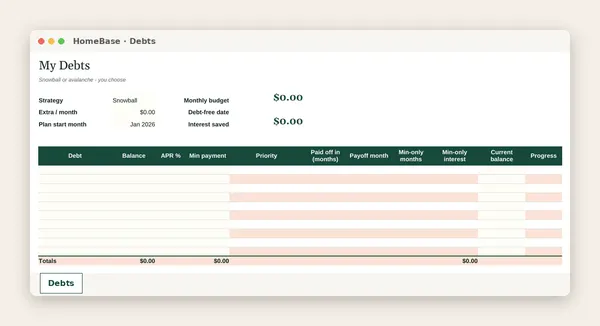
The Debt Payoff Planner ($6.99) shows you exactly how much compound interest you can stop paying. List up to 10 debts with their APRs, choose snowball or avalanche, add any extra monthly payment, and the spreadsheet builds a month-by-month payoff schedule with your debt-free date and the interest you save compared with paying only the minimums.
Once the debt is handled, the Sinking Funds Tracker ($4.99) does the savings math. It tells you how much to set aside each month to hit every goal on time, so your money can keep compounding instead of getting pulled out for surprises. Both work in Microsoft Excel and Google Sheets, and you'll find the rest on our Spreadsheets page.
Compound interest rewards patience. Start small, start soon, keep the interest working, and let time do the heavy lifting.
Make it easier
Tools for this

Spreadsheets
Debt Payoff Planner
Pick snowball or avalanche, add any extra payment, and get your debt-free month instantly.

Spreadsheets
Sinking Funds Tracker
It does the math: how much to set aside each month to hit every goal on time.
Frequently asked questions
What is compound interest in simple terms? Compound interest is interest earned on both your original money and the interest it has already earned, so your balance grows faster over time. If $1,000 earns 5% a year, you have $1,050 after one year and $1,102.50 after two, because the second year's interest is paid on $1,050. Over 30 years, that same $1,000 grows to about $4,322.
What is the formula for compound interest? The compound interest formula is A = P(1 + r/n)^(nt), where P is the starting amount, r is the annual rate as a decimal, n is how many times interest compounds each year and t is the number of years. For $1,000 at 5% compounded monthly for 10 years, the result is about $1,647. The free HomeBase compound interest calculator does this math for you.
What is the difference between simple interest and compound interest? Simple interest is paid only on the original amount, while compound interest is paid on the original amount plus any interest already added. At 5%, $1,000 earning simple interest grows to $2,500 in 30 years, but with yearly compounding it grows to about $4,322. The longer the money sits, the wider the gap between simple interest vs. compound interest becomes.
How does compound interest work on a savings account? On a savings account, compound interest is usually calculated daily or monthly and added to your balance each month, so next month's interest is figured on a slightly bigger balance. The account's APY shows the yearly return including compounding. Leaving the interest in the account and adding regular deposits is what makes the balance grow faster over the years.
How does compound interest work on credit card debt? On credit card debt, unpaid interest is added to your balance and then charged interest itself, often every day. The CFPB explains that many issuers use a daily periodic rate, which is your APR divided by 360 or 365. The HomeBase Debt Payoff Planner ($6.99) shows how much interest you save and your debt-free date when you pay more than the minimum.
How often is interest compounded? Interest can be compounded daily, monthly, quarterly or yearly, depending on the account or loan. Many savings accounts and credit cards compound daily and credit or charge interest monthly. More frequent compounding adds a little more, but the rate and the number of years matter much more: $1,000 at 5% for 10 years is about $1,629 compounded yearly and $1,649 compounded daily.
What is the difference between APR and APY? APR is the yearly interest rate on borrowing without the effect of compounding, while APY is the yearly return on savings with compounding included. A 5% rate compounded monthly works out to about a 5.12% APY. Compare APR when you borrow and APY when you save, so you're comparing the same kind of number across offers.
How much will $100 a month grow with compound interest? At a 5% return compounded monthly, $100 a month grows to about $15,528 in 10 years, $41,103 in 20 years and $83,226 in 30 years. You'd deposit $36,000 over 30 years, so about $47,000 of that balance is growth. These are illustrations, not promises, because real savings rates and investment returns change over time.
Why is starting early so important with compound interest? Starting early matters because compound interest grows slowly at first and much faster later, so extra years add more than extra dollars. Saving $100 a month at 5% for 40 years builds about $152,602, while 20 years builds about $41,103, even though you only deposited twice as much. Even a small automatic deposit started now gives your money more time to work.
What is the rule of 72? The rule of 72 is a quick way to estimate how long it takes money to double with compound interest: divide 72 by the annual interest rate. At 6%, money doubles in about 12 years, and at 9% in about 8 years. The same shortcut shows how fast an unpaid debt can double, which is a strong reason to pay high-rate balances first.
Is compound interest good or bad? Compound interest is good when you're saving and bad when you're borrowing, because the same math works in both directions. In a savings account, it grows your balance without extra effort. On credit cards and other debt, it grows what you owe. The HomeBase Debt Payoff Planner ($6.99) helps you stop the bad kind so the good kind can take over.
Should I pay off debt or save to earn compound interest? In most cases, pay off high-interest debt before saving extra, while keeping a small emergency fund. Paying off a card that charges 24% is like earning a guaranteed 24% return, which no savings account pays. Once the high-rate debt is gone, redirect that same monthly payment into savings so compound interest starts working for you instead of against you.
How can I calculate compound interest without doing the math? You can calculate compound interest without doing the math by using the free HomeBase compound interest calculator, which shows your balance year by year based on your starting amount, rate, time and monthly deposits. For savings goals, the HomeBase Sinking Funds Tracker ($4.99) works out how much to set aside each month to reach each goal on time.
How do I explain compound interest to kids? Explain compound interest to kids as money that earns its own money, like a snowball rolling downhill and picking up more snow. Give them a simple example: if you add 10 cents a month for every dollar they keep saved, including the dimes you already added, their savings grow a little faster each month. Letting them watch a real balance grow on a chart makes the idea stick.
More from HomeBase
You may also like

Printables
Budget Planner Printable
Twelve undated pages you can print every month: budget, bills, spending, savings and debt.

Spreadsheets
Bill Tracker Spreadsheet
Bills due in 3 days or less light up red, so nothing slips through.

Spreadsheets
Paycheck Budget Spreadsheet
Enter your bills once. The sheet tells you which paycheck pays each one, all year.

Spreadsheets
Zero-Based Budget Spreadsheet
The 'Left to budget' counter turns green when every dollar has a job.
 Club
Monthly club
Money Club
Anyone who wants a clear plan for the month's bills, holiday spending and savings.
Free printable
Give every dollar a job: get the free monthly budget template
A printable zero-based monthly budget: income, bills, everyday spending and savings on one page, with a planned vs. actual column. You'll also get our weekly HomeBase email with simple budgeting and bill-paying tips.
