

The short answer: How much house can you afford? A common rule of thumb is to keep your full house payment (principal, interest, property taxes and insurance) at or below 28% of your gross monthly income, and all of your debt payments at or below 36%. On a $75,000 salary that means about $1,750 a month for housing, or roughly a $240,000 home with 10% down at a 7% rate.
Our picks for how much house can i afford

Printables
Budget Planner Printable
Twelve undated pages you can print every month: budget, bills, spending, savings and debt.

Spreadsheets
Sinking Funds Tracker
It does the math: how much to set aside each month to hit every goal on time.
 Save 57%
Bundles
Ultimate Budget Bundle
All 6 spreadsheets + both printable planners - for less than half the price of buying them separately.
Below is a salary table, the math behind it and a simple test to see if the payment really fits your take-home budget.
The lender's number tells you what you can borrow. Your budget tells you what you can live with, and those two numbers are often far apart.
How much house can I afford by salary?
This table uses the 28% rule, 10% down, a 30-year fixed rate of 7% and about 1.5% of the home price a year for property taxes and insurance. It leaves out HOA dues and mortgage insurance, so treat it as a ceiling, not a target.
| Gross salary | 28% for housing (monthly) | Approximate home price | Principal and interest |
|---|---|---|---|
| $50,000 | $1,167 | $160,000 | about $965 |
| $75,000 | $1,750 | $240,000 | about $1,450 |
| $100,000 | $2,333 | $320,000 | about $1,930 |
| $125,000 | $2,917 | $400,000 | about $2,410 |
| $150,000 | $3,500 | $485,000 | about $2,900 |
Rates move every week, and your own rate depends on your credit score, down payment and loan type. The CFPB's rate explorer shows what lenders are offering for your situation, so check the current number before you run your own math. Low-down-payment loans change this math too, so see our guide to first-time home buyer programs for FHA, VA and USDA options.
The 28/36 rule, explained
- 28% front-end limit: your monthly housing payment divided by your gross monthly income.
- 36% back-end limit: housing plus car loans, student loans, credit card minimums and other debt payments, divided by gross monthly income.
That second number is your debt-to-income ratio. The CFPB's guide to debt-to-income ratios shows how to add up your monthly debt payments and divide by gross income, and notes that limits differ by lender and loan. If you already pay $500 a month toward a car, the room left for a house shrinks by the same $500. See how to calculate your debt-to-income ratio for a worked example.
How to figure out your own number in 5 steps
- Start with take-home pay. Write down what actually lands in your account each month, not your salary.
- List every fixed bill. Car, insurance, phone, child care, subscriptions and minimum debt payments.
- Set your saving first. Keep retirement, an emergency fund and a home repair fund in the plan before you price houses.
- See what's left for housing. The leftover amount, minus utilities and upkeep, is your comfortable payment.
- Compare it to the 28% number. Use whichever is lower when you set your price range. For more on this topic, see our money calculators.
A printable budget planner makes this easier because you can see every bill on one page before you talk to a lender.
Costs that change what you can afford
| Cost | Why it matters | What to do |
|---|---|---|
| Down payment | A bigger down payment shrinks the loan and the payment | Track it in a savings fund |
| Mortgage insurance | Usually added on conventional loans with less than 20% down | Ask your lender for the monthly amount |
| Property taxes | Vary widely by county | Look up the tax bill on listings you like |
| Homeowners insurance | Rising in many states | Get a quote before you make an offer |
| HOA dues | Common in condos and newer subdivisions | Add them to the housing payment |
| Closing costs | Listed on your Loan Estimate | Save for them separately from the down payment |
| Maintenance | Roofs, appliances and HVAC wear out | Set aside a monthly repair fund |
The CFPB's page on private mortgage insurance explains when lenders require it and how it protects the lender rather than you.
Tips to afford more house without stretching
- Pay down a car loan or credit card first. A lower debt load raises the 36% room for housing.
- Grow the down payment. Follow a plan like how to save for a house and track every deposit.
- Shop more than one lender. Small rate differences add up over 30 years.
- Price the whole month. Utilities, lawn care and commuting costs belong in the comparison.
- Keep your emergency fund. Our guide to building an emergency fund explains why it should survive closing day.
Still renting while you save? Use how much rent can I afford to keep today's budget on track. If you already own a home, compare mortgage refinancing before changing your mortgage payment.
Plan the budget before you shop for homes
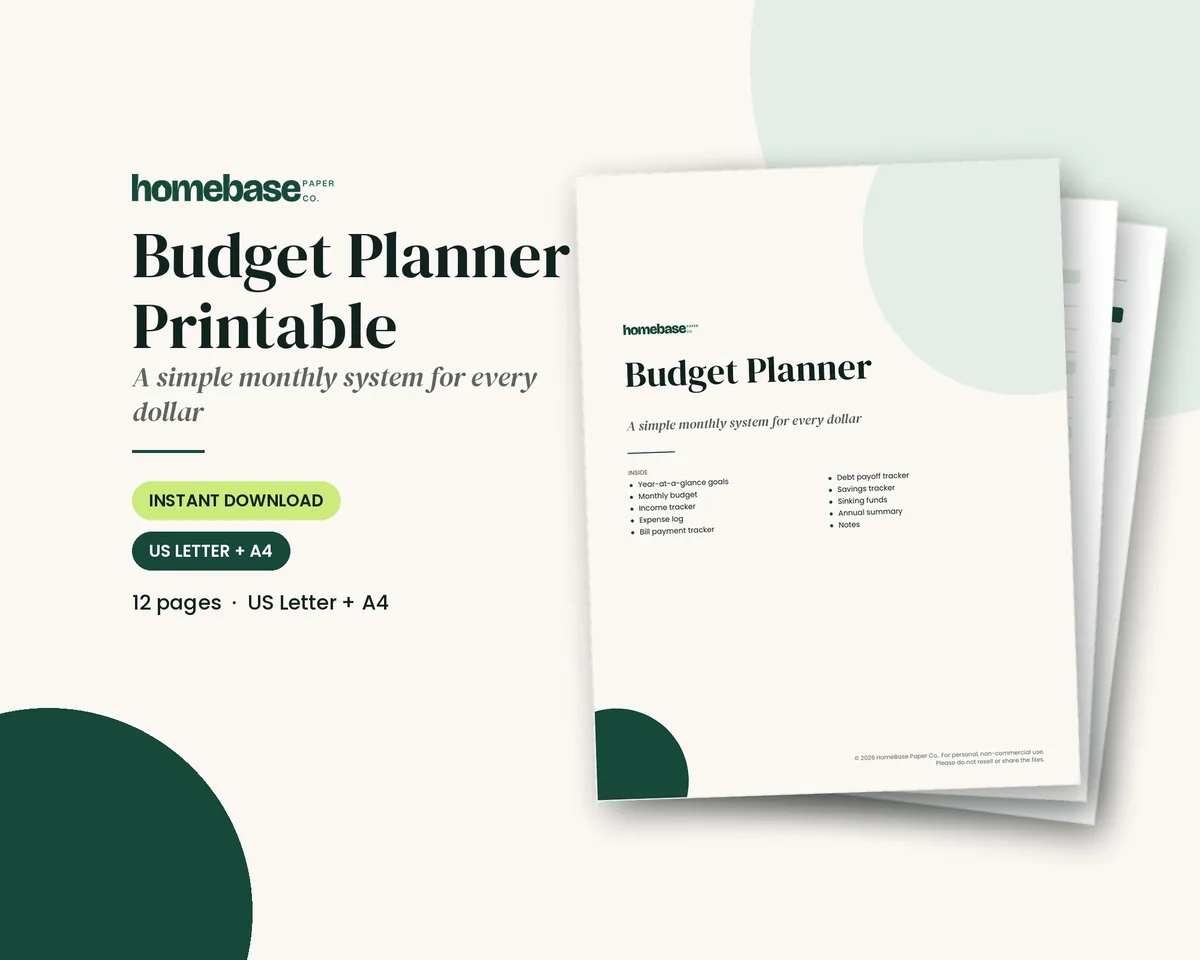
- Budget Planner Printable, $5.99. Monthly budget pages to find the house payment that truly fits.
- Sinking Funds Tracker, $4.99. Track your down payment, closing costs and repair fund side by side.
- Ultimate Budget Bundle, $19.99 (regularly $46.42 for the items bought separately). Budget, bills, debt payoff and savings tools in one set.
See all our money planners and spreadsheets.
Before comparing homes, use the mortgage payment calculator to separate principal and interest from the taxes, insurance and other housing costs you need to budget.
Budget Planner Printable
Twelve undated pages you can print every month: budget, bills, spending, savings and debt.
$5.99 · Instant download. Print at home or fill it in on screen. Or browse the full Budget & Money collection.
Frequently asked questions
How much house can I afford on my salary? A common starting point is the 28/36 rule: keep your total house payment, including taxes and insurance, at or under 28% of your gross monthly income, and all debt payments at or under 36%. On a $75,000 salary that is about $1,750 a month for housing, which works out to roughly a $240,000 home with 10% down at a 7% rate.
What is the 28/36 rule? The 28/36 rule is a lender guideline. Your housing payment (principal, interest, property taxes and homeowners insurance) should be no more than 28% of your gross monthly income, and your total monthly debt payments, including that housing payment, should be no more than 36%.
How much house can I afford with a $100,000 salary? With a $100,000 salary, 28% of gross income is about $2,333 a month for housing. With 10% down, a 7% rate and about 1.5% of the price a year for taxes and insurance, that supports a home of roughly $320,000. A bigger down payment or lower rate raises the number; car loans or student loans lower it.
How much house can I afford making $50,000 a year? At $50,000 a year, 28% of gross income is about $1,167 a month for housing. With 10% down at a 7% rate, that supports a home price of roughly $160,000, before HOA dues or mortgage insurance.
Does the lender's preapproval tell me what I can afford? A lender's preapproval doesn't tell you exactly what you can afford. A preapproval shows the most a lender is willing to lend based on your income, debts and credit. It doesn't know about child care, saving goals or how much you like to keep for travel, so the payment you can live with may be lower than the amount you're approved for.
What is a good debt-to-income ratio for a mortgage? A good debt-to-income ratio for a mortgage is as low as you can get it, and many buyers aim for 36% or less in total. The Consumer Financial Protection Bureau explains that DTI is your monthly debt payments divided by your gross monthly income and that limits vary by loan and lender. Many buyers aim for 36% or less in total so the budget still has room to breathe.
How much should I have saved before buying a house? Plan for three piles of money: the down payment, closing costs and an emergency fund that is still there after you move in. Your lender's Loan Estimate lists your expected closing costs, and many owners keep three to six months of expenses for repairs and surprises.
Do I need 20% down to buy a house? No, you don't need 20% down to buy a house. Many loans allow much less than 20% down. With less than 20% down on a conventional loan, you will usually pay private mortgage insurance, which raises the monthly payment until you build enough equity.
How do interest rates change how much house I can afford? Rates change the payment on every dollar you borrow. A $300,000 loan over 30 years costs about $1,800 a month in principal and interest at 6% and about $2,000 at 7%, so a single point can change your price range by tens of thousands of dollars.
What costs do people forget when buying a home? The most commonly missed costs are property taxes, homeowners insurance, HOA dues, utilities that are higher than in an apartment, and maintenance. A sinking fund for home repairs keeps a new roof or water heater from landing on a credit card.
Free printable
Give every dollar a job: get the free monthly budget template
A printable zero-based monthly budget: income, bills, everyday spending and savings on one page, with a planned vs. actual column. You'll also get our weekly HomeBase email with simple budgeting and bill-paying tips.

Sources
- CFPB: What is a debt-to-income ratio? consumerfinance.gov
- CFPB: Explore interest rates consumerfinance.gov
- CFPB: What is private mortgage insurance? consumerfinance.gov