

The short answer: This estate planning checklist covers the documents, decisions and records that protect your family if something happens to you. Estate planning isn't only for wealthy people. If you have children, a home, a bank or retirement account, or simply people you'd want to handle your affairs, a few basic documents and an organized list of accounts can save your loved ones a great deal of time, money and stress.
Our picks for estate planning checklist
 Save 57%
Bundles
Ultimate Budget Bundle
All 6 spreadsheets + both printable planners - for less than half the price of buying them separately.

Spreadsheets
Bill Tracker Spreadsheet
Bills due in 3 days or less light up red, so nothing slips through.
This page is general education, not financial, legal or tax advice. A big part of estate planning is simply knowing what you have. The Ultimate Budget Bundle keeps your accounts and budget in one place, and the Bill Tracker Spreadsheet lists every recurring bill your family would need to know about.

Why an estate plan matters
Without a plan, state law decides who receives your property and who raises your minor children, and your family may face a slower, more expensive court process. A plan lets you choose. It also covers what happens if you're alive but unable to make decisions, which many people forget. The National Institute on Aging's checklist stresses that getting your affairs in order ahead of time helps your family act quickly and confidently.
The core estate planning documents
| Document | What it does | Who needs it |
|---|---|---|
| Will | Names who receives your property and a guardian for minor kids | Almost every adult |
| Beneficiary designations | Pass retirement accounts and life insurance directly | Anyone with these accounts |
| Durable financial power of attorney | Lets someone manage your money if you can't | Every adult |
| Health care power of attorney | Names someone to make medical decisions | Every adult |
| Advance directive or living will | States your wishes for medical care | Every adult |
| Revocable living trust | Can help avoid probate and manage assets | Some families, depending on state and assets |
Estate planning checklist: step by step
- List what you own. Bank accounts, retirement accounts, investments, real estate, vehicles, life insurance and valuable personal items.
- List what you owe. Mortgage, car loans, credit cards and other debts.
- Choose your people. An executor, a guardian for minor children, a financial agent and a health care agent, plus backups.
- Write or update your will. Many people work with an estate planning attorney to make sure it's valid in their state.
- Check every beneficiary designation. Retirement accounts and life insurance usually go to whoever is named on the form, even if your will says something else.
- Sign powers of attorney. One for finances and one for health care.
- Record your health care wishes in an advance directive.
- Plan for digital accounts. List email, cloud storage, photos and online accounts, and how you'd like them handled.
- Store everything safely and tell your executor where to find it.
- Review every few years and after major life events.
Estate planning checklist by life stage
The same documents matter at every stage, but the priorities shift:
| Life stage | Start with |
|---|---|
| Newly married or partnered | Beneficiary designations, health care and financial powers of attorney, a simple will |
| New parent | A will naming a guardian for your child, life insurance beneficiaries, a plan for who manages the money |
| Homeowner | Check how the title is held, name beneficiaries on retirement accounts, list the mortgage and insurance |
| Age 50 and up | Update beneficiaries, advance directive, an organized list of accounts and passwords |
| Retired | Review everything every few years, confirm your executor and agents are still willing and able |
For the full organizing step, our if-something-happens-to-me binder shows what to put in one place, and the Swedish death cleaning guide covers sorting belongings.
Choosing an executor and agents
Your executor carries out your will, pays final bills and distributes your property. Choose someone organized, trustworthy and willing, and talk with them first. Our guide to being an executor of an estate explains what the job involves. Your financial agent under a power of attorney manages money for you if you can't. The CFPB's guides for managing someone else's money explain these roles in plain language, which is helpful to share with the people you choose. For more on this topic, see our peace-of-mind planning.
Health care decisions
An advance directive and a health care power of attorney make sure your medical wishes are known and that someone you trust can speak for you. The National Institute on Aging's guide to advance directives explains the common forms. Talk through your wishes with your health care agent so they understand your values, not just the paperwork.
Do you need to worry about estate tax?
Most families don't owe federal estate tax, because it applies only to very large estates above a high exemption amount. The IRS estate tax page lists the threshold for each year: the basic exclusion amount is $15,000,000 per person for people who die in 2026, and a surviving spouse may be able to use a deceased spouse's unused exemption (portability) if an estate tax return is filed. Some states have their own estate or inheritance taxes with lower limits, so it's worth checking your state's rules or asking a professional.
Organize your records
A good estate plan is only useful if your family can find it. Keep a simple master list with each account, the institution, the type of account and a contact number, without writing passwords on the same page. Add a list of recurring bills, insurance policies and where originals are stored. A personal financial statement is a handy way to summarize what you own and owe in one page.
When to update your plan
Life changes. Review your estate planning checklist after marriage, divorce, a new child, a death in the family, a move to a new state, buying a home or a big change in income. Even without a major event, a quick review every three to five years keeps everything current. Many people pair it with their yearly money check-in or end-of-year financial checklist.
The bottom line
You don't have to finish everything at once. Start this week by listing your accounts and checking your beneficiary forms, then schedule time to sign a will and powers of attorney. Each step you complete makes things easier for the people you love.
Leave your family a plan, not a puzzle
All 6 spreadsheets + both printable planners - for less than half the price of buying them separately.
$19.99 $46.42 · Instant download. Print at home or fill it in on screen. Or browse the full Budget & Money collection.
Frequently asked questions
What should be on an estate planning checklist? An estate planning checklist should include a will, beneficiary designations on retirement accounts and life insurance, a durable financial power of attorney, a health care power of attorney and advance directive, a list of accounts and debts, guardianship choices for minor children, digital account instructions, and a note on where all of these documents are stored.
Do I need an estate plan if I don't have much money? Yes, you still need an estate plan if you don't have much money, because estate plans are not only for wealthy people. Anyone with children, a home, a car, a bank account, a retirement account or pets benefits from naming who should handle their money and health decisions if they can't, and who should receive what they leave behind. Basic documents also save your family time and stress.
How often should I update my estate plan? Review your estate planning checklist every three to five years and after major life events such as marriage, divorce, a birth or adoption, a death in the family, a move to another state, or a big change in your finances. Beneficiary designations especially should be checked, because they usually override what your will says.
Do I need a lawyer for estate planning? Simple estate plans can sometimes be done with state-specific forms, but a licensed estate planning attorney can make sure your documents are valid in your state, coordinate your will with your beneficiary designations and handle trusts, blended families, businesses or special needs planning. Many people use an attorney for the core documents and do the organizing themselves.
What is the federal estate tax exemption in 2026? The federal estate tax basic exclusion amount is $15,000,000 per person for people who die in 2026, according to the IRS. Most families owe no federal estate tax, though some states have their own estate or inheritance taxes with lower limits.
Free printable
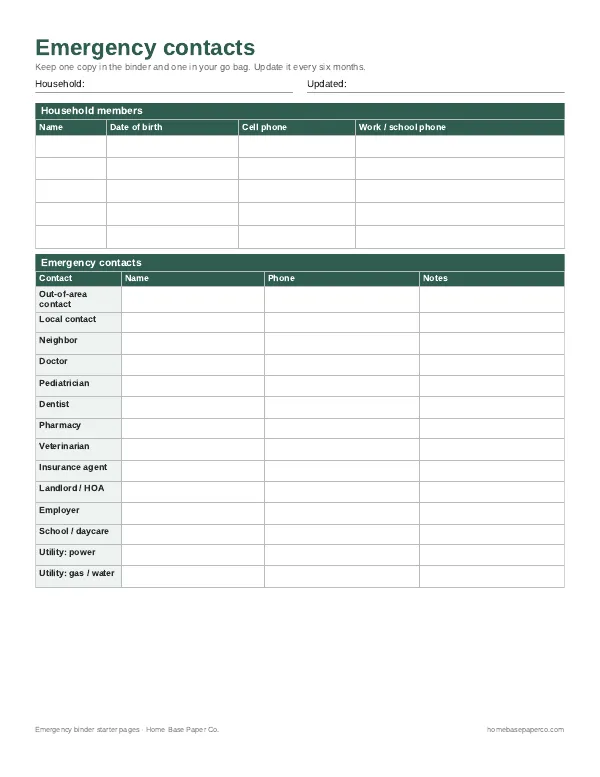
Have the important stuff in one place: get the free emergency binder pages
Printable starter pages for household members, emergency contacts, medical notes and where key documents live. You'll also get our weekly HomeBase email with simple ways to keep family records and important papers in order.
Sources
- National Institute on Aging: Getting your affairs in order checklist nia.nih.gov
- CFPB: Managing someone else's money consumerfinance.gov
- IRS: Estate tax irs.gov
- National Institute on Aging's guide to advance directives nia.nih.gov