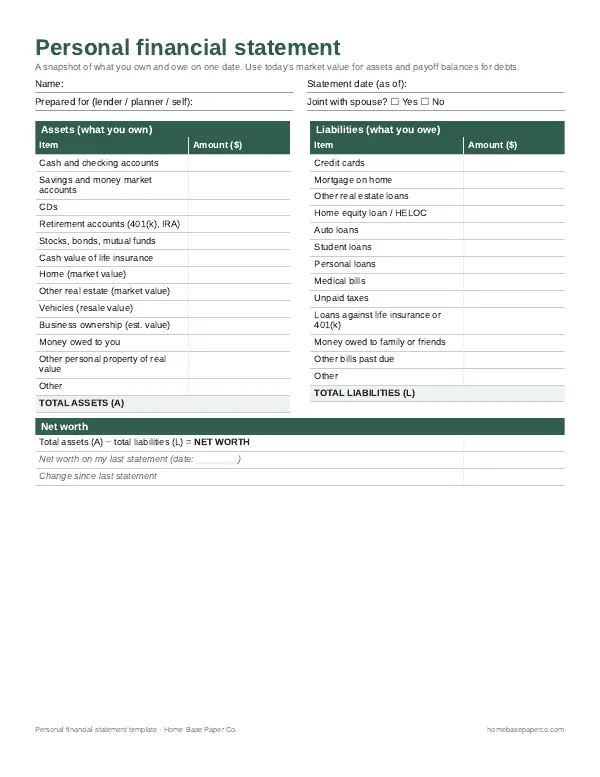
The short answer: a personal financial statement lists everything you own and everything you owe on one date, and shows the difference: your net worth.
- Banks ask for one before a small business loan or a personal guarantee
- Families use one to track progress each year
- Free template: a two-page PDF
- A filled-in example and how SBA Form 413 differs
- Next step: Get the free personal financial statement template (we email it to you); want more? The If Something Happens to Me Binder is $11.99.
A personal financial statement is a short document that lists everything you own and everything you owe on one date, and shows the difference: your net worth. Banks ask for one before a small business loan, a mortgage on investment property or a personal guarantee. Families use one to see whether they are moving forward each year. Below is our free personal financial statement template, a two-page PDF, plus step-by-step instructions, a filled-in example, what goes in each section and how lender forms like SBA Form 413 differ.
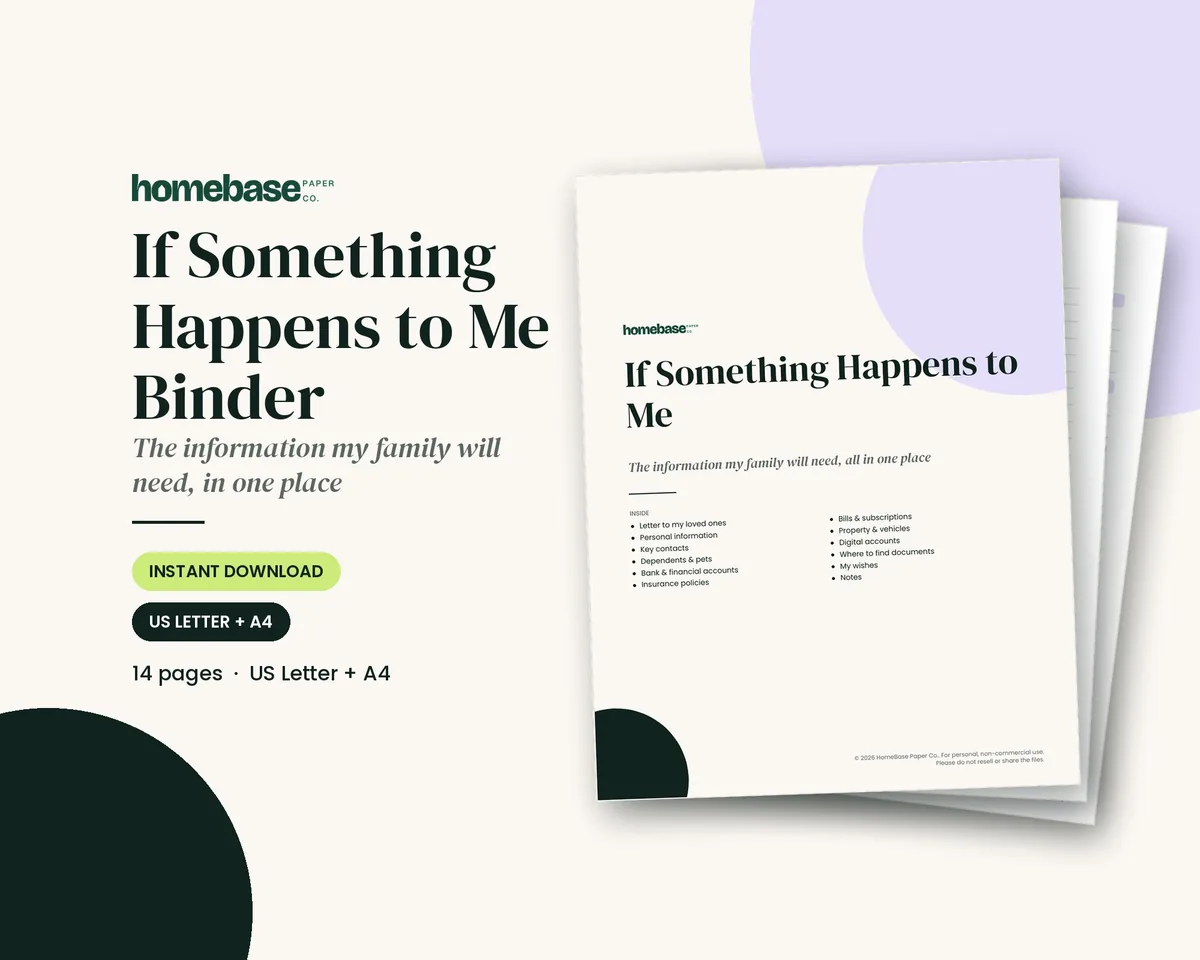
To keep the details behind each line in one place, our If Something Happens to Me Binder has pages for bank and financial accounts, insurance policies, property and vehicles.
What is a personal financial statement?
A personal financial statement is the household version of a company's balance sheet. It answers one question: if you sold everything you own and paid off everything you owe today, what would be left? Investopedia's definition puts it the same way: it lists the assets and liabilities of an individual or couple, and net worth is assets minus liabilities.
There are two common versions:
- A personal planning statement. Just assets, liabilities and net worth, updated once or twice a year to track progress.
- A lender statement. Adds annual income, contingent liabilities and detailed schedules for real estate, loans and investments. The lender uses it with your credit report and tax returns.
What goes on a personal financial statement
| Section | What to list | How to value it |
|---|---|---|
| Cash | Checking, savings, money market, CDs | Current balance |
| Investments | Brokerage accounts, stocks, bonds, mutual funds | Current market value |
| Retirement | 401(k), 403(b), IRA, pension cash value | Current statement balance |
| Real estate | Home, rental property, land | Realistic market value today |
| Vehicles | Cars, motorcycles, boats | Private-party resale value |
| Other assets | Business interest, life insurance cash value, money owed to you | A cautious estimate |
| Liabilities | Mortgage, HELOC, auto loans, student loans, credit cards, personal loans, medical bills, unpaid taxes | Payoff balance, not monthly payment |
| Income | Salary, bonuses, business, rental and investment income | Annual gross amounts |
| Contingent liabilities | Co-signed loans, guarantees, legal claims | Amount you could owe |
Leave out everyday belongings like furniture and clothes unless something has real resale value. It keeps the statement honest and avoids inflating your net worth.
Personal financial statement example
Here is a simple example for a couple applying for a small business loan. All figures are illustrative.
| Assets | Amount | Liabilities | Amount |
|---|---|---|---|
| Checking and savings | $18,500 | Mortgage | $212,000 |
| Retirement accounts | $96,000 | Auto loan | $14,200 |
| Brokerage account | $22,000 | Student loans | $19,800 |
| Home (market value) | $340,000 | Credit cards | $3,100 |
| Two vehicles | $27,000 | ||
| Total assets | $503,500 | Total liabilities | $249,100 |
Net worth: $503,500 − $249,100 = $254,400.
On a lender form they would also list annual income, say $118,000 in combined salary, and any contingent liabilities, such as a car loan co-signed for a son.
How to use our free personal financial statement template
The free personal financial statement template at the top of this page is two US Letter pages. You can print it and fill it in by hand, or keep it next to your computer while you type the numbers into a lender's form.
Page 1: assets, liabilities and net worth. Fill in the "as of" date first. List 13 types of assets on the left, from cash and checking to money owed to you, and 13 types of debts on the right, from credit cards to past-due bills. Total each column, subtract, and write your net worth in the box. Two extra lines let you record last year's net worth and the change.
Page 2: income and details. Lenders usually want annual income by source, so list salary, bonuses, business, rental and investment income. Then record contingent liabilities, like loans you co-signed. Three detail tables cover real estate, loans and credit lines and investments. A signature line sits at the bottom.
What lenders look at on your statement
| What they check | Why it matters |
|---|---|
| Net worth | Shows the cushion behind the loan |
| Liquid assets (cash and investments) | Money you could use to repay quickly or cover a slow month |
| Total debt and monthly payments | How much of your income is already spoken for |
| Contingent liabilities | Debts that could land on you later |
| Consistency with tax returns and statements | Whether the numbers can be trusted |
A strong statement is not just a big number. It is an accurate one that matches every document the lender also sees.
Personal financial statement instructions: how to fill it out step by step
- Choose an "as of" date. Every number should reflect the same day, usually the end of last month.
- Gather statements. Pull your latest bank, brokerage, retirement, mortgage, loan and credit card statements.
- List assets at today's value. Use market values for property and vehicles, not purchase prices.
- List every debt at its payoff balance. Include small balances like a store card or medical bill.
- Total each side and subtract. Assets minus liabilities equals net worth. It can be negative, and that is common early in life.
- Add income and contingent liabilities if the statement is for a lender.
- Review and sign. Check each figure against a statement. Lenders rely on your signature that it is accurate.
- Save a copy with the date, so next year you can compare.
Personal liquidity statement: how much of your net worth you can actually use
A personal liquidity statement takes the asset side of your personal financial statement and sorts it by how fast each item can become cash without a big loss. Lenders look at it because a high net worth tied up in a house and a 401(k) does not pay a bill next month. You can build one from the same numbers in five minutes.
| Liquidity tier | What goes here | Example couple above |
|---|---|---|
| Cash now | Checking, savings, money market | $18,500 |
| Cash in days | Brokerage account (stocks, bonds, funds) at current value | $22,000 |
| Locked up with a cost | 401(k), 403(b) and IRA balances | $96,000 |
| Slow to sell | Home, vehicles, business interest | $367,000 |
The couple in the example has $40,500 in liquid assets (the first two rows) against $3,100 in credit card debt, so their short-term debts are covered many times over. Most of their $503,500 in assets is not liquid: retirement money taken out before age 59½ generally owes a 10% additional tax on top of income tax, and a house or car takes weeks to sell.
To turn the statement into a planning tool, divide your liquid assets by one month of essential spending. The result is how many months you could cover if income stopped, which is the same question an emergency fund answers. Track it alongside net worth each year, or log it monthly on an emergency fund tracker.
Lender forms: SBA Form 413 and bank versions
If you are applying for an SBA-backed loan, the lender will ask for SBA Form 413. According to the SBA, the form is used to assess repayment ability and creditworthiness for 7(a) and 504 loans, disaster loans and surety bonds, and to review eligibility for the Women-Owned Small Business (WOSB) and 8(a) programs. The current version took effect on February 13, 2025. Each owner with a significant share of the business usually completes one.
Banks and credit unions often have their own personal financial statement forms with similar sections. The work is the same, so keep your own completed template up to date and copy the numbers onto whatever form the lender requires.
Common mistakes lenders notice
- Using purchase price instead of market value for a home, car or business.
- Leaving off small debts like a store card or a personal loan from a family member.
- Forgetting contingent liabilities, especially co-signed loans.
- Mixing dates, such as a bank balance from today and a loan balance from six months ago.
- Numbers that do not match tax returns or bank statements the lender also sees.
Using a personal financial statement for your own planning
You do not need a loan application to benefit. Investor.gov recommends listing your assets and debts in a net worth statement and updating it every year. Comparing one year to the next shows whether paying down debt and saving are working.
| What changed | What it tells you |
|---|---|
| Net worth up | Saving, paying down debt or rising home and investment values |
| Liabilities down | Your debt plan is working |
| Cash up | Your emergency fund is growing |
| Net worth down | New debt, a big expense or falling market values; look at which line moved |
For a deeper walkthrough of the math and national medians, see our guide on how to calculate net worth.
Personal vs. business financial statement templates
"Financial statement template" can mean two different things. A personal financial statement, like the free template on this page, lists one person's or couple's assets and liabilities on a single date. A business uses a set of financial statements instead: a profit and loss statement for income and expenses over a period, a balance sheet for what the business owns and owes, and a cash flow statement for the cash that moves in and out. If a lender asks a small business owner for financial statements, they usually want both: the business statements plus a personal financial statement from each owner. For the business side, see our free profit and loss statement template and cash flow statement example.
Keep the documents behind your statement organized
A personal financial statement is only as good as the records behind it. When account numbers, balances and policies are in one place, the next update takes 20 minutes instead of an afternoon.
- If Something Happens to Me Binder ($11.99): pages for bank and financial accounts, insurance policies, bills and subscriptions, property and vehicles, digital accounts and where to find documents. Everything you need for a personal financial statement, plus what your family would need in an emergency.
- Annual Budget Spreadsheet ($6.99): 12 monthly tabs, a transaction log and a planned vs. actual dashboard. It shows the yearly spending a lender may ask about.
Affiliate links: we may earn a small commission. As an Amazon Associate we earn from qualifying purchases. Details.
For the paper originals behind each line, a fireproof and waterproof document box keeps deeds, titles and statements in one place, and a 1-inch view binder holds your signed statement with last year's copy for comparison.
To pull your paperwork together, read how to organize important documents. If you are also checking how much of your income goes to debt, our guide on how to calculate debt-to-income ratio pairs well with your statement.
A financial statement is a great first step on an estate planning checklist, since your family will need to know what you own and owe. If others depend on your income, look at term life insurance at the same time.
Make it easier
Tools for this

Printables
If Something Happens to Me Binder
Accounts, insurance, bills, contacts, documents and your wishes - so your family isn't left guessing.

Spreadsheets
Annual Budget Spreadsheet
See exactly where your money goes every month - without complicated software.
Frequently asked questions
What is a personal financial statement? A personal financial statement is a one- or two-page summary of everything you own and everything you owe on a specific date. Assets minus liabilities gives your net worth. Lenders use it to judge whether you can repay a loan, and families use it to track progress year to year.
What is included in a personal financial statement? A personal financial statement includes your assets, such as cash, savings, retirement accounts, investments, home and vehicles, and your liabilities, such as a mortgage, car loans, student loans and credit cards. Lender versions also ask for annual income, contingent liabilities like co-signed loans and details on real estate and loans.
Where can I get a personal financial statement template? You can download our free personal financial statement template above, a two-page PDF with assets, liabilities, net worth, annual income, contingent liabilities and detail tables. For an SBA loan, use SBA Form 413, which is the government's official personal financial statement form for its loan programs.
What is SBA Form 413? SBA Form 413 is the Small Business Administration's personal financial statement. The SBA uses it to assess repayment ability and creditworthiness for 7(a) and 504 loans, disaster loans and surety bonds, and for WOSB and 8(a) program eligibility. Owners usually complete one each if they hold 20% or more of the business.
How do I fill out a personal financial statement? Pick an 'as of' date, gather your latest bank, retirement, loan and credit card statements, and list each asset at today's market value and each debt at its payoff balance. Total each side, subtract liabilities from assets to get net worth, then add income and any contingent liabilities if a lender asks.
Is a personal financial statement the same as a net worth statement? A personal financial statement is mostly the same as a net worth statement. A net worth statement lists assets and liabilities and the difference between them. A personal financial statement starts there but, in lender versions, also asks for income, contingent liabilities and supporting schedules. For personal planning the two terms are often used for the same document.
Why do banks ask for a personal financial statement? Banks ask for a personal financial statement to see your full financial picture before lending, especially for small business loans, commercial real estate, lines of credit and personal guarantees. It shows what you could use to repay, what you already owe and whether your net worth supports the loan.
What value should I use for my house and car? Use a realistic current market value, what the home or car would sell for today, not what you paid. For a home, recent nearby sales or an appraisal work. For a car, use a used car pricing guide's private-party value. List the full loan balances separately as liabilities.
Should I include retirement accounts on a personal financial statement? Yes, you should include retirement accounts on a personal financial statement. List 401(k), 403(b) and IRA balances as assets at their current statement value. Lenders know these accounts may carry taxes or penalties if withdrawn early, but they still count. For your own tracking, use the statement balance consistently each time.
What are contingent liabilities on a personal financial statement? Contingent liabilities are debts you might have to pay but do not owe yet. Examples include a loan you co-signed or personally guaranteed, a lawsuit or legal claim against you and taxes you may owe. Lenders ask because these could become real debts and affect your ability to repay.
How often should I update a personal financial statement? Update a personal financial statement at least once a year for your own planning, and any time you apply for a loan. Investor.gov suggests updating a net worth statement every year. Many lenders want a statement dated within the last 90 days, so check their rules before you submit.
Is it illegal to make a mistake on a personal financial statement? No, an honest mistake isn't illegal and you can correct it, but knowingly giving false information to a lender on a loan application is a serious federal offense. Honest mistakes happen. Sign only what you have checked. Use real statements, keep copies and fix any error as soon as you find it.
What is a financial statement template? A financial statement template is a fill-in form for reporting money in a standard layout. For individuals, that's usually a personal financial statement listing assets, liabilities and net worth on one date; for businesses, it's a profit and loss statement, a balance sheet and a cash flow statement.
More from HomeBase
You may also like

Printables
Budget Planner Printable
Twelve undated pages you can print every month: budget, bills, spending, savings and debt.

Spreadsheets
Bill Tracker Spreadsheet
Bills due in 3 days or less light up red, so nothing slips through.

Spreadsheets
Sinking Funds Tracker
It does the math: how much to set aside each month to hit every goal on time.

Spreadsheets
Paycheck Budget Spreadsheet
Enter your bills once. The sheet tells you which paycheck pays each one, all year.
 Club
Monthly club
Money Club
Anyone who wants a clear plan for the month's bills, holiday spending and savings.
Free printable
See your net worth on one page
Assets, liabilities, income and a net worth box. You'll also get our weekly HomeBase email with simple budgeting and bill-paying tips.