The short answer: an expense reimbursement policy is a short set of written rules: which work costs you'll pay back, what proof to turn in, who approves it and how fast the money comes back. Set it up as an IRS accountable plan so reimbursements stay off employees' taxable wages.
- Accountable plan rules: business connection, substantiation and return of excess
- Every expense needs a receipt and a written purpose within a set time
- Mileage in 2026 has two rates
- Set limits, pre-approval rules and deadlines
- Next step: Plan it with the Business Income & Expense Tracker ($7.99).
A small business expense reimbursement policy is a short set of written rules. It tells your team which work costs you'll pay back, what proof to turn in, who approves it and how fast the money comes back. Set it up as an IRS accountable plan and those reimbursements stay off your employees' taxable wages. That means every expense is for business, each one is backed by a receipt and a written purpose within a set time, and any unspent advance is returned. For a team of two to twenty people, a one-page expense reimbursement policy and a simple expense report are enough.
Below you'll find how to reimburse employees for expenses the right way: the accountable plan rules, a 7-step setup, a fill-in policy outline, expense report must-haves, 2026 mileage and a worked example. One quick note: this is general education, not tax, legal or payroll advice. Rules vary by state and business type, so have your tax professional or payroll provider look over your final policy.
What an expense reimbursement policy does (and who needs one)
You need a process the moment someone else spends their own money for your business, like a helper buying shipping supplies or a rep driving to a craft fair. Without written rules, every reimbursement becomes a judgment call, receipts go missing and the tax treatment can quietly go wrong.
A simple employee expense reimbursement process does four jobs:
- Sets expectations. People know before they spend what's covered and what isn't.
- Protects your team's paychecks. Under an accountable plan, reimbursements aren't wages, so no income tax or payroll tax comes out of them.
- Protects your deduction. In Publication 334, Tax Guide for Small Business, the IRS says you can generally deduct what you reimburse employees for travel, meals, and car and truck expenses. How you deduct it depends partly on whether your plan is accountable or nonaccountable.
- Keeps your books clean. Every reimbursement arrives with its proof, already sorted by category.
Who this is for: businesses with W-2 employees. That can include owners who are on their own corporation's payroll, so ask your tax pro how it applies to you. If you're a sole proprietor with no staff, you don't reimburse yourself. Pub 334 is clear that a sole proprietor isn't an employee of the business, so you deduct your business costs directly. Our small business tax deduction checklist covers that side. Independent contractors follow separate rules for accounting to a client, and chapter 6 of Publication 463 explains them.
How an accountable plan keeps reimbursements non-taxable
"Accountable plan" sounds like something only big companies have. It isn't. It just means your reimbursement arrangement requires three things. Publication 15 (2026), Employer's Tax Guide lists them:
- Business connection. The employee paid or incurred an allowable expense while working for you. The money is a true repayment, not wages under another name.
- Substantiation. The employee accounts for the expense to you within a reasonable period of time.
- Return of excess. Any amount paid beyond the substantiated expenses goes back to you within a reasonable period of time.
Pub 15 then spells out the payoff. Amounts paid under an accountable plan aren't wages, so no income tax is withheld and they aren't subject to Social Security, Medicare or FUTA tax. Pub 463 adds that when the rules are met, those reimbursements shouldn't appear in box 1 of the employee's Form W-2.
Accountable vs. nonaccountable plan at a glance
| Accountable plan | Nonaccountable plan | |
|---|---|---|
| Receipts and business purpose required? | Yes, within a reasonable time | No, or not enforced |
| Unspent advances returned? | Yes | Not required |
| Tax treatment for the employee | Not wages; no withholding | Wages (supplemental wages) |
| Payroll taxes | None on the reimbursement | Income tax withholding, Social Security, Medicare, FUTA |
| Shows in W-2 box 1? | No | Yes |
A plan can slide into nonaccountable territory one payment at a time. Pub 15 says that happens when you don't require timely receipts or the return of unused advances, pay an allowance regardless of real expenses, or call wages a "reimbursement." A flat $100 a month "phone allowance" with no records is the classic example. Advances work the same way. If part of an advance isn't substantiated or returned in time, Pub 15 says that excess is taxed as wages in the first payroll period after the reasonable period ends.
What counts as a "reasonable period of time"
Pub 15 and Pub 463 give the same safe-harbor timelines. Build them straight into your policy:
| Event | Safe-harbor deadline |
|---|---|
| Employee receives an advance | Within 30 days of when the expense is paid or incurred |
| Employee turns in receipts and business purpose | Within 60 days after the expense was paid or incurred |
| Employee returns any excess | Within 120 days after the expense was paid or incurred |
| Alternative: periodic statement method | You send a statement at least quarterly asking for outstanding amounts to be returned or accounted for, and the employee responds within 120 days |
Most small teams use the fixed dates because they're easy to explain. Tighter deadlines, such as 30 days, keep your books current.
How to set up your employee expense reimbursement process in 7 steps
- Decide what you'll reimburse. List the categories your team actually spends on, like mileage, parking and tolls, travel, meals on business trips, supplies, postage, and software or training you approve. Then list what you won't cover, such as commuting, personal items, traffic tickets, upgrades or spouse travel. Pub 463 warns that reimbursing nondeductible costs, like meals when someone works late at the office without traveling, fails the business connection rule. That part is taxed as wages.
- Pick your methods. Choose actual cost with receipts, a mileage rate for personal cars and, if you like, per diem for overnight travel. Pub 15 says an allowance counts as accounted for when it doesn't go over federal rates, such as the IRS standard mileage rate or the federal per diem rates. The employee still has to prove the time, place and business purpose.
- Set limits and pre-approval rules. For example, any single purchase over $250 needs a quick okay first, hotels need approval before booking, and meals have a sensible cap. Pick numbers that fit your budget. There's no IRS number to copy here.
- Write the deadlines. Use the safe-harbor timelines above, or tighter ones. Add a payment promise, such as "approved reports are paid within 10 business days."
- Create one expense report format. Use the same fields every time (see the table below). A simple spreadsheet or a one-page form works.
- Name the approver and the payer. On a small team, the manager approves and the owner or bookkeeper pays. If you're both, take a second look the next day before you send money.
- Roll it out and get a signature. Share the policy and walk through one sample report together. Have each person sign and date an acknowledgment, and keep a copy with your business records.
What to put in a simple reimbursement policy
Your written policy can fit on one page. Here's an outline you can fill in:
| Section | What to write |
|---|---|
| Purpose | "[Business name] reimburses employees for reasonable, ordinary and necessary business expenses under an IRS accountable plan." |
| Who it covers | All employees; note any exceptions |
| Covered expenses | Your list from step 1 |
| Not covered | Commuting, personal items, fines, upgrades, guest travel, and anything that needed approval and didn't get it |
| Mileage | "Paid at the IRS business standard mileage rate in effect on the date of the trip." |
| Proof required | Itemized receipts plus the date, amount, place and business purpose of each expense |
| Pre-approval | Your dollar threshold and categories |
| Deadlines | Report within [30 or 60] days; excess advances returned within [120] days |
| Approval and payment | Who approves, who pays, how (direct deposit or check) and how fast |
| Records | Where reports and receipts are stored and for how long |
| Acknowledgment | Employee signature and date |
Some states require employers to reimburse certain work expenses, so check your state labor department's guidance before finalizing what's "not covered."
What every expense report needs
The substantiation rule is really about the expense report. Pub 463 says an employee adequately accounts by giving you an expense statement, log or similar record made at or near the time of the expense. It has to come with documentary evidence, such as receipts. Pub 463 also says the records should be the same kind the employee would need to show the IRS if it questioned a deduction.
| Field | Why it matters |
|---|---|
| Employee name and report period | Ties the report to a person and a time frame |
| Date of each expense | Proves timing and sets the right mileage rate |
| Vendor and place | Shows where the money went |
| Amount | Must match the receipt |
| Category | Lets you total by category for your books and your tax return |
| Business purpose | Pub 463 says a written statement of business purpose is generally required |
| For meals: who attended | Pub 463 says a restaurant receipt should show the restaurant's name and location, the number of people served, and the date and amount |
| For mileage: start, end, miles, purpose | A mileage line takes the place of a receipt for car use |
| Receipt attached? | A photo or scan is fine; label it with the date and amount |
| Advance received, if any | So you can work out what's owed either way |
| Employee signature, approver signature, date paid | Your audit trail |
About receipts under $75: Pub 463 says documentary evidence isn't needed for an expense under $75 other than lodging. It also isn't needed for a transportation expense when a receipt isn't readily available. The employee still has to record the amount, date, place and business purpose. Many small businesses simply require a receipt for everything.
Our free small business expense spreadsheet has the date, category, amount, payment method and receipt columns most teams start with. Add an employee name column and a reimbursable column, and it can double as your running reimbursement log.
Mileage reimbursement in 2026: two rates
Mileage is the most common small-team reimbursement, and 2026 is unusual. The IRS standard mileage rates page lists two business rates for the year:
- 72.5 cents per mile for January 1 through June 30, 2026
- 76 cents per mile for July 1 through December 31, 2026
The 2025 rate was 70 cents.
| Trip dates | Business rate | Example: 100 business miles |
|---|---|---|
| Jan 1 – Jun 30, 2026 | 72.5¢ per mile | $72.50 |
| Jul 1 – Dec 31, 2026 | 76¢ per mile | $76.00 |
That's why the date on every mileage line matters. A report that runs from late June into July needs both rates. Pub 15 says that when you reimburse at or below the federal rate, the employee is treated as having accounted for the amount. They still need to prove the business miles and purpose. If you pay more than the federal rate, the excess is wages. Driving between home and the regular workplace is commuting, not business mileage, so leave it out of your policy.
Approval and payment steps
Keep the flow short enough to happen every month:
| Step | Who | When | What they check |
|---|---|---|---|
| 1. Submit report | Employee | Within your deadline | Every line has a date, amount, category, purpose and receipt |
| 2. Review and approve | Manager or owner | Within 5 business days | Matches policy, pre-approvals on file, math is right |
| 3. Pay | Owner or bookkeeper | Within 10 business days of approval | Pay the approved amount, minus any unused advance |
| 4. Record | Bookkeeper | Same day as payment | Log each line by category and file the receipts |
Ask for the year's last reports by mid-December so they land in the right tax year.
Pay it separately from wages if you can. A separate transfer or check keeps things clear. If you add it to a paycheck instead, Pub 15 says a single payment that includes both wages and an expense reimbursement must specify the reimbursement amount. Your payroll provider can usually add it as a non-taxable reimbursement line.
A worked example
Here's a sample report for a two-person shop. The numbers are only for illustration.
| Date | Expense | Category | Purpose | Amount |
|---|---|---|---|---|
| Mar 10 | 120 miles at 72.5¢ | Mileage | Drive to wholesale supplier and back | $87.00 |
| Mar 10 | Parking garage | Parking and tolls | Supplier visit | $12.00 |
| Mar 14 | Packing tape and mailers | Supplies | Shipping customer orders | $46.38 |
| Mar 21 | Lunch, 2 people | Meals | Planning meeting with a wholesale buyer | $58.40 |
| Total reimbursement | $203.78 |
The manager approves it on March 31, and the owner pays $203.78 by direct deposit on April 3. None of it goes on the employee's W-2. On the business side, each line is logged in its own category. One thing to know: you pay back the whole lunch, but most business meals are generally only 50% deductible for the business, as the tax deduction checklist explains.
Now an advance. In August, the same employee gets a $300 advance for a trade show. The receipts total $262.50, so they return $37.50, well within 120 days. Any miles they drive after July 1 use the 76-cent rate.
Track reimbursements with the Business Income & Expense Tracker
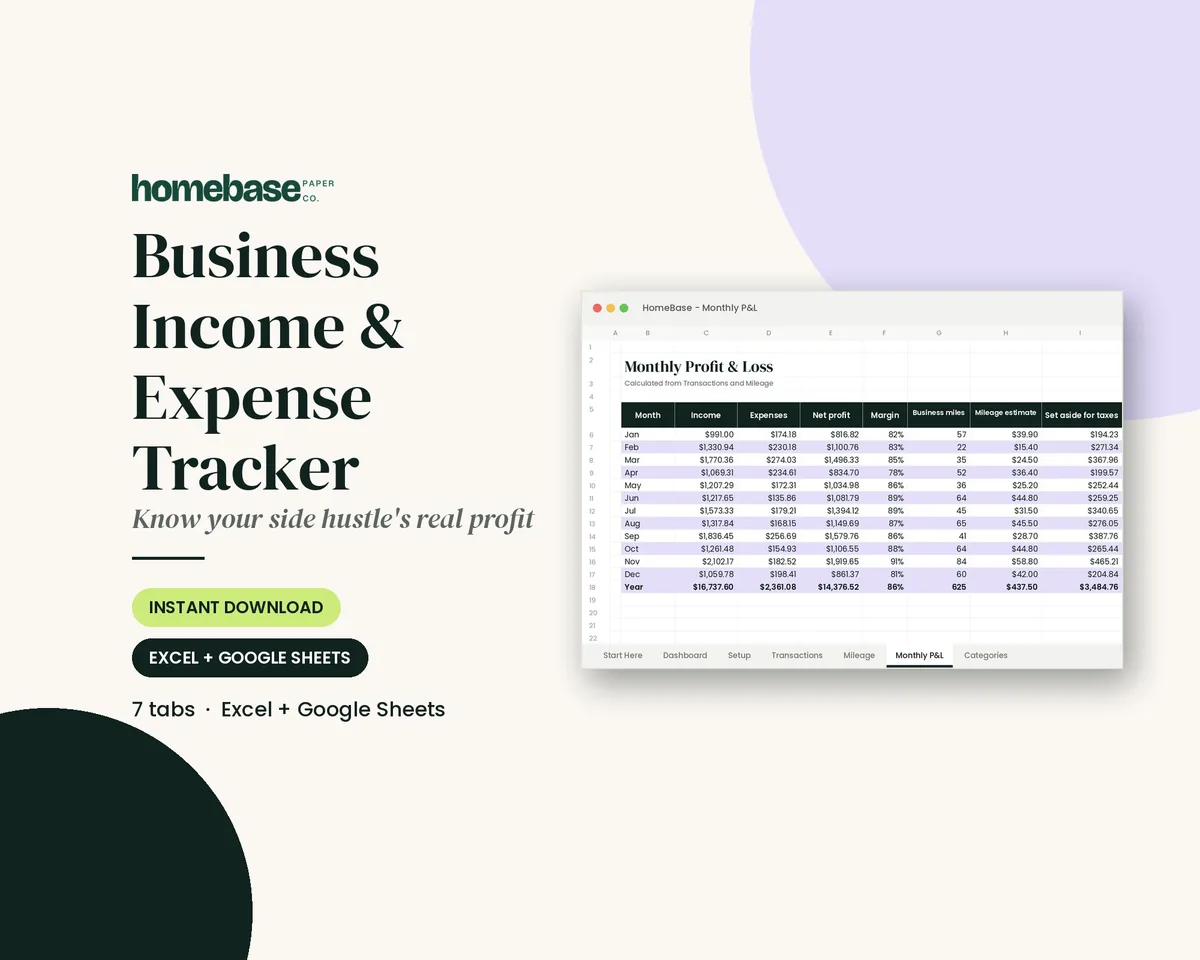
Once you start paying people back, you need one place where every reimbursed expense lands in the right category. Our Business Income & Expense Tracker ($7.99) is a spreadsheet for Excel and Google Sheets. It includes:
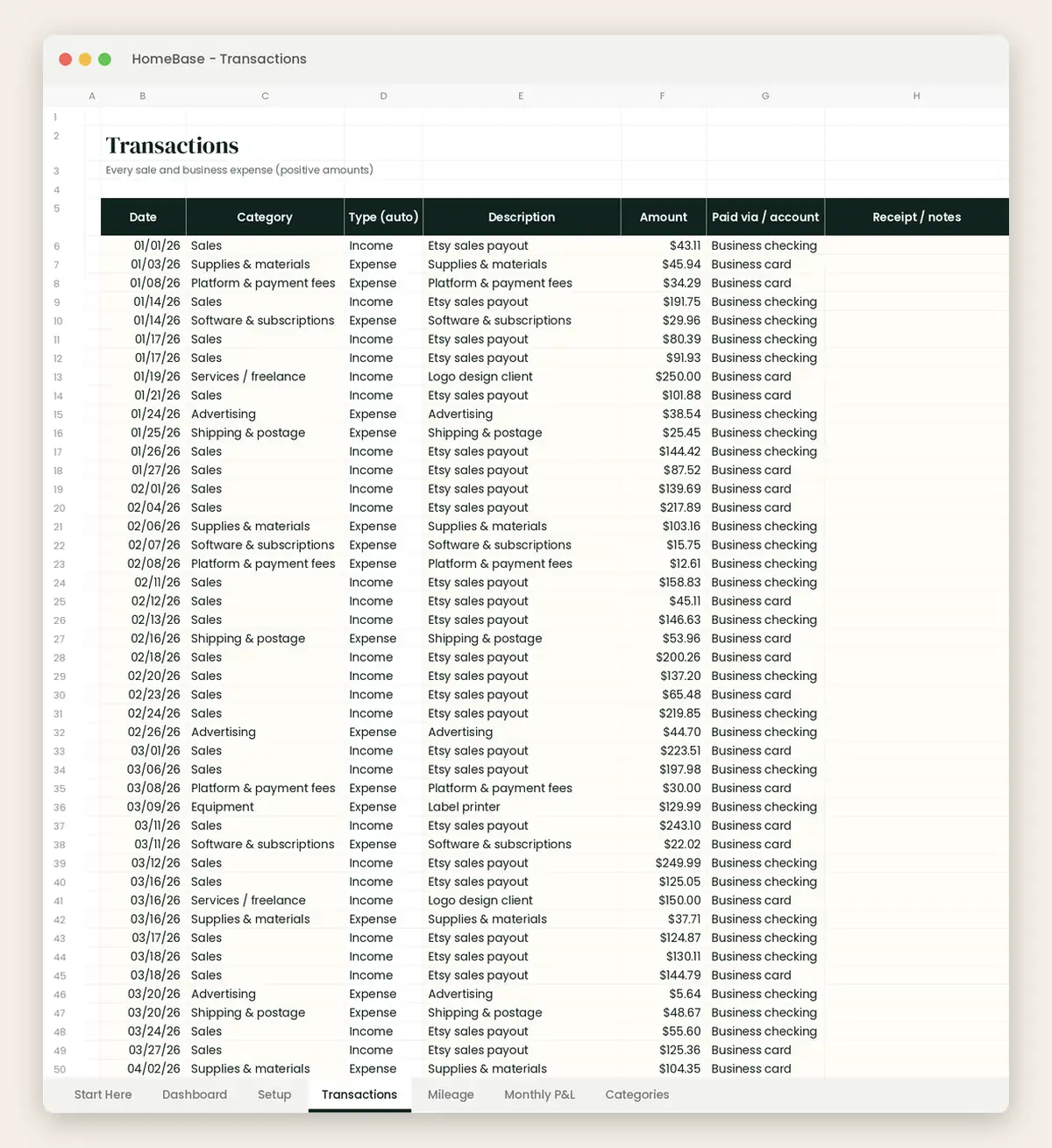
- A transaction log with a category dropdown, where the income or expense type fills in automatically
- A "paid via / account" column and a "receipt / notes" column, so you can note which employee was paid back and where the receipt is filed
- A mileage log with an estimated deduction, using a rate you set
- A monthly profit and loss, plus month and year totals by category
- A monthly tax set-aside estimate and a dashboard with a chart
It isn't a payroll system. It's a simple log for tidy records, and its totals are estimates, not tax advice. The mileage log uses one rate, so log your 2026 trips at 72.5 cents through June and work out July through December at 76 cents.
You can browse all our budget and business spreadsheets in Spreadsheets.
Keep the records after you pay
Keep each signed report with its receipts. Pub 463 says employees who turn in their records and get reimbursed generally don't have to keep their own copies. That means your business ends up holding the originals, so store them carefully. Our guide on how long to keep documents has a keep-or-shred list. Setting up an organizer for important documents can help you build a simple folder system.
Before HomeBase, I worked as an executive assistant and as an HR associate. I also grew up the oldest of three in Detroit, the one my family counted on to keep everything coordinated. A good process feels the same anywhere: everyone knows the rules, nobody has to chase anyone, and nobody wonders when they'll be paid back. Write your one page, walk your team through it and let the system do the work.
Make it easier
Tools for this
Spreadsheets
Business Income & Expense Tracker
Log sales, expenses and business miles - see your monthly profit, category totals for tax time and how much to set aside.

Spreadsheets
Annual Budget Spreadsheet
See exactly where your money goes every month - without complicated software.
Spreadsheets
Rental Property Tracker
Log rent and expenses once - see who has paid each month, cash flow per property and category totals for tax time.
Frequently asked questions
What is a small business expense reimbursement policy? A small business expense reimbursement policy is a one-page set of rules for paying employees back for work costs they cover themselves. It lists what's covered and what isn't, the proof required (receipts, dates and business purpose), who approves reports, the deadlines and how fast you pay. Written as an IRS accountable plan, it keeps reimbursements off employees' taxable wages. Pair it with a log like the Business Income & Expense Tracker ($7.99) so every reimbursed cost lands in the right category for your books.
What is an accountable plan reimbursement? An accountable plan reimbursement is a repayment of business expenses that isn't taxed as wages. IRS Publication 15 says the plan must require three things: the expense has a business connection, the employee substantiates it within a reasonable period, and any excess is returned within a reasonable period. When those rules are met, the reimbursement isn't subject to income tax withholding, Social Security, Medicare or FUTA tax, and it shouldn't appear in box 1 of the employee's W-2.
How do I reimburse employees for expenses? To reimburse employees for expenses, collect an expense report with receipts, approve it, pay the approved amount and record each line by category. Use one report format with the date, vendor, amount, category and business purpose of every expense, plus attendees for meals and miles for car trips. Pay it separately from wages if you can, or show it as a separate non-taxable line on the paycheck. Then log each expense in your books; the Business Income & Expense Tracker ($7.99) gives you a category dropdown and monthly totals for that.
Are employee expense reimbursements taxable? Employee expense reimbursements aren't taxable when you pay them under an accountable plan. Publication 15 says those amounts aren't wages and aren't subject to income, Social Security, Medicare or FUTA taxes. Reimbursements under a nonaccountable plan, such as a flat allowance with no receipts, are treated as supplemental wages and taxed. If an advance isn't substantiated or returned on time, the excess becomes taxable wages in the first payroll period after the reasonable period ends.
How long do employees have to submit an expense report? Under the IRS safe harbor, employees should account for expenses within 60 days after they're paid or incurred. Publication 15 also treats an advance as timely if it's paid within 30 days of the expense, and excess amounts as timely if they're returned within 120 days. Instead of fixed dates, you can send a statement at least quarterly and give employees 120 days to respond. Many small businesses set a tighter 30-day or monthly deadline to keep their books current.
What should an expense report include? An expense report should include the date, vendor, place, amount, category and business purpose of every expense, plus the receipt. Publication 463 says a restaurant receipt should show the restaurant's name and location, the number of people served, and the date and amount, so meal lines should also list who attended. Mileage lines need the date, start and end points, miles and purpose. Add the employee's name, any advance received, and signatures for the employee and the approver.
Do employees need receipts for every expense? Employees don't always need receipts, but they always need a record. Publication 463 says documentary evidence isn't needed for an expense under $75 other than lodging, or for a transportation expense when a receipt isn't readily available. The amount, date, place and business purpose still have to be recorded. Many small businesses require a receipt for everything anyway, because one simple rule is easier to follow than an exception.
What is the 2026 mileage reimbursement rate? The 2026 IRS business mileage rate is 72.5 cents per mile from January 1 through June 30 and 76 cents per mile from July 1 through December 31. Both come from the IRS standard mileage rates page; the 2025 rate was 70 cents. Reimbursing at or below the federal rate counts as accounted for, as long as employees still record the date, miles and business purpose. If your mileage log uses one rate, as the one in the Business Income & Expense Tracker does, figure the two halves of the year separately.
Can I give employees a flat monthly allowance instead? You can, but a flat allowance with no records is usually taxable wages. Publication 15 says payments are nonaccountable when employees aren't required to substantiate expenses or return unused amounts, or when you pay regardless of whether you expect real expenses. An allowance stays non-taxable only when it's tied to real business expenses and substantiated, for example mileage paid at or below the IRS rate with a trip log. If you pay more than the federal rate, the excess is reported as wages.
What happens if an employee doesn't return an unused advance? An unused advance that isn't returned within a reasonable period becomes taxable wages. Publication 15 says the amount beyond the substantiated expenses is treated as paid under a nonaccountable plan and is subject to income, Social Security, Medicare and FUTA taxes for the first payroll period after the reasonable period ends. The IRS safe harbor for returning excess is 120 days after the expense. A quarterly statement listing open advances helps you catch them in time.
Can a small business deduct employee reimbursements? A small business can generally deduct what it reimburses employees for business expenses. Publication 334 says how you deduct the reimbursement depends partly on whether you use an accountable or nonaccountable plan, and it points to Publication 15 for the details. The usual limits still apply on your side, such as the 50% limit on most business meals. Logging each reimbursed line by category, as the Business Income & Expense Tracker ($7.99) does, keeps those totals ready for tax time.
Can a sole proprietor reimburse themselves? A sole proprietor doesn't reimburse themselves, because the owner isn't an employee of the business. Publication 334 says that plainly. Instead, you deduct your ordinary and necessary business expenses directly on Schedule C. If your business is a corporation and you're on its payroll, an accountable plan may cover your expenses too, so ask your tax professional how it applies to your setup. Our small business tax deduction checklist covers the sole proprietor side.
Can employees deduct expenses I don't reimburse? Most employees can't deduct unreimbursed work expenses on their federal return right now. Publication 463 explains that miscellaneous itemized deductions subject to the 2% floor are suspended for tax years beginning after 2017, with narrow exceptions such as Armed Forces reservists and qualified performing artists. It also says an employee who could have been reimbursed but didn't claim it can't deduct that expense. That's one more reason a clear reimbursement policy matters to your team.
Should I pay reimbursements through payroll? You can pay reimbursements through payroll, but the reimbursement must be shown separately. Publication 15 says that if a single payment includes both wages and an expense reimbursement, you must specify the amount of the reimbursement. Most payroll providers can add a non-taxable reimbursement line. Many small businesses simply send a separate direct deposit or check, which keeps the record clean and avoids accidental withholding.
What expenses should a reimbursement policy exclude? A reimbursement policy should exclude personal costs, commuting, fines and anything that isn't an ordinary and necessary business expense. Common exclusions are traffic and parking tickets, personal items, upgrades, spouse or guest travel, and purchases that needed pre-approval and didn't get it. Publication 463 notes that reimbursing nondeductible costs, such as meals when someone works late without traveling, doesn't meet the business connection rule, so that part is treated as nonaccountable and taxable.
How long should I keep expense reports and receipts? Keep expense reports and receipts for as long as they support your tax return, which is generally at least 3 years after you file and longer in some cases. Publication 463 says employees who turn in their records and get reimbursed generally don't need to keep copies, so the business holds the originals. Store each signed report with its receipts by month. Our guide on how long to keep documents has a simple keep-or-shred list.
Is there a template for tracking reimbursed business expenses? Yes, a business expense spreadsheet with a notes column works well for tracking reimbursements. Our Business Income & Expense Tracker ($7.99) for Excel and Google Sheets has a transaction log with a category dropdown, a paid via column, a receipt and notes column, a mileage log, a monthly profit and loss and year totals by category. If you just want a basic log to start, our free small business expense spreadsheet covers the date, category, amount and receipt columns.
More from HomeBase
You may also like

Printables
Budget Planner Printable
Twelve undated pages you can print every month: budget, bills, spending, savings and debt.

Spreadsheets
Bill Tracker Spreadsheet
Bills due in 3 days or less light up red, so nothing slips through.

Spreadsheets
Sinking Funds Tracker
It does the math: how much to set aside each month to hit every goal on time.

Spreadsheets
Paycheck Budget Spreadsheet
Enter your bills once. The sheet tells you which paycheck pays each one, all year.
 Club
Monthly club
Money Club
Anyone who wants a clear plan for the month's bills, holiday spending and savings.
Free printable
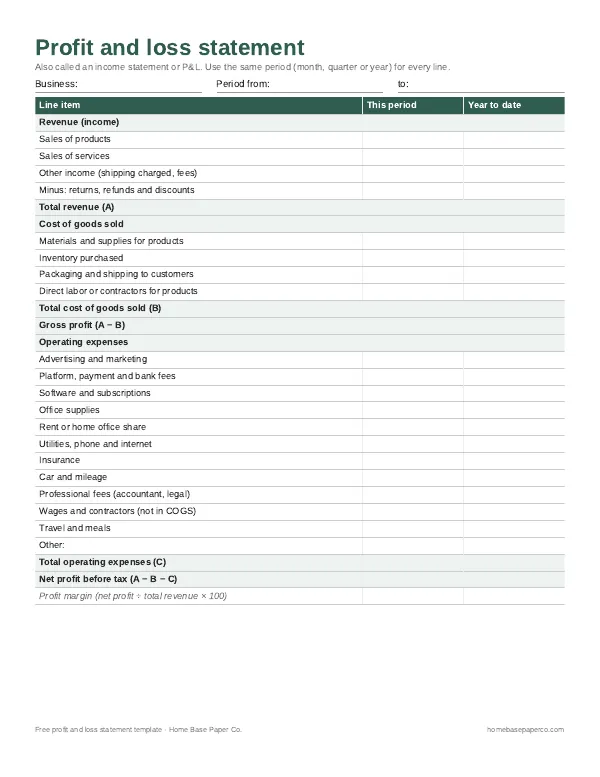
Know your real profit: get the free P&L template
A printable profit and loss statement that walks through revenue, costs and expenses line by line for any month, quarter or year. You'll also get our weekly HomeBase email with simple small business paperwork and money tips.