The short answer: the standard deduction for 2026 is $16,100 if you are single, $32,200 if you are married filing jointly and $24,150 if you are head of household. It is the flat amount the IRS lets you subtract from your income before tax is figured, and you take it unless your itemized deductions add up to more.
- 2025 returns (filed in 2026): $15,750 single, $31,500 joint, $23,625 head of household
- 65 or older or blind: add $1,650 each, or $2,050 if unmarried
- New for 2025 to 2028: an extra $6,000 senior deduction per person 65+
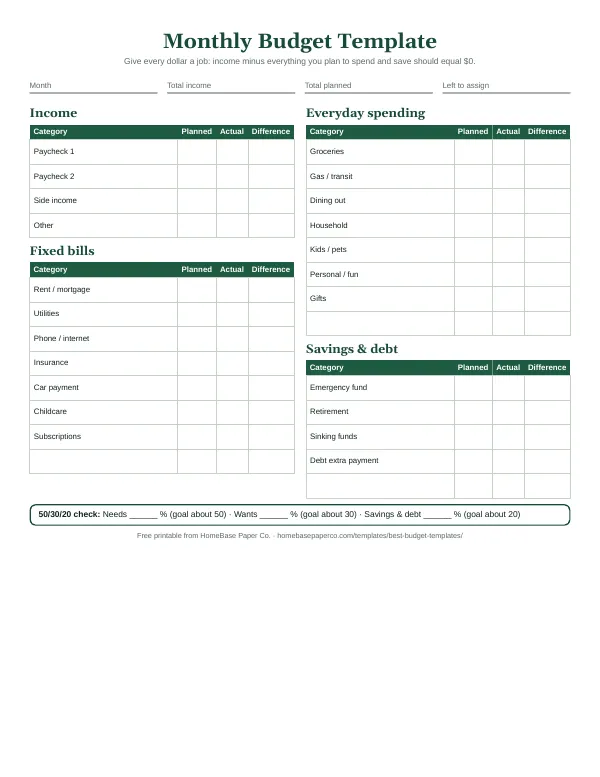
- Free help: grab the personal financial statement template to see your full money picture
- Next step: Plan the year's taxes and spending in the Annual Budget Spreadsheet ($6.99).
Our picks for standard deduction
Spreadsheets
Annual Budget Spreadsheet
See exactly where your money goes every month - without complicated software.

Printables
Budget Planner Printable
Twelve undated pages you can print every month: budget, bills, spending, savings and debt.

Spreadsheets
Business Income & Expense Tracker
Log sales, expenses and business miles - see your monthly profit, category totals for tax time and how much to set aside.
Checked November 4, 2026 against IRS Revenue Procedure 2025-32 and IRS Topic 551. Tax rules change; check the IRS pages in Sources before you file.
Standard deduction amounts for 2026 and 2025
The standard deduction goes up most years for inflation. The 2025 tax law also raised it, so any chart showing $15,000 for a single filer is already out of date. Here are the current numbers.
| Filing status | Tax year 2025 (file in 2026) | Tax year 2026 (file in 2027) |
|---|---|---|
| Single | $15,750 | $16,100 |
| Married filing separately | $15,750 | $16,100 |
| Married filing jointly | $31,500 | $32,200 |
| Qualifying surviving spouse | $31,500 | $32,200 |
| Head of household | $23,625 | $24,150 |
The 2026 amounts are from IRS Revenue Procedure 2025-32, section 4.14. You will use them on the return you file in early 2027.
Extra amounts for age 65+ and blindness
If you are 65 or older at the end of the year, or blind on the last day of the year, you get an additional standard deduction on top of the basic amount. IRS Topic 551 explains that you count as 65 on the day before your 65th birthday.
| Situation (tax year 2026) | Extra per qualifying condition |
|---|---|
| Married (joint or separate) or surviving spouse | $1,650 per person, per condition |
| Single or head of household | $2,050 per condition |
So a single 66-year-old in 2026 would have a standard deduction of $16,100 + $2,050 = $18,150. A married couple who are both over 65 would have $32,200 + $1,650 + $1,650 = $35,500.
The separate $6,000 senior deduction
From 2025 through 2028, people 65 and older can also take a new deduction of up to $6,000 each, or $12,000 for a couple who both qualify. The IRS's Working Families Tax Cuts page says it phases out once modified adjusted gross income is over $75,000 ($150,000 for joint filers). You can claim it whether you itemize or take the standard deduction, but you need a valid Social Security number and married couples must file jointly.
Standard deduction vs itemizing: how to choose
You get one or the other, so take whichever is bigger. Most households take the standard deduction because their itemized deductions do not add up to more. IRS Topic 501 lists what can be itemized on Schedule A.
- Add up your possible itemized deductions. The common ones are mortgage interest, state and local taxes up to the cap, charitable gifts, and medical bills above 7.5% of your adjusted gross income.
- Compare the total with your standard deduction, including any 65+ or blindness amounts.
- Pick the larger number. If they are close, itemizing takes more paperwork, so the standard deduction is often the easier win.
- Check the married filing separately rule. If one spouse itemizes, the other must itemize too.
- Re-check every year. A new mortgage, a big donation year or large medical bills can flip the answer.
Our tax deductions list walks through what counts if you are near the line. Self-employed? Business expenses are deducted on Schedule C whether or not you itemize, so see the small business tax deduction checklist.
How much the standard deduction actually saves
A deduction lowers your taxable income, not your tax bill directly. The savings depend on your top tax bracket. For 2026, the first $12,400 of a single filer's taxable income is taxed at 10%, the next slice up to $50,400 at 12%, and the next up to $105,700 at 22%.
| Filing status (2026) | Standard deduction | Saved at 12% | Saved at 22% |
|---|---|---|---|
| Single | $16,100 | about $1,932 | about $3,542 |
| Married filing jointly | $32,200 | about $3,864 | about $7,084 |
| Head of household | $24,150 | about $2,898 | about $5,313 |
These are rough figures that assume the whole deduction falls in one bracket. Your real savings depend on your full return.
Example: a single filer earning $55,000
A single filer with a $55,000 salary and no other income subtracts the $16,100 standard deduction, which leaves $38,900 of taxable income. That puts their top dollars in the 12% bracket. If their itemized deductions were only $6,000, itemizing would cost them about $1,212 more in tax, so the standard deduction is the clear choice.
Special rules: dependents, teens and who can't take it
- Dependents. If someone else can claim you, your standard deduction is the greater of $1,350 or your earned income plus $450, up to the normal amount. A teen who earns $5,000 at a summer job has a $5,450 deduction, so they owe no federal income tax on it. See our guide to jobs for 14 year olds for first-job ideas.
- Married filing separately. If your spouse itemizes, you must itemize too.
- Not allowed. Nonresident aliens (with a few exceptions), short-year returns, and estates, trusts and partnerships cannot use it.
Plan your tax year in a budget
Knowing your standard deduction helps you estimate what you will owe or get back. That lets you budget your refund, or set money aside, before tax season.
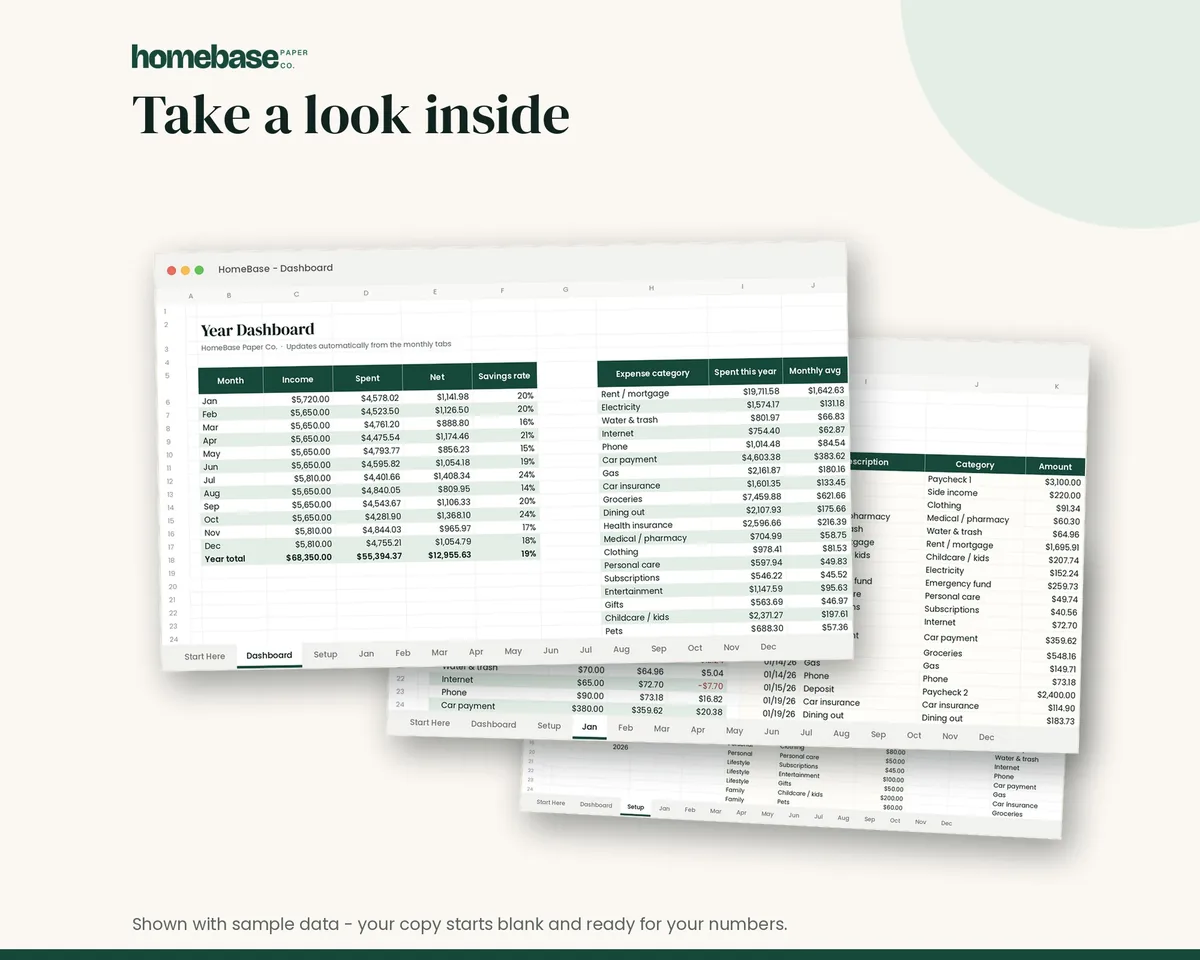
- Annual Budget Spreadsheet ($6.99): a full-year view, so you can plan for tax payments and refunds.
- Budget Planner Printable ($5.99): monthly pages for tracking where your refund or tax savings go.
- Small Business Income & Expense Tracker ($7.99): for side hustlers who need clean Schedule C numbers.
For more, read how Social Security works or learn how to read a pay stub, or browse all printable planners.
Annual Budget Spreadsheet
See exactly where your money goes every month - without complicated software.
$6.99 · Instant download. Print at home or fill it in on screen. Or browse the full Budget & Money collection.
Frequently asked questions
What is the standard deduction for 2026? For tax year 2026, the returns most people file in early 2027, the IRS set the standard deduction at $16,100 for single filers and married couples filing separately, $32,200 for married couples filing jointly and qualifying surviving spouses, and $24,150 for heads of household. The amounts come from IRS Revenue Procedure 2025-32.
What is the standard deduction for 2025 taxes? For tax year 2025, the returns filed in early 2026, the standard deduction is $15,750 for single and married filing separately, $31,500 for married filing jointly and $23,625 for head of household. These were raised by the 2025 tax law, so older charts showing $15,000 for single filers are out of date.
Should I take the standard deduction or itemize? Take the standard deduction unless your itemized deductions add up to more. Add up what you could itemize, such as mortgage interest, state and local taxes up to the cap, charitable gifts and large medical bills, and compare the total with your standard deduction. Most households come out ahead with the standard deduction, especially since it was raised in 2025.
How much is the extra standard deduction for people 65 and older? For 2026 the additional standard deduction is $1,650 per person who is 65 or older or blind, or $2,050 if you are unmarried and not a surviving spouse. Someone who is both 65 and blind gets the extra amount twice. This is separate from the new $6,000 senior deduction, which you can claim on top of it.
What is the new $6,000 senior deduction? From 2025 through 2028, each person 65 or older can deduct an extra $6,000, or $12,000 for a married couple who both qualify. It phases out above $75,000 of modified adjusted gross income, or $150,000 on a joint return. You need a valid Social Security number, married people must file jointly, and you can claim it whether or not you itemize.
What is the standard deduction if someone can claim me as a dependent? If you can be claimed as a dependent, such as a teen with a part-time job, your standard deduction is limited to the greater of $1,350 or your earned income plus $450, but never more than the normal amount for your filing status. That is why many working teens owe no federal income tax on small summer earnings.
Does the standard deduction reduce my taxes dollar for dollar? The standard deduction does not reduce your taxes dollar for dollar. A deduction lowers the income that gets taxed, not the tax itself. If you are in the 12% bracket, a $16,100 standard deduction saves about $1,932 in federal income tax. A credit, such as the Child Tax Credit, is the kind of break that comes off your tax bill dollar for dollar.
Can married couples filing separately both take the standard deduction? Married couples filing separately can both take the standard deduction only if neither spouse itemizes. The IRS rule is that if one spouse filing separately itemizes, the other must itemize too, even if their standard deduction would have been larger. Couples who file separately should decide together which method each will use before either return goes in.
Who cannot take the standard deduction? You cannot take it if you are married filing separately and your spouse itemizes, if you were a nonresident or dual-status alien for the year (with a few exceptions), if you are filing a short-year return because you changed your accounting period, or if the return is for an estate, trust, common trust fund or partnership.
Do I still need to keep receipts if I take the standard deduction? You do not need receipts to claim the standard deduction itself, but keep your W-2s, 1099s and records for any credits or above-the-line deductions you claim. If you are close to the itemizing line, tracking mortgage interest, property tax and giving all year tells you which way to file without a scramble in April.
When will the IRS announce the 2027 standard deduction? The IRS usually publishes the next year's inflation-adjusted amounts in October or November. As of early November 2026 the 2027 figures were not on this page yet, so use the 2026 numbers for planning and check the IRS newsroom before you budget for the following year.
Does my state use the same standard deduction? Many states don't use the same standard deduction as the federal return. Some states start from the federal amount, some set their own smaller deduction and some have no income tax at all. Check your state revenue department's instructions for the form you file, and budget for state tax separately from the federal number on this page.
Free printable
Give every dollar a job: get the free monthly budget template
A printable zero-based monthly budget: income, bills, everyday spending and savings on one page, with a planned vs. actual column. You'll also get our weekly HomeBase email with simple budgeting and bill-paying tips.