The short answer: This tax deductions list covers the deductions most individuals and families can claim on their 2026 return, which you file in early 2027. It starts with the standard deduction, then lists itemized deductions, deductions you can take without itemizing, and the new tips, overtime, car loan and senior deductions. Use it as a checklist when you gather your paperwork.
- 2026 standard deduction: $16,100 single, $32,200 married filing jointly, $24,150 head of household
- Itemize only if your itemized total beats that amount
- Self-employed? Get the free small business expense spreadsheet (we email it to you)
- Next step: track deductible costs all year in the Annual Budget Spreadsheet ($6.99).
Our picks for tax deductions list

Spreadsheets
Annual Budget Spreadsheet
See exactly where your money goes every month - without complicated software.
 Save 57%
Bundles
Ultimate Budget Bundle
All 6 spreadsheets + both printable planners - for less than half the price of buying them separately.
It is general education, not tax advice.
Tracking deductible expenses all year makes tax time easier. The Annual Budget Spreadsheet has categories for medical, charity and work costs, and the Ultimate Budget Bundle adds bill and savings trackers.

Standard deduction amounts for 2026
Most people take the standard deduction. Here are the amounts from the IRS 2026 inflation adjustments.
| Filing status | 2025 standard deduction | 2026 standard deduction |
|---|---|---|
| Single or married filing separately | $15,750 | $16,100 |
| Married filing jointly | $31,500 | $32,200 |
| Head of household | $23,625 | $24,150 |
People who are 65 or older, or blind, get an additional standard deduction on top of these amounts.
Itemized deductions list
You can itemize instead of taking the standard deduction. It only helps if your itemized total is higher. IRS Tax Topic 501 explains how to compare the two.
- Mortgage interest on a home loan for your main or second home, within IRS limits.
- State and local taxes (SALT), including property tax and either income or sales tax, up to a cap.
- Charitable gifts to qualified charities, with receipts.
- Medical and dental costs above 7.5% of your adjusted gross income.
- Casualty and theft losses from a federally declared disaster.
- Gambling losses, up to the amount of gambling winnings you report.
The SALT cap and other limits changed under the 2025 tax law, so check the current numbers on IRS.gov for the year you are filing.
Deductions you can take without itemizing
These are often called above-the-line deductions or adjustments to income. You can take them and still use the standard deduction. Once you know your taxable income, check the 2026 tax brackets to see which marginal rate applies. For more on this topic, see our tax planning guides.
- Student loan interest: up to $2,500 a year, with income limits.
- Traditional IRA contributions: may be deductible, depending on income and workplace plans.
- Health savings account (HSA) contributions: if you have a high-deductible health plan.
- Half of self-employment tax: for freelancers and business owners.
- Self-employed health insurance premiums.
- Educator expenses: for eligible teachers who buy classroom supplies.
New deductions for 2025 through 2028
The 2025 tax law added four temporary deductions. The IRS summary for individuals and workers lists the details. You can claim each one whether or not you itemize.
| Deduction | Maximum per year | Phaseout starts (MAGI) |
|---|---|---|
| Qualified tips | $25,000 | $150,000 ($300,000 joint) |
| Qualified overtime pay | $12,500 ($25,000 joint) | $150,000 ($300,000 joint) |
| Car loan interest on a qualifying new vehicle | $10,000 | $100,000 ($200,000 joint) |
| Seniors 65 and older | $6,000 per person | $75,000 ($150,000 joint) |
Each one has rules. For example, the car loan deduction only covers loans taken out after 2024 for new personal vehicles with final assembly in the United States. The overtime deduction only covers the extra "half" in time-and-a-half pay.
Tax deductions for small business owners
If you are self-employed or run a side business, you may also deduct business expenses. These include supplies, a home office, business mileage and software. See our small business tax deduction checklist for the business list, and our mileage log for taxes to track drives.
Tax deductions vs. tax credits
A deduction and a credit are not the same thing. A deduction lowers the income that gets taxed. If you are in the 12% bracket, a $1,000 deduction saves you about $120. A credit lowers your tax bill dollar for dollar, so a $1,000 credit saves you $1,000. Common credits include the child tax credit, education credits and the earned income tax credit. Check both lists when you file.
How to keep track of your deductions
- Save receipts for charity, medical and work costs in one folder as you go.
- Keep year-end forms like Form 1098 for mortgage interest and Form 1098-E for student loans.
- Write down mileage and dates for any business or charity driving.
- Review last year's return so you don't forget a deduction you used before.
- Use our tax documents checklist before you file.
Rules change often, and every situation is different. For questions about your own return, talk with a tax professional or use the free tools on IRS.gov.
Track income, expenses and profit in one sheet
See exactly where your money goes every month - without complicated software.
$6.99 · Instant download. Print at home or fill it in on screen. Or browse the full Budget & Money collection.
Frequently asked questions
What is on the list of common tax deductions? A tax deductions list for individuals usually includes the standard deduction, mortgage interest, state and local taxes, charitable gifts and large medical bills for people who itemize. It also includes deductions anyone can take, such as student loan interest, traditional IRA and HSA contributions, and, for 2025 through 2028, the new deductions for tips, overtime, car loan interest and seniors.
What is the standard deduction for 2026? For tax year 2026, the returns you file in early 2027, the IRS standard deduction is $16,100 for single filers and married people filing separately, $32,200 for married couples filing jointly, and $24,150 for heads of household. People who are 65 or older or blind get an extra amount on top of these, and many seniors can also claim the new $6,000 senior deduction.
Should I itemize or take the standard deduction? Add up your itemized deductions, such as mortgage interest, state and local taxes, charitable gifts and medical costs above the limit. If the total is more than your standard deduction, itemizing usually lowers your tax more. If it is less, take the standard deduction. Tax software will usually run this comparison for you, and the IRS has a free tool to help.
Can I take the new tips and overtime deductions without itemizing? Yes, according to the IRS, the new deductions for qualified tips, qualified overtime pay, car loan interest on qualifying new vehicles and the extra senior deduction are available whether you itemize or take the standard deduction. Each one has its own limits, income phaseouts and rules, so check the details on IRS.gov or with a tax professional before you file.
Free printable
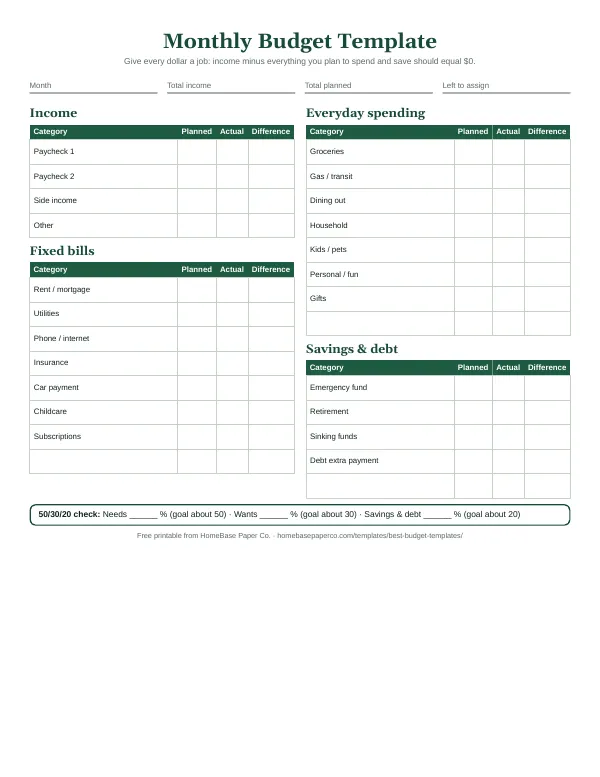
Give every dollar a job: get the free monthly budget template
A printable zero-based monthly budget: income, bills, everyday spending and savings on one page, with a planned vs. actual column. You'll also get our weekly HomeBase email with simple budgeting and bill-paying tips.