

The short answer: if you're behind on bills, rank every bill by what it protects and pay those first. Then call each company you can't pay in full before the due date and ask for a hardship plan.
- Pay first: housing, then utilities, then what gets you to work, essential insurance and court-ordered payments
- List each bill with: the normal amount, past-due amount, next due date and any late fee or shutoff date
- Don't take on new debt to pay old debt, and write down the plan
- Catch up one bill at a time, using assistance programs for the biggest bills
- Next step: Plan it with the Bill Tracker Spreadsheet ($4.99).
If you're behind on bills, start by listing every bill and ranking it by what it protects: your housing, your income, your insurance and anything a court ordered. Pay those first. Then call every company you can't pay in full before the due date, ask for a hardship plan, apply for any help you qualify for and track each payment until you're caught up. That's the whole plan. The rest of this guide walks you through it step by step, with tables you can copy.
I'm Malaysia. I grew up in Detroit, the oldest of three, in a working family that rebuilt after 2008. I know that a tight month isn't a character flaw. It's a math problem, and math problems get easier when everything is written down in one place. So let's write it down.
What to pay first
The Consumer Financial Protection Bureau's prioritizing bills worksheet puts it simply: identify what you need to pay to protect your housing and income, keep your insurance and meet any court-ordered obligations. It also warns against paying the "squeakiest wheel," the company that calls the most, just because it's loud.
Here's that idea as a quick-reference table.
| Priority | Bill type | Examples | What's at risk if it's late |
|---|---|---|---|
| 1 | Housing | Rent, mortgage, property taxes, lot rent | Late fees, eviction or foreclosure |
| 2 | Utilities | Electric, gas, water, sewer, trash | Shutoff plus reconnection fees |
| 3 | Getting to work | Car payment, gas, bus fare, work tools | Repossession, losing your income |
| 4 | Essential insurance | Car, health, renters or home insurance | Losing coverage when you need it |
| 5 | Court-ordered payments | Support orders, court fines and fees | Legal consequences |
| 6 | Unsecured bills | Credit cards, medical bills, personal loans | Late fees, credit damage, higher interest |
| 7 | Nice-to-haves | Streaming, apps, memberships | Nothing serious. Pause or cancel |
Your order might be a little different. If you work from home, your internet bill may belong up near utilities. If you don't drive, the car payment drops. The point is to decide on purpose, not by whoever calls first.
Step 1: Make one list of every bill
You can't rank bills you can't see. Pull your last two months of bank and card statements, every paper bill and every overdue notice, and put everything on one page.
For each bill, write down:
- Name of the company and its phone number
- Normal monthly amount
- Past-due amount, if any
- Next due date
- What it protects: home, income, insurance, legal or "other"
- Any late fee or shutoff date printed on the notice
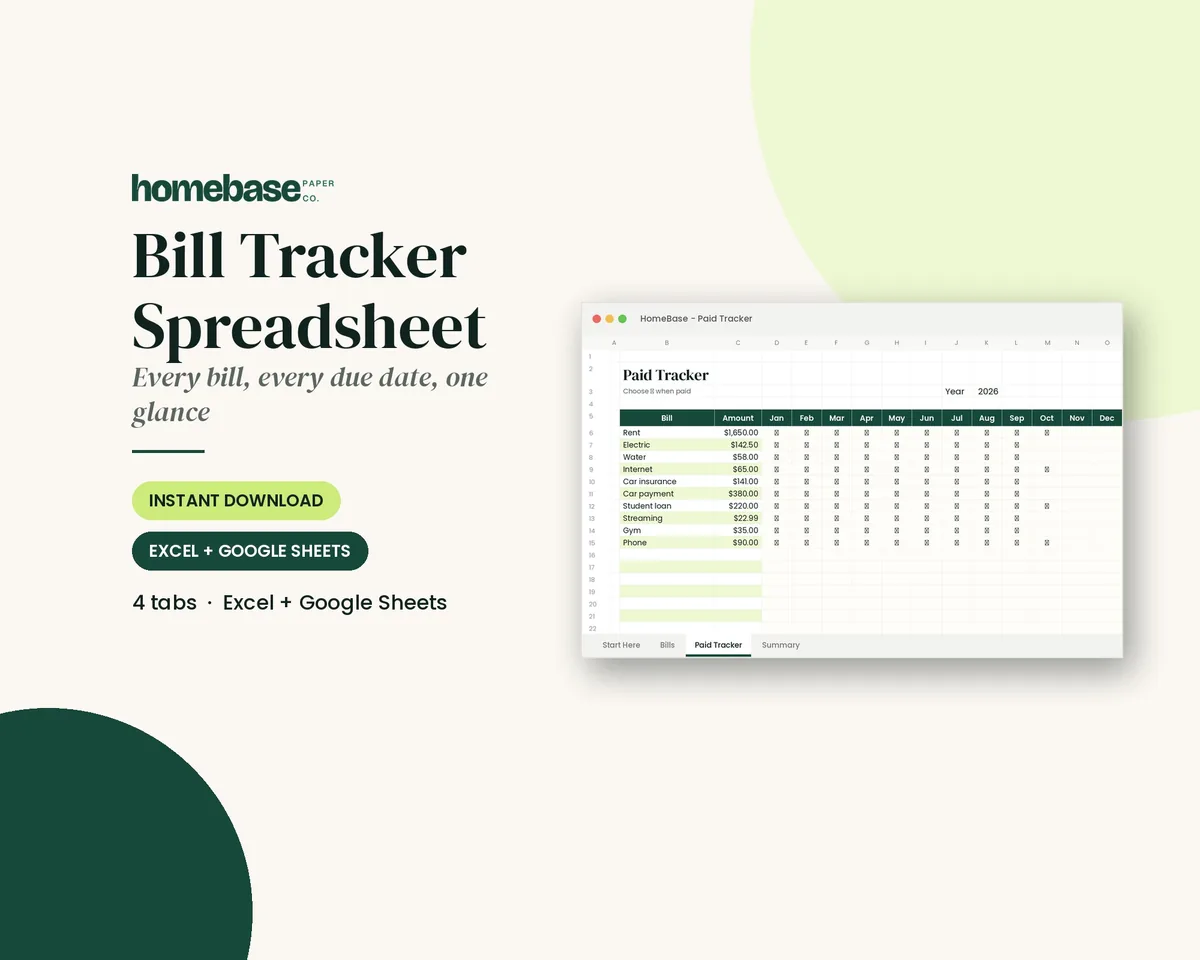
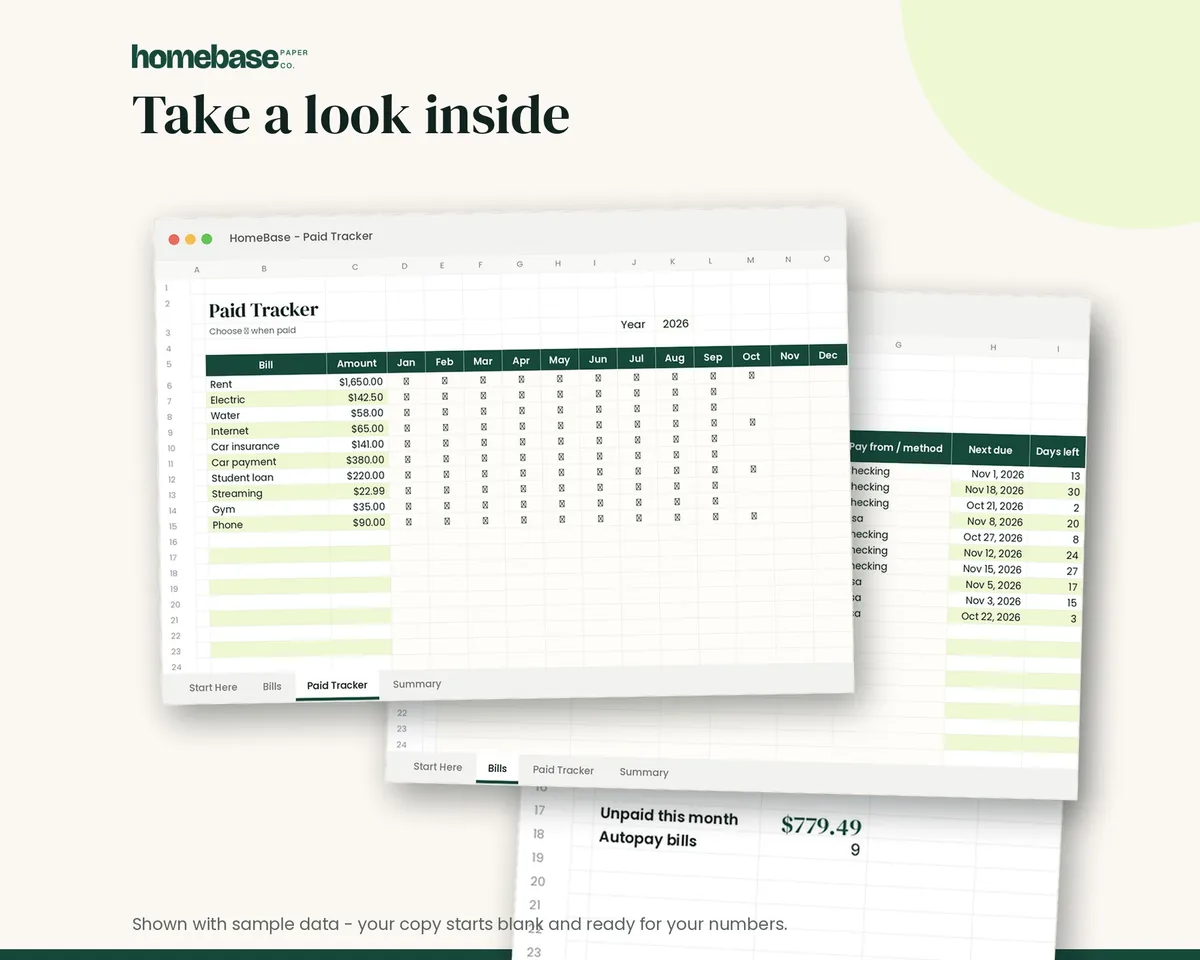
This is exactly what the Bill Tracker Spreadsheet ($4.99) is built for. You enter each bill once with its category and autopay status, and it calculates the next due date and the days left. Bills due in three days or less turn red, and a 12-month paid tracker with checkmarks shows what you've paid and what's still open each month. It works in Excel and Google Sheets.
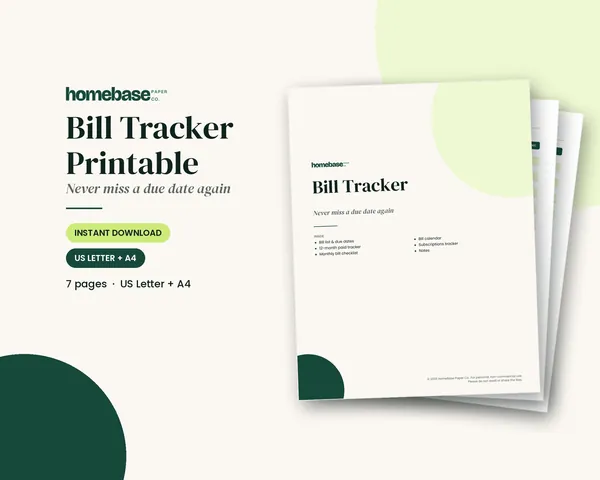
If you'd rather work on paper, the Bill Tracker Printable ($3.49) has a My Bills list, a 12-month paid tracker, a monthly bill checklist, a bill calendar and a subscriptions page. Both are on our spreadsheets and printables pages if you want to compare.
Step 2: Find out exactly how much money you have
Next, write down every dollar coming in before your next few due dates. Include paychecks, side income, benefits and any support you receive. Then line up each paycheck with the bills due before the next one.
| Paycheck date | Amount | Bills due before next paycheck | Total due | Left over (or short) |
|---|---|---|---|---|
| Example: the 5th | $1,200 | Rent, phone | $1,150 | $50 |
| Example: the 19th | $1,200 | Car, electric, insurance | $780 | $420 |
The numbers above are only an example. Your own table will show you two things fast: which paychecks are tight, and how big the gap really is. Sometimes "I'm drowning" turns out to be a $200 shortfall on one paycheck, which is a very different problem from being $200 short every month.
If you get paid every week or every two weeks, the Paycheck Budget Spreadsheet ($5.99) does this for you. You enter your bills once, it calculates your pay dates for the year, assigns each bill to the right paycheck and shows what's left to spend from each one. Our paycheck budget planner guide shows how it works.
Step 3: Rank your bills and build a short-term plan
Now put a number next to every bill using the priority table above. Then fill in a short-term plan like this one for the next 30 days. If winter utility costs are part of the shortfall, review these ways to lower your heating bill before the next bill arrives.
| Bill | Priority | Amount due | What I'll pay | When | Call needed? |
|---|---|---|---|---|---|
| Rent | 1 | Full | |||
| Electric | 2 | Full or partial | Yes, ask about a plan | ||
| Car payment | 3 | Full | |||
| Car insurance | 4 | Full | |||
| Credit card | 6 | Minimum or less | Yes, ask about hardship | ||
| Streaming | 7 | $0 (paused) | No |
A few rules of thumb help here:
- Keep top-priority bills fully current whenever you can. A partial rent payment may still mean a late fee or a notice.
- Pause or cancel every "nice-to-have" until you're caught up. The subscriptions page in the Bill Tracker Printable makes these easy to spot.
- Don't take on new debt to pay old debt without reading every fee and rate. A high-cost loan can turn one tight month into several.
- Write down the plan. Decisions you make once on paper are easier to follow than decisions you remake every time a bill arrives.
Step 4: Call creditors before the due date
This is the step most people skip, and it's often the one that helps the most. The CFPB's worksheet says not to ignore bills you can't pay. If you must miss a payment, call the company, tell them you'll miss it and explain why.
If a collector contacts you about a debt you do not recognize, send a debt validation letter within 30 days. Our free template makes it easy. For other letters to lenders or landlords, start from our letter template.
For credit cards, the CFPB's guide on what to do if you can't pay your credit card bills says to contact your card company right away and explain:
- why you can't pay the minimum,
- how much you can afford to pay,
- when you could restart your normal payments, and
- what new payment amount you're asking for, and for how long.
That four-part script works for almost any bill. Here's how it might look on a call log:
| Company | Date called | Person I spoke with | What they offered | Confirmation # | Follow-up date |
|---|---|---|---|---|---|
| Electric company | |||||
| Card issuer |
Things you can ask for (not every company will say yes, but it costs nothing to ask):
- A payment plan that spreads a past-due balance over several months
- A new due date that lines up with your paycheck
- A temporary lower payment or hardship program
- A waived late fee, especially if you've usually paid on time
- A written confirmation of whatever you agree to
Write every agreement into your tracker the same day, with the new amount and date, so the plan doesn't live only in your memory.
How being behind affects your credit, and for how long
Calling early matters partly because of your credit report. Late payments can be reported to the credit bureaus, and the CFPB says a credit reporting company generally can report most negative information for seven years. The damage fades as the entry ages and as you add on-time payments, so catching up now and keeping every bill current afterward is the practical fix.
Not every bill shows up there. Rent, utilities and phone bills often don't appear on your credit report unless the account goes to collections, but a late fee or shutoff can still hit your budget and your housing. For cards and loans, ask the lender before the due date what they will report, and get any agreement in writing. To see what is on your file today, follow our guide to checking your credit report, and see how to build credit once you're caught up.
Step 5: Get help with the biggest bills
You don't have to close the whole gap by yourself. A few kinds of help are worth checking right away.
If most of what you owe is on credit cards, a nonprofit credit counselor may suggest a debt management plan, which rolls those cards into one monthly payment, often at a lower interest rate.
Energy bills. The federal Low Income Home Energy Assistance Program (LIHEAP) helps eligible households with heating and cooling bills, energy crises, shutoffs and reconnecting service. You apply through your state or local agency. The program's page points to EnergyHelp.us and the National Energy Assistance Referral line at 1-866-674-6327. It also notes that LIHEAP never charges a fee to receive a benefit, so apply directly through your state or local agency.
Local help. Dialing 211 can connect you with local programs for rent, utilities and food in many areas. Your utility company may also have its own payment-assistance or budget-billing program, so ask on the same call where you ask for a payment plan.
Credit counseling. A reputable credit counselor can review your full budget and help you build a plan. The CFPB notes that many credit counseling organizations are nonprofits, but you should still ask whether you'll be charged, how much and for what.
Choose debt relief help carefully. The FTC's guide to getting out of debt is clear: a reputable company won't ask you to pay upfront before it settles any of your debts or enrolls you in a debt management plan, and no one can guarantee to settle all your debts. The FTC also points to credit unions, universities, U.S. Cooperative Extension Service branches and military personal financial managers as places that may offer low-cost counseling.
Step 6: Catch up one bill at a time
Once this month is covered, you can start shrinking what's past due. Keep it simple:
- Stay current first. Pay this month's priority bills in full so you don't fall further behind.
- Pick one past-due balance to focus on. Many people start with the one that has a shutoff date or the highest late fees. For more on this topic, see our bills hub.
- Add whatever extra you can, even $20 a paycheck, to that one balance.
- When it's cleared, roll that payment to the next past-due bill.
- Check it off in your tracker every time. Watching the list shrink is real motivation.
If you're also carrying credit card or loan balances, the Debt Payoff Planner ($6.99) handles up to 10 debts. You pick snowball or avalanche, add any extra payment, and it shows the payoff month for every debt and your debt-free date. Not sure which method fits? Read debt snowball vs. avalanche.
Here's a simple catch-up tracker you can copy:
| Past-due bill | Balance owed | Agreed extra payment | Payments made | Cleared? |
|---|---|---|---|---|
| Electric | ||||
| Card | ||||
| Medical |
Step 7: Build a system so you don't fall behind again
Catching up is the hard part. Staying caught up is mostly a habit. Pick the pieces that fit your life:
Start with a free bill calendar so every due date and payday sits on one page.
- One weekly money check. Ten minutes on the same day every week to look at what's due, what's paid and what's red.
- Bills matched to paychecks. Every bill gets assigned to a specific paycheck so nothing sneaks up on you.
- Due dates that make sense. Once you're current, ask companies to move due dates closer to your paydays.
- A small cushion. Even a little money set aside makes the next surprise bill less scary. Our emergency fund tracker guide shows one way to start.
- Lower bills where you can. See how to lower your monthly bills for calls worth making once things are steady.
For the weekly system itself, our guide on how to organize bills covers the full setup: one list, one calendar and one weekly check.
Spreadsheet or printable: which tracker fits?
| Bill Tracker Spreadsheet | Bill Tracker Printable | |
|---|---|---|
| Price | $4.99 | $3.49 |
| Format | Excel and Google Sheets | 7-page PDF, US Letter and A4 |
| Due-date math | Automatic next due date and days left | You write dates on the bill calendar |
| Alerts | Bills due in 3 days or less turn red | Visual check on paper |
| Paid tracking | 12-month tracker with checkmarks | 12-month paid tracker and monthly checklist |
| Extras | Paid and unpaid totals, spending by category with a chart | Subscriptions page and notes |
| Best for | People who want the math done for them | People who like to see and check off bills by hand |
Want the whole set? The Ultimate Budget Bundle ($19.99) includes both bill trackers plus the Paycheck Budget Spreadsheet, the Debt Payoff Planner and four more budgeting tools. You can see all of our bundles and the full money collection too.
A quick word on stress
Being behind on bills is heavy. The letters, the calls and the math all pile up. What helps is moving from a pile to a plan: one list, one ranked order, one call log and one tracker you check every week. You don't have to fix everything today. You only have to know what you're paying next, and why.
These templates help you organize your own numbers. They aren't financial, tax or legal advice, so for complicated situations like a lawsuit, wage garnishment or a foreclosure notice, talk with a qualified professional, a HUD-approved housing counselor or a legal aid office near you.
Get the Bill Tracker Spreadsheet ($4.99) or get the Bill Tracker Printable ($3.49) and start your list today.
Make it easier
Tools for this

Spreadsheets
Bill Tracker Spreadsheet
Bills due in 3 days or less light up red, so nothing slips through.
 Starter pick

Spreadsheets
Paycheck Budget Spreadsheet
Enter your bills once. The sheet tells you which paycheck pays each one, all year.
Frequently asked questions
What should I do first if I'm behind on bills? Make one list of every bill, what's past due and what each one protects, then pay housing, utilities, transportation to work and insurance first. A Bill Tracker Spreadsheet ($4.99) holds that list in one place, shows days left until each due date and turns bills red when they're three days out.
Which bills should I pay first when I can't pay them all? Pay the bills that protect your home, your income, your insurance and any court-ordered obligations first. Unsecured bills like credit cards and medical bills usually come after those, but call those companies too so they know your plan.
Should I call my creditors if I can't pay? Yes, call before the due date if you can. Explain why you can't pay, how much you can pay, when you expect to get back to normal and what payment you're asking for. Many companies have hardship options, but they can only offer them if you ask.
Is it better to pay a little on every bill or pay some bills in full? Usually it's better to keep your top-priority bills fully current and then make the best partial payments you can on the rest. A Paycheck Budget Spreadsheet ($5.99) shows which paycheck covers which bill, so you can see exactly what's left for partial payments.
How do I catch up on past-due bills? Catch up one bill at a time: stay current on this month's bills, then add a small extra amount to the oldest past-due balance until it's cleared, and roll that amount to the next one. The Debt Payoff Planner ($6.99) shows the month each balance will be paid off.
Can I get help paying my electric or gas bill? Yes, you can get help paying your electric or gas bill. The federal Low Income Home Energy Assistance Program (LIHEAP) helps eligible households with heating and cooling bills, shutoffs and reconnection. You apply through your state or local agency, and the program never charges a fee to receive a benefit.
Should I pay a debt settlement company to fix my bills? Be very careful before you pay a debt settlement company to fix your bills. The FTC says a debt relief company shouldn't charge you before it settles any of your debts, and nobody can guarantee to make all your debt go away. A nonprofit credit counselor that reviews your whole budget first is usually a safer place to start.
What is a credit counselor and is it free? A credit counselor reviews your income, bills and debts and helps you build a plan. Many are nonprofits and some are low cost, but not all are free, so ask about every fee in writing before you sign up.
How do I stop falling behind on bills again? Give every bill a due date, a paycheck and a weekly check-in. The Bill Tracker Printable ($3.49) gives you a bill list, a 12-month paid tracker and a bill calendar you can check off by hand, and the spreadsheet version adds automatic due-soon alerts.
Does being behind on bills hurt my credit? Yes, being behind on bills can hurt your credit. Late payments can lead to late fees, negative entries on your credit report and lower credit scores, and some creditors raise interest rates after a payment is late. Calling the company early and getting a written plan is the best way to limit the damage.
Is a spreadsheet or a printable better for catching up on bills? Pick the one you'll actually open every week. The Bill Tracker Spreadsheet ($4.99) does the date math and flags due-soon bills for you, while the Bill Tracker Printable ($3.49) suits anyone who wants to see and check off bills on paper.
How long do late payments stay on my credit report? A late payment can stay on your credit report for up to seven years. The CFPB says a credit reporting company generally can report most negative information for seven years. Paying the account current and then paying on time every month matters more to your scores as the late entry ages.
More from HomeBase
You may also like

Printables
Budget Planner Printable
Twelve undated pages you can print every month: budget, bills, spending, savings and debt.

Spreadsheets
Sinking Funds Tracker
It does the math: how much to set aside each month to hit every goal on time.

Spreadsheets
Zero-Based Budget Spreadsheet
The 'Left to budget' counter turns green when every dollar has a job.
 Save 57%
Bundles
Ultimate Budget Bundle
All 6 spreadsheets + both printable planners - for less than half the price of buying them separately.
 Club
Monthly club
Money Club
Anyone who wants a clear plan for the month's bills, holiday spending and savings.
Free printable
Never miss a payment: get the free bill calendar
A printable monthly bill calendar with room for due dates, amounts and paydays, so every payment has a plan before the month starts. You'll also get our weekly HomeBase email with simple budgeting and bill-paying tips.

Sources
- How long does negative information stay on my credit report? (Consumer Financial Protection Bureau) consumerfinance.gov
- Prioritizing bills worksheet files.consumerfinance.gov
- What to do if you can't pay your credit card bills consumerfinance.gov
- Low Income Home Energy Assistance Program (LIHEAP) acf.hhs.gov
- Guide to getting out of debt consumer.ftc.gov