

The short answer: a debt validation letter is the letter you send a debt collector to dispute a debt and ask it to prove the debt is yours and the amount is right.
- Send it in writing within 30 days
- Include: the reference number, a clear dispute statement and a request to pause collection
- Don't call instead of writing or admit the debt
- Sample letter and timeline below
- Next step: Get the free debt validation letter template (we email it to you); want more? The Debt Payoff Planner is $6.99.
A debt validation letter is the letter you send a debt collector to dispute a debt and ask it to prove the debt is yours and the amount is right. If a collector contacts you about a debt you do not recognize, or the balance looks wrong, this letter is your first step. Under the federal debt collection rule, the CFPB says that if you dispute in writing within 30 days of getting the collector's validation notice, the collector must pause collecting the disputed amount until it responds. Below you will find what to include, a sample letter, a timeline and a free debt validation letter template you can print and fill in.

Debt validation vs. debt verification letter
The terms get mixed up, so here is how they fit together.
A different letter covers an accurate late payment you want forgiven: a goodwill letter. Our guide explains when it can help and includes a sample.
| Document | Who sends it | What it is |
|---|---|---|
| Validation notice | The debt collector | The required notice with the creditor, account number, itemized amount and your 30-day dispute deadline |
| Debt validation letter or debt verification letter | You | Your written dispute asking the collector to verify the debt and name the original creditor |
| Verification response | The debt collector | The collector's answer to your dispute, with documents supporting the debt |
What the collector's validation notice must include
The CFPB lists the validation information a collector generally must give you, either in its first communication or within five days after it. The detailed requirements are in Regulation F, section 1006.34.
- A statement that the communication is from a debt collector
- Your name and mailing information, and the collector's
- The name of the creditor you owe the debt to
- The account number, if any
- An itemization of the current amount, reflecting interest, fees, payments and credits since a particular date
- The current amount of the debt
- How to reply if you think the debt is not yours or the amount is wrong
- An end date for the 30-day dispute period
Read the notice carefully. Write down the dispute end date. That date drives everything else.
When to send a debt validation letter
Send one when:
- You do not recognize the debt or the collector's name.
- The amount is higher than you expected, or includes fees you do not understand.
- You already paid or settled the debt.
- The debt might belong to someone with a similar name, or to a relative who passed away.
- The debt is very old and you want to know the dates before deciding what to do.
- You simply want proof before you pay anything.
Even if you think the debt is yours, asking for verification is reasonable. It confirms the amount and who now owns the account.
What to include in your letter
- Your contact details and the date.
- The collector's name and address from the validation notice.
- The reference or account number they gave you.
- A clear dispute statement, such as "I dispute this debt. Please verify it."
- Requests for information: the original creditor's name and address, an itemization of the amount, a copy of documents showing the debt is yours and the date of last payment.
- A request to pause collection of the disputed amount until you get verification.
- How you want to be contacted, such as in writing only, and any times or places they should not contact you, like at work.
- A line saying the letter is not an acknowledgment that you owe the debt.
- Your signature.
Sample debt validation letter
[Your name] [Your address] [Date]
[Collector name] [Collector address]
Re: Reference number [number]
I am writing in response to your notice dated [date]. I dispute this debt and request that you verify it.
Please send me: the name and address of the original creditor; the account number with the original creditor; an itemization of the amount you say I owe, including interest and fees; a copy of documents showing that I owe this debt; and the date of the last payment.
Please stop collecting this debt until you have mailed me the information requested. Please contact me in writing only at the address above.
This letter is not an acknowledgment that I owe this debt.
Sincerely, [Signature]
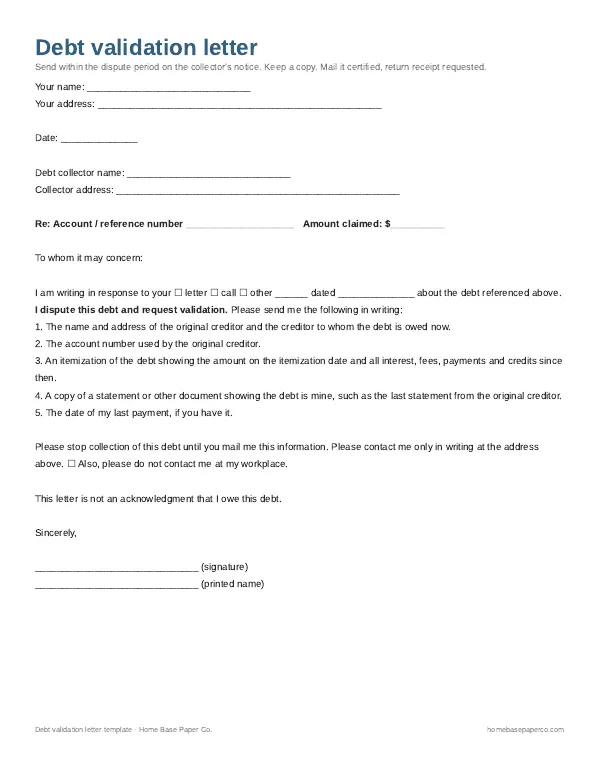
The free template below has this letter as a fill-in form with check boxes, plus a tracker for dates and responses.
Timeline after you send it
| Step | When | What to do |
|---|---|---|
| Validation notice arrives | Day 0 | Write the dispute end date on your calendar |
| Mail your letter | As soon as possible, within 30 days | Use certified mail with return receipt; keep a copy |
| Receipt confirms delivery | A few days later | File the green card or tracking proof with your copy |
| Collection pauses | Until they respond | They should not collect the disputed amount until verification is sent |
| Verification arrives | Varies | Compare it with your records; check the creditor, amount and dates |
| Next decision | After review | Pay, negotiate, dispute further, or get legal help |
The CFPB explains that a collector must stop collection activity after a timely written dispute until it sends verification, and that collection can restart once it does. If you still disagree, you can keep disputing, and you can dispute the account with the credit bureaus too.
What to do with the collector's response
When verification arrives, compare it line by line with your own records.
| What you find | Next step |
|---|---|
| The debt is not yours | Dispute again in writing, explain why, and dispute it with the credit bureaus |
| The amount is wrong | Send a written dispute pointing to the specific fees or interest you question |
| The debt is yours and correct | Decide whether to pay in full, set up a payment plan or negotiate a settlement in writing |
| The debt is very old | Check your state's statute of limitations before paying or agreeing to anything |
| No response at all | Keep your records; the collector should not resume collecting the disputed amount |
If you decide to pay, get any settlement or payment plan in writing before you send money, and pay in a way that leaves a record. Keep the final letter showing the account is paid or settled.
Mistakes to avoid
- Missing the 30-day window. You can dispute later, but you may lose the pause on collection.
- Calling instead of writing. A phone dispute is not the same as a written one under the rule.
- Admitting the debt. Stick to facts; do not say the debt is yours or apologize.
- Making a small payment first. On an old debt, a payment can restart the statute of limitations in some states.
- Not keeping records. Save every letter, envelope and receipt, and log every call with the date and what was said.
- Sharing sensitive details. Do not give your bank account or full Social Security number to a caller until you have verified who they are.
Track every debt and payment
Whether the debt is verified or not, it helps to see all of your balances in one place. The Debt Payoff Planner ($6.99) is an Excel and Google Sheets spreadsheet with four tabs. You list each debt with its balance, APR and minimum payment, choose snowball or avalanche, and it shows your payoff order, month-by-month plan and debt-free date, with a payment log to record each payment.
If you are juggling bills while you sort out a collection account, the Bill Tracker Spreadsheet ($4.99) lists every bill with its next due date and autopay status, flags bills due soon in red and has a 12-month paid tracker.
For a bigger plan, read our guides on how to get out of debt and what to do if you are behind on bills. If the debt is from a hospital or doctor, see our page on medical debt. Our free debt tracker is another simple way to see everything you owe.
This page is general information, not legal advice. For help with your situation, contact the CFPB, your state attorney general or a local legal aid office.
Make it easier
Tools for this

Spreadsheets
Debt Payoff Planner
Pick snowball or avalanche, add any extra payment, and get your debt-free month instantly.

Spreadsheets
Bill Tracker Spreadsheet
Bills due in 3 days or less light up red, so nothing slips through.
Frequently asked questions
What is a debt validation letter? A debt validation letter is the letter you send a debt collector asking it to prove a debt is yours and that the amount is right. People also use the term for the validation notice the collector must send you. Your letter disputes the debt and asks for verification and the original creditor's name.
What is the difference between a debt validation letter and a debt verification letter? A validation notice is what the collector sends you with the debt details and your 30-day dispute deadline. A debt verification letter is what you send asking the collector to verify the debt, or what the collector sends back responding to your dispute. Many people use the two terms interchangeably for the dispute letter.
How long do I have to send a debt validation letter? Send it in writing within the 30-day dispute period listed on the collector's validation notice. The CFPB says disputing in writing within that window requires the collector to pause collecting the disputed amount until it responds. You can dispute later, but you may lose that protection.
What should a debt validation letter include? Include your name and address, the collector's name and address, the reference or account number from their notice, a clear statement that you dispute the debt, and a request for the original creditor's name and address, an itemization of the amount, and proof the debt is yours. Sign and date it and keep a copy.
Should I send a debt validation letter by certified mail? Yes, send a debt validation letter by certified mail with a return receipt; it's the safest choice because it proves the collector received your letter and the date it arrived, which matters for the 30-day window. Some collectors accept disputes online or by email; if you use those, save a screenshot or confirmation.
What happens after I send a debt validation letter? If you disputed in writing within 30 days, the collector must stop collecting the disputed amount until it sends verification. After it responds, it can resume contact unless you tell it in writing to stop. If it cannot verify the debt, it should not keep trying to collect it.
Does a debt validation letter admit that I owe the debt? No, a debt validation letter doesn't admit that you owe the debt. A well-written debt validation letter disputes the debt and asks for proof without admitting it is yours. Avoid phrases like I know I owe this or I am sorry I fell behind. The CFPB warns that statements you make to collectors are recorded and could be used later.
Can a collector report a debt to the credit bureaus after I dispute it? Yes, but if a collector reports a debt you have disputed, it should be noted as disputed. You can also dispute an inaccurate collection account directly with Equifax, Experian and TransUnion. Check your free credit reports at AnnualCreditReport.com to see what is listed.
What if the debt collector never responds to my validation letter? If you disputed in writing within the 30-day window and the collector never sends verification, it should not resume collecting. Keep your certified mail receipt and copies. If it keeps calling or reports the debt anyway, you can submit a complaint with the CFPB and your state attorney general.
Can I use a debt validation letter for an old debt? Yes, you can use a debt validation letter for an old debt. You can ask for verification of any debt a collector contacts you about. For old debts, also check your state's statute of limitations. Be careful, because in some states making a payment or acknowledging an old debt in writing can restart the clock for a lawsuit.
Is there a free debt validation letter template? Yes, there's a free debt validation letter template on this page. Our free debt validation letter template is a 2-page PDF with a fill-in dispute letter on page one and a key-dates tracker, mailing checklist, response table and contact log on page two. The CFPB also publishes sample letters for responding to debt collectors.
Do I need a lawyer to send a debt validation letter? No, you don't need a lawyer to send a debt validation letter. Anyone can send a debt validation letter on their own. Consider talking to a consumer lawyer or legal aid office if you are being sued, if the collector ignores the rules, or if the debt is large. Under federal law, if you win a case against a collector you may recover legal fees.
More from HomeBase
You may also like

Printables
Budget Planner Printable
Twelve undated pages you can print every month: budget, bills, spending, savings and debt.

Spreadsheets
Sinking Funds Tracker
It does the math: how much to set aside each month to hit every goal on time.

Spreadsheets
Paycheck Budget Spreadsheet
Enter your bills once. The sheet tells you which paycheck pays each one, all year.

Spreadsheets
Zero-Based Budget Spreadsheet
The 'Left to budget' counter turns green when every dollar has a job.
 Club
Monthly club
Money Club
Anyone who wants a clear plan for the month's bills, holiday spending and savings.
Free printable
Get the free debt validation letter template
A fill-in letter asking a collector to verify a debt, with a short checklist for sending it and keeping records. You'll also get our weekly HomeBase email with simple budgeting and bill-paying tips.
Sources
- What information does a debt collector have to give me? (CFPB) consumerfinance.gov
- Can a debt collector still collect after I've disputed it? (CFPB) consumerfinance.gov
- Regulation F, 12 CFR 1006.34 Validation information (CFPB) consumerfinance.gov