


The short answer: how to get out of debt starts with seeing every balance in one place, then repeating a payoff plan each month until the balances hit zero.
- Build a small cushion before you speed up payments
- Find money with a tighter budget, lower bills or more income
- Pick a method: debt snowball or debt avalanche
- Pay something on every account each month and stop adding new debt
- Next step: Plan it with the Debt Payoff Planner ($6.99).
Learning how to get out of debt starts with one plain step: seeing every balance in one place. From there, it's a plan you repeat each month until the balances hit zero. This guide walks through the steps, the two main payoff methods, ways to lower interest and how to protect your progress.
Our Debt Payoff Planner turns these steps into one sheet: list up to 10 debts, pick snowball or avalanche, add any extra payment and see your debt-free date.
You're not alone if this feels heavy. The Federal Reserve's Survey of Household Economics and Decisionmaking tracks how many households would struggle with an unexpected expense, and many families carry credit card balances from month to month.
Step 1: List every debt
Write down each debt with five details:
| Debt | Balance | Interest rate | Minimum | Due date |
|---|---|---|---|---|
| Credit card A | ||||
| Credit card B | ||||
| Car loan | ||||
| Student loan | ||||
| Medical bill |
Pull the numbers from your statements or online accounts, not memory. A free credit report from AnnualCreditReport.com can help you spot accounts you forgot about, such as an old store card or a medical bill that went to collections. Add store cards, buy now pay later plans and money owed to family. Our debt tracker guide has a simple layout for this list.
To see how long a card balance will take at your current payment, check the payoff tables in how long to pay off credit card debt.
Step 2: Build a small cushion
Before you throw every extra dollar at debt, set aside a small cushion, often $500 to $1,000. It keeps a flat tire or a copay from going straight back on a card. Keep it in a separate savings account so it's not easy to spend.
This cushion is step 2 in the financial order of operations, which lays out what to do with each extra dollar.
Step 3: Find money to put toward debt
Most extra money comes from three places:
- A tighter budget. Give every dollar a job and see where it leaks. Our how to stick to a budget guide has practical tips.
- Lower bills. Call providers, cancel unused subscriptions and shop insurance. See how to lower monthly bills.
- More income. Extra shifts, a side job, selling things you don't use or putting raises and tax refunds toward debt.
Step 4: Pick a payoff method
Debt snowball: pay minimums on everything and put extra on the smallest balance. When it's gone, roll that payment into the next one. Fast wins help many people keep going.
Our free debt payoff calculator shows your debt-free date and total interest for both methods.
Debt avalanche: put extra on the highest interest rate first. It usually saves the most interest.
Both work if you stick with them. Our debt snowball vs. avalanche guide compares them with examples.
How to pay off debt: which debt to pay first
If you are searching for how to pay off debt, the order matters as much as the amount. Use this priority list before you choose snowball or avalanche:
- Anything that protects your home, power and car. Rent or mortgage, utilities and the car you need for work come first, because falling behind there causes the biggest problems fastest.
- Minimums on every account. Paying at least the minimum on time keeps late fees and penalty rates away and protects your credit history.
- High-interest debt. Credit cards and payday-style loans usually cost the most. The CFPB's credit card resources explain how interest and minimum payments work on your statement.
- Everything else, in your chosen order. Medical bills, personal loans, car loans and student loans, smallest-first (snowball) or highest-rate-first (avalanche).
| Situation | Pay off first | Why |
|---|---|---|
| You need quick wins to stay motivated | Smallest balance | Each payoff frees a payment and builds momentum |
| You want to pay the least interest | Highest interest rate | Every extra dollar stops the most interest |
| One card is near its limit | That card | Lowers your utilization and the chance of over-limit fees |
| A debt is in collections | Get validation first | You have the right to confirm the amount before paying |
How to pay off debt on a low income
A small income doesn't mean you can't make progress. It means the plan has to be smaller and steadier:
- Pay something on every account each month, even when it's only the minimum, and call before a due date you can't meet.
- Ask for hardship programs. Many card issuers and hospitals have them. Write down who you spoke to and get new terms in writing.
- Check for help you may qualify for, such as utility assistance or a hospital's financial assistance policy, so that money can go to debt instead.
- Put windfalls to work. Tax refunds, a bonus or money from selling something can make a payment you couldn't make otherwise.
- Use a free nonprofit credit counselor if the minimums are more than you can pay. The FTC's how to get out of debt guide explains what a reputable counselor does.
How to pay off debt fast
Speed comes from the gap between what you owe each month and what you can pay. To widen the gap: pause extras for 90 days, sell what you don't use, take on a short-term side gig, call to lower rates, and send every raise straight to the debt. Plug your numbers into our debt payoff calculator to see how much an extra $50 or $100 a month moves your debt-free date.
Step 5: Lower your interest where you can
- Call your card companies and ask for a lower rate, especially if you've paid on time.
- Consider a balance transfer to a lower-rate card if you can pay it off before the promotional rate ends. Check the transfer fee.
- Look at a consolidation loan from a bank or credit union with a lower fixed rate.
- Ask about hardship programs if your income dropped.
Lower interest means more of each payment goes to the balance.
Step 6: Know where to get help
If the numbers don't work even with a tight budget, talk to a nonprofit credit counselor. They can review your budget and may suggest a debt management plan. The FTC's guide to getting out of debt explains the options, from counseling to settlement and bankruptcy, and what to watch for with paid debt relief services.
If a debt is with a collector, the CFPB's debt collection page explains your rights, including asking for validation of the debt.
What to do if you are already behind
If you've missed payments, call each lender before the account goes to collections. Ask what they can offer: a payment plan, a short pause, a lower rate or a due date that lines up with payday. Put the most important bills first, such as housing, utilities, car payments you need for work and insurance. Our behind on bills guide shows how to rank them.
If a collector calls about a debt that looks wrong, ask for proof in writing first. Our debt validation letter guide has a free template and a 30-day timeline. For more on this topic, see our debt payoff hub.
If hospital or doctor bills are part of the pile, our guide to medical debt shows how to check bills, ask for financial assistance and negotiate before you pay.
Get every new arrangement in writing and save it with your statements. Keep paying something on time each month, even if it's small, so the account doesn't fall further behind.
Make it a family plan
If you share money with a partner, sit down together and look at the full list. Agree on the method, the monthly amount and one small reward for each paid-off account. A short money date once a month keeps both of you on the same page and stops surprises. Kids can help too, by picking a free family outing to celebrate each milestone.
Step 7: Stop adding new debt
Paying off debt while adding more is like bailing a leaky boat. A few habits help:
- Leave cards at home or remove them from shopping apps.
- Use a cash or debit budget for spending categories that tend to run over.
- Wait 48 hours before any unplanned purchase over a set amount.
- Plan for yearly costs, like car registration and holidays, with sinking funds.
Step 8: Track progress every month
Seeing balances fall is the best motivation there is. Once a month, update each balance and your debt-free date. Celebrate each paid-off account in a small way that doesn't cost much.
Wondering what life looks like once every balance hits zero? Our guide to becoming debt free shows how to find your debt-free date and what to do with the money you free up.
Paying down debt also raises your net worth. Learn how to calculate net worth and check it each quarter to see the progress.
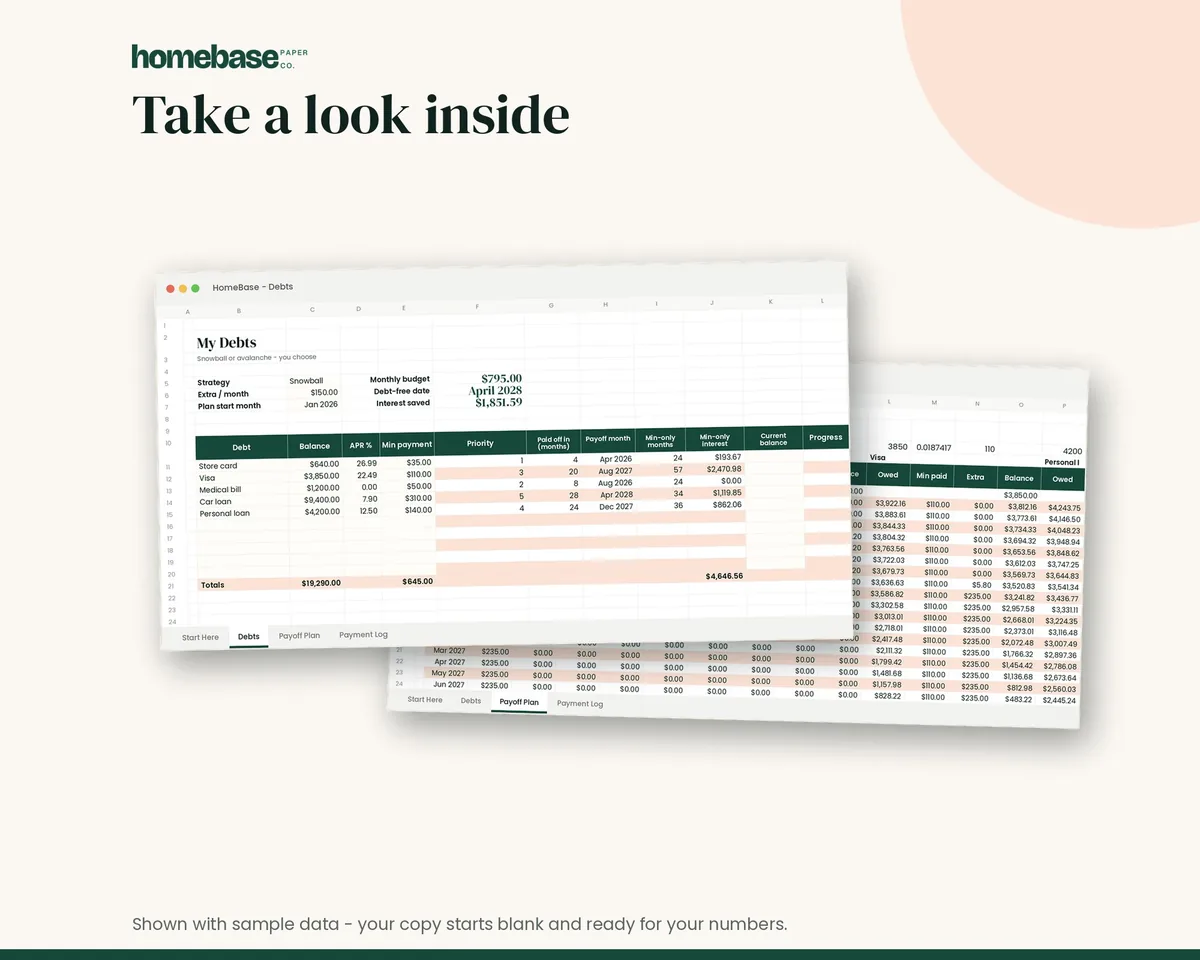
The Debt Payoff Planner ($6.99) handles up to 10 debts with a snowball or avalanche switch, extra-payment roll-over, a month-by-month payoff schedule, your debt-free date and interest saved compared with paying minimums. Pair it with the Zero-Based Budget Spreadsheet ($6.99) to find extra money each month, and the Bill Tracker Spreadsheet ($4.99) so no payment is ever late.
For a deeper dive, read budgeting for beginners, behind on bills and our guide to the debt payoff planner in Excel.
Mostly carrying card balances? Our credit card debt payoff plan walks through seven steps, and our guide to debt consolidation explains when one loan can lower your rate. With good credit, a 0% balance transfer credit card can cut the interest while you pay the balance down.
Make it easier
Tools for this

Spreadsheets
Debt Payoff Planner
Pick snowball or avalanche, add any extra payment, and get your debt-free month instantly.

Spreadsheets
Zero-Based Budget Spreadsheet
The 'Left to budget' counter turns green when every dollar has a job.

Spreadsheets
Bill Tracker Spreadsheet
Bills due in 3 days or less light up red, so nothing slips through.
Frequently asked questions
How do I get out of debt fast? The fastest way to get out of debt is to free up as much money as you can each month and send all of it to one debt at a time. List every debt, cut or pause spending you can live without, look for extra income, and lower interest where possible. Then pick the snowball or avalanche method and stick with it.
What is the first step to get out of debt? Write down every debt: who you owe, the balance, the interest rate, the minimum payment and the due date. Many people avoid this step because it feels scary, but you can't make a plan without the full picture. Most people find the total less frightening once it's on paper.
Should I pay off debt or save first? Most people do both, in small steps. A small starter cushion, such as $500 to $1,000, keeps a surprise bill from going on a credit card. After that, put extra money toward debt. Once high-interest debt is gone, build a fuller emergency fund.
What is the debt snowball method? With the debt snowball, you pay minimums on everything and put any extra money toward the smallest balance first. When it's paid off, you roll that payment into the next smallest. Quick wins keep many people motivated. It may cost a little more in interest than the avalanche method.
What is the debt avalanche method? With the debt avalanche, you put extra money toward the debt with the highest interest rate first, while paying minimums on the rest. It usually saves the most money in interest. It can feel slower at the start if your highest-rate debt also has a big balance.
Can I negotiate with my creditors? Yes, you can often negotiate with your creditors. Call before you fall behind and ask about a lower interest rate, a hardship plan, a lower payment for a few months or waived late fees. Write down who you spoke with and what they agreed to. Ask for any new terms in writing.
Is debt consolidation a good idea? It can be, if the new loan or balance transfer has a lower interest rate and you stop adding new debt. Read the fees, the length of the loan and what happens when a promotional rate ends. Consolidation only moves the debt. A budget is what actually pays it off.
What is a debt management plan? A debt management plan is set up through a nonprofit credit counseling agency. You make one monthly payment to the agency, which pays your creditors, often at lower interest rates they've agreed to. Plans usually take three to five years. Our debt management plan guide explains how they work.
How can I tell a reputable debt relief company from a risky one? Be wary of any company that promises to make debt disappear, tells you to stop talking to creditors, or wants fees before it has settled anything. The FTC's guide on how to get out of debt explains your options and the warning signs. Nonprofit credit counseling is usually a safer first call.
What are my rights if a debt collector calls? Debt collectors must follow federal rules. They can't harass you, lie about what you owe or call at unreasonable hours. You can ask for written validation of the debt and dispute it if it's wrong. The CFPB's debt collection page explains your rights and how to respond.
How long does it take to get out of debt? Two to five years is a common timeline for getting out of credit card debt with a steady plan, and many people manage it in that window. Your own timeline depends on how much you owe, your interest rates and how much extra you can pay each month. A debt payoff spreadsheet such as the Debt Payoff Planner shows your debt-free date and how it moves when you add extra payments.
How do I get out of credit card debt? List every card with its balance, interest rate and minimum, pay the minimum on all of them and put every extra dollar on one card: the smallest balance first (snowball) or the highest rate first (avalanche). Stop adding new charges while you pay down. Our Debt Payoff Planner shows your debt-free date for either order.
How do I pay off debt? To pay off debt, list every balance with its interest rate and minimum, keep up with essentials and minimums, then send all extra money to one debt at a time: the smallest balance first with the debt snowball or the highest rate first with the debt avalanche. When one is gone, roll its payment into the next. Our debt payoff calculator shows your debt-free date for either order.
Which debt should I pay off first? Keep housing, utilities and your car current first, and pay at least the minimum on everything else. Then put extra money on the debt with the highest interest rate if you want to save the most, or the smallest balance if quick wins keep you going. If a debt is in collections, ask the collector to validate it before you pay.
How can I pay off debt on a low income? Pay at least something on every account, call creditors before you miss a payment to ask about hardship plans, check whether you qualify for assistance programs that free up cash, and put windfalls such as tax refunds toward debt. A nonprofit credit counselor can review your budget for free and tell you whether a debt management plan makes sense.
Is it better to pay off debt or invest? Many people pay off high-interest debt such as credit cards before investing beyond any employer retirement match, because the interest on that debt is usually higher than an investment return you can count on. Low-rate debt, such as some mortgages, is often paid on schedule while you invest. If you aren't sure, a fee-only financial planner can look at your numbers.
More from HomeBase
You may also like

Printables
Budget Planner Printable
Twelve undated pages you can print every month: budget, bills, spending, savings and debt.

Spreadsheets
Sinking Funds Tracker
It does the math: how much to set aside each month to hit every goal on time.

Spreadsheets
Paycheck Budget Spreadsheet
Enter your bills once. The sheet tells you which paycheck pays each one, all year.
 Save 57%
Bundles
Ultimate Budget Bundle
All 6 spreadsheets + both printable planners - for less than half the price of buying them separately.
 Club
Monthly club
Money Club
Anyone who wants a clear plan for the month's bills, holiday spending and savings.
Free printable
Never miss a payment: get the free bill calendar
A printable monthly bill calendar with room for due dates, amounts and paydays, so every payment has a plan before the month starts. You'll also get our weekly HomeBase email with simple budgeting and bill-paying tips.

Sources
- FTC: How to get out of debt consumer.ftc.gov
- CFPB: Debt collection consumerfinance.gov
- Federal Reserve: Survey of Household Economics and Decisionmaking federalreserve.gov
- Credit card resources consumerfinance.gov