

The short answer: a college student budget spreads money that comes in lumps, like aid refunds, savings and family help, across every month of the term. Divide each lump sum by the months it has to last and give every dollar a job.
- Pick a period: a semester works well
- Count it all: housing, utilities, food, books and supplies, and school fees
- Often forgotten: deposits, access codes, lab fees and fees billed after the semester starts
- Worked example: one fall semester living off campus, with a template, is below
- Next step: Plan it with the Paycheck Budget Spreadsheet ($5.99).
A college student budget is a plan that spreads the money you get in lumps, like financial aid refunds, savings and family help, plus any paychecks, across every month of the term, so rent, food, books and phone are covered before anything else. To make one, pick a time period (a semester works well), add up all your money in, list your real costs, divide the lump sums by the months they have to last, and give every dollar a job. The steps, the template and the worked example below show exactly how.
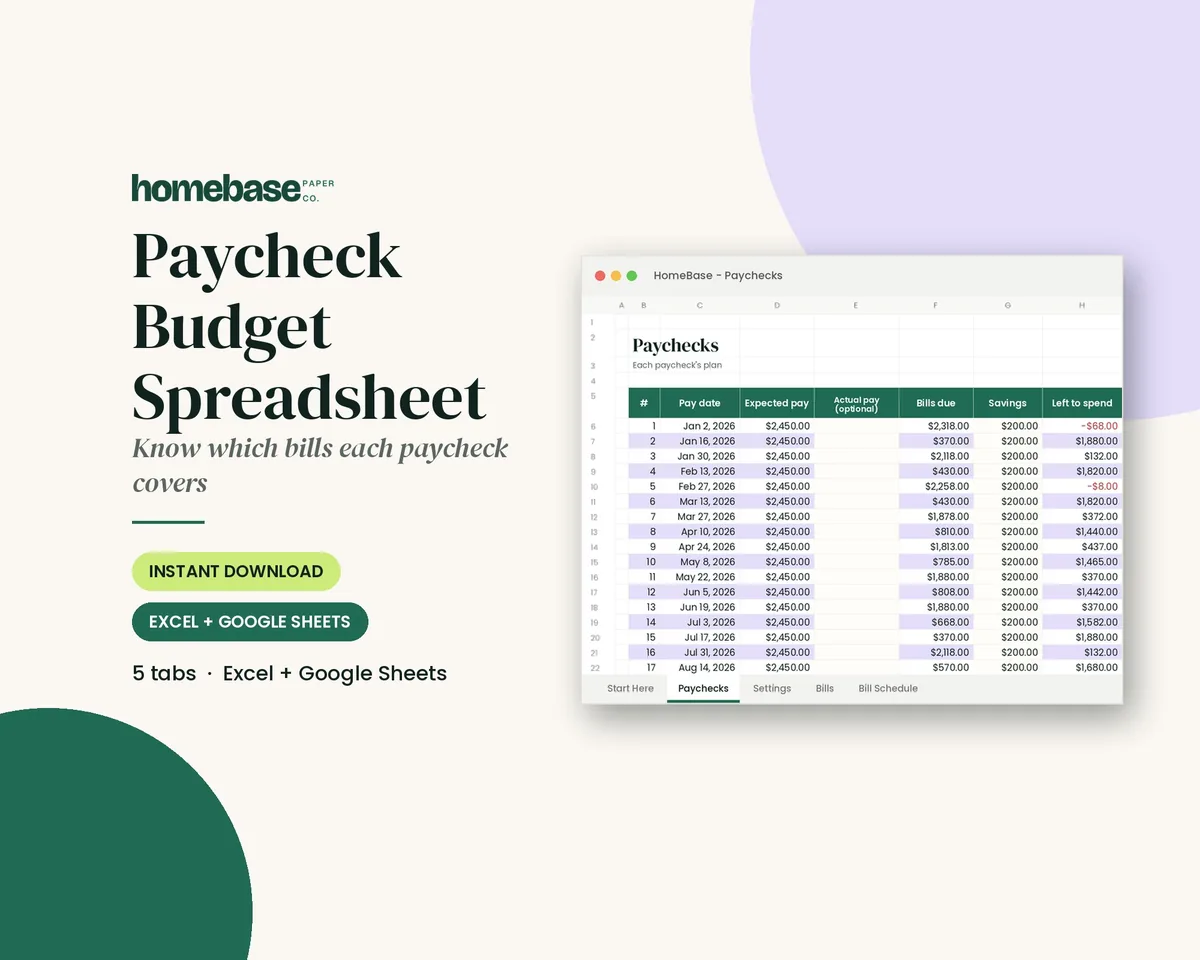
If you also have a campus job, our Paycheck Budget Spreadsheet works with weekly, biweekly, semi-monthly or monthly pay and shows which paycheck pays each bill and what's left to spend per paycheck.
Every dollar amount in this guide is an example to show the math. Your school, your city and your aid package will set your real numbers.
Why budgeting in college is different
A regular household budget assumes a paycheck that shows up on schedule. College money rarely works that way. A lot of it arrives once or twice a year: a refund after tuition is paid, a scholarship check, money saved over the summer. Then it has to last for months.
After graduation, our guide on how to pay off student loans fast shows how extra payments shorten the timeline.
That's why the most common college money problem isn't overspending on one big thing. It's running short in the last few weeks of the semester because the lump sum got spent like a paycheck.
Federal Student Aid's guide for first-time college students puts it simply: decide the time period for your budget (a month, an academic year or a calendar year), then figure out how much money you have coming in and how much is going out. The rest of this guide turns that into a plan you can actually follow.
What goes into a college student budget
Federal Student Aid's page on understanding college costs lists the main costs: tuition, food and housing, books and supplies, fees, equipment and room materials, and travel and personal expenses. Here's how those look in a student's monthly budget.
| Category | What to count | Often forgotten |
|---|---|---|
| Housing | Dorm or your share of rent | Deposits, renter's insurance, move-in costs |
| Utilities and internet | Your share of electric, water, Wi-Fi | Utility deposits, the month before your first refund |
| Food | Meal plan, groceries, eating out | Late-night food, coffee runs, delivery fees |
| Books and supplies | Textbooks, access codes, notebooks | Lab fees, printing, calculator, art supplies |
| School fees | Activity, lab, parking permit | Fees billed after the semester starts |
| Transportation | Gas, transit pass, rideshares | Car insurance, repairs, parking tickets |
| Phone and subscriptions | Phone bill, streaming, apps | Free trials that turn into charges |
| Personal | Toiletries, laundry, clothes, haircuts | Gifts and birthdays |
| Travel home | Trips at breaks and holidays | Holiday fares booked late |
| Savings | Emergency fund, next semester | Almost always forgotten |
How to make a college student budget in 7 steps
Step 1: Pick your budget period
Choose the stretch of time your money has to cover. For most students, one semester or quarter is the easiest, because that's how aid, tuition bills and housing usually line up. Count the months from the first day you need money to the next time money arrives. A fall semester that runs from mid-August to mid-December is about four months of spending.
Step 2: List all your money in
Write down every source and when it arrives:
- financial aid refund (what's left after the school applies your aid to tuition, fees and housing)
- scholarships or grants paid to you directly
- Federal Work-Study or a part-time job
- money from family, if any
- summer savings
Federal Student Aid notes that your money in includes income from work and financial aid such as scholarships, grants, Federal Work-Study and student loans. If part of your money is a loan, write that down too, because it's money you'll pay back later.
Step 3: Turn lump sums into a monthly amount
This is the step that saves your semester. Divide every lump sum by the number of months it has to last.
Monthly amount from a lump sum = lump sum ÷ months it has to cover
A $1,800 refund for a four-month semester is $450 a month, not $1,800 to spend in August. Some students move the lump sum into savings and transfer one month's share into checking at the start of each month. It makes the refund feel like a paycheck.
Step 4: Add your regular income
Paychecks from a campus or part-time job are the easiest money to plan around because they arrive on a schedule. Write down your expected take-home pay per paycheck and how often you're paid. If your hours change week to week, budget using a lower, safer number and treat anything extra as a bonus for savings.
Step 5: List your monthly costs
Go through the category table above and write a monthly number next to each one. Use real numbers wherever you can: your lease, your phone bill, your meal plan. For costs that come once a term, like textbooks or a parking permit, divide by the number of months so they fit the monthly plan.
Step 6: Subtract and give every dollar a job
Money in per month − costs per month = what's left
If the answer is positive, give the extra a job: emergency savings, next semester, or the trip home at winter break. If it's negative, now is the time to fix it, not in week twelve. Look first at the flexible lines, like food out, subscriptions and fun.
Step 7: Check in every week
A college budget works best with a short weekly check. Every Sunday, compare what you spent with what you planned, and adjust the next week. Five minutes a week beats one stressful hour at the end of the month.
College student budget template
Copy this college budget template into a notebook or spreadsheet. Fill in the "Plan" column at the start of the semester and the "Actual" column each month.
| Line | Plan per month | Actual |
|---|---|---|
| Money in | ||
| Aid refund ÷ months | $ | $ |
| Job or Work-Study take-home | $ | $ |
| Family help | $ | $ |
| Savings ÷ months | $ | $ |
| Total money in | $ | $ |
| Money out | ||
| Housing | $ | $ |
| Utilities and internet | $ | $ |
| Food | $ | $ |
| Books and supplies ÷ months | $ | $ |
| Transportation | $ | $ |
| Phone and subscriptions | $ | $ |
| Personal | $ | $ |
| Fun | $ | $ |
| Travel home fund | $ | $ |
| Emergency savings | $ | $ |
| Total money out | $ | $ |
| Left to assign (in − out) | $ | $ |
Worked example: one fall semester, living off campus
Here's the template filled in for a student sharing an apartment, with example numbers for a four-month semester. Every line adds up.
Money in per month
| Source | Math | Per month |
|---|---|---|
| Aid refund | $1,800 ÷ 4 months | $450 |
| Part-time job take-home | Estimate after taxes | $480 |
| Family help | Set amount | $100 |
| Total | $1,030 |
Money out per month
| Category | Math | Per month |
|---|---|---|
| Rent share | Lease | $450 |
| Utilities and internet share | Split with roommates | $60 |
| Groceries and food | Estimate | $200 |
| Phone | Plan | $35 |
| Transportation | Gas or transit | $40 |
| Personal | Toiletries, laundry | $30 |
| Fun | Set limit | $60 |
| Books and supplies | $240 ÷ 4 months | $60 |
| Emergency savings | Set amount | $50 |
| Travel home fund | $180 trip ÷ 4 months | $45 |
| Total | $1,030 |
Money in minus money out is $0, so every dollar has a job. The $50 a month in emergency savings adds up to $200 by the end of the term, and the travel fund covers the $180 trip home at winter break without touching the food money.
Ways to lower college costs
Federal Student Aid offers several practical ideas across its college cost and first-year pages:
| Idea | How it saves |
|---|---|
| Buy or rent used textbooks | Lower upfront cost; FSA notes college bookstores sometimes buy books back for only 10% of the price, so check online buyback first |
| Use student discounts | Some tech companies offer student pricing on laptops; theaters and venues often have student tickets |
| Go to free campus events | Concerts, performances and student days at museums cost little or nothing |
| Share housing | Splitting rent with roommates and carpooling lowers housing and gas costs |
| Live with family, if you can | Can remove the biggest line in the budget |
| Look into resident advisor roles | Many schools offer reduced housing or tuition for RAs |
| Check your health coverage | Most young adults can stay on a parent's plan until age 26 |
| Take a full course load if you can | Finishing sooner means fewer semesters to pay for |
| Ask about broadband discounts | FSA says Federal Pell Grant recipients may qualify for discounted internet |
Semester budget or monthly budget?
You need both, and they work together. The semester budget is the big picture: all the money that has to last from move-in to finals, and the once-a-term costs like books, fees and the trip home. The monthly budget is what you follow day to day. You build the semester plan first, divide it into months, then track each month against it.
Plan your class load on the same calendar: our free academic planner runs from August 2026 with class schedules and an assignment tracker.
If you're paid by a job every week or every two weeks, add one more layer: plan which bills each paycheck covers. Rent is often due on the first, so the paycheck right before it needs to hold the rent money.
After graduation, the same habits carry into budgeting for young adults: your first paycheck, first apartment and student loan payments. When it's time to move out, our list of first apartment essentials shows what to buy first.
Common college budget mistakes
- Spending the refund like a paycheck. Divide it by the months first, then spend.
- Forgetting once-a-term costs. Books, lab fees and parking permits come at the start of the semester, right when money feels plentiful.
- Skipping the trip home. Holiday travel is easy to forget until fares are already high.
- No emergency savings. Without a cushion, a small surprise goes straight onto a credit card.
- Never checking in. A budget you set up in August and never look at again can't warn you in October.
Credit cards and the emergency fund
A credit card can help you build credit, but only if you pay the full statement balance every month. The Consumer Financial Protection Bureau's credit card guide points out that most cards have more than one APR, that an introductory or promotional rate ends and a higher rate takes over, and that fees like an annual fee can add to what the card really costs. Read those terms before you apply.
The bigger protection is a small emergency fund. Federal Student Aid suggests opening an account with a bank or credit union that has convenient locations near campus and starting an emergency fund in a savings account if you can. Even $25 or $50 a month means a flat tire or a lost charger doesn't become a credit card balance.
Why this matters to me
I'm Malaysia. I worked to put myself through Oakland University, and it took much longer than the usual four years. I kept going. I know what it's like to make school, work and money fit together, and that's exactly why I believe in a plan you write down. When the money has a job before the month starts, there's one less thing to worry about while you're studying.
Plan your semester with the Paycheck Budget Spreadsheet
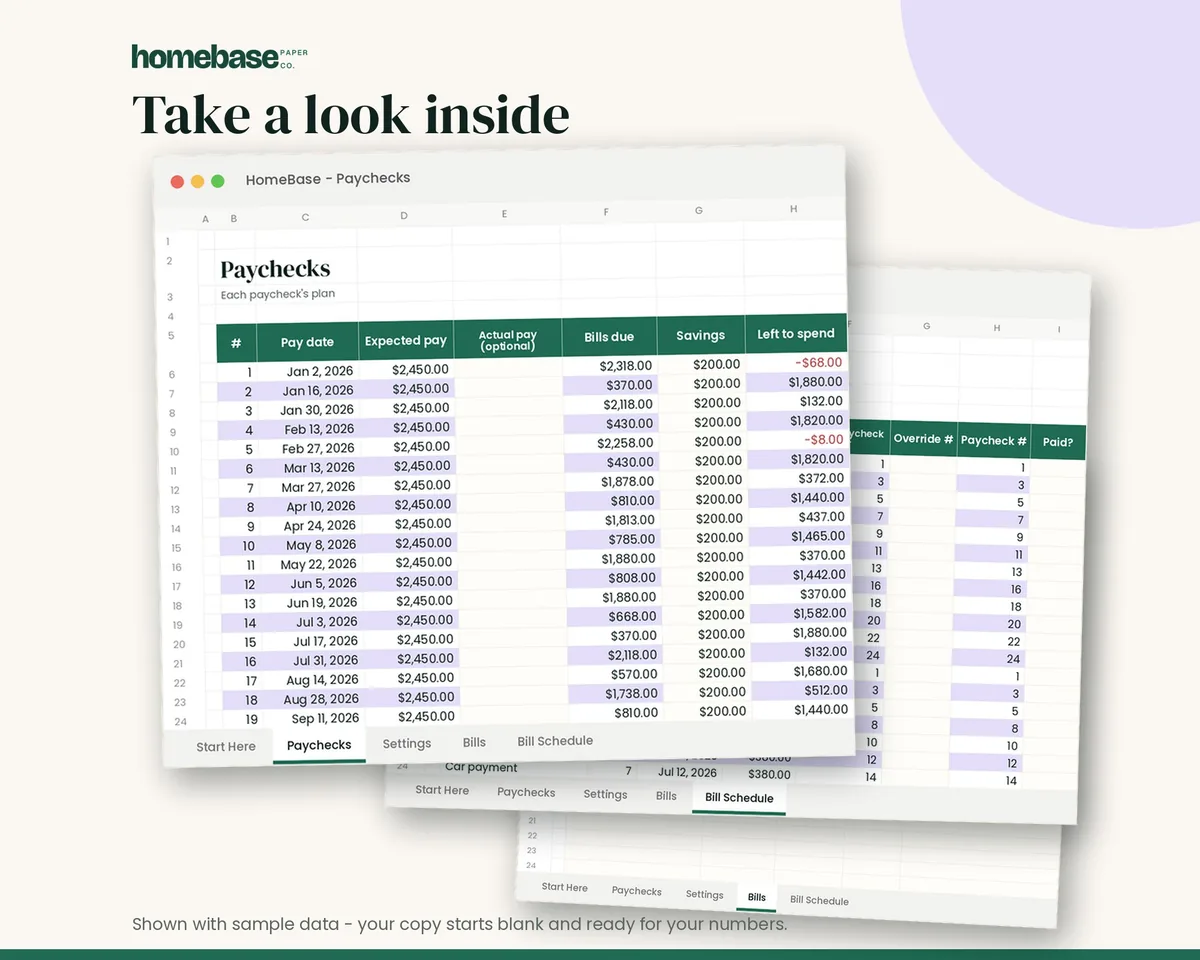
If you have a campus or part-time job, the Paycheck Budget Spreadsheet ($5.99) is built for budgeting one paycheck at a time. It works in Excel and Google Sheets and:
- handles weekly, biweekly, semi-monthly or monthly pay
- calculates your pay dates for the year
- lets you enter bills once and auto-assigns each one to the right paycheck
- shows what's left to spend from each paycheck, with paid checkmarks
For trip money, textbooks for next semester and an emergency fund, the Sinking Funds Tracker ($4.99) shows how much to set aside each month to reach each goal on time. Prefer paper? The Budget Planner Printable ($5.99) gives you twelve undated pages for your budget, bills, spending and savings, so you can start in any month of the school year.
Browse every tool in Spreadsheets or see the paper versions in Printables. New to budgeting in general? Start with our beginner's guide to making a budget, and if your hours change a lot, our guide to budgeting with irregular income can help.
Before move-in day, many families host a send-off. Our graduation party ideas include budget-friendly themes, food and a $300 open-house plan.
Parents planning ahead can read our guide to the 529 plan, a tax-advantaged way to save for college costs.
Make it easier
Tools for this

Spreadsheets
Paycheck Budget Spreadsheet
Enter your bills once. The sheet tells you which paycheck pays each one, all year.

Spreadsheets
Sinking Funds Tracker
It does the math: how much to set aside each month to hit every goal on time.

Printables
Budget Planner Printable
Twelve undated pages you can print every month: budget, bills, spending, savings and debt.
Frequently asked questions
What is a college student budget? A college student budget is a plan that spreads aid refunds, savings, family help and paychecks across every month of the term. The Paycheck Budget Spreadsheet ($5.99) makes it easy to see what each paycheck covers.
How do I make a college student budget? Pick a budget period, list all money in, divide lump sums by the months they must last, list your costs, and give every dollar a job. The Budget Planner Printable ($5.99) has undated pages for each of those steps.
How much should a college student budget per month? Budget the total of your real monthly costs, since the right number depends on your school, housing and aid. Add up rent, food, books and phone, compare that with your monthly money in, and track it in the Paycheck Budget Spreadsheet ($5.99).
How do I budget my financial aid refund? Divide the refund by the number of months it has to last, then move one month's share into checking at a time. A $1,800 refund for a four-month semester is $450 a month.
Should I make a semester budget or a monthly budget? Use both: a semester budget for the big picture and a monthly budget to follow day to day. Build the semester plan first, then split it into months.
What should a college budget include? Include housing, utilities, food, books and supplies, fees, transportation, phone, personal costs, travel home and savings. Federal Student Aid lists these same core college costs.
How do I budget with a part-time job in college? Budget one paycheck at a time and use a safe, lower estimate if your hours change. The Paycheck Budget Spreadsheet ($5.99) handles weekly or biweekly pay and assigns each bill to the right paycheck.
How do I budget for textbooks? Estimate the semester's book cost and divide it by the months in the term, or save toward it ahead of time. The Sinking Funds Tracker ($4.99) shows the monthly amount needed to hit each savings goal on time.
How can college students save money? Buy or rent used textbooks, use student discounts, share housing, carpool and go to free campus events. Federal Student Aid recommends all of these.
Should a college student have an emergency fund? Yes, a college student should have an emergency fund, and even a small one helps. Federal Student Aid suggests starting an emergency fund in a savings account if you can, and $25 to $50 a month adds up over a semester.
Should college students get a credit card? Yes, if you'll pay it off every month: a credit card can build credit only if you pay the full balance every month. Read the APRs and fees first, because the CFPB notes promotional rates end and higher rates take over.
How do I budget for trips home during breaks? Give the trip its own savings line and divide the cost by the months before you travel. The Sinking Funds Tracker ($4.99) keeps that goal separate from your food and rent money.
Is there a college student budget template? Yes, this guide includes a free fill-in template and a worked example. For a ready-made version, the Paycheck Budget Spreadsheet ($5.99) works in Excel and Google Sheets.
Can I use a printable budget planner in college? Yes, a printable planner works well if you like writing things down. The Budget Planner Printable ($5.99) has 12 undated pages, so you can start in any month of the school year.
How often should I check my college budget? Check it once a week for about five minutes. A short weekly check lets you fix small problems before the end of the month.
More from HomeBase
You may also like

Spreadsheets
Bill Tracker Spreadsheet
Bills due in 3 days or less light up red, so nothing slips through.

Spreadsheets
Zero-Based Budget Spreadsheet
The 'Left to budget' counter turns green when every dollar has a job.
 Save 57%
Bundles
Ultimate Budget Bundle
All 6 spreadsheets + both printable planners - for less than half the price of buying them separately.

Spreadsheets
Annual Budget Spreadsheet
See exactly where your money goes every month - without complicated software.
 Club
Monthly club
Money Club
Anyone who wants a clear plan for the month's bills, holiday spending and savings.
Free printable
Have the important stuff in one place: get the free emergency binder pages
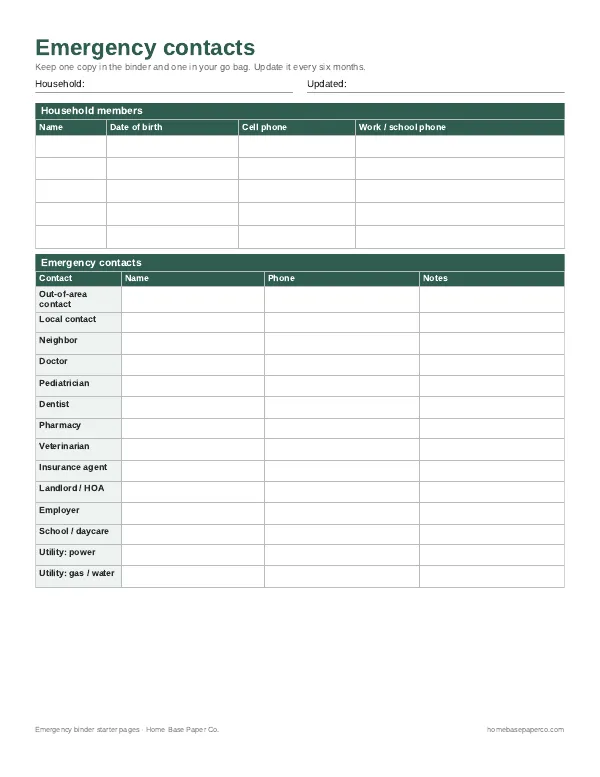
Printable starter pages for household members, emergency contacts, medical notes and where key documents live. You'll also get our weekly HomeBase email with simple ways to keep family records and important papers in order.
Sources
- First-time college students studentaid.gov
- Understanding college costs studentaid.gov
- Credit card guide consumerfinance.gov