

The short answer: to save $10,000 in a year, you need about $833 a month, $385 every two weeks, $192 a week or $27.40 a day. Most people get there by combining three or four sources.
- Automate the base amount on payday into a separate account
- Split your tax refund before it lands
- Save raises and windfalls first
- Check in on the same day each month and celebrate milestones
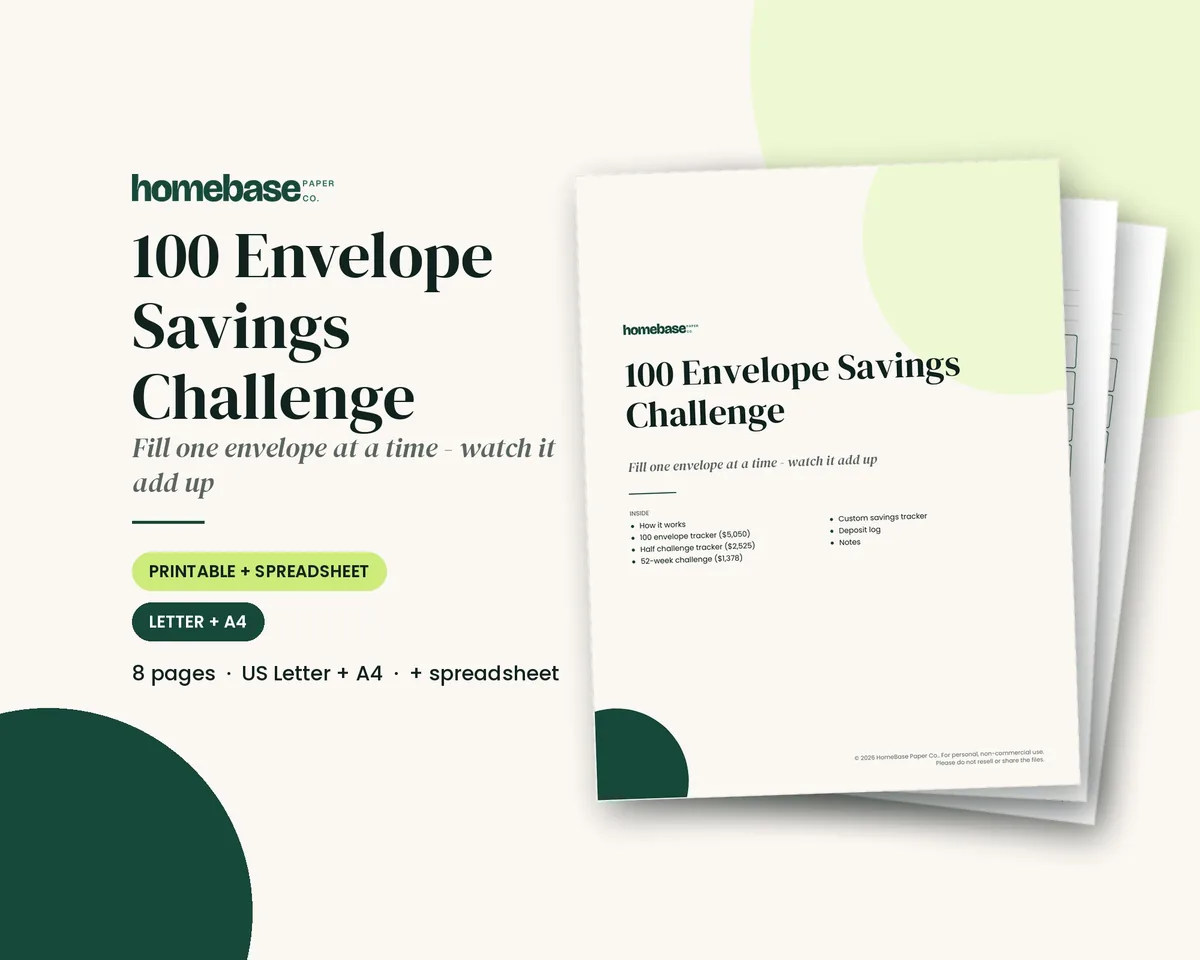
- Next step: Plan it with the 100 Envelope Savings Challenge ($3.99).
To learn how to save $10,000 in a year, start with the math: you need about $833 a month, $385 every two weeks, $192 a week or $27.40 a day. Most people get there by combining three or four sources, such as an automatic transfer on payday, a few trimmed bills, a share of a tax refund or other windfall, and a little extra income. You don't need one giant sacrifice. You need a clear number, a separate account, and a plan you can check every month.
Below you'll find the full breakdown by pay schedule, a quick test to see if $10,000 fits your budget, a sample mix of where the money can come from, a month-by-month plan, three ways to turn it into a $10,000 savings challenge, and how to track it so you actually finish. Every dollar amount in the examples is hypothetical, so swap in your own numbers. If you like a game, the 100 Envelope Savings Challenge ($3.99) turns into a $10,100 plan when you double each envelope.
How much to save to reach $10,000 in a year
Here's what $10,000 looks like broken into the pay schedules most households use.
| How often you save | Number of deposits | Amount each time | Total |
|---|---|---|---|
| Monthly | 12 | $833.34 | $10,000.08 |
| Twice a month (1st and 15th) | 24 | $416.67 | $10,000.08 |
| Every two weeks (biweekly) | 26 | $384.62 | $10,000.12 |
| Weekly | 52 | $192.31 | $10,000.12 |
| Daily | 365 | $27.40 | $10,001 |
That last row is where the "$27.39 rule" or "$27.40 rule" you may have seen comes from. Saving $27.39 a day gets you $9,997; rounding up to $27.40 puts you just over $10,000. It's a helpful way to picture the goal, but very few people actually move money every day. Matching your deposit to your payday works better, because the money leaves before you have a chance to spend it.
If you're paid biweekly, you'll get two "extra" paychecks in a year (26 checks instead of 24). Saving most of those two checks can cover a big piece of the goal on its own.
Is saving $10,000 in a year realistic for you?
Whether you can save 10k in a year depends on your take-home pay and your fixed costs, not on willpower. Divide $833 by your monthly take-home pay to see what share of your income the goal needs.
| Monthly take-home pay (hypothetical) | $833 a month as a share of pay |
|---|---|
| $3,000 | 28% |
| $4,000 | 21% |
| $5,000 | 17% |
| $6,000 | 14% |
| $8,000 | 10% |
If your number is 20% or less, a year is very doable with a few changes. If it's closer to 30%, you'll probably need a windfall or extra income to make it work (see how to make money online for ideas). And if it isn't realistic right now, stretch the timeline instead of giving up:
| Timeline | Monthly amount | Weekly amount |
|---|---|---|
| 12 months | $833 | $192 |
| 18 months | $556 | $128 |
| 24 months | $417 | $96 |
| 36 months | $278 | $64 |
Our guide to how much of your paycheck you should save can help you pick a percentage that fits the rest of your budget. I took the long way through school, and it taught me that slow progress is still progress. A $10,000 goal you reach in two years is far better than a one-year plan you quit in March.
Where the $10,000 can come from
Very few people find $833 a month in one place. It's easier to stack several smaller sources. Here's a sample mix for a hypothetical household:
| Source | Example amount | Yearly total |
|---|---|---|
| Automatic transfer on payday | $250 a month | $3,000 |
| Share of a tax refund or bonus | One-time | $2,000 |
| Extra income (overtime, side work, selling a skill) | $150 a month | $1,800 |
| Trimming groceries with a meal plan | $25 a week | $1,300 |
| Shopping insurance and phone plans | $70 a month | $840 |
| Selling things you no longer use | One-time | $600 |
| Pausing or canceling unused subscriptions | $40 a month | $480 |
| Total | $10,020 |
Your mix will look different, and that's the point. Write your own version of this table before you start, because it tells you whether the plan adds up on paper.
A few notes on the biggest sources:
- Automate the base amount. The Consumer Financial Protection Bureau's guide to building an emergency fund calls automatic recurring transfers one of the easiest ways to save consistently. It also suggests asking your employer whether you can split your direct deposit between checking and savings.
- Split your tax refund before it lands. If you expect a refund, the IRS lets you divide a direct-deposit refund into up to three accounts using your tax software, or Form 8888 if you file on paper. Sending part of it straight to savings means you never have to talk yourself out of spending it.
- Groceries are usually the most flexible big category. Rent and car payments are hard to change quickly, but a weekly meal plan can trim food costs right away. Our guide to meal planning on a budget walks through it.
- Save raises and windfalls first. If you get a raise, a bonus or a cash gift, decide how much goes to the goal before the money arrives.
If you're looking for more ideas to free up cash, our list of ways to save money covers food, bills and shopping in detail. This page stays focused on hitting one specific number.
A month-by-month plan to save $10,000
Saving the exact same amount every month looks neat on paper, but real life is lumpy. Some months bring a refund or a bonus; others bring holidays and back-to-school costs. This sample plan front-loads the work and leaves room for expensive months. You can start it in any month.
| Month | Focus | Saved this month (hypothetical) | Running total |
|---|---|---|---|
| 1 | Open a separate savings account, set up the automatic transfer, track every expense | $500 | $500 |
| 2 | Cancel unused subscriptions; call about insurance, phone and internet | $700 | $1,200 |
| 3 | Start a weekly meal plan and grocery budget | $750 | $1,950 |
| 4 | Windfall month: save most of a tax refund, bonus or extra paycheck | $2,300 | $4,250 |
| 5 | Declutter and sell things you no longer use | $1,000 | $5,250 |
| 6 | Midyear check: are you at least halfway? Adjust the plan | $800 | $6,050 |
| 7 | Add a small source of extra income | $900 | $6,950 |
| 8 | Keep extra income going; save any raise | $900 | $7,850 |
| 9 | Plan holiday spending now so it doesn't come out of savings | $800 | $8,650 |
| 10 | Lean month: protect the automatic transfer | $450 | $9,100 |
| 11 | Lean month: stick to the holiday budget | $450 | $9,550 |
| 12 | Final push and celebrate | $450 | $10,000 |
Notice that the plan crosses the halfway mark around month five. That's intentional. Getting ahead early gives you a cushion for the months when saving is hardest. If your expensive season falls at a different time of year, move the lean months to match.
Start now: a $10,000 plan from November 2026
You do not need to wait for January. If you start with your first deposit on Friday, November 13, 2026, these schedules reach $10,000 within a year:
| Schedule | Deposit | Number of deposits | Total | Finish date |
|---|---|---|---|---|
| Monthly | $833 | 12 | $9,996 | October 2027 (first deposit November 2026) |
| Biweekly | $385 | 26 | $10,010 | Friday, October 29, 2027 |
| Weekly | $192 | 52 | $9,984 | Friday, November 5, 2027 |
Because November and December include holiday spending, schedule your first transfers on payday so they leave your account before you shop. A sinking fund for gifts keeps December from raiding the $10,000 goal, and our 52 week savings challenge is a lighter way to start if $10,000 feels too big.
Three ways to turn it into a $10,000 savings challenge
Some people stay motivated with a flat number. Others need a game. Here are three ways to set up a 10000 savings challenge (some people call it a 10k savings challenge), depending on how you like to save.
1. The doubled 100 envelope challenge ($10,100)
The classic 100 envelope challenge uses envelopes numbered 1 to 100 and saves $5,050. Double every envelope ($2, $4, $6 and so on, up to $200) and the total becomes $10,100. Fill about two envelopes a week and you'll finish in roughly 50 weeks, averaging about $202 a week. Pick easy envelopes in tight weeks and bigger ones when you have more breathing room.
2. The scaled 52-week challenge (about $10,004)
The standard 52-week savings challenge saves $1,378 by putting away $1 in week one, $2 in week two and so on. Multiply each week by $7.26 and you'll save about $10,004. Week one is $7.26 and week 52 is $377.52, so the end of the year gets steep. Many people run it in reverse, starting with the biggest weeks while motivation is high.
3. The flat paycheck challenge ($10,000)
Save $384.62 from every biweekly paycheck (or $192.31 a week) and mark off each deposit on a chart. It's the simplest version and the easiest to automate.
| Challenge style | Total | Average per week | Best for |
|---|---|---|---|
| Doubled 100 envelopes | $10,100 | About $202 | Flexible, uneven income |
| Scaled 52-week (×$7.26) | About $10,004 | About $192 | People who like a slow build |
| Flat paycheck | $10,000 | $192 | Steady paychecks, full automation |
If $10,000 is more than you can do this year, our savings challenge ideas compare smaller options, from the penny challenge to the half-size envelope version.
Where to keep your $10,000
Keep it somewhere separate from your everyday checking account, so it's harder to dip into and easy to see grow. A savings account at an insured bank or credit union is a good home for money you'll need within a year or two. A high-yield savings account can earn more interest than a standard account, so compare current rates before you open one. Money you will not need for at least a year can also go into savings bonds, which are sold through TreasuryDirect with a $10,000 yearly limit per series.
Make sure your bank is FDIC-insured (or that your credit union is federally insured). The FDIC explains in Understanding Deposit Insurance that deposit insurance covers $250,000 per depositor, per FDIC-insured bank, for each account ownership category. A $10,000 goal sits well inside that limit.
If you're new to savings accounts, start with our explainer on what a savings account is.
Should you build an emergency fund or pay off debt first?
If you have no emergency savings at all, make the first part of your $10,000 your emergency fund. The CFPB notes that even a small cushion helps you recover faster from unexpected costs and stay on track toward bigger goals. Our emergency fund tracker guide shows simple ways to watch it grow.
If you carry high-interest credit card debt, compare what the debt costs you with what your savings earns. Many people keep a starter cushion, then split extra money between savings and debt payoff. Our comparison of the debt snowball vs. debt avalanche can help you choose a payoff order. This is general education, not financial advice, so talk with a qualified professional about your situation if you're unsure.
How to track your progress (and actually finish)
The CFPB recommends regularly monitoring your savings and celebrating your successes, and both matter more than they sound. A goal you can see is a goal you keep working toward.
- Write the goal and the date at the top of one page. "$10,000 by next October" is clearer than "save more."
- Pick one tracker. A coloring chart, an envelope chart or a spreadsheet all work. Our savings goal tracker ideas show a few formats.
- Check in on the same day each month. Compare your running total with the month-by-month table above.
- Celebrate milestones. Mark $2,500, $5,000 and $7,500 with something small and free.
- Adjust instead of quitting. If you fall behind, add a month or trim a category. A plan you pick back up beats a perfect plan you abandon.
If you're saving for several things at once (holidays, car repairs and the $10,000 goal), a sinking funds setup keeps each goal in its own lane, so a car repair doesn't quietly drain your main goal. For more on staying motivated in the middle months, read our guide to savings motivation.
Mistakes that derail a $10,000 goal
- Keeping the money in checking. If you can see it next to your bill money, you'll spend it.
- Cutting so hard you rebound. A budget with zero fun money usually breaks by month three. Leave a little room.
- Ignoring irregular expenses. Car registration, gifts and annual subscriptions don't disappear. Plan for them so they don't come out of your savings.
- Not giving every dollar a job. A zero-based budget makes sure the savings transfer is planned before the month starts, not funded with whatever is left.
- Treating one bad month as failure. Recalculate the remaining months and keep going.
Why I plan this way
Before I started HomeBase Paper Co., I worked as an ABA technician with children with special needs. The lesson I lean on most from that work is that big changes come from small, repeatable steps, and from making the next step obvious. A $10,000 goal works the same way. Nobody saves $10,000 in one move. You save $192 this week, then you do it again.
I also think of a budget as stewardship, not a cage. Saving isn't only about cutting back. It's how you make room for the things you're dreaming about, whether that's a cushion that lets you sleep better or a trip you've wanted for years.
Get the tools to hit your $10,000 goal
If the challenge approach appeals to you, the 100 Envelope Savings Challenge ($3.99) includes the classic chart, a half-size version, a 52-week challenge and a tracker spreadsheet that does the math. Double each envelope and it becomes your $10,100 plan. If you'd rather work backwards from a goal date, the Sinking Funds Tracker ($4.99) shows how much to set aside each month for up to 20 savings goals in Excel or Google Sheets.
Want the whole system? The Ultimate Budget Bundle gives you six budget spreadsheets (including the Zero-Based Budget Spreadsheet and the Sinking Funds Tracker) plus two printable planners for $19.99 instead of $46.42 bought separately, a 57% saving. You can also browse every money printable on our printables page or all of our budget spreadsheets.
Pick your number, pick your tracker, and make the first transfer this week. Small, repeatable steps add up to $10,000.
Make it easier
Tools for this
 Starter pick
Printables
100 Envelope Savings Challenge
Classic, half and 52-week challenges to print, plus a spreadsheet that tracks every envelope and tells you how much to save each week.

Spreadsheets
Sinking Funds Tracker
It does the math: how much to set aside each month to hit every goal on time.
 Save 57%
Bundles
Ultimate Budget Bundle
All 6 spreadsheets + both printable planners - for less than half the price of buying them separately.
Frequently asked questions
How can I save $10,000 in a year? The Sinking Funds Tracker ($4.99) makes a $10,000 goal easier because it calculates exactly how much to set aside each month to hit your date. To get there, you need about $833 a month, $385 every two weeks or $192 a week. Most people combine an automatic payday transfer, a few trimmed bills, part of a tax refund or bonus, and a little extra income.
How can I save $10,000 in a year starting in November 2026? To save $10,000 starting in November 2026, set up automatic transfers of $833 a month, $385 every two weeks or $192 a week from your first payday in November. Biweekly deposits starting November 13, 2026 reach $10,010 by the 26th deposit on October 29, 2027.
How much do I need to save each week to have $10,000 in a year? The 100 Envelope Savings Challenge ($3.99) includes a 52-week chart that helps you stick to a weekly habit like this one. To reach $10,000 in 52 weeks, you need to save $192.31 a week. If that's too much, saving $96 a week gets you there in about two years.
How much is $10,000 a year per month? The Zero-Based Budget Spreadsheet ($6.99) helps you fit a monthly savings amount into your plan before the month starts. $10,000 a year works out to $833.33 a month, or $833.34 if you round up so you hit the goal. That's $416.67 if you save twice a month and $384.62 if you save every two weeks.
What is the $27.40 rule? The $27.40 rule says that saving $27.40 a day for 365 days adds up to just over $10,000 in a year. Some articles call it the $27.39 rule, which gets you to $9,997. It's a helpful way to picture the goal, but most people find it easier to save the same total from each paycheck with an automatic transfer.
What is the 10000 savings challenge? The 100 Envelope Savings Challenge ($3.99) is the easiest way to run a $10,000 challenge, because doubling every envelope turns its $5,050 total into $10,100. A 10000 savings challenge is any game-style plan for saving $10,000 in about a year. Popular versions include the doubled 100 envelope challenge, a 52-week challenge multiplied by $7.26, and a flat amount from every paycheck.
How do I do a 10k savings challenge with envelopes? The 100 Envelope Savings Challenge ($3.99) gives you the numbered chart and a tracker, so you only need to double each amount. Label envelopes $2, $4, $6 and so on up to $200, then fill about two a week. You'll save $10,100 in roughly 50 weeks, averaging about $202 a week, and you can pick smaller envelopes in tight weeks.
Is saving $10,000 in a year realistic? The Ultimate Budget Bundle ($19.99, save 57%) helps you test whether $10,000 fits, because its annual and zero-based budget spreadsheets show your full year on one screen. For many households it's realistic if $833 a month is 20% or less of take-home pay. If it's closer to 30%, plan on a windfall or extra income, or stretch the goal to 18 or 24 months.
Can I save $10,000 in a year on a low income? The 100 Envelope Savings Challenge ($3.99) includes a half-size version that works well on a tighter budget while you build the habit. On a low income, $10,000 in one year may not be realistic, and that's okay. A longer timeline, such as $278 a month for three years, still gets you to the same place. Start with a small emergency cushion first.
Where should I keep the money I'm saving? The Sinking Funds Tracker ($4.99) keeps a record of each goal, but the money itself belongs in a separate savings account at an insured bank or credit union. A high-yield savings account may earn more interest than a standard one, so compare current rates. The FDIC insures deposits up to $250,000 per depositor, per insured bank, for each ownership category.
Should I pay off debt or save $10,000 first? The Debt Payoff Planner ($6.99), included in the Ultimate Budget Bundle, helps you see how fast your debt disappears if you split extra money between debt and savings. Many people build a small emergency fund first, then compare the interest rate on their debt with what their savings earns. High-interest credit card debt often deserves attention before a big savings goal.
How much should I save from each paycheck to reach $10,000? The Paycheck Budget Spreadsheet ($5.99) helps you plan each paycheck, including your savings transfer, one check at a time. If you're paid every two weeks, save $384.62 per paycheck. If you're paid twice a month, save $416.67. If you're paid weekly, save $192.31. Set the transfer for payday so the money moves before you spend it.
What if I fall behind on my $10,000 savings plan? The Sinking Funds Tracker ($4.99) recalculates what you need each month, so falling behind becomes a quick adjustment instead of a reason to quit. Divide what's left by the months remaining and see if it still works. If not, add a few months or find one more source of money. A plan you pick back up beats a perfect plan you abandon.
Can I use my tax refund to save $10,000? A tax refund can cover a big share of the goal, and the 100 Envelope Savings Challenge ($3.99) tracker makes it satisfying to mark off a stack of envelopes at once. The IRS lets you split a direct-deposit refund into up to three accounts through your tax software, or with Form 8888 on a paper return, so part of it can go straight to savings.
How do I stay motivated to save $10,000? The 100 Envelope Savings Challenge ($3.99) keeps motivation high because you can see every envelope you've filled. Write your goal and date at the top of one page, check your total on the same day each month, and celebrate small milestones at $2,500, $5,000 and $7,500. The CFPB recommends both monitoring your progress and celebrating your successes.
More from HomeBase
You may also like

Printables
Budget Planner Printable
Twelve undated pages you can print every month: budget, bills, spending, savings and debt.

Spreadsheets
Bill Tracker Spreadsheet
Bills due in 3 days or less light up red, so nothing slips through.

Spreadsheets
Paycheck Budget Spreadsheet
Enter your bills once. The sheet tells you which paycheck pays each one, all year.

Spreadsheets
Annual Budget Spreadsheet
See exactly where your money goes every month - without complicated software.
 Club
Monthly club
Money Club
Anyone who wants a clear plan for the month's bills, holiday spending and savings.
Free printable
Give every dollar a job: get the free monthly budget template
A printable zero-based monthly budget: income, bills, everyday spending and savings on one page, with a planned vs. actual column. You'll also get our weekly HomeBase email with simple budgeting and bill-paying tips.
