

The short answer: disposable income is the money you have left after taxes. It's the number that matters most for your budget, because it's the money you actually get to work with.
- Formula: gross income minus taxes
- Example: $5,000 gross monthly pay leaves $3,997.50
- Not the same as discretionary income, which is what's left after essentials
- Budget it in 5 steps and give the rest a job
- Next step: Plan it with the Paycheck Budget Spreadsheet ($5.99).
Disposable income is the money you have left after taxes. It's the number that matters most for your budget, because it's the money you actually get to work with. Your salary might be $60,000, but you never see all of it. Once federal and state income tax and Social Security and Medicare are taken out, what's left is your disposable income. This guide explains the disposable income definition and what disposable income means in everyday use, the formula, a worked example, how it differs from discretionary income and take-home pay, and how to budget it so it covers your bills and your goals.
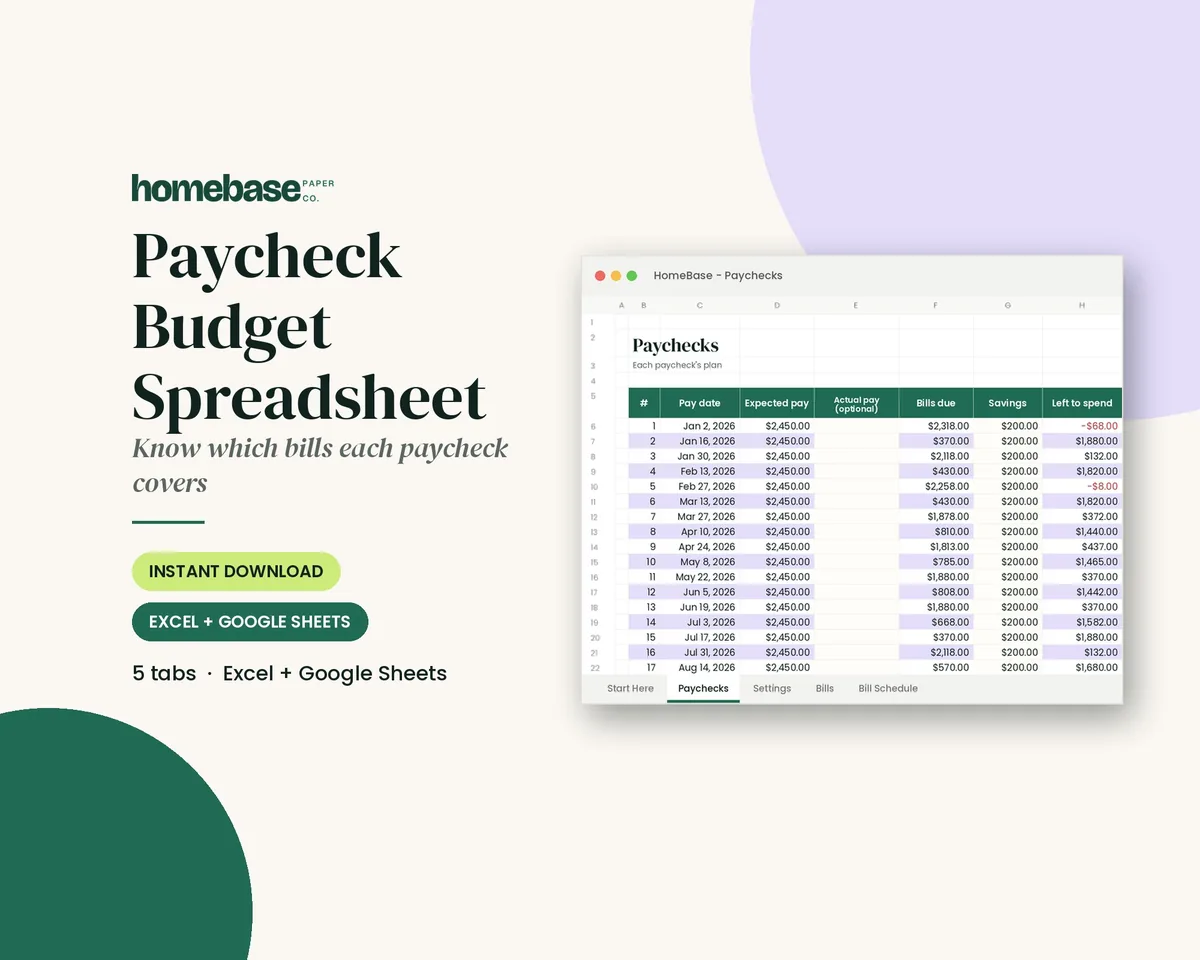
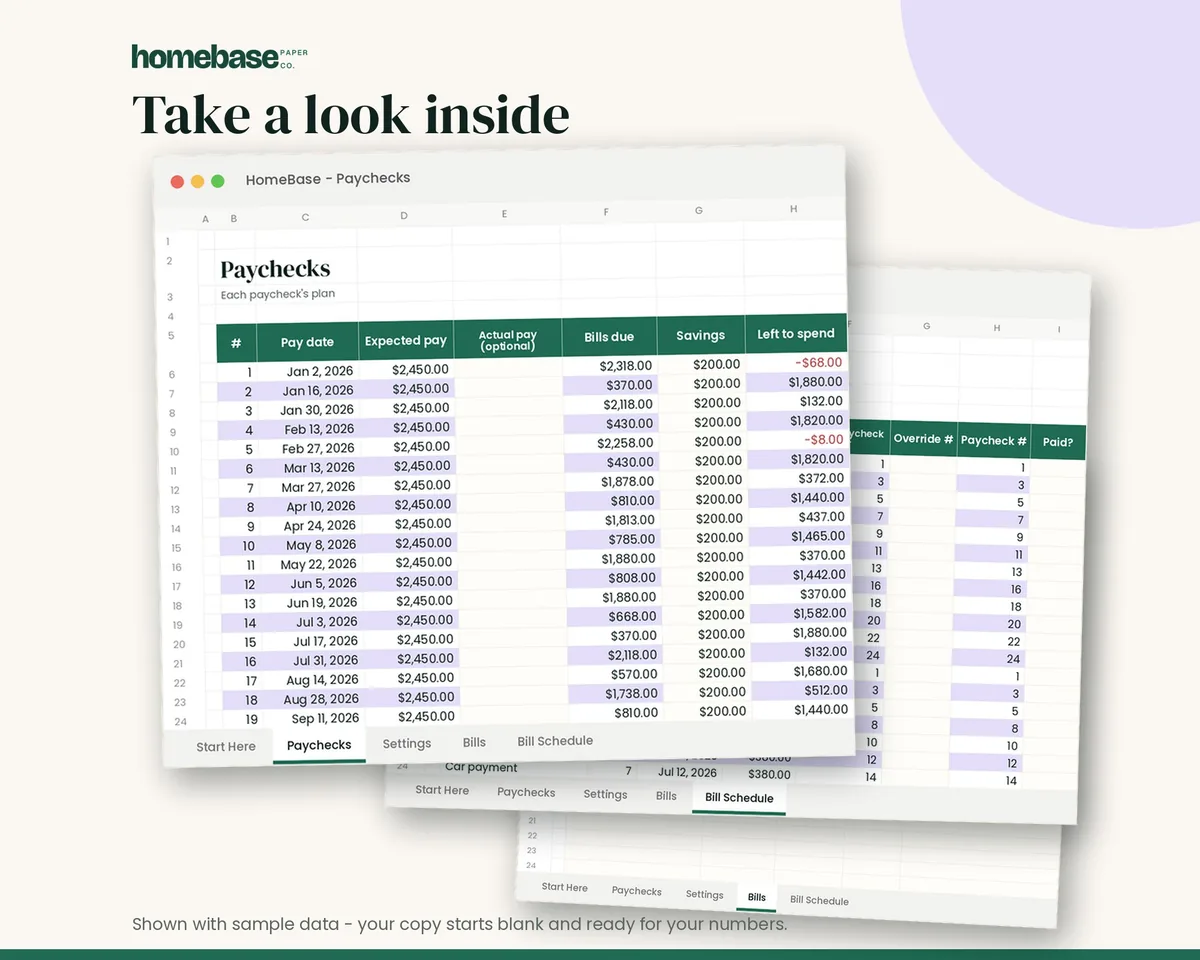
Our Paycheck Budget Spreadsheet starts from what actually lands in your account: enter your bills once, and it shows which paycheck pays each one and how much is left to spend per paycheck.
Disposable income definition
The U.S. Bureau of Economic Analysis (BEA), which publishes the national numbers, puts it simply: the income that's left after people pay their taxes is disposable personal income, also known as after-tax income. It's the amount people are able to spend, save or invest.
For a household, that means all of your income from every source, such as wages, self-employment, benefits, interest and child support, minus the taxes you pay on it. Everything you spend money on, from rent to groceries to a streaming service, is paid out of disposable income.
Disposable income meaning: three ways people use the term
Disposable income means slightly different things depending on who is talking, which is why the definition can feel confusing.
| Who is using it | What disposable income means | Example |
|---|---|---|
| Your budget | All your income minus the taxes taken from it | $5,000 gross a month leaves $3,997.50 in the example below |
| Economists and the news | The national total, "disposable personal income (DPI)," which the BEA defines as personal income less personal current taxes | Monthly reports say DPI rose or fell by a percent |
| Everyday speech | Often used loosely to mean "fun money" | "I don't have much disposable income this month" |
The third use is really discretionary income, the money left after taxes and essentials, which is covered further down. When you build a budget, use the first meaning: start from what's left after taxes, then subtract needs to find what you can spend freely.
The disposable income formula
Disposable income = gross income - taxes
Here's how to calculate disposable income in one line.
The taxes usually include:
- Federal income tax
- State and local income tax, where you have it
- Social Security and Medicare (FICA): 7.65% of wages for most employees, which is 6.2% for Social Security plus 1.45% for Medicare
- Self-employment tax, if you work for yourself
If you're not sure what your gross income is, our guide to gross monthly income shows how to work it out for salary, hourly and irregular pay.
A worked example
Here's a simple monthly example for one earner. The tax amounts are illustrations; yours depend on where you live, your filing status and your deductions.
| Line | Amount |
|---|---|
| Gross monthly pay | $5,000 |
| Federal income tax | - $480 |
| State income tax | - $140 |
| Social Security (6.2%) | - $310 |
| Medicare (1.45%) | - $72.50 |
| Disposable income | $3,997.50 |
Of every $5,000 earned, about $4,000 is disposable income. That's the number to budget from, not the $5,000.
Disposable income vs. discretionary income
These two terms get mixed up all the time, but the difference is important.
- Disposable income is what's left after taxes.
- Discretionary income is what's left after taxes and the essentials: housing, utilities, groceries, transportation, insurance, child care and minimum debt payments.
Continuing the example above:
| Line | Amount |
|---|---|
| Disposable income | $3,997.50 |
| Rent | - $1,450 |
| Utilities and phone | - $260 |
| Groceries | - $520 |
| Car payment, insurance and gas | - $640 |
| Minimum debt payments | - $180 |
| Discretionary income | $947.50 |
The $947.50 is the money you can choose what to do with: savings, extra debt payments, dining out, travel or hobbies. When people say "I have no money left," they usually mean their discretionary income is close to zero, even though their disposable income is thousands of dollars.
Disposable income vs. take-home pay
Take-home pay, or net pay, is what actually hits your bank account. It's disposable income minus any other paycheck deductions, such as:
- Health, dental and vision insurance premiums
- 401(k) or 403(b) contributions
- Health savings account (HSA) or flexible spending account (FSA) contributions
- Union dues or wage garnishments
So for most workers, take-home pay is a little lower than disposable income. For budgeting, take-home pay is the practical number, because it's what you can spend. Just remember that your 401(k) and HSA contributions are savings you've already made, not money that disappeared.
Where disposable income goes in a typical household
The U.S. Bureau of Labor Statistics' Consumer Expenditure Survey shows how the average household spent its money in 2024. Total spending averaged $78,535 a year. Here's the share that went to each major area:
| Spending area | Share of 2024 spending |
|---|---|
| Housing | 33.4% |
| Transportation | 17.0% |
| Food | 12.9% |
| Personal insurance and pensions | 12.5% |
| Healthcare | 7.9% |
| Entertainment | 4.6% |
| Cash contributions | 2.9% |
| Apparel and services | 2.5% |
| Everything else | about 6% |
Housing, transportation and food take almost two-thirds of the average household's spending. That's why those three are the first places to look if your discretionary income feels too small.
How to budget your disposable income in 5 steps
The Consumer Financial Protection Bureau's budgeting approach starts with the same question this page does: where does my money come from? Then it moves to where your money goes, when bills are due and, finally, a working budget.
- List every source of after-tax income. Use take-home pay from each job plus any benefits, child support or side income.
- List your fixed bills and due dates. Rent, car payment, insurance, phone and loans.
- Estimate your variable essentials. Average three months of groceries, gas and utilities. Our guide to variable expenses shows how.
- Set savings and debt goals. Decide on an amount for an emergency fund, sinking funds and extra debt payments before the fun money.
- Give the rest a job. In a zero-based budget, income minus everything you plan equals zero, so every dollar has a purpose.
Our Paycheck Budget Spreadsheet ($5.99) is built for step 2: enter your bills once and it shows which paycheck pays each one, all year. Our Zero-Based Budget Spreadsheet ($6.99) handles step 5, and its "Left to budget" counter turns green when every dollar of disposable income has a job.
A simple guide for splitting disposable income
The 50/30/20 budget is a popular starting point for after-tax income:
- 50% for needs: housing, utilities, groceries, transportation, insurance, minimum debt payments
- 30% for wants: dining out, travel, hobbies, subscriptions
- 20% for savings and debt payoff: emergency fund, retirement, extra payments
On $4,000 of disposable income, that's about $2,000 for needs, $1,200 for wants and $800 for savings and debt. If your needs are well over half, you're not doing anything wrong, but it tells you where the pressure is. Our guide to the 50/30/20 budget walks through it in detail.
How to increase your disposable income
Because disposable income is income minus taxes, there are only two ways to raise it:
- Earn more. Ask for a raise, pick up overtime, start a side job or sell things you no longer use.
- Pay less tax legally. Contribute to pre-tax retirement accounts or an HSA, claim credits you qualify for, and check your W-4 so you're not over-withholding all year. A big refund means you lent the government money interest-free.
Cutting bills doesn't raise disposable income, but it does raise discretionary income, which is the part you feel. Both matter.
Common disposable income mistakes
- Budgeting from gross pay. A $60,000 salary is not $5,000 a month to spend. Always start from what's left after taxes, and in practice from take-home pay.
- Forgetting irregular income taxes. If you freelance or drive for a delivery app, no one withholds tax for you. Set aside part of every payment for taxes, or your disposable income will look bigger than it is. Our guide to budgeting with irregular income shows how.
- Counting a tax refund as a bonus. A refund is your own money coming back. Plan for it, but don't build your monthly budget around it.
- Spending a raise before you see it. A raise is taxed too. Wait for the first new paycheck, then decide how much goes to savings before lifestyle costs creep up.
- Ignoring annual costs. Car registration, gifts and insurance paid twice a year all come out of disposable income. Divide them by 12 and save monthly.
Disposable income for couples and families
For a household with two earners, add both partners' after-tax income to get household disposable income. Then decide how you'll share costs: pooled, split 50/50 or split by each person's share of income. A couple earning $4,000 and $2,000 a month after taxes might split shared bills two-thirds and one-third. Whatever you choose, write it down and review it at a monthly money meeting. Our guide to how to budget as a couple covers the options.
Disposable income and the economy
BEA publishes U.S. disposable personal income every month in its Personal Income and Outlays release, along with a "real" version adjusted for inflation. It also reports the personal saving rate, which is the share of disposable income people save rather than spend. Economists watch these numbers closely, because consumer spending is a big part of the economy.
Put your disposable income to work
Knowing your disposable income is the first step. Deciding what every dollar does is the second. If you'd rather work on paper, our Budget Planner Printable ($5.99) has 12 undated pages you can print every month: budget, bills, spending, savings and debt. Or get everything in our Ultimate Budget Bundle ($19.99), which includes all six budget spreadsheets plus both printable planners, for less than half the price of buying them separately.
Make it easier
Tools for this

Spreadsheets
Paycheck Budget Spreadsheet
Enter your bills once. The sheet tells you which paycheck pays each one, all year.

Spreadsheets
Zero-Based Budget Spreadsheet
The 'Left to budget' counter turns green when every dollar has a job.

Printables
Budget Planner Printable
Twelve undated pages you can print every month: budget, bills, spending, savings and debt.
Frequently asked questions
What is disposable income? Disposable income is the money you have left after paying income and payroll taxes. It is your after-tax income, the amount you can spend, save or invest. The U.S. Bureau of Economic Analysis describes disposable personal income as the income left after people pay their taxes, also known as after-tax income.
How do you calculate disposable income? To calculate disposable income, start with your gross income and subtract income taxes and payroll taxes. The formula is: disposable income = gross income - taxes. For example, $5,000 of gross monthly pay minus $1,000 in federal, state and FICA taxes leaves $4,000 of disposable income.
What is the difference between disposable and discretionary income? Disposable income is what is left after taxes. Discretionary income is what is left after taxes and essential costs like housing, food, utilities, transportation and minimum debt payments. Discretionary income is always smaller, and it is the money you can choose to save, invest or spend on wants.
Is disposable income the same as take-home pay? Disposable income is not exactly the same as take-home pay. Take-home pay is what lands in your bank account after taxes and any other paycheck deductions, such as health insurance premiums or 401(k) contributions. Disposable income in the economic sense only subtracts taxes, so it is usually a little higher than your take-home pay.
Is rent paid from disposable income? Yes, rent is paid from disposable income. Rent, groceries, utilities and every other bill are paid out of disposable income, because disposable income is all of your after-tax money. Once you subtract rent and other necessities, what is left is your discretionary income.
What is a good amount of disposable income? A good amount of disposable income is enough to cover your needs with room left to save. A common guide is the 50/30/20 budget: about 50% of after-tax income for needs, 30% for wants and 20% for savings and debt payoff. If needs take far more than half, look at housing and transportation first.
What is disposable income used for? Disposable income is used for everything you pay for after taxes: housing, food, transportation, insurance, debt payments, savings, retirement contributions and fun. BEA tracks the share people save as the personal saving rate, which is saving as a percentage of disposable income.
Do 401(k) contributions reduce disposable income? No, not in the economic definition, because disposable income only subtracts taxes. In your personal budget, pre-tax 401(k) contributions lower your take-home pay and also lower your taxable income. Most people budget from take-home pay and count the 401(k) as savings.
How can I increase my disposable income? You can increase disposable income by earning more, through a raise, overtime or a side job, or by legally lowering your taxes, for example with pre-tax retirement and health savings accounts or by updating your W-4 so you are not over-withholding. Lowering bills raises discretionary income, not disposable income.
What is per capita disposable income? Per capita disposable income is the total disposable income of a country or area divided by its population. Economists use it to compare living standards. BEA publishes U.S. disposable personal income each month in its Personal Income and Outlays release.
Why does disposable income matter to the economy? Disposable income matters because it is the money households can spend or save, and consumer spending drives much of the U.S. economy. When disposable income rises faster than prices, households can afford more. BEA reports the figure monthly and also adjusts it for inflation as real disposable income.
What is the best way to budget my disposable income? The best way to budget disposable income is to give every dollar of take-home pay a job before the month starts: bills, essentials, savings, debt and fun. Our Paycheck Budget Spreadsheet ($5.99) tells you which paycheck pays each bill, all year.
More from HomeBase
You may also like

Spreadsheets
Bill Tracker Spreadsheet
Bills due in 3 days or less light up red, so nothing slips through.

Spreadsheets
Sinking Funds Tracker
It does the math: how much to set aside each month to hit every goal on time.

Spreadsheets
Annual Budget Spreadsheet
See exactly where your money goes every month - without complicated software.

Spreadsheets
Debt Payoff Planner
Pick snowball or avalanche, add any extra payment, and get your debt-free month instantly.
 Club
Monthly club
Money Club
Anyone who wants a clear plan for the month's bills, holiday spending and savings.
Free printable
Give every dollar a job: get the free monthly budget template
A printable zero-based monthly budget: income, bills, everyday spending and savings on one page, with a planned vs. actual column. You'll also get our weekly HomeBase email with simple budgeting and bill-paying tips.

Sources
- U.S. Bureau of Economic Analysis: Income and saving bea.gov
- U.S. Bureau of Economic Analysis: Disposable personal income bea.gov
- U.S. Bureau of Labor Statistics: Consumer Expenditures 2024 bls.gov
- CFPB: Budgeting, how to create a budget and stick with it consumerfinance.gov
- Personal income less personal current taxes bea.gov