

The short answer: gross monthly income is the total you earn in a month before taxes and other deductions come out. You need it for loan, mortgage and apartment applications.
- Salary: divide by 12, so $60,000 is $5,000 a month
- Hourly: rate x hours per week x 52 / 12
- Biweekly: paycheck gross x 26 / 12
- Budget with net income, the take-home pay, not gross
- Next step: Plan it with the Paycheck Budget Spreadsheet ($5.99).
Gross monthly income is the total you earn in a month before taxes and other deductions come out. The Consumer Financial Protection Bureau describes it as "the amount of money you have earned before your taxes and other deductions are taken out." You need this number for loan, mortgage and apartment applications. Below you will find formulas for every pay schedule, worked examples, and how gross income differs from the take-home pay you actually budget with.
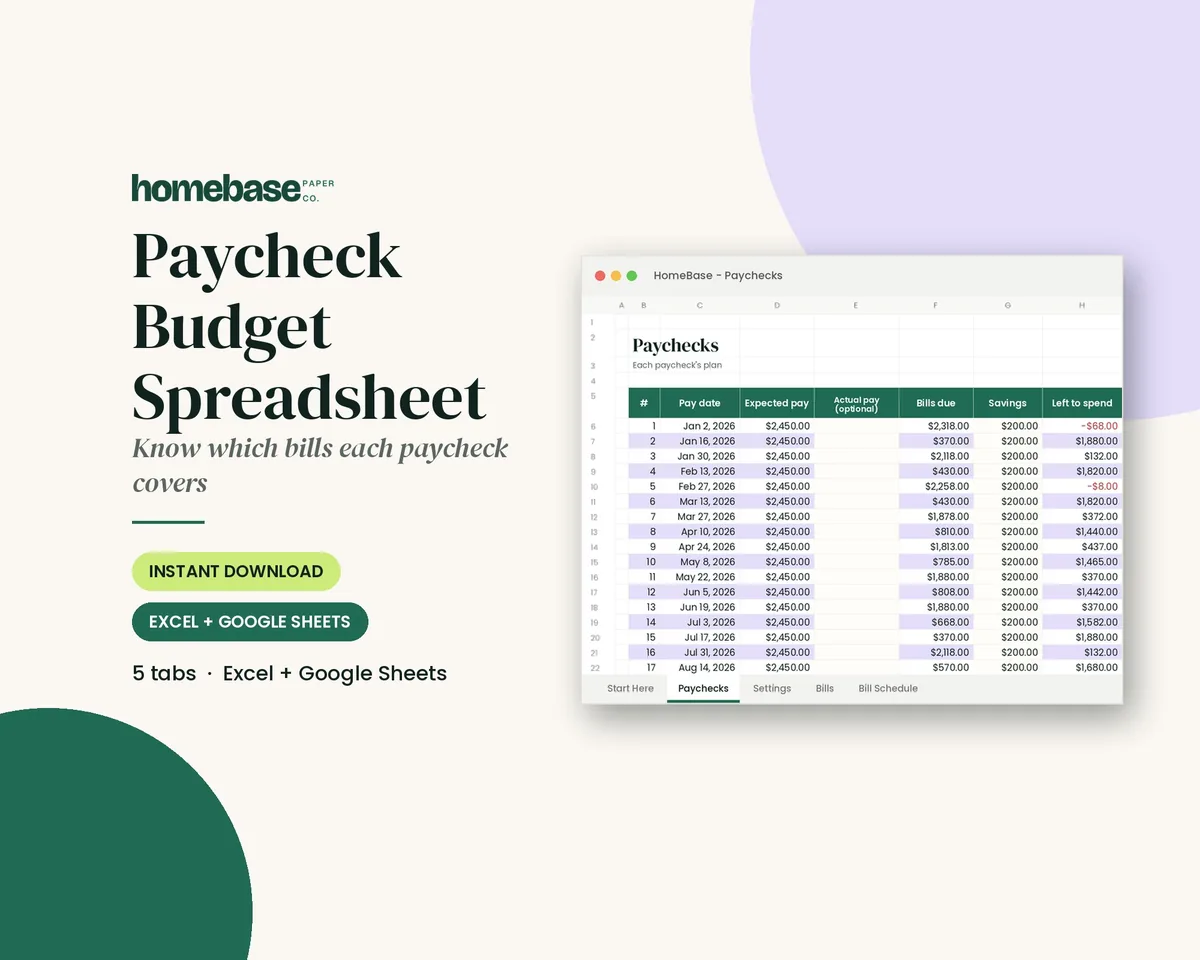
Once you know your gross pay, budget from your take-home pay. Our Paycheck Budget Spreadsheet works with weekly, biweekly, semi-monthly or monthly pay, lists your pay dates for the year and shows which paycheck pays each bill.
Gross monthly income formulas by pay type
For more on twice-a-month paychecks, see our guide to semi monthly pay and how it compares with biweekly pay.
| How you are paid | Formula | Example | Gross monthly income |
|---|---|---|---|
| Annual salary | Salary / 12 | $60,000 / 12 | $5,000 |
| Hourly | Rate x hours per week x 52 / 12 | $20 x 40 x 52 / 12 | $3,466.67 |
| Weekly | Weekly gross x 52 / 12 | $900 x 52 / 12 | $3,900 |
| Biweekly (every 2 weeks) | Paycheck gross x 26 / 12 | $2,000 x 26 / 12 | $4,333.33 |
| Semi-monthly (twice a month) | Paycheck gross x 2 | $2,200 x 2 | $4,400 |
| Monthly | Monthly gross | $4,800 | $4,800 |
| Variable or self-employed | Last 12 months total / 12 | $54,000 / 12 | $4,500 |
Use your gross pay for each paycheck, not the deposit amount. The gross figure is usually labeled "gross pay" or "total earnings" near the top of your pay stub.
What is gross monthly income, exactly?
Gross monthly income includes everything you earn before deductions. That usually means:
- Wages or salary
- Overtime pay
- Bonuses and commissions
- Tips
- Self-employment or side-gig income
- Rental income
- Regular payments such as pensions, Social Security, alimony or child support
The IRS explains in What is taxable and nontaxable income? that you can receive income as money, property or services, and that an amount is generally taxable unless it is specifically exempted by law. For a loan or apartment application, though, the question is usually simpler: what do you earn each month before deductions? Some income, such as certain benefits, may be nontaxable but still count on an application. Follow the instructions on the form.
Gross vs. net monthly income
| Gross monthly income | Net monthly income | |
|---|---|---|
| What it is | Earnings before deductions | Take-home pay after deductions |
| Includes taxes withheld? | Yes | No |
| Who uses it | Lenders, landlords, DTI ratio | Your monthly budget |
| Where to find it | Top of your pay stub ("gross pay") | Bottom of your pay stub ("net pay") |
The gap between the two is made up of deductions: federal and state income tax, Social Security and Medicare, retirement contributions, health insurance premiums and anything else taken out. Our guide on how to read a pay stub walks through each line.
Gross monthly income by salary and hourly wage
If you just need a quick answer, find your salary or hourly rate below. Hourly figures assume 40 hours a week for 52 weeks (2,080 hours a year).
| Annual salary | Gross monthly income |
|---|---|
| $30,000 | $2,500 |
| $40,000 | $3,333.33 |
| $50,000 | $4,166.67 |
| $60,000 | $5,000 |
| $75,000 | $6,250 |
| $100,000 | $8,333.33 |
| Hourly wage (full time) | Annual gross | Gross monthly income |
|---|---|---|
| $15 | $31,200 | $2,600 |
| $18 | $37,440 | $3,120 |
| $20 | $41,600 | $3,466.67 |
| $25 | $52,000 | $4,333.33 |
| $30 | $62,400 | $5,200 |
If you work fewer hours, or your hours change from week to week, use your actual average weekly hours in the formula instead of 40.
Gross monthly income with more than one income source
Many households have more than one source of income. Calculate each one separately, convert it to a monthly figure, then add them together:
| Income source | How it is paid | Monthly gross |
|---|---|---|
| Main job | $2,000 biweekly | $4,333.33 |
| Weekend job | $15 x 10 hours weekly | $650 |
| Freelance work | About $6,000 a year | $500 |
| Total | $5,483.33 |
For a household application, such as a joint mortgage or a shared apartment, each applicant usually lists their own income, and the lender or landlord combines them. Keep a few months of pay stubs and, for side income, bank statements or invoices, because applications often ask you to document what you list.
When income is irregular
Commissions, tips, gig work and seasonal jobs make monthly income bounce around. Two simple ways to handle it:
- For applications, total the last 12 months of gross income and divide by 12. That smooths out slow and busy months.
- For budgeting, plan your fixed bills around a low month. When a strong month comes in, move the extra to savings or a sinking fund so it covers the next slow month.
How to calculate gross monthly income step by step
- Find your pay schedule. Weekly, biweekly, semi-monthly or monthly. Check your pay stub or offer letter.
- Find your gross pay per period. Use the gross amount, before any deductions.
- Annualize it. Multiply by 52 (weekly), 26 (biweekly), 24 (semi-monthly) or 12 (monthly).
- Add other regular income. Include side income, rental income or other regular payments for the year.
- Divide by 12. The result is your gross monthly income.
Why biweekly pay is not "two paychecks a month"
If you are paid every two weeks, you get 26 paychecks a year, not 24. That means two months each year have three paydays. Doubling one paycheck understates your gross monthly income. In the example above, $2,000 x 2 is $4,000, but the true monthly average is $4,333.33.
The difference matters for your budget too. Those two "extra" paychecks can be planned in advance for savings, debt payoff or annual bills. The Paycheck Budget Spreadsheet ($5.99) handles weekly, biweekly, semi-monthly or monthly pay, calculates your pay dates for the year and assigns each bill to the paycheck that pays it, so three-paycheck months are easy to see.
Gross monthly income and your debt-to-income ratio
Lenders use gross monthly income to calculate your debt-to-income ratio, or DTI. The CFPB's debt-to-income ratio explainer defines DTI as all your monthly debt payments divided by your gross monthly income.
The CFPB's example: a $1,500 mortgage, a $100 auto loan and $400 in other debts add up to $2,000 a month. With a gross monthly income of $6,000, the DTI is 33 percent. Different loan products and lenders have different DTI limits. For a full walkthrough, see how to calculate your debt-to-income ratio.
| Monthly debt payments | Gross monthly income | DTI |
|---|---|---|
| $1,000 | $5,000 | 20% |
| $1,500 | $5,000 | 30% |
| $2,000 | $6,000 | 33% |
| $2,200 | $5,000 | 44% |
Gross monthly income for renters
Many landlords compare rent to gross monthly income. The common 30% rule keeps rent at or below 30% of your gross monthly income, and some landlords instead ask for income of about three times the rent. Each landlord sets its own standard. With $4,500 in gross monthly income, the 30% rule points to rent of about $1,350, and the 3x rule to about $1,500. Our guide on how much rent you can afford compares the 30%, 40x and 3x rules side by side and tests the result against your take-home budget.
Where you will be asked for gross monthly income
Knowing your number ahead of time saves a scramble when a form asks for it. You will typically see a gross monthly income field on:
- Mortgage and home equity applications
- Auto loan and personal loan applications
- Credit card applications (often as annual income)
- Apartment rental applications
- Some income-based programs and payment plans
Keep a note of your gross monthly income, how you calculated it and the date, and update it after a raise or job change. That way every application uses the same, consistent figure.
Budget with net income, not gross
Gross monthly income is the number lenders want, but your bills are paid from net income. If you build a budget on gross pay, you will plan to spend money that has already gone to taxes and benefits. A better approach:
What is left after taxes is your disposable income. Our guide has the formula, a worked example and how it differs from discretionary income.
- Use gross monthly income for applications and DTI.
- Use net monthly income to build your budget.
- Check how your net income splits across needs, wants and savings with the 50/30/20 budget.
- Revisit both numbers when you get a raise, change jobs or change your benefits.
The Annual Budget Spreadsheet ($6.99) has a setup tab for your categories and plan, 12 monthly tabs and planned vs. actual by category, so you can budget from take-home pay all year. If you want the paycheck planner, debt payoff planner, bill tracker and the other budgeting tools together, the Ultimate Budget Bundle ($19.99, $46.42 if bought separately) includes all 6 spreadsheets and both printable planners.
Common mistakes when figuring gross monthly income
- Using take-home pay. Applications ask for gross income. Using net pay understates what you earn.
- Doubling a biweekly paycheck. Multiply by 26 and divide by 12 instead.
- Leaving out regular extra income. Overtime, tips and side income count if they are steady and you can document them.
- Counting a one-time bonus as monthly income. Spread it over 12 months or list it separately.
- Ignoring how the lender defines income. Self-employed borrowers in particular should ask whether the lender wants gross receipts or net profit.
Make it easier
Tools for this

Spreadsheets
Paycheck Budget Spreadsheet
Enter your bills once. The sheet tells you which paycheck pays each one, all year.

Spreadsheets
Annual Budget Spreadsheet
See exactly where your money goes every month - without complicated software.
 Save 57%
Bundles
Ultimate Budget Bundle
All 6 spreadsheets + both printable planners - for less than half the price of buying them separately.
Frequently asked questions
What is gross monthly income? Gross monthly income is the total amount you earn in a month before taxes and other deductions are taken out. The CFPB describes it as the money you have earned before your taxes and other deductions. It includes wages, salary, overtime, bonuses, commissions, tips and other regular income, not just your take-home pay.
How do I calculate gross monthly income from salary? Divide your annual salary by 12. For example, a $60,000 salary is $5,000 in gross monthly income ($60,000 / 12). Use the salary before any taxes, retirement contributions or insurance premiums are subtracted.
How do I calculate gross monthly income from an hourly wage? Multiply your hourly rate by the hours you work per week, multiply by 52 weeks, then divide by 12. At $20 an hour and 40 hours a week, that is $20 x 40 x 52 = $41,600 a year, or about $3,467 a month.
How do I calculate gross monthly income if I am paid biweekly? Multiply your gross pay per paycheck by 26 (the number of biweekly paychecks in a year), then divide by 12. A $2,000 gross biweekly paycheck is $52,000 a year, or about $4,333 a month. Do not simply double one paycheck, because some months have three paydays.
What is the difference between gross and net monthly income? Gross monthly income is what you earn before deductions. Net monthly income is your take-home pay after federal and state income taxes, Social Security and Medicare, retirement contributions, health insurance and other deductions. Lenders usually use gross income; your budget should use net income.
Is gross monthly income before or after taxes? Yes, gross monthly income is before taxes. Gross monthly income is the amount you earn before any taxes or deductions are taken out. Your pay stub usually shows gross pay at the top and net pay, the amount actually deposited, at the bottom.
Why do lenders ask for gross monthly income? Lenders use gross monthly income to calculate your debt-to-income ratio. The CFPB explains that DTI is your total monthly debt payments divided by your gross monthly income, and it is one way lenders measure your ability to manage monthly payments. Different lenders and loan products have different DTI limits.
What counts as gross monthly income? It usually includes wages, salary, overtime, bonuses, commissions, tips, self-employment income, rental income, and regular income such as alimony, pensions or Social Security. On a loan or rental application, follow the form's instructions, because some lenders ask you to list certain income separately or document it.
How do I calculate gross monthly income if I am self-employed? Add up your business income over the past 12 months and divide by 12. Many lenders look at net self-employment income after business expenses, often based on your tax returns, so ask which figure they want. Keeping monthly income and expense records makes this much easier.
What if my income changes every month? If your income changes every month, use an average. Add up your gross income for the last 6 or 12 months and divide by the number of months. For budgeting, it is safer to plan around a lower-than-average month so your fixed bills are always covered.
Is gross monthly income the same as AGI? No, gross monthly income is not the same as AGI. Adjusted gross income (AGI) is a tax figure for the whole year, after certain adjustments such as some retirement contributions. Gross monthly income is simply your total monthly earnings before deductions. They are related but used for different purposes.
How do I find my gross monthly income on my pay stub? Look for gross pay for the current period, or year-to-date gross pay. Multiply your per-paycheck gross by the number of paychecks in a year, then divide by 12. If your pay varies, divide year-to-date gross pay by the number of months so far.
More from HomeBase
You may also like

Printables
Budget Planner Printable
Twelve undated pages you can print every month: budget, bills, spending, savings and debt.

Spreadsheets
Bill Tracker Spreadsheet
Bills due in 3 days or less light up red, so nothing slips through.

Spreadsheets
Sinking Funds Tracker
It does the math: how much to set aside each month to hit every goal on time.

Spreadsheets
Zero-Based Budget Spreadsheet
The 'Left to budget' counter turns green when every dollar has a job.
 Club
Monthly club
Money Club
Anyone who wants a clear plan for the month's bills, holiday spending and savings.
Free printable
Give every dollar a job: get the free monthly budget template
A printable zero-based monthly budget: income, bills, everyday spending and savings on one page, with a planned vs. actual column. You'll also get our weekly HomeBase email with simple budgeting and bill-paying tips.
