

The short answer: the 401k contribution limits for 2026 are $24,500 from your paycheck, plus an $8,000 catch-up at age 50 or older ($11,250 if you turn 60 to 63 this year). Your money plus your employer's can't top $72,000.
- 2026 maximums by age: under 50 $24,500 · 50 to 59 and 64+ $32,500 · 60 to 63 $35,750
- 2027 (projected, not official yet): $25,500 regular, $8,500 catch-up, $11,750 at 60 to 63, $75,000 total. The IRS usually confirms in November.
- Free download: get the free personal financial statement template (we email it to you) to see your 401k next to everything you own and owe. To find room for a bigger contribution, the Paycheck Budget Spreadsheet is $5.99.
Checked November 11, 2026, against IRS Notice 2025-67 and the IRS 401(k) limit pages. Below: every 2026 limit in one table, the 2027 outlook, per-paycheck amounts, how the match and the total limit work, catch-up and Roth catch-up rules, other plan limits, and what to do if you go over.
401k contribution limits at a glance (2025, 2026 and 2027)
These are the numbers most people search for. The 2025 and 2026 figures are official IRS limits. The 2027 column is a projection until the IRS announces it.
| Limit | 2025 | 2026 (official) | 2027 (projected) |
|---|---|---|---|
| Employee deferral (pre-tax + Roth) | $23,500 | $24,500 | $25,500 |
| Catch-up, age 50+ | $7,500 | $8,000 | $8,500 |
| Super catch-up, ages 60 to 63 | $11,250 | $11,250 | $11,750 |
| Total under 50 (you + employer) | $70,000 | $72,000 | $75,000 |
| Total at 50+ with catch-up | $77,500 | $80,000 | $83,500 |
| Total at 60 to 63 with super catch-up | $81,250 | $83,250 | $86,750 |
| Pay that counts for contributions | $350,000 | $360,000 | $375,000 |
| Roth catch-up wage test (prior-year FICA wages) | n/a | $150,000 | $155,000 |
| Highly compensated employee threshold | $160,000 | $160,000 | $170,000 |
The 2026 numbers come from the IRS announcement of the 2026 limits and IRS Notice 2025-67. The 2027 projections are Milliman's final estimates, published after the September 2026 inflation report. Totals with catch-up are our math: the total limit plus the catch-up.
Quick tip: if your birthday puts you at 50 any time in 2026, you count as 50 for the whole year. The same calendar-year rule applies to the 60 to 63 window.
The 2027 401k limit: what we know so far
As of November 11, 2026, the IRS has not released the 2027 limits. Its November 5 release of 2027 tax inflation adjustments (brackets and the standard deduction) did not include retirement plan limits; those come in a separate notice, and last year's arrived on November 13. It sets them each fall from the change in consumer prices through September, then rounds down. The employee limit moves in $500 steps, and so does the catch-up.
Milliman's final 2027 forecast assumes about a 3.5% increase factor. That's enough to lift the employee limit by $1,000 and the catch-up by $500. Marsh's projection matches on the main limits.
What to do now: set your 2027 election at the 2026 amount, $24,500, then raise it when the IRS confirms. Most plans let you change your percentage any pay period. If you're 50+, plan for $32,500 now and bump it later.
We'll update this page when the official 2027 numbers are out.
The 2027 compensation limit: projected $375,000
The 2027 compensation limit, also called the 401(a)(17) limit, is the most pay a 401k plan can count when it figures your match, profit sharing or contribution percentage. For 2026 it is $360,000; Milliman and Marsh both project $375,000 for 2027. The limit moves in $5,000 steps, so the projected $15,000 jump is the biggest dollar increase on the 2027 list.
It does not cap what you can earn or the $24,500 you can defer. It caps the salary a percentage is applied to:
| Salary | Employer match formula | Pay the plan can count (2026) | Match you receive |
|---|---|---|---|
| $150,000 | 5% of pay | $150,000 | $7,500 |
| $360,000 | 5% of pay | $360,000 | $18,000 |
| $400,000 | 5% of pay | $360,000 | $18,000 (not $20,000) |
If you earn above the limit and contribute a flat percentage, you can also hit $24,500 early in the year and stop getting a per-paycheck match. Ask HR whether your plan has a "true-up" that adds the missing match at year end; if it doesn't, spread your contributions across every paycheck.
How much to contribute per paycheck to max out your 401k
Divide the annual limit by the number of paychecks left in the year. Here are the full-year numbers for 2026:
| Pay schedule | Checks a year | Max at under 50 ($24,500) | Max at 50+ ($32,500) | Max at 60 to 63 ($35,750) |
|---|---|---|---|---|
| Weekly | 52 | $471.15 | $625.00 | $687.50 |
| Every two weeks | 26 | $942.31 | $1,250.00 | $1,375.00 |
| Twice a month | 24 | $1,020.83 | $1,354.17 | $1,489.58 |
| Monthly | 12 | $2,041.67 | $2,708.33 | $2,979.17 |
And if the projected 2027 limits hold:
| Pay schedule | Max at under 50 ($25,500) | Max at 50+ ($34,000) | Max at 60 to 63 ($37,250) |
|---|---|---|---|
| Every two weeks | $980.77 | $1,307.69 | $1,432.69 |
| Twice a month | $1,062.50 | $1,416.67 | $1,552.08 |
| Monthly | $2,125.00 | $2,833.33 | $3,104.17 |
What percentage of your salary is the max?
Most plans ask for a percentage, not a dollar amount. To hit $24,500 in 2026:
| Salary | Percent needed to max out |
|---|---|
| $50,000 | 49.0% |
| $60,000 | 40.8% |
| $75,000 | 32.7% |
| $100,000 | 24.5% |
| $150,000 | 16.3% |
| $200,000 | 12.25% |
Watch the match: if you hit the cap in October, your paychecks stop holding money back. Some plans also stop matching for the rest of the year, unless they offer a "true-up." Ask HR before you front-load. Spreading it evenly across all checks is the safe default.
Budget tip: a bigger contribution means a smaller check. Our guide on how to read a pay stub shows where the 401k line sits, and the budget percentages guide shows how much of your income most plans aim to save.
How the two 401k limits work together
The IRS sets two separate caps, and mixing them up is the most common mistake.
- The employee limit ($24,500 in 2026). This covers only money taken from your paycheck. Pre-tax and Roth deferrals share it.
- The total limit ($72,000 in 2026). This covers your deferrals, employer match, profit-sharing money and forfeitures. It also can't go over 100% of your pay.
Catch-up money sits outside both. That's why the true ceiling is $80,000 at 50+ and $83,250 at ages 60 to 63, according to the IRS page on 401(k) contribution limits.
Employer match examples
| Match formula | Salary | You put in | Employer adds | Total for the year |
|---|---|---|---|---|
| 100% of the first 4% | $60,000 | $2,400 (4%) | $2,400 | $4,800 |
| 50% of the first 6% | $80,000 | $4,800 (6%) | $2,400 | $7,200 |
| 100% of the first 3%, then 50% of the next 2% | $100,000 | $5,000 (5%) | $4,000 | $9,000 |
| 100% of the first 6% | $150,000 | $24,500 (max) | $9,000 | $33,500 |
Rule of thumb: contribute at least enough to get the full match. In the second row, stopping at 3% would leave $1,200 of free money on the table each year.
Who can actually reach $72,000?
Very few workers hit the total limit from a regular job. It mostly matters for:
- People with big profit-sharing contributions from their employer
- Plans that allow after-tax contributions (sometimes used for a "mega backdoor Roth")
- Self-employed people with a solo 401k, who can add an employer contribution on top of their own $24,500
Catch-up contributions: 50+ and the 60 to 63 super catch-up
If your plan allows them, you can add catch-up money once you're 50 by December 31. You don't need to be "behind" to use it.
| Your age in 2026 | Catch-up allowed | Your total deferral max |
|---|---|---|
| Under 50 | $0 | $24,500 |
| 50 to 59 | $8,000 | $32,500 |
| 60, 61, 62 or 63 | $11,250 | $35,750 |
| 64 and older | $8,000 | $32,500 |
The super catch-up came from the SECURE 2.0 Act. It's only for the four calendar years when you turn 60, 61, 62 or 63. At 64 you go back to the regular catch-up. The IRS catch-up contribution page lists the plan types that allow it.
The new Roth catch-up rule for high earners
Starting in 2026, a high earner's catch-up money has to go in as Roth (after-tax).
- Who it hits: anyone whose FICA wages from that employer were over $150,000 in the prior year. For 2026, that means 2025 wages from box 3 of your W-2.
- What changes: your regular $24,500 can still be pre-tax. Only the catch-up portion must be Roth.
- If your plan has no Roth option: you may not be able to make catch-ups there at all. Ask your plan administrator.
- 2027: the wage test is projected to rise to about $155,000, using 2026 wages.
Traditional vs. Roth 401k: same limit, different tax timing
Both share the one $24,500 cap, so you choose how to split it.
| Traditional (pre-tax) 401k | Roth 401k | |
|---|---|---|
| Lowers this year's taxable income | Yes | No |
| Taxed when you withdraw in retirement | Yes | No, if the rules are met |
| Employer match | Usually goes in pre-tax | Usually pre-tax (some plans now allow Roth match) |
| Good fit if | You're in a higher bracket now than you expect later | You're early in your career or expect higher taxes later |
Tax savings example: a single filer earning $60,000 who puts $6,000 into a traditional 401k cuts 2026 taxable income from $43,900 to $37,900, after the $16,100 standard deduction. That lowers federal income tax by $720, because those dollars would have been taxed at 12%. At a 22% bracket, $10,000 in pre-tax deferrals saves $2,200. See our standard deduction guide for the 2026 amounts, and the 2026 tax brackets to find your marginal rate before you pick traditional or Roth.
For the Roth side outside work, our Roth IRA guide covers income limits and how to open one.
2026 limits for other retirement accounts
Here's how a 401k compares with the other accounts people stack with it.
| Account | 2026 limit | Catch-up | Notes |
|---|---|---|---|
| 401(k), 403(b), Thrift Savings Plan | $24,500 | $8,000 at 50+; $11,250 at 60 to 63 | 401(k) and 403(b) deferrals share one personal limit |
| Governmental 457(b) | $24,500 | $8,000 at 50+; $11,250 at 60 to 63 | Separate from the 401(k)/403(b) limit, so you can max both |
| SIMPLE IRA / SIMPLE 401(k) | $17,000 | $4,000 at 50+; $5,250 at 60 to 63 | $18,100 in some smaller-employer plans |
| Traditional or Roth IRA | $7,500 | $1,100 at 50+ | Roth income phase-out $153,000 to $168,000 single |
| Total 401(k) additions (you + employer) | $72,000 | Catch-up on top | Or 100% of pay, if lower |
The SIMPLE and IRA numbers come from the same IRS announcement. The IRS keeps a running table of every year's figures on its COLA increases page.
Stacking order many people use: 401k up to the match, then a Roth IRA, then back to the 401k toward the max. Keep an emergency fund first, so you don't raid retirement money for a car repair.
401k limit history: how the limits have grown
| Year | Employee limit | Catch-up (50+) | Total limit |
|---|---|---|---|
| 2020 | $19,500 | $6,500 | $57,000 |
| 2021 | $19,500 | $6,500 | $58,000 |
| 2022 | $20,500 | $6,500 | $61,000 |
| 2023 | $22,500 | $7,500 | $66,000 |
| 2024 | $23,000 | $7,500 | $69,000 |
| 2025 | $23,500 | $7,500 | $70,000 |
| 2026 | $24,500 | $8,000 | $72,000 |
| 2027 (projected) | $25,500 | $8,500 | $75,000 |
That's a $5,000 jump in the employee limit since 2020, or about 26%. If your contribution percentage hasn't changed in years, you may be further from the max than you think.
Special situations that trip people up
Changing jobs mid-year
The $24,500 limit is per person, not per plan. A new employer's payroll doesn't know what you put in at your old job. Add both together and lower your new election if you need to.
Example: you put $15,000 into your old plan through June. At the new job you can defer only $9,500 more in 2026 (under 50).
Two jobs or a side business
Deferrals across unrelated employers still share one personal limit. The total $72,000 limit, though, applies per employer. A self-employed side business with a solo 401k can take a separate employer contribution, even if you already maxed out deferrals at your day job.
High earners and plan limits
Your plan can set a lower limit than the IRS does. Highly compensated employees, those earning over $160,000 in 2025 for the 2026 plan year, may be capped lower so the plan passes fairness testing. Only the first $360,000 of pay counts toward contributions and matches in 2026.
Contributed too much?
If your deferrals across all plans go over the limit:
- Tell your plan administrator before April 15 of the next year.
- Ask for the excess, plus any earnings, to be paid out.
- The excess is taxed in the year you contributed it, and the earnings in the year paid out. It doesn't trigger the 10% early-withdrawal tax.
Miss April 15 and the IRS says the excess gets taxed twice: once now and again when you withdraw it.
Your 401k contribution checklist for the rest of 2026 and for 2027
- Find your year-to-date total on your latest pay stub or plan website.
- Count the paychecks left in 2026 and divide what's left of your limit by that number.
- Confirm the match formula and whether your plan does a year-end true-up.
- Check your age band: 50+, or turning 60 to 63, adds catch-up room.
- Check the Roth catch-up rule if your 2025 wages were over $150,000.
- Pick traditional, Roth or a split based on your bracket now vs. later.
- Raise your 2027 election once the IRS confirms the new limit. Even 1% more a year adds up.
- Update your budget so the smaller paycheck still covers every bill.
For the bigger picture, see how to save for retirement, how to start investing, and how your balance compares in average savings by age. Our free compound interest calculator shows what a higher contribution grows into. Social Security fills in the rest of retirement income; see how Social Security works.
Templates to make room for your 401k
Raising your contribution is easier when you can see exactly what each paycheck still covers.

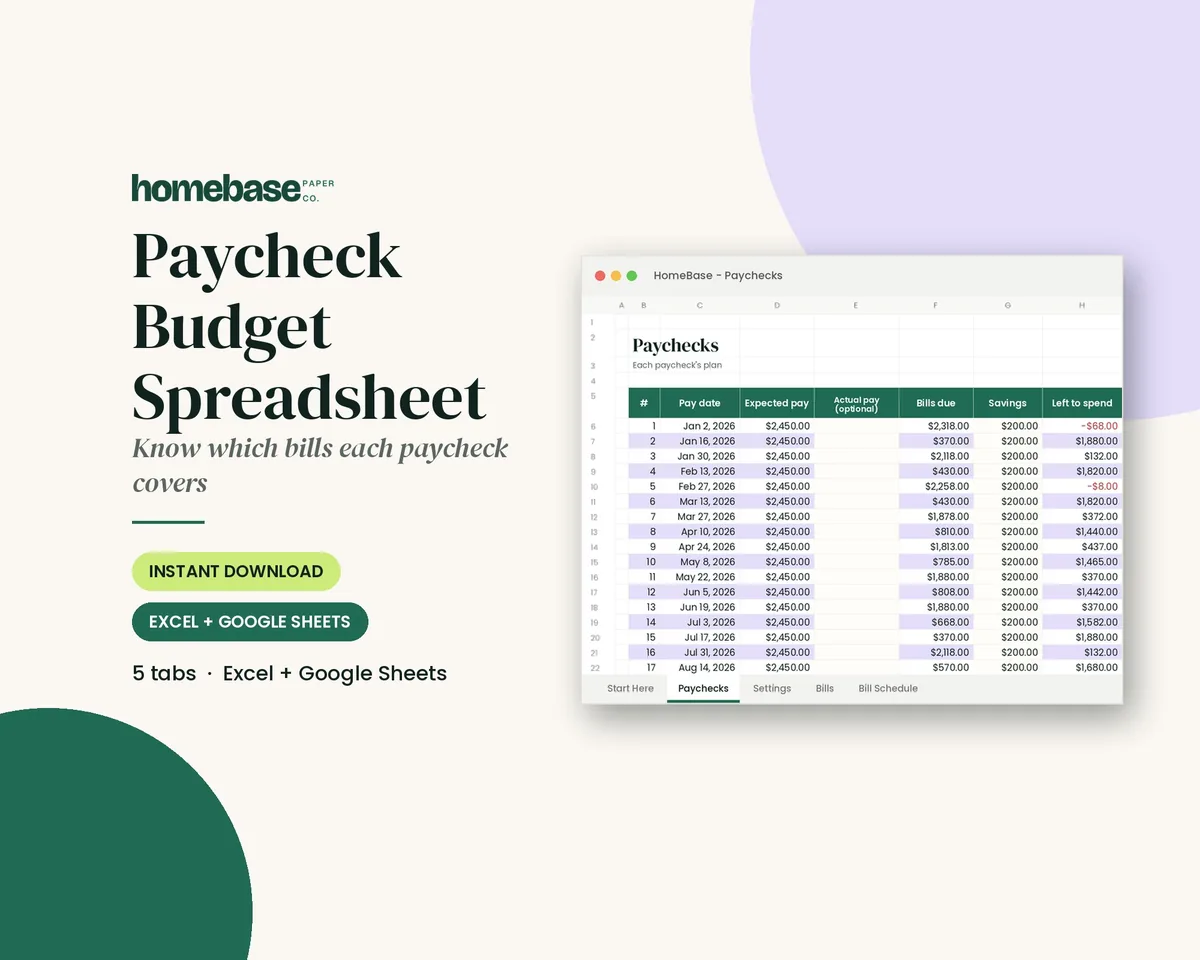
- Paycheck Budget Spreadsheet, $5.99: enter your bills once and see which paycheck pays each one, for weekly, biweekly or monthly pay. Test a 1% or 2% higher 401k contribution and see what's left.
- Annual Budget Spreadsheet, $6.99: a 12-month Google Sheets template (it works in Excel too) to track income, bills and savings deposits all year.
- Ultimate Budget Bundle, $19.99 (
$46.42bought separately): all six budget spreadsheets plus both printable planners.
Browse every budget spreadsheet, our printable planners or money bundles.
The bottom line
For 2026, you can put $24,500 of your own pay into a 401k, plus $8,000 at 50+ or $11,250 if you're turning 60 to 63. Employer money counts only toward the $72,000 total limit. The 2027 limits are projected at $25,500 and $8,500, and we'll update this page as soon as the IRS confirms them. Grab the full match first, raise your percentage a little each year, and check the per-paycheck math so you don't overshoot.
Make it easier
Tools for this
Spreadsheets
Paycheck Budget Spreadsheet
Enter your bills once. The sheet tells you which paycheck pays each one, all year.

Spreadsheets
Annual Budget Spreadsheet
See exactly where your money goes every month - without complicated software.
 Save 57%
Bundles
Ultimate Budget Bundle
All 6 spreadsheets + both printable planners - for less than half the price of buying them separately.
Frequently asked questions
What are the 401k contribution limits for 2026? The 401k contribution limit for 2026 is $24,500 in employee deferrals, up from $23,500 in 2025. Workers 50 and older can add an $8,000 catch-up for $32,500, and workers who turn 60 to 63 in 2026 can add $11,250 instead, for $35,750. Employee plus employer money is capped at $72,000.
What is the 401k limit for 2027? The IRS had not announced the 2027 401k limit as of November 4, 2026. Milliman's final estimate, based on September 2026 inflation data, is $25,500 for employee deferrals, an $8,500 catch-up at 50+, $11,750 at ages 60 to 63 and a $75,000 total limit. The IRS usually confirms the numbers in November.
What is the 401k catch-up contribution limit? The 401k catch-up contribution limit for 2026 is $8,000 for anyone 50 or older by December 31. A higher super catch-up of $11,250 applies if you turn 60, 61, 62 or 63 during 2026. Catch-up money goes on top of the $24,500 regular limit, and your plan has to allow it.
What is the 401k max contribution including employer match? The 401k max contribution including employer match is $72,000 for 2026, or 100% of your pay if that is lower. That cap covers your deferrals, matching and profit-sharing money and forfeitures. Catch-up contributions sit on top, so the ceiling is $80,000 at 50+ and $83,250 at ages 60 to 63.
Does the employer match count toward the $24,500 limit? The employer match does not count toward the $24,500 employee limit for 2026. The $24,500 cap covers only money taken from your paycheck, pre-tax or Roth. Matching and profit-sharing money counts toward the separate $72,000 total limit along with your own deferrals.
Do Roth 401k contributions have the same limit? Roth 401k and traditional 401k contributions share one limit, $24,500 for 2026. You can split it any way your plan allows, such as $12,000 Roth and $12,500 pre-tax, but the two together can't go over the cap. Roth IRA contributions are a separate limit of $7,500.
Can I contribute to a 401k and an IRA in the same year? Yes, you can contribute to a 401k and an IRA in the same year. The 2026 IRA limit is $7,500 ($8,600 at 50+), on top of the $24,500 401k limit. Being covered by a workplace plan can limit the tax deduction for a traditional IRA, and Roth IRA eligibility depends on income.
What happens if I contribute too much to my 401k? If your deferrals go over the limit, tell your plan administrator before April 15 of the next year and ask for the excess plus earnings to be paid out. The excess is taxed in the year you contributed it. If you leave it in the plan, the IRS says it gets taxed twice, once now and again at withdrawal.
Is the 401k limit per person or per plan? The $24,500 employee deferral limit is per person, not per plan. If you change jobs or have two 401k plans, all your deferrals add up toward one $24,500 cap. The $72,000 total limit works per employer, so a side business with its own solo 401k can get separate employer contributions.
How much should I put in my 401k per paycheck to max it out? To max out a 401k in 2026, put in about $942.31 per paycheck if you're paid every two weeks (26 checks), $1,020.83 if paid twice a month, or $2,041.67 if paid monthly. At 50+ with the full catch-up, the biweekly amount is $1,250. Check whether your plan stops your match once you hit the cap early.
Who has to make catch-up contributions as Roth starting in 2026? Starting in 2026, if your prior-year FICA wages from your employer were over $150,000, your catch-up contributions must go in as Roth. In 2026 that test uses 2025 wages. Your regular $24,500 can still be pre-tax. If your plan has no Roth option, high earners may not be able to make catch-ups there.
When is the deadline for 401k contributions? The deadline for 401k employee contributions is the end of the plan year, which is December 31 for most plans, because the money has to come out of a paycheck. That is different from IRAs, where you can contribute for 2026 until the April 2027 tax filing deadline.
Which HomeBase spreadsheet helps me fit a bigger 401k contribution into my budget? The Paycheck Budget Spreadsheet at $5.99 is the best HomeBase fit. You enter your bills once and see which paycheck pays each one, so you can test a higher 401k percentage and see what is left in every check. It works in Excel and Google Sheets for weekly, biweekly or monthly pay.
Is there a HomeBase template for tracking a whole year of savings and bills? The Annual Budget Spreadsheet at $6.99 tracks 12 months of income, bills and savings in one Google Sheets or Excel file, so you can log 401k, IRA and emergency fund deposits next to everything else. For every budget sheet plus two printables, the Ultimate Budget Bundle is $19.99.
More from HomeBase
You may also like

Printables
Budget Planner Printable
Twelve undated pages you can print every month: budget, bills, spending, savings and debt.

Spreadsheets
Bill Tracker Spreadsheet
Bills due in 3 days or less light up red, so nothing slips through.

Spreadsheets
Sinking Funds Tracker
It does the math: how much to set aside each month to hit every goal on time.

Spreadsheets
Zero-Based Budget Spreadsheet
The 'Left to budget' counter turns green when every dollar has a job.
 Club
Monthly club
Money Club
Anyone who wants a clear plan for the month's bills, holiday spending and savings.
Free printable
Give every dollar a job: get the free monthly budget template
A printable zero-based monthly budget: income, bills, everyday spending and savings on one page, with a planned vs. actual column. You'll also get our weekly HomeBase email with simple budgeting and bill-paying tips.

Sources
- IRS: 401(k) limit increases to $24,500 for 2026, IRA limit increases to $7,500 irs.gov
- IRS: Retirement topics, 401(k) and profit-sharing plan contribution limits irs.gov
- IRS: Retirement topics, catch-up contributions irs.gov
- IRS: COLA increases for dollar limitations on benefits and contributions irs.gov