

The short answer: living paycheck to paycheck means every dollar of each paycheck is spoken for before the next one arrives, with no cushion.
- You don't need a big raise to start
- Budget from your lowest normal paycheck
- Cover essentials first, then build a small buffer
- 10 steps and a sample paycheck plan
- Next step: Plan it with the Paycheck Budget Spreadsheet ($5.99).
Living paycheck to paycheck means every dollar of each paycheck is spoken for before the next one arrives. There's no cushion, so a late check, a car repair or a doctor's bill can send you to a credit card or leave a bill unpaid. It's stressful, and it's far more common than most people admit. The good news: you don't need a big raise to start breaking the cycle. You need a plan for each paycheck and a small buffer that grows over time. Here's how to build both. Over time, the goal is to live below your means.
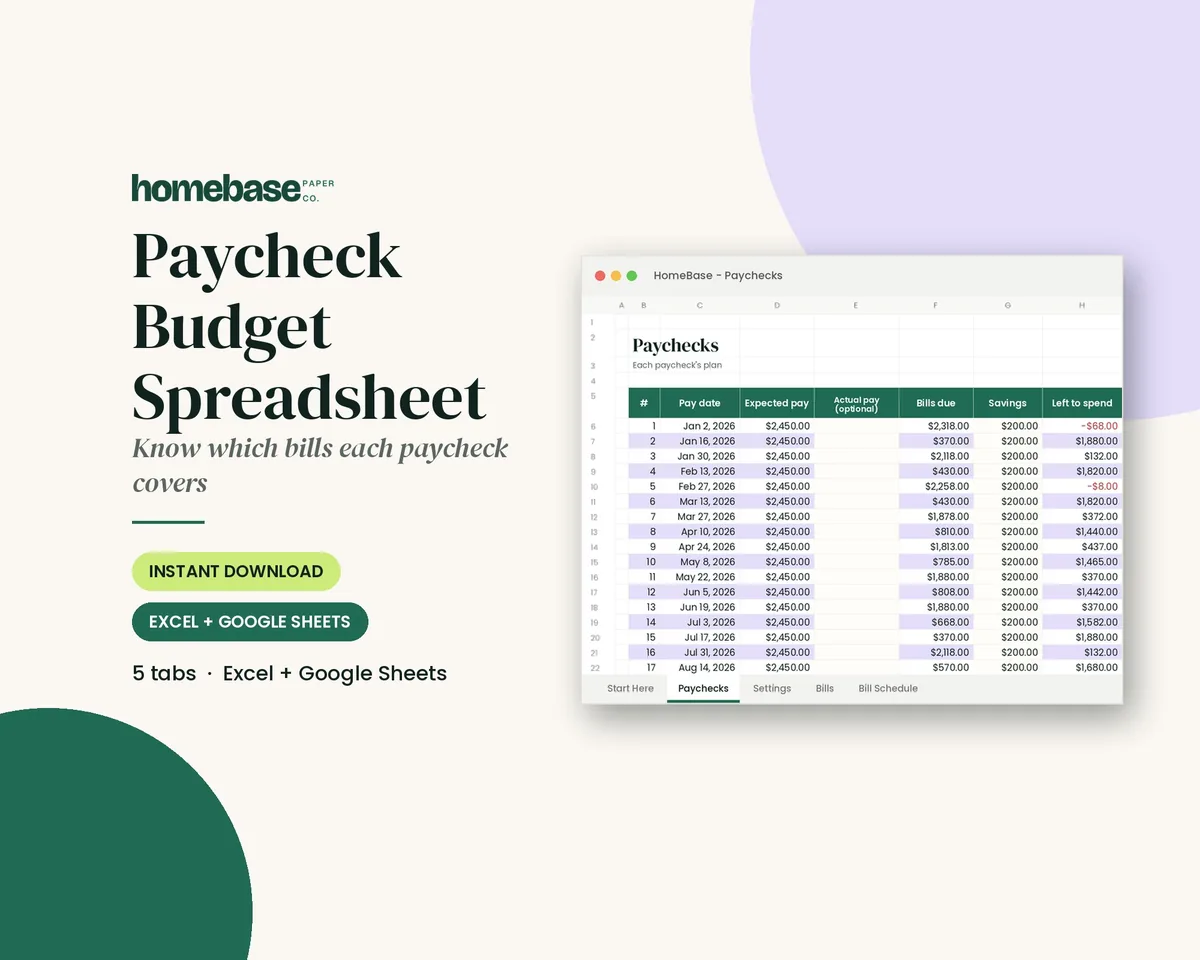
Our Paycheck Budget Spreadsheet is built for this: enter your bills once, and it assigns each one to the paycheck that pays it and shows what's left to spend per paycheck, all year.
How common is living paycheck to paycheck?
The Federal Reserve surveys thousands of adults every year about their finances. Its report on household well-being in 2025 found:
- 63% of adults would cover a $400 emergency expense with cash or its equivalent. That share hasn't changed in three years and is below the 68% high in 2021.
- 55% had an emergency fund that would cover three months of expenses.
- 59% had a major unexpected expense in the past year. The most common were vehicle repairs (30%), home or appliance repairs (22%) and medical bills (21%).
- 16% didn't pay all their bills in full in the month before the survey.
The full report also asked how often people have money left over at the end of the month. Only 41% said always or often, while 18% said rarely and 12% said never. Income made a big difference: 19% of adults earning under $25,000 always or often had money left over, compared with 59% of those earning $100,000 or more.
The link between leftover money and savings is striking. Among people who always had money left at month-end, 86% had a three-month emergency fund. Among those who never did, it was 13%. Having a little left each month is how savings start.
Signs you're living paycheck to paycheck
- You check your balance before buying groceries.
- You time bills to the day your paycheck lands.
- One unexpected bill means using a credit card or skipping another bill.
- You've had an overdraft or late fee in the past few months.
- You don't have $500 you could get to today without borrowing.
- You don't know exactly where last month's money went.
If two or three of these sound familiar, the steps below are for you.
How to stop living paycheck to paycheck: 10 steps
1. Map your pay dates and due dates
Write every pay date for the next two months. Then write every bill with its due date and amount. Most people find that one paycheck is overloaded (often the one that covers rent) while the other has room. That's the source of a lot of month-to-month stress.
2. Assign every bill to a paycheck
Group the bills by the paycheck that will pay them. Then subtract those bills from each check to see what's left to spend from that check. This is the core of a paycheck budget, and it often reveals money you didn't know you had. Our guide to the paycheck budget planner walks through it.
3. Move due dates to balance the load
If one paycheck can't cover its bills, call your card issuers, utilities and lenders and ask to move due dates. Many let you choose a date online. Spreading bills evenly across checks prevents the gap that causes late fees.
4. Track spending for 30 days
Write down every purchase for one month. The CFPB's spending tracker is a simple free worksheet for it. Look for the two or three categories that are bigger than you thought.
5. Cut two things, not twenty
Pick the two easiest wins: a subscription you rarely use, a cheaper phone plan, one fewer takeout order a week. Cutting $60 a month is a $720-a-year buffer.
6. Start a starter buffer
Open a separate savings account and set an automatic transfer on payday. Start with $10, $25 or $50 per paycheck. At $50 per biweekly check, you'll have about $500 in five months and $1,300 in a year. Your first goal is $500 to $1,000.
7. Turn predictable "surprises" into sinking funds
Car registration, holiday gifts, school supplies and annual subscriptions aren't emergencies. They're expenses you know are coming. Divide each one by the paychecks until it's due and set that much aside. Our guide to sinking funds shows how.
8. Stop the debt spiral
High-interest debt is often what keeps people stuck. Once your buffer is in place, list your debts and focus extra money on one at a time. Our guide to how to get out of debt explains the order. Not all debt is equal; here's how to tell good debt vs. bad debt.
9. Give windfalls a job
Tax refunds, bonuses and gifts can do in one day what months of saving would. Before the money arrives, decide on a split, such as half to the buffer, a quarter to debt and a quarter to something you enjoy.
10. Look at income too
If your budget is already tight on essentials, cutting can only go so far. Ask for a raise, pick up extra shifts, sell things you no longer use or look into a side income. Our guide to how to budget on a low income has more on stretching a tight paycheck.
A sample paycheck plan
Here's how one biweekly paycheck of $1,600 might be planned:
| Item | Amount |
|---|---|
| Paycheck | $1,600 |
| Rent (half) | −$650 |
| Car payment | −$280 |
| Phone and internet | −$110 |
| Groceries and gas for two weeks | −$300 |
| Sinking funds (car, holidays, gifts) | −$60 |
| Starter buffer | −$50 |
| Left to spend | $150 |
Nothing about this paycheck is extreme. But because every dollar has a job, the $150 is truly free to spend, the buffer grows every payday and next December's gifts are already funded.
For how big that savings line should be, see how much of my paycheck should I save, with percentages by goal.
If your income changes from check to check
Hourly, tipped, gig and commission work make living paycheck to paycheck even harder, because you can't count on the same amount each time. A few adjustments help:
- Budget from your lowest normal paycheck. Look at the last three months and plan with the smallest typical check, not the average.
- Put the extra in a holding account. When a check comes in above your base, move the difference to a separate savings account. Draw from it in lean weeks.
- Cover essentials first. Rent, utilities, groceries, transportation and minimum payments come out of every check before anything else.
- Smooth it out over time. Once the holding account has about one month of essentials, pay yourself the same amount from it each week. Your income still varies, but your spending doesn't have to.
Your first-week checklist
- List your next four pay dates.
- List every bill for the next month with its due date.
- Assign each bill to a paycheck and find the overloaded check.
- Call one company to move a due date if needed.
- Open a separate savings account and set a $10 to $50 transfer for payday.
- Cancel one subscription you don't use.
Mistakes that keep people stuck
- Budgeting by month when you're paid every two weeks. A monthly budget hides the overloaded paycheck.
- Saving whatever's left. Usually nothing is left. Save first, automatically.
- Using the buffer for wants. It's for emergencies and timing gaps only.
- Ignoring irregular bills. That's where most "surprise" expenses come from.
Tools that make it easier
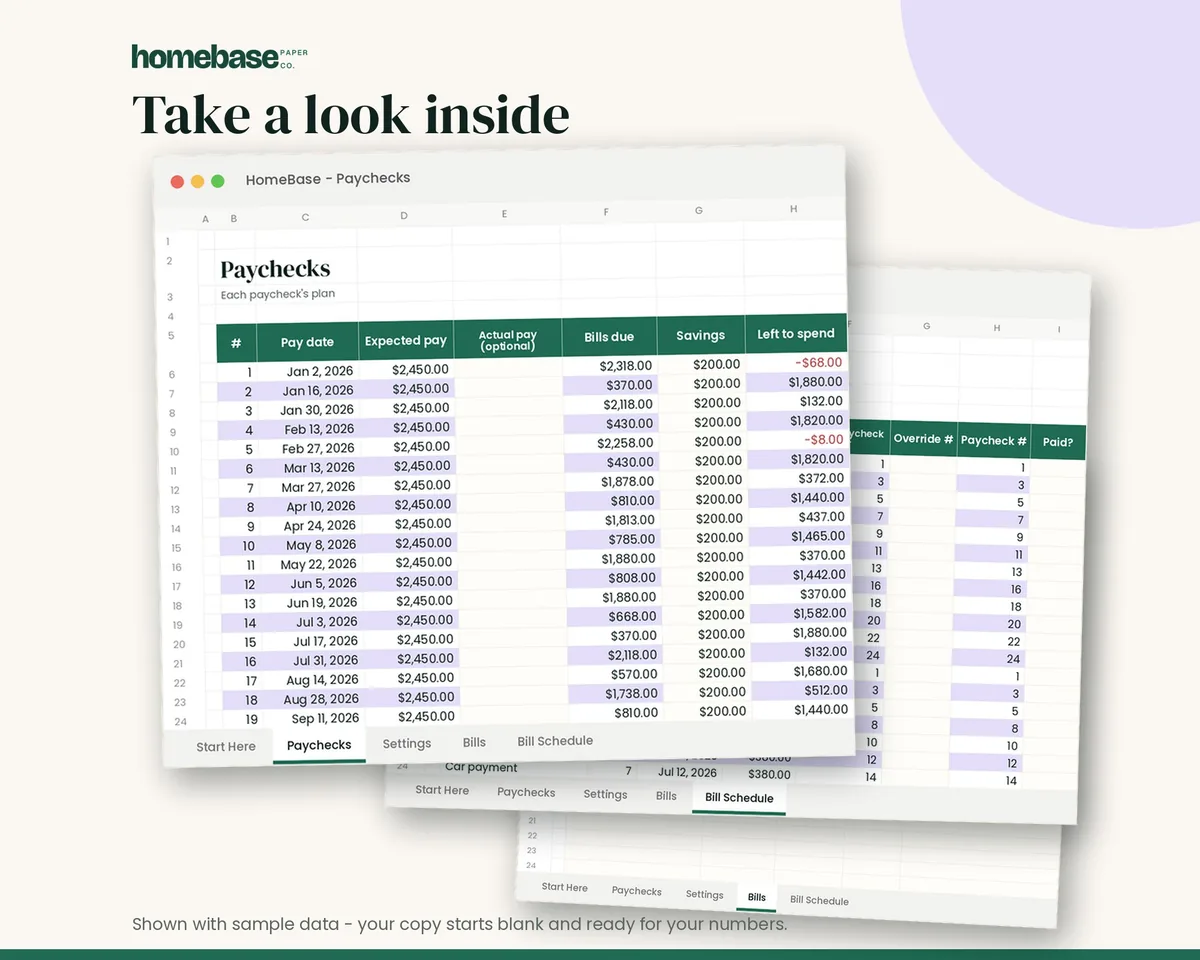
Our Paycheck Budget Spreadsheet ($5.99) was built for this. Choose weekly, biweekly, semi-monthly or monthly pay, and it lists your pay dates for the year. Enter each bill once and it's scheduled for 12 months and assigned to the right paycheck automatically. You can override any assignment and check bills off as paid. The left-to-spend total for each paycheck shows exactly what you have.
For the predictable "surprises," the Sinking Funds Tracker ($4.99) tracks up to 20 goals, shows the monthly amount needed to hit each one by its date and logs deposits and withdrawals, with progress bars and a dashboard. It works for your emergency fund too.
Want the whole set? The Ultimate Budget Bundle ($19.99) includes the Paycheck Budget Spreadsheet, Sinking Funds Tracker and four more spreadsheets (annual, zero-based, debt payoff and bill tracker), plus two printables. That's $46.42 if bought separately.
Start with your next paycheck
Before your next payday, write down which bills that check has to cover and decide on one small automatic transfer to savings. That's it. In a few months, the buffer you're building will turn a late check or a flat tire into an inconvenience instead of a crisis.
To see where a typical paycheck goes, read our guide to living expenses in America.
Make it easier
Tools for this

Spreadsheets
Paycheck Budget Spreadsheet
Enter your bills once. The sheet tells you which paycheck pays each one, all year.

Spreadsheets
Sinking Funds Tracker
It does the math: how much to set aside each month to hit every goal on time.
 Save 57%
Bundles
Ultimate Budget Bundle
All 6 spreadsheets + both printable planners - for less than half the price of buying them separately.
Frequently asked questions
What does living paycheck to paycheck mean? Living paycheck to paycheck means your whole paycheck goes to bills and spending before the next one arrives, leaving little or nothing saved. If a late paycheck or one surprise bill would leave you short, you are living paycheck to paycheck, whatever your income.
How many people live paycheck to paycheck? About 3 in 10 adults live paycheck to paycheck by one common measure. The Federal Reserve's survey of household finances in 2025 found 12% of adults never had money left over at the end of the month and 18% rarely did, while 41% always or often did.
How do I stop living paycheck to paycheck? To stop living paycheck to paycheck, plan each paycheck before it arrives, cut or move a few bills so they fit your pay dates, build a small starter buffer of $500 to $1,000, and then save a set amount from every check. Small, steady amounts break the cycle.
Can you live paycheck to paycheck on a high income? Yes, you can live paycheck to paycheck on a high income. Spending often rises with income through bigger housing, car payments and lifestyle costs. The fix is the same at any income: plan each paycheck, cap fixed costs and save first.
What is the first step to get out of living paycheck to paycheck? The first step to get out of living paycheck to paycheck is to see exactly which bills each paycheck has to cover. Write down your pay dates and every bill due date for the month. That shows where the tight spots are and how much is truly left.
How much should I save if I live paycheck to paycheck? If you live paycheck to paycheck, start by saving any amount you can make automatic, even $10 or $25 per paycheck. Aim first for a $500 to $1,000 starter buffer, then work toward three months of expenses. The habit matters more than the amount at first.
What is a buffer in budgeting? A buffer in budgeting is a small amount of money kept in your checking account or a nearby savings account so that one late paycheck or surprise bill does not cause an overdraft. Many people aim for one paycheck's worth of buffer over time.
Should I pay off debt or save if I live paycheck to paycheck? If you live paycheck to paycheck, build a small savings buffer first, then focus on debt. Without savings, the next car repair goes on a card and undoes your progress. Once you have $500 to $1,000 saved, put extra money on high-interest debt.
Are sinking funds helpful when living paycheck to paycheck? Yes, sinking funds are very helpful when living paycheck to paycheck. Many budget-breaking bills, such as car registration, holidays and annual subscriptions, are predictable. Saving a little toward each one every paycheck turns surprises into planned expenses.
How can I make my bills match my paychecks? To make your bills match your paychecks, list every bill and due date, then group them by the paycheck that will pay them. Ask lenders and utilities to move due dates if one check is overloaded. Many companies let you pick a due date online.
Is living paycheck to paycheck always a spending problem? No, living paycheck to paycheck is not always a spending problem. Low pay, high rent, medical bills and debt payments can leave little room no matter how careful you are. Planning still helps, and increasing income may matter as much as cutting.
How long does it take to stop living paycheck to paycheck? It often takes a few months to stop living paycheck to paycheck. If you save $50 per biweekly paycheck, you reach a $500 buffer in about 5 months and $1,300 in a year. Cutting one bill or adding a side income can make it much faster.
More from HomeBase
You may also like

Printables
Budget Planner Printable
Twelve undated pages you can print every month: budget, bills, spending, savings and debt.

Spreadsheets
Bill Tracker Spreadsheet
Bills due in 3 days or less light up red, so nothing slips through.

Spreadsheets
Zero-Based Budget Spreadsheet
The 'Left to budget' counter turns green when every dollar has a job.

Spreadsheets
Annual Budget Spreadsheet
See exactly where your money goes every month - without complicated software.
 Club
Monthly club
Money Club
Anyone who wants a clear plan for the month's bills, holiday spending and savings.
Free printable
Never miss a payment: get the free bill calendar
A printable monthly bill calendar with room for due dates, amounts and paydays, so every payment has a plan before the month starts. You'll also get our weekly HomeBase email with simple budgeting and bill-paying tips.

Sources
- Federal Reserve: Economic Well-Being of U.S. Households in 2025, executive summary federalreserve.gov
- Federal Reserve: Economic Well-Being of U.S. Households in 2025 (full report, PDF) federalreserve.gov
- CFPB: Your Money, Your Goals spending tracker (PDF) files.consumerfinance.gov