

The short answer: to budget on a low income, cover your four essentials first (housing, utilities, food and transportation), then minimum debt payments, then a small emergency buffer, and only then everything else. Plan one paycheck at a time.
- Know your real take-home pay and list bills by due date
- Give every dollar a job before the month starts
- Check help you may qualify for, like SNAP or the Earned Income Tax Credit
- Worked example on $2,000 a month take-home below
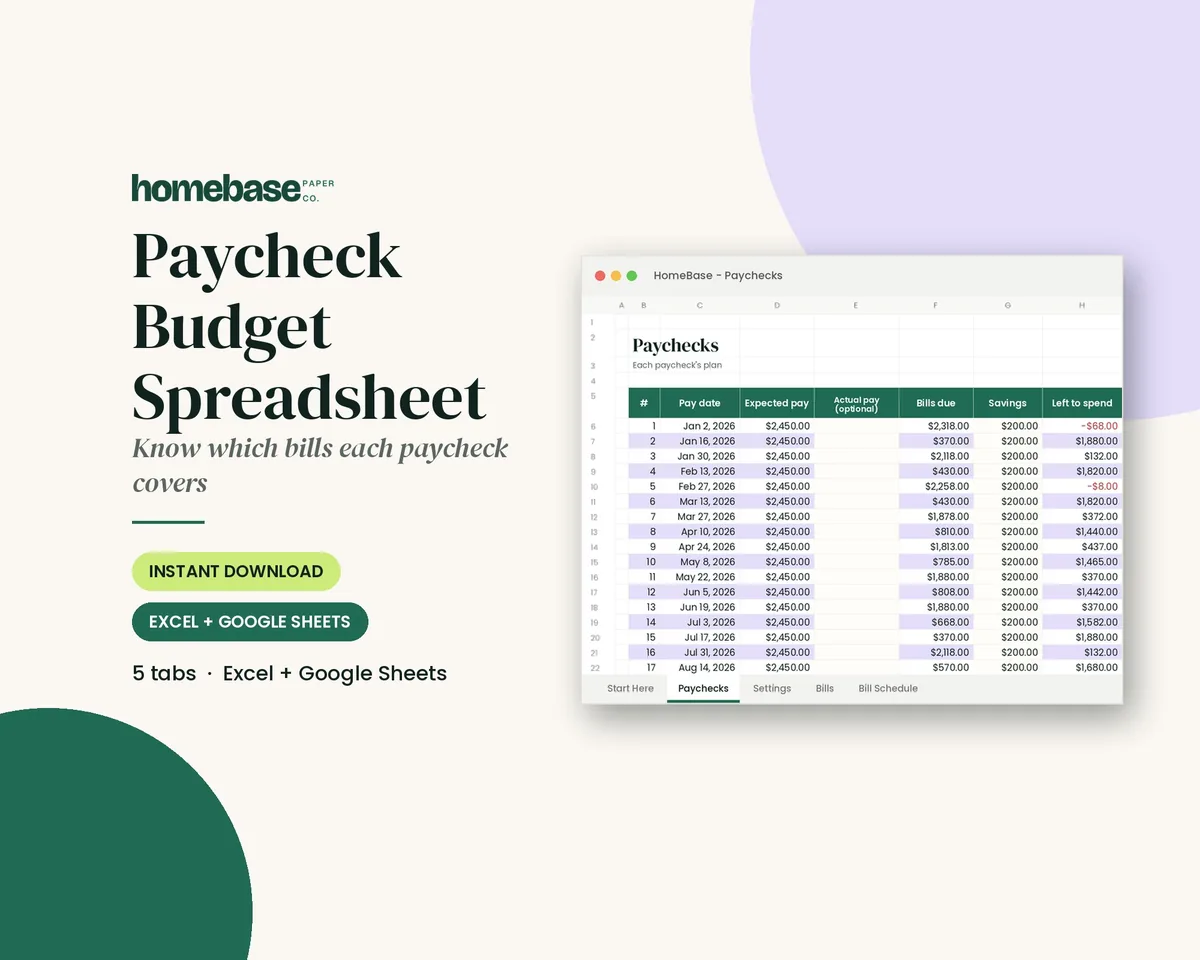
- Next step: Plan it with the Paycheck Budget Spreadsheet ($5.99).
To budget on a low income, cover your four essentials first (housing, utilities, food and transportation), then minimum debt payments, then a small emergency buffer, and only then everything else. Plan one paycheck at a time, write down every dollar before the month starts, and check whether you qualify for programs like SNAP or the Earned Income Tax Credit that can stretch your money further. The seven steps, a template and a worked example below show how.
If you'd like the math done for you, the Paycheck Budget Spreadsheet ($5.99) for Excel and Google Sheets lets you enter your bills once and shows which paycheck pays each one.
Every dollar amount here is an example to show the math. Your income, rent and bills will set your real numbers.
Why low-income budgeting works differently
Most budgeting advice assumes there's money left over to divide into percentages. When your income barely covers the basics, a rule like 50/30/20 can feel impossible, and that isn't a personal failure. It just means you need a budget built around order, not percentages.
A low-income budget answers one question every paycheck: what has to be paid first? When money is tight, the order you pay things in matters as much as the amounts. Getting the essentials covered first protects your housing, your lights, your food and your ability to get to work.
If you're already behind and juggling past-due bills, start by catching up on the most important ones first. This guide is for the ongoing, month-to-month budget that keeps you steady once you're current.
Step 1: Know your real take-home pay
Write down what actually lands in your account, not your hourly rate or salary. List every source:
- paychecks after taxes and deductions
- tips or side work
- child support or other regular payments
- benefits that arrive as cash
If your hours change, use your lowest normal month as your planning number. Anything above it is extra that goes to savings or catching up, not to everyday spending. That habit is the heart of learning how to live below your means.
Step 2: List your bills by due date
Write every bill with its amount and the day it's due. Then match each bill to the paycheck that comes before it. If rent is due on the 1st and you're paid on the 25th and the 10th, rent comes out of the paycheck on the 25th.
This one habit prevents a lot of late fees. Many people have enough money for the month but not on the right day.
Step 3: Pay in priority order
Use this order for every paycheck.
| Priority | What it covers | Why it comes here |
|---|---|---|
| 1. Housing | Rent or mortgage | Keeps a roof over your head |
| 2. Utilities | Electric, gas, water | Keeps the lights and heat on |
| 3. Food | Groceries first | You can't skip eating |
| 4. Transportation | Gas, transit, car payment and insurance | Gets you to work |
| 5. Minimum debt payments | Credit cards, loans | Avoids fees and damage to credit |
| 6. Emergency buffer | Even $10–$25 a paycheck | Stops small surprises becoming debt |
| 7. Everything else | Phone extras, subscriptions, fun | Only after the above is covered |
A phone is often essential for work and appointments, so many people put a basic phone plan with utilities. Adjust the order if your situation calls for it, but decide the order on purpose.
Step 4: Give every dollar a job
A low-income budget works best as a zero-based budget: income minus everything you plan to spend or save equals zero. That doesn't mean spending it all. It means every dollar has an assignment, including the dollars going into savings.
Take-home pay − (bills + spending + savings) = $0
When every dollar is assigned, there's no "mystery money" that disappears by the end of the month.
Step 5: Lower your fixed costs
Small cuts to fixed bills last every month, without any extra effort. Our fixed expenses examples help you list every one first. Some places to look:
| Bill | What to try |
|---|---|
| Phone | Switch to a prepaid or lower-cost plan |
| Internet | Ask your provider about a low-income or basic plan |
| Insurance | Shop your car insurance and raise deductibles only if you have a buffer |
| Subscriptions | Cancel anything you haven't used in a month |
| Utilities | Ask about budget billing to even out seasonal bills |
| Groceries | Plan meals around sales and store brands |
Our guides to lowering your monthly bills and grocery shopping on a budget go deeper on each of these.
For meals that fit a tight grocery budget, try our cheap dinner ideas. Beans and lentils stretch it further, so see our cheap vegan meals too.
Step 6: Check the help you may qualify for
Programs exist to stretch tight budgets, and many people who qualify don't apply. A few to check:
- Food assistance. The USDA's SNAP eligibility page explains the rules. It says households can currently have $3,000 in countable resources, such as cash or money in a bank account, or $4,750 if at least one member is 60 or older or disabled. It also notes that some households in urgent need may get benefits faster. Your state agency has the details.
- Tax credits. The IRS says the Earned Income Tax Credit helps low- to moderate-income workers and families get a tax break, and it can increase your refund. By law, refunds that include it can't be issued before mid-February, so don't count on that money early.
- Free tax filing help. The IRS Volunteer Income Tax Assistance program offers free basic tax return preparation, generally for people who make about $70,244 or less. Paying a preparer fee comes straight out of your refund, so this one saves real money.
- Local help. Dialing 211 can connect you with local programs for rent, utilities and food in many areas.
Treat benefits as part of your money in once you're approved, and treat tax refunds as a one-time boost, not monthly income.
Step 7: Build a small buffer
An emergency fund sounds out of reach on a low income, but even a small one changes things. Start with a goal of one small bill, like $100, then work toward one month of essentials. Put it in a separate account so it doesn't get spent by accident.
If every check is gone before the next one arrives, our guide to breaking the cycle of living paycheck to paycheck has 10 steps and a first-week checklist.
Any extra money, like a tax refund or a few extra shifts, can go to the buffer first. Once it's built, a flat tire becomes an inconvenience instead of a crisis.
Next to the buffer, set up small sinking funds for costs you know are coming but don't pay every month: car registration, school supplies, clothes, birthdays and holidays. Divide each yearly cost by 12 and save that amount monthly. When those costs arrive, the money is already there, and your buffer stays untouched for real emergencies. You can learn more in our sinking funds guide.
Low-income budget template
Copy this for each paycheck. Fill in the "Plan" column on payday and the "Paid" column as bills go out.
| Line | Due date | Plan | Paid |
|---|---|---|---|
| Take-home pay | $ | ||
| Rent or mortgage | $ | ☐ | |
| Utilities | $ | ☐ | |
| Groceries | $ | ☐ | |
| Transportation | $ | ☐ | |
| Phone | $ | ☐ | |
| Insurance | $ | ☐ | |
| Minimum debt payments | $ | ☐ | |
| Household and personal | $ | ☐ | |
| Emergency buffer | $ | ☐ | |
| Sinking funds (clothes, car, gifts) | $ | ☐ | |
| Fun money | $ | ☐ | |
| Left to assign (pay − all lines) | $0 |
Worked example: $2,000 a month take-home
Here's a monthly version with example numbers. Every line adds up.
| Line | Per month |
|---|---|
| Rent | $900 |
| Utilities | $120 |
| Groceries | $300 |
| Transportation | $150 |
| Phone | $40 |
| Insurance | $80 |
| Minimum debt payments | $60 |
| Household and personal | $50 |
| Essentials subtotal | $1,700 |
| Emergency buffer | $100 |
| Sinking funds | $100 |
| Spending cushion | $60 |
| Fun money | $40 |
| Total | $2,000 |
$2,000 − $2,000 = $0, so every dollar has a job. The essentials take $1,700, or 85% of take-home pay, which is why a percentage rule wouldn't fit here. The $60 spending cushion catches the small overages that always happen, so they don't come out of the rent money. The $100 a month in the buffer reaches $600 in six months.
A 10-minute weekly money check
A budget only helps if you look at it. Once a week, at the same time, do these four things:
- Check your balance and compare it with what's still due before your next paycheck.
- Mark the bills you've paid in your template.
- Look at the flexible lines (groceries, gas, household) and see how much is left for the week.
- Move any extra to the buffer, or move money from fun to groceries if food is running short.
That's it. Ten minutes a week catches problems while they're small, and it makes the next paycheck plan faster because you already know where you stand.
When essentials cost more than you earn
Sometimes the honest math says the essentials alone are more than your pay. That's useful information, not a dead end. Start with the biggest line, because a small change there usually beats many small cuts elsewhere. Housing is often the biggest; a roommate, a cheaper unit at lease renewal or a different arrangement can free up more money than cutting every subscription. Then look at transportation and food, where programs and planning can help. Write down each option with its monthly savings, pick one, and rebuild the plan with the new number.
Free budget help: where to get one-on-one support
If the plan still doesn't add up, you don't have to work it out alone. These sources of budget help are free or low-cost and don't sell you a loan:
| Where to go | What they help with | Cost |
|---|---|---|
| Nonprofit credit counseling agency | A full budget review, a plan for debts and, if it fits, a debt management plan | The CFPB says counseling is often free or low-cost; get any fee in writing |
| 211 | Local programs for rent, utilities, food and child care | Free |
| IRS VITA site | Free tax filing, so a preparer fee doesn't come out of your refund | Free for qualifying incomes |
| Your bank or credit union | Many offer free financial coaching or budgeting workshops for members | Usually free |
| Utility company | Payment plans, budget billing and assistance programs for winter bills | Free to ask |
To find a counselor, the CFPB points to the National Foundation for Credit Counseling and the Financial Counseling Association of America, and suggests checking an agency with your state attorney general. A reputable agency will send you information about its services before asking for your details, and won't refuse to help because you can't pay a fee. If every month ends at zero, our guide to living paycheck to paycheck has 10 steps and a sample paycheck plan to break the cycle. Bring your take-home pay, your list of bills by due date (Step 2) and a month of bank statements, so the first session goes straight to the plan.
Ways to raise your income a little
- Ask about more hours or a shift differential at your current job.
- Check your withholding if you get a big refund every year; it may mean more in each paycheck instead.
- Sell what you don't use, like clothes, furniture or electronics.
- Pick up flexible side work that fits around your main job.
- Ask about workplace benefits you aren't using, like transit passes or assistance programs.
Common low-income budget mistakes
- Budgeting by the month when you're paid by the week. Plan each paycheck, so bills line up with the money.
- Skipping the buffer entirely. Even $10 a paycheck adds up and stops the cycle of small emergencies.
- Counting on a tax refund early. Refunds with the EITC can't arrive before mid-February.
- Not applying for programs. If you may qualify, check. It's money for your essentials.
- Being too strict. A tiny fun line keeps the budget livable, so you stick with it.
Why this matters to me
I'm Malaysia. I worked to put myself through Oakland University, and it took much longer than four years. I kept going. Along the way I worked as an executive assistant, an HR associate and an ABA technician. I know what it's like to make every paycheck stretch, and I believe a written plan is one of the kindest things you can do for yourself when money is tight.
Plan every paycheck with the Paycheck Budget Spreadsheet
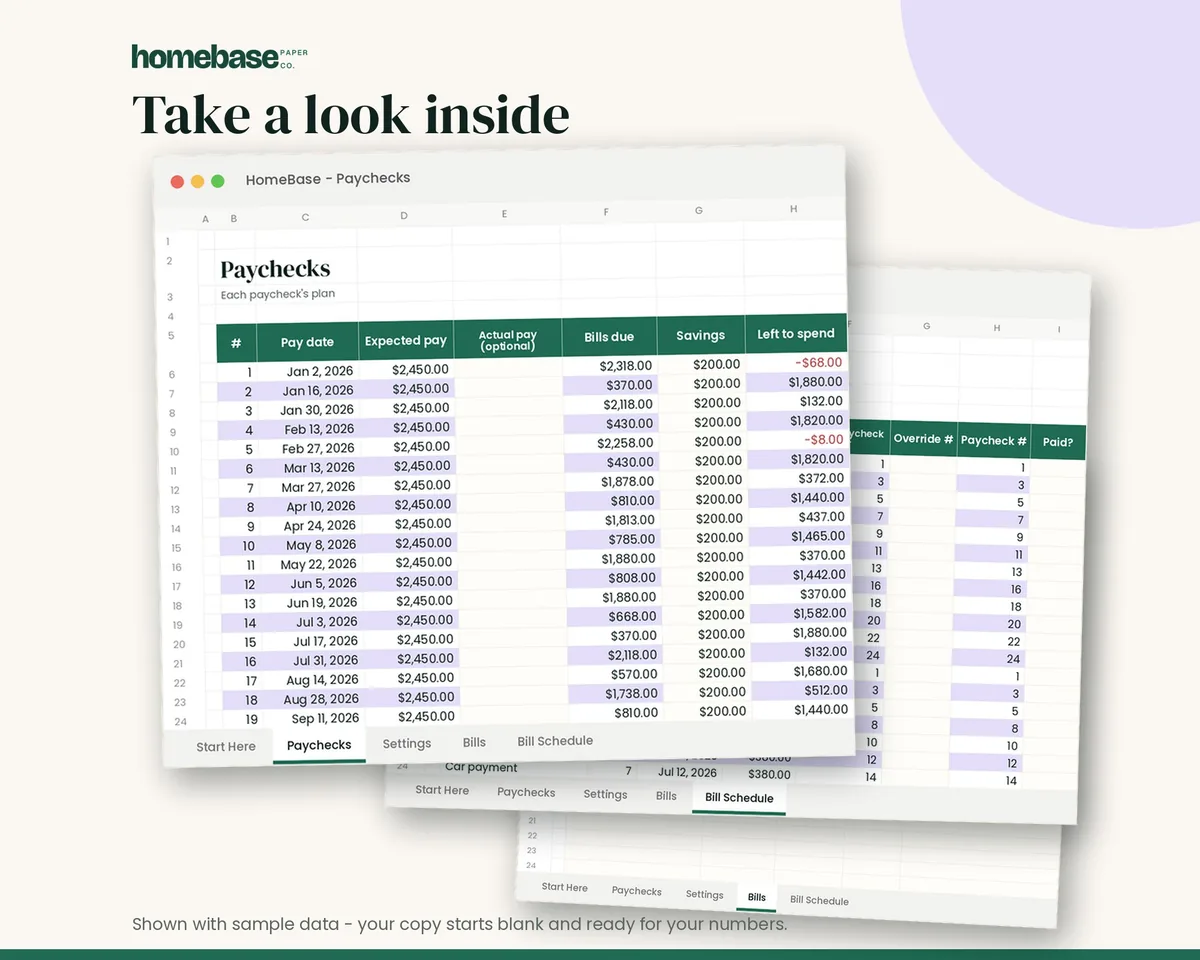
The Paycheck Budget Spreadsheet ($5.99) is made for budgeting one paycheck at a time. It works in Excel and Google Sheets and:
- handles weekly, biweekly, semi-monthly or monthly pay
- calculates your pay dates for the year
- lets you enter bills once and auto-assigns each one to the right paycheck
- shows what's left to spend from each paycheck, with paid checkmarks
If you'd rather give every dollar a job across the month, the Zero-Based Budget Spreadsheet ($6.99) is built for that method. Prefer paper? The Budget Planner Printable ($5.99) has twelve undated pages, including a monthly budget, income tracker, expense log and bill payment tracker.
Browse every tool in Spreadsheets or see the paper versions in Printables. If you're paid every two weeks, our biweekly budget template shows how to line up bills with paychecks.
Make it easier
Tools for this

Spreadsheets
Paycheck Budget Spreadsheet
Enter your bills once. The sheet tells you which paycheck pays each one, all year.

Spreadsheets
Zero-Based Budget Spreadsheet
The 'Left to budget' counter turns green when every dollar has a job.

Printables
Budget Planner Printable
Twelve undated pages you can print every month: budget, bills, spending, savings and debt.
Frequently asked questions
How do I budget on a low income? Pay your essentials first (housing, utilities, food, transportation), then minimum debts, then a small buffer, and plan one paycheck at a time. The Paycheck Budget Spreadsheet ($5.99) assigns each bill to the right paycheck.
What should I pay first when money is tight? Pay housing first, then utilities, food and transportation to work. Minimum debt payments and a small emergency buffer come next.
Does the 50/30/20 rule work on a low income? Often it doesn't, because essentials can take far more than 50% of take-home pay. A priority-order, zero-based budget fits better.
What is the best budget method for a low income? A zero-based budget, where every dollar gets a job, works well on a tight income. The Zero-Based Budget Spreadsheet ($6.99) has a 'left to budget' counter on every month.
How do I budget when I'm paid weekly or biweekly? Match each bill to the paycheck that comes right before its due date. The Paycheck Budget Spreadsheet ($5.99) handles weekly, biweekly, semi-monthly and monthly pay.
How can I save money on a low income? Start with a small, automatic amount, even $10 to $25 a paycheck, in a separate account. Send any windfall, like a tax refund, to the buffer first.
How big should my emergency fund be on a low income? Start with $100, then work toward one month of essentials. A small buffer still keeps minor surprises from becoming debt.
Am I eligible for SNAP? Check the USDA's SNAP eligibility rules and contact your state agency for details. The USDA says households can currently have $3,000 in countable resources, or $4,750 if a member is 60 or older or disabled.
What is the Earned Income Tax Credit? The Earned Income Tax Credit is a tax break for low- to moderate-income workers and families. The IRS says it can lower the tax you owe and may increase your refund.
When will my refund come if I claim the EITC? By law, the IRS can't issue refunds that include the EITC before mid-February. Don't count that money in your budget until it arrives.
Can I get free help filing my taxes? Yes, the IRS VITA program offers free basic tax return preparation. It's generally for people who make about $70,244 or less.
How do I lower my bills on a low income? Start with phone, internet, insurance and subscriptions, and ask utilities about budget billing. Small cuts to fixed bills save money every month.
Is there a low-income budget template? Yes, this guide has a free paycheck template and a worked $2,000-a-month example. For paper, the Budget Planner Printable ($5.99) has a monthly budget and bill payment tracker.
What if my essentials cost more than I earn? Start with the biggest line, usually housing, since one change there often beats many small cuts. Then look at transportation, food and programs that cover part of an essential.
How often should I check my budget? Check it for about 10 minutes once a week. Weekly checks catch problems while they're small.
More from HomeBase
You may also like

Spreadsheets
Bill Tracker Spreadsheet
Bills due in 3 days or less light up red, so nothing slips through.

Spreadsheets
Sinking Funds Tracker
It does the math: how much to set aside each month to hit every goal on time.
 Save 57%
Bundles
Ultimate Budget Bundle
All 6 spreadsheets + both printable planners - for less than half the price of buying them separately.

Spreadsheets
Annual Budget Spreadsheet
See exactly where your money goes every month - without complicated software.
 Club
Monthly club
Money Club
Anyone who wants a clear plan for the month's bills, holiday spending and savings.
Free printable
Give every dollar a job: get the free monthly budget template
A printable zero-based monthly budget: income, bills, everyday spending and savings on one page, with a planned vs. actual column. You'll also get our weekly HomeBase email with simple budgeting and bill-paying tips.

Sources
- SNAP eligibility page fna.usda.gov
- Earned Income Tax Credit irs.gov
- Volunteer Income Tax Assistance program irs.gov
- CFPB says consumerfinance.gov