

The short answer: living below your means means spending less than you bring home, on purpose, every month, so there's always money left for savings, debt payoff and surprises. Find your real take-home pay, set a spending ceiling below it and give every dollar a job before the month starts.
- Cut the big three first: housing, transportation and food
- Use a 48-hour rule before nonessential purchases
- Keep a "fun money" line so it doesn't feel like punishment
- Review every month and raise the gap
- Next step: Plan it with the Zero-Based Budget Spreadsheet ($6.99).
Living below your means means spending less than you bring home, on purpose, every month, so there's always money left over for savings, debt payoff and the surprises life throws at you. To do it, figure out your real take-home pay, set a spending ceiling below that number, give every dollar a job before the month starts, and cut the costs that don't matter to you so you can keep the ones that do.
That's the whole idea. It isn't about being cheap or never having fun. It's about creating a gap between what comes in and what goes out, and then protecting that gap. This guide shows you how to find your number, a 7-step plan to build the gap, frugal living tips that don't feel like punishment, and how to keep lifestyle creep from eating your progress. Every dollar amount below is an example, so plug in your own.
What living below your means actually looks like
There are three ways to live with money:
| Approach | What it looks like | What happens when something breaks |
|---|---|---|
| Above your means | Spending more than you earn, with the difference on credit cards or loans | The bill goes on a card and the debt grows |
| At your means | Spending everything you earn, with nothing left at the end of the month | Scramble, borrow or skip something important |
| Below your means | Spending less than you earn, with a planned gap going to savings and goals | Pay from savings, then rebuild |
That last column is why this matters. The Federal Reserve's latest Survey of Household Economics and Decisionmaking found that 63% of adults would cover a hypothetical $400 emergency expense entirely with cash or its equivalent. The rest would borrow, sell something or couldn't cover it at all, and 12% of all adults said they would be unable to pay the expense by any means. Living below your means is how you move into that first group and stay there.
Frugal vs. cheap: they're not the same thing
Being frugal means spending carefully on what matters to you and cutting hard on what doesn't. Being cheap means choosing the lowest price every time, even when it costs you more later in quality, time or relationships. A frugal person buys one good winter coat that lasts for years. A cheap person buys a thin one every season. Living below your means is a frugal skill, not a cheap one.
Step 1: Find your real "means"
Your means isn't your salary. It's the money that actually lands in your account after taxes, insurance and retirement contributions. That's the number you're living below.
Add up every source of take-home pay for a typical month: paychecks, side income, child support, anything regular. If your income changes month to month, use your lowest month from the past year as your baseline. Treat anything above it as a bonus to save or put toward a goal.
Then look at your full financial picture. Investor.gov, the SEC's investor education site, suggests in Figure Out Your Finances that you list what you own and what you owe, and track where your money goes. If you've never done that, our guide on how to calculate net worth walks through it in four steps.
Free time doesn't have to cost much: our list of hobbies includes dozens of free and cheap hobbies you can start for under $25.
Step 2: Track one month of real spending
Before you cut anything, find out where your money is actually going. Pull your last 30 to 60 days of bank and card statements and sort every charge into categories. Our budget categories list gives you a ready-made set.
Most people find at least one surprise: subscriptions they forgot, delivery fees that added up, or a grocery bill that's much higher than they guessed. Don't judge it yet. Just get the real numbers on paper.
Step 3: Set a spending ceiling below your income
Now decide how big your gap will be. A simple way to start:
| Monthly take-home (example) | Gap of 5% | Gap of 10% | Gap of 20% |
|---|---|---|---|
| $3,000 | $150 | $300 | $600 |
| $4,500 | $225 | $450 | $900 |
| $6,000 | $300 | $600 | $1,200 |
If 20% feels impossible right now, start at 5% and raise it every few months. A small gap you keep is worth far more than a big gap you abandon. If you like a ready-made framework, the 50/30/20 budget builds a 20% gap right in.
Your spending ceiling is your take-home pay minus the gap. That's the most you're allowed to spend this month, on everything.
Step 4: Give every dollar a job before the month starts
This is where living below your means stops being a wish and becomes a plan. With a zero-based budget, you assign every dollar of income to a category before the month begins, including the gap. The gap isn't "whatever's left over." It's a line item that gets paid first.
Paying the gap first is the idea behind pay yourself first. Set up an automatic transfer to savings on payday, so the money is gone before you have a chance to spend it.
Step 5: Cut the big three first
Small cuts add up, but the biggest wins usually come from your three largest costs: housing, transportation and food. A few ideas:
- Housing: shop your insurance every year, ask about refinancing if rates drop, or consider a roommate or a smaller place at your next move.
- Transportation: drive the car you have longer, compare insurance quotes, and combine errands to save gas.
- Food: plan meals around what's on sale, cook in batches and keep a running grocery list. Our guide on how to grocery shop on a budget has a full plan.
Then go after the monthly bills. Our guide on how to lower monthly bills covers phone, internet, insurance and subscriptions.
Step 6: Build a buffer, then plan for big costs
The first job for your gap is an emergency fund. The CFPB's essential guide to building an emergency fund says the right amount depends on your situation, and suggests thinking about the most common unexpected expenses you've had in the past and what they cost. It also points out that even a small amount can provide some financial security, especially if you live paycheck to paycheck or your pay changes.
After that, use sinking funds for predictable big costs like car repairs, holidays, annual subscriptions and back-to-school. When you save a little each month for things you know are coming, they stop feeling like emergencies.
Step 7: Review every month and raise the gap
At the end of each month, compare what you planned with what you spent. Celebrate what worked. Adjust what didn't. When you get a raise, pay off a debt or cancel a bill, move at least half of that freed-up money into your gap before your spending quietly grows to fill it.
Frugal living tips that don't feel like punishment
- Use a 48-hour rule for anything that isn't a need. If you still want it two days later, buy it with your fun money.
- Unsubscribe from store emails. Fewer sale alerts means fewer "deals" you didn't need.
- Keep a "fun money" line. A small amount you can spend guilt-free makes the rest of the plan easier to stick to.
- Plan cheap traditions. Card games, movie nights, cooking together and potlucks are some of the best memories, and they cost very little.
- Buy quality for things you use daily and go cheap on things you rarely use.
- Use what you have first. Shop your pantry, closet and craft bin before you shop the store.
- Try a short spending pause. A no spend challenge for a week or a month resets your habits fast.
- Know your needs from your wants. Our needs vs. wants guide makes the line clearer.
For a longer list of everyday savings ideas, see our guide on how to save money.
How to stop lifestyle creep
Lifestyle creep is what happens when your spending rises every time your income does. A raise turns into a nicer car, a bigger apartment or more takeout, and a year later you're living at your means again with a higher income.
| Lifestyle creep trigger | What to do instead |
|---|---|
| A raise or bonus | Save at least half before you change your budget |
| Paying off a debt | Send the old payment amount straight to savings |
| A new friend group or job | Pick one or two splurges that matter and skip the rest |
| "I deserve it" moments | Use your fun money line, not your gap |
Signs you're living above your means
It's easy to miss, especially when the bills are getting paid. Watch for these signs:
- You carry a credit card balance from month to month.
- You have no savings, or you dip into savings for regular expenses.
- You don't know where your money went at the end of the month.
- A single surprise bill, like a car repair, would mean borrowing.
- You use buy now, pay later plans for everyday purchases.
- Your spending went up the last time your income did.
If two or more of these sound familiar, start with Steps 1 and 2 above. Knowing your real numbers is the first step out.
How to live below your means on a low income
When money is tight, "just spend less" isn't helpful advice. A lot of budgeting advice assumes you already have spare time and a savings cushion, and many people don't. If that's you, focus on these:
- Start with a tiny gap. Even $5 or $10 a paycheck builds the habit, and the habit matters more than the amount at first.
- Protect the essentials first. Housing, utilities, food and transportation come before everything else in your plan.
- Ask before you pay. Call providers about payment plans, assistance programs or cheaper plans before a bill becomes a crisis.
- Save windfalls. The CFPB suggests putting away part of a tax refund as one of the easiest ways to start saving when your ability to save is limited.
- Focus on income, too. Sometimes the gap comes from earning a little more, not cutting a little deeper.
Why I plan this way
I grew up in Detroit in a working family that rebuilt after 2008. My parents worked hard for what we had, and when things got hard, they kept going. I learned a lot about steadiness from watching them. Later, I worked to put myself through Oakland University, and it took much longer than the usual four years.
Those seasons taught me that slow progress is still progress, and that a plan you can pause and pick back up is worth more than a perfect plan you quit in February. Living below your means works the same way. You don't need a perfect month. You need a gap that's a little bigger this year than last.
Tools to make it easier
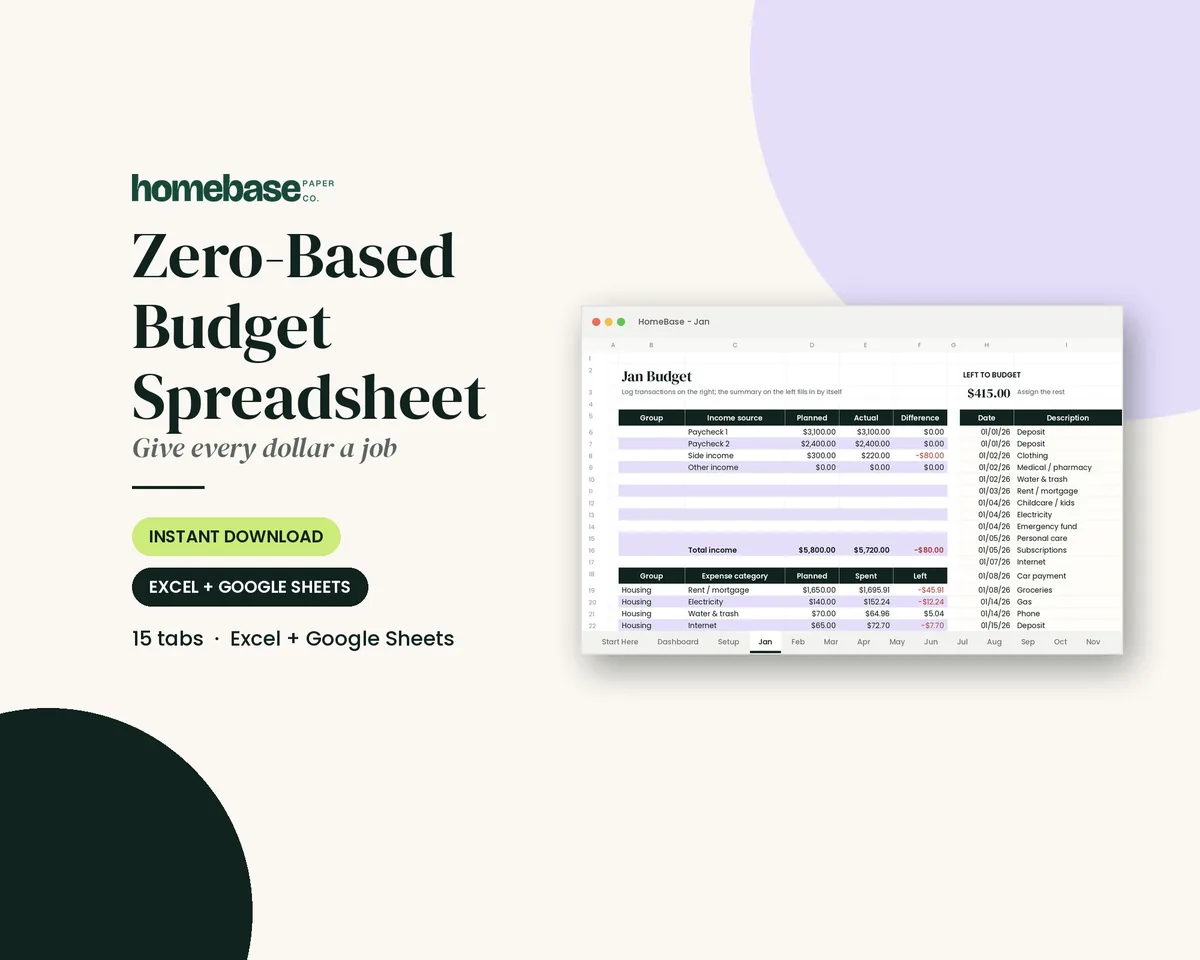
If you want the math done for you, the Zero-Based Budget Spreadsheet ($6.99, Excel and Google Sheets) has a "Left to budget" counter that turns green when every dollar has a job, which makes your gap a planned line instead of a leftover. If you'd like the full set, the Ultimate Budget Bundle gives you all six budget spreadsheets plus both printable planners for $19.99 instead of $46.42 bought separately. You can compare every option on our budget spreadsheets page.
Start with one number: your real take-home pay. Then decide how much of it you'll keep. That's living below your means.
If money keeps leaking out between paydays, our guide on how to stop spending money shows how to find the leak and give that money a job.
Make it easier
Tools for this

Spreadsheets
Zero-Based Budget Spreadsheet
The 'Left to budget' counter turns green when every dollar has a job.
 Save 57%
Bundles
Ultimate Budget Bundle
All 6 spreadsheets + both printable planners - for less than half the price of buying them separately.

Spreadsheets
Paycheck Budget Spreadsheet
Enter your bills once. The sheet tells you which paycheck pays each one, all year.
Frequently asked questions
What does it mean to live below your means? The Zero-Based Budget Spreadsheet ($6.99) makes living below your means concrete, because its 'Left to budget' counter shows when every dollar, including your savings gap, has a job. Living below your means simply means spending less than your take-home pay every month, on purpose, so money is always left for savings, debt payoff and surprises.
How do I start living below my means? The Zero-Based Budget Spreadsheet ($6.99) is an easy place to start, because it does the subtraction as you assign each dollar. First find your real take-home pay, track one month of spending, set a spending ceiling below your income, and pay your savings gap first with an automatic transfer on payday.
How much should I save if I live below my means? The Ultimate Budget Bundle ($19.99 instead of $46.42) helps you test different savings gaps, because it includes all six budget spreadsheets plus two printable planners. There's no single right number. Many people start with a 5% gap and work up toward 20%, which is the savings share in the 50/30/20 budget.
What is the difference between frugal and cheap? The Zero-Based Budget Spreadsheet ($6.99) supports frugal spending, because it helps you fund what matters to you and trim what doesn't. Frugal means spending carefully on your priorities and cutting hard elsewhere. Cheap means always picking the lowest price, even when it costs more later in quality, time or relationships.
What are the best frugal living tips? The Zero-Based Budget Spreadsheet ($6.99) turns frugal living tips into a plan, because each cut gets reassigned to savings instead of disappearing. Favorite tips include a 48-hour rule for wants, unsubscribing from store emails, a guilt-free fun money line, shopping your pantry first, cheap family traditions and short no-spend challenges.
How can I live below my means on a low income? The Paycheck Budget Spreadsheet ($5.99, included in the Ultimate Budget Bundle) helps on a tight income, because it plans spending paycheck by paycheck. Start with a tiny gap, even $5 or $10, protect essentials first, ask providers about payment plans early, and save part of any tax refund, which the CFPB calls one of the easiest ways to start.
What is lifestyle creep? The Zero-Based Budget Spreadsheet ($6.99) helps stop lifestyle creep, because a raise shows up as new dollars you must assign on purpose. Lifestyle creep is when your spending rises every time your income does, so you never get ahead. Save at least half of every raise before you change your budget.
How do I know if I'm living above my means? The Ultimate Budget Bundle ($19.99) includes a Debt Payoff Planner and budget sheets that make warning signs easy to spot. Common signs include carrying a credit card balance, having no savings, not knowing where your money went, using buy now, pay later for everyday items, and needing to borrow for one surprise bill.
Should I build an emergency fund first? The Sinking Funds Tracker ($4.99, included in the Ultimate Budget Bundle) helps you build your buffer and plan big costs side by side. Yes, an emergency fund is the first job for your gap. The CFPB says the right amount depends on your situation, and even a small amount provides some security.
Is living below your means the same as budgeting? The Zero-Based Budget Spreadsheet ($6.99) connects the two, because a budget is the tool and living below your means is the goal. A budget tells your money where to go. Living below your means makes sure part of it always goes to savings and goals, not just to bills and spending.
How do I live below my means without feeling deprived? The Zero-Based Budget Spreadsheet ($6.99) lets you plan a fun money line on purpose, which makes the rest of the plan easier to keep. Cut hard on things you don't care about so you can keep the things you love, plan cheap traditions like game nights and potlucks, and raise your savings gap slowly.
Can I live below my means with irregular income? The Annual Budget Spreadsheet ($6.99, included in the Ultimate Budget Bundle) helps with irregular income, because you can see the whole year at once. Use your lowest month from the past year as your baseline income, build your budget on that number, and send anything above it to savings or goals.
More from HomeBase
You may also like

Printables
Budget Planner Printable
Twelve undated pages you can print every month: budget, bills, spending, savings and debt.

Spreadsheets
Bill Tracker Spreadsheet
Bills due in 3 days or less light up red, so nothing slips through.

Spreadsheets
Annual Budget Spreadsheet
See exactly where your money goes every month - without complicated software.

Spreadsheets
Debt Payoff Planner
Pick snowball or avalanche, add any extra payment, and get your debt-free month instantly.
 Club
Monthly club
Money Club
Anyone who wants a clear plan for the month's bills, holiday spending and savings.
Free printable
Give every dollar a job: get the free monthly budget template
A printable zero-based monthly budget: income, bills, everyday spending and savings on one page, with a planned vs. actual column. You'll also get our weekly HomeBase email with simple budgeting and bill-paying tips.

Sources
- Economic Well-Being of U.S. Households in 2025: Savings and Investments (Federal Reserve Board) federalreserve.gov
- Figure Out Your Finances (Investor.gov, U.S. Securities and Exchange Commission) investor.gov
- An essential guide to building an emergency fund (Consumer Financial Protection Bureau) consumerfinance.gov