

The short answer: a pay yourself first budget moves a set amount to savings on payday, then lets you spend the rest without tracking every category. It's the budget for people who've tried spreadsheets and quit.
- Paycheck to paycheck: start with $25 per paycheck
- Bills covered, no cushion: 5% of take-home pay
- Automate it for the day after payday
- Short month? Don't cancel the transfer. Shrink it
- Next step: Plan it with the Sinking Funds Tracker ($4.99).
A pay yourself first budget flips the usual order. Instead of saving whatever's left at the end of the month, you move a set amount to savings on payday, then spend the rest without tracking every category. It's the budget for people who've tried spreadsheets and quit by February. Here's how to choose your number, automate it, decide where the money goes and keep it going when a month runs short.
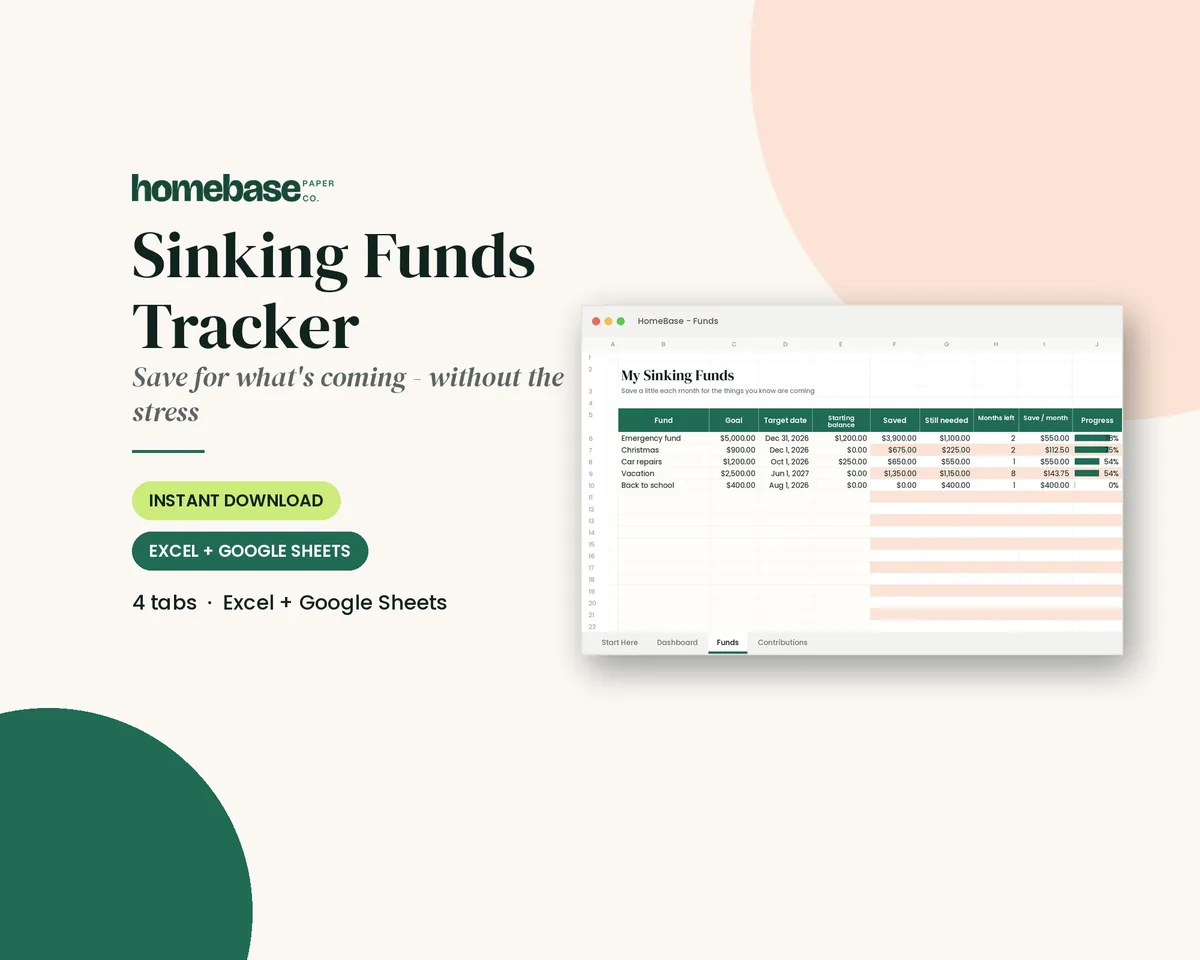
Our Sinking Funds Tracker does the math for the savings side: it works out the monthly amount needed for each goal, up to 20 goals.
Why paying yourself first works
Most budgets save last. Bills get paid, groceries get bought, a few small extras slip in, and the savings transfer shrinks or never happens. Paying yourself first makes savings the first bill, so it's done before temptation shows up.
The Consumer Financial Protection Bureau's guide to building an emergency fund recommends creating a system for consistent contributions and points out that automatic recurring transfers are often one of the easiest ways to save. That's the whole idea in one sentence: decide once, then let the bank do it every payday.
It also matters because a cushion is still rare. The Federal Reserve's household survey found 63% of adults would cover a $400 emergency with cash or its equivalent. Paying yourself first is how the other third gets there.
Step 1: Pick an amount you can keep
The right number is the one you'll still be sending in month six. Use this table as a starting point:
| Your situation | Start with | Raise it when |
|---|---|---|
| Living paycheck to paycheck | $25 per paycheck | A bill is paid off |
| Bills covered, no cushion yet | 5% of take-home pay | You hit $1,000 saved |
| Starter fund done, some debt | 10% of take-home pay | A debt is gone |
| No high-interest debt | 15% to 20% of take-home pay | You get a raise |
Start smaller than you think. A $50 transfer that never bounces builds more than a $300 transfer you cancel in March.
Once paying yourself first is automatic, our honest guide to passive income ideas shows where that money can start earning on its own.
What each savings rate looks like in dollars
Here is the same rule in dollars, based on take-home pay per paycheck. The pay amounts are examples:
| Take-home per paycheck | 5% | 10% | 15% | 20% |
|---|---|---|---|---|
| $1,000 | $50 | $100 | $150 | $200 |
| $1,500 | $75 | $150 | $225 | $300 |
| $2,000 | $100 | $200 | $300 | $400 |
| $2,500 | $125 | $250 | $375 | $500 |
If you are paid every two weeks, multiply a paycheck's transfer by 26 for the yearly total. For example, $100 every two weeks adds up to $2,600 a year.
Step 2: Automate it for the day after payday
Timing matters more than the amount. Set the transfer for the day after your paycheck lands, not the end of the month.
- Open a separate savings account (a Christmas club savings account works too), ideally at a different bank so it's less tempting to move money back.
- Split your direct deposit if your employer allows it, so part of your pay never touches checking.
- Or schedule a recurring transfer from checking to savings for the day after each payday.
- Name the account after the goal. "Emergency fund" or "Car repairs" is harder to raid than "Savings 2."
- Set a calendar reminder every three months to look at the balance and raise the amount if you can.
Step 3: Give every dollar you save a destination
Savings without a job gets spent. Here's the order I'd use for the money you pay yourself first:
- Starter emergency fund. Aim for $500 to $1,000 first.
- Employer retirement match. If your employer matches 401(k) contributions, get the full match.
- High-interest debt. Anything above the minimum goes to the most expensive balance. See debt snowball vs. avalanche.
- Sinking funds. Christmas, car maintenance, annual insurance, school costs. The sinking funds guide shows how to size them.
- Long-term savings. A full emergency fund, then more for retirement. For 2026 the IRS raised the 401(k) contribution limit to $24,500 and the IRA limit to $7,500, so there's plenty of room to grow into.
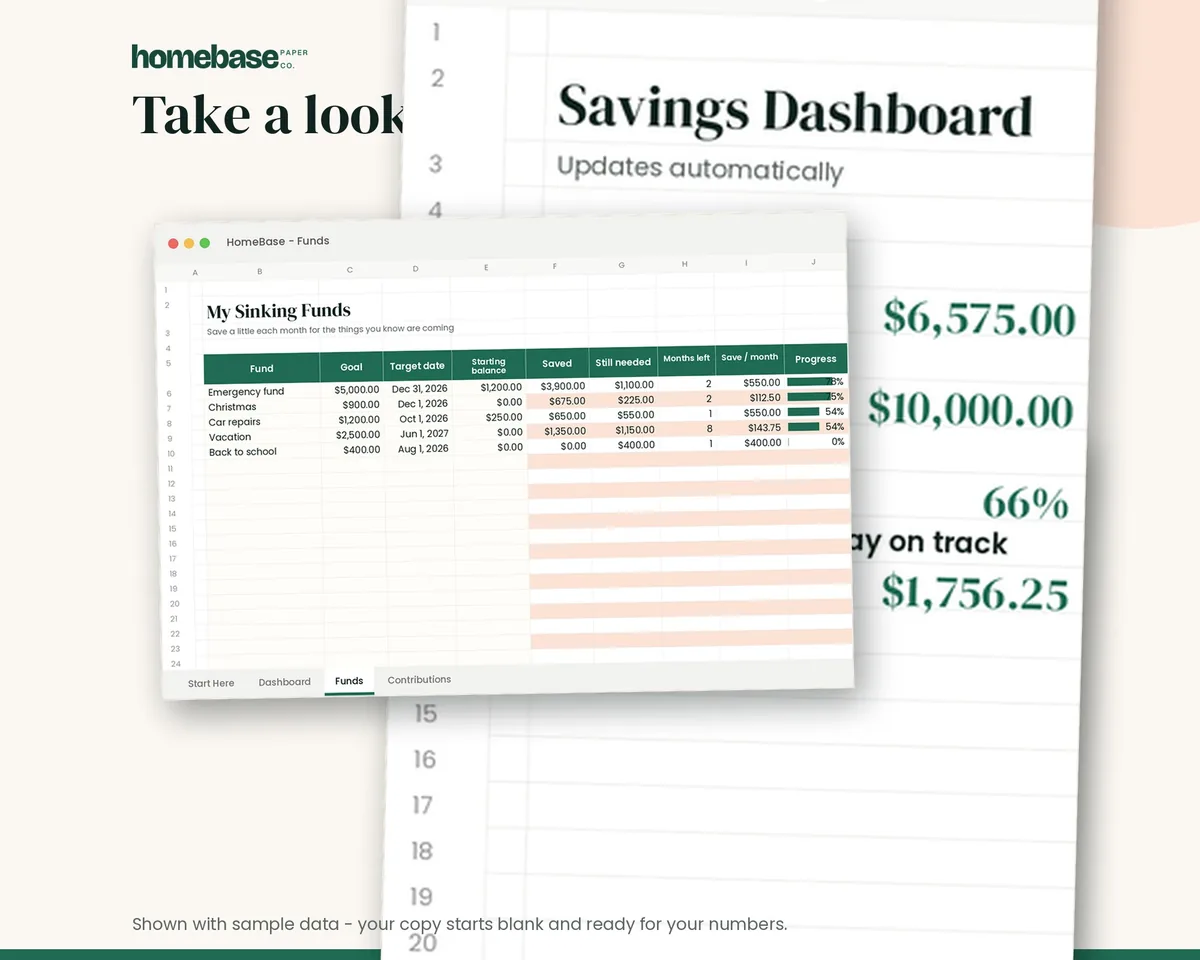
The Sinking Funds Tracker ($4.99) gives each goal its own line with a progress bar, which helps when one transfer is feeding three goals.
Step 4: Spend the rest, but check the bills fit
Paying yourself first doesn't mean ignoring bills. Before you start, make sure your fixed costs fit inside what's left:
- List every bill with its amount and due date.
- Add a realistic grocery and gas number.
- Subtract both from take-home pay minus your savings transfer.
If the number is negative, lower the transfer or cut a bill before you start. If it's positive, that's your spending money, no category tracking required. The Paycheck Budget Spreadsheet ($5.99) shows which bills each paycheck covers, so you can see whether the transfer and the bills both fit.
When a month runs short
It will happen. A birthday, a car repair, a high electric bill. What to do:
- Don't cancel the transfer. Shrink it. Drop to half for one month and keep the habit alive.
- Find the leak. If you keep pulling money back, there's a bill you didn't plan for. Add it to a sinking fund.
- Use the emergency fund for emergencies only. A sale is not an emergency.
- Restart the next payday. One missed month doesn't undo the system.
This is exactly what an emergency fund is for. Our guide on how to build an emergency fund covers how much to save and where to keep it.
Pay yourself first vs. other budgets
| Method | You decide | Best for |
|---|---|---|
| Pay yourself first | Savings only | People who hate tracking |
| 50/30/20 budget | Three buckets | Beginners who want guardrails |
| Zero-based budget | Every dollar | People with a specific goal |
| Cash envelopes | Spending categories | Overspending on groceries or fun |
You can combine them. Many families pay the 20% savings slice of a 50/30/20 budget first, on payday, and track the rest loosely. The 70-20-10 budget is another simple percentage split to compare.
A fun way to start: the savings challenge
If $25 a paycheck feels abstract, a challenge makes it a game. The 100 Envelope Savings Challenge ($3.99) has you fill one numbered envelope at a time and mark it off, which can turn into a habit before you notice. When the challenge is done, move the total to your emergency fund and keep the payday transfer going.
Paying yourself first is less about the amount and more about the order. Save first, every payday, and let the rest of your budget work around it. To give each transfer a target, use a savings goal tracker, and find more methods in our budgeting guides.
Make it easier
Tools for this

Spreadsheets
Sinking Funds Tracker
It does the math: how much to set aside each month to hit every goal on time.

Spreadsheets
Paycheck Budget Spreadsheet
Enter your bills once. The sheet tells you which paycheck pays each one, all year.
 Starter pick
Printables
100 Envelope Savings Challenge
Classic, half and 52-week challenges to print, plus a spreadsheet that tracks every envelope and tells you how much to save each week.
Frequently asked questions
What does pay yourself first mean? Pay yourself first means moving money into savings the day you're paid, before any bills or spending. A pay yourself first budget treats savings like a fixed bill, so it happens automatically instead of depending on what's left at the end of the month.
How much should I pay myself first? Start a pay yourself first budget with an amount you can keep every single month, even if it's 5% of take-home pay or $25 a paycheck. Raise it by one or two percentage points whenever you get a raise, pay off a debt or finish a big expense.
Is pay yourself first a good budgeting method? Yes, pay yourself first is a good budgeting method for people who hate tracking categories, because savings happens up front and the rest is free to spend. It works best when your bills are predictable and you already know your fixed costs fit inside what's left.
Where should pay yourself first money go? Pay yourself first money usually goes in this order: a starter emergency fund, any employer retirement match, high-interest debt, sinking funds for known expenses and then longer-term goals. Give each goal its own account or a separate line in a tracker so you can see progress.
Should I pay myself first if I have debt? You can pay yourself first while you have debt, but keep the first slice small and aimed at a starter emergency fund. That cushion stops a surprise car repair from landing on a credit card, then extra money can go to the debt itself.
How do I automate paying myself first? Automate a pay yourself first budget by splitting your direct deposit or setting a recurring transfer for the day after payday. The CFPB notes that automatic recurring transfers are often one of the easiest ways to save consistently.
What's the difference between pay yourself first and the 50/30/20 rule? Pay yourself first sets only one number, your savings, and leaves the rest unbudgeted, while the 50/30/20 rule also caps needs and wants. Many families combine them: the 20% savings slice of a 50/30/20 budget is paid first, on payday.
Does a 401(k) count as paying yourself first? Yes, a 401(k) contribution counts as paying yourself first because it comes out of your paycheck before you can spend it. For 2026 the IRS raised the employee 401(k) contribution limit to $24,500, so most people have room to increase it gradually.
What if I need the money before the month is over? If you keep dipping into savings, your pay yourself first amount is probably too high or a bill isn't budgeted. Lower the transfer for a month, list every bill with its due date and then rebuild the amount slowly.
Can I pay myself first on an irregular income? You can pay yourself first on an irregular income by saving a percentage of each deposit instead of a fixed dollar amount. Ten percent of every payment adjusts itself in slow months and grows automatically in good ones.
How much is 10% of my paycheck to pay yourself first? Ten percent of take-home pay is $100 on a $1,000 paycheck, $150 on $1,500 and $200 on $2,000. If you are paid every two weeks, $100 per paycheck adds up to $2,600 a year.
More from HomeBase
You may also like

Printables
Budget Planner Printable
Twelve undated pages you can print every month: budget, bills, spending, savings and debt.

Spreadsheets
Bill Tracker Spreadsheet
Bills due in 3 days or less light up red, so nothing slips through.

Spreadsheets
Zero-Based Budget Spreadsheet
The 'Left to budget' counter turns green when every dollar has a job.
 Save 57%
Bundles
Ultimate Budget Bundle
All 6 spreadsheets + both printable planners - for less than half the price of buying them separately.
 Club
Monthly club
Money Club
Anyone who wants a clear plan for the month's bills, holiday spending and savings.
Free printable
Give every dollar a job: get the free monthly budget template
A printable zero-based monthly budget: income, bills, everyday spending and savings on one page, with a planned vs. actual column. You'll also get our weekly HomeBase email with simple budgeting and bill-paying tips.
