

The short answer: these 30 passive income ideas are grouped in 6 groups and rated by the upfront money and work each one takes.
- Savings that earn interest: low risk, needs cash
- Digital products: high upfront work, little cash
- Content: very high upfront work, months or years unpaid
- Start with one stream and watch for red flags
- Next step: Plan it with the Annual Budget Spreadsheet ($6.99).
Our picks for passive income ideas

Spreadsheets
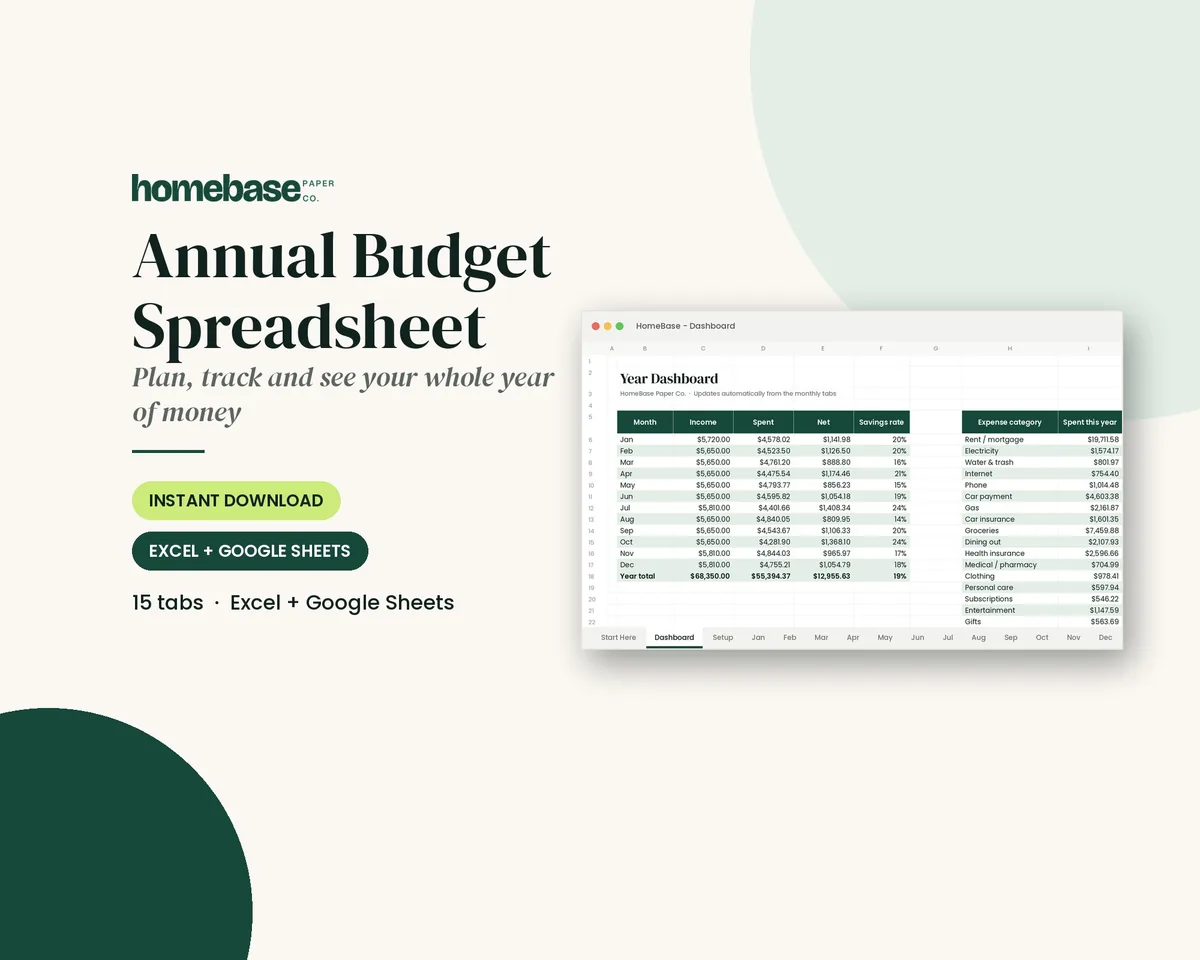
Annual Budget Spreadsheet
See exactly where your money goes every month - without complicated software.

Spreadsheets
Sinking Funds Tracker
It does the math: how much to set aside each month to hit every goal on time.
Spreadsheets
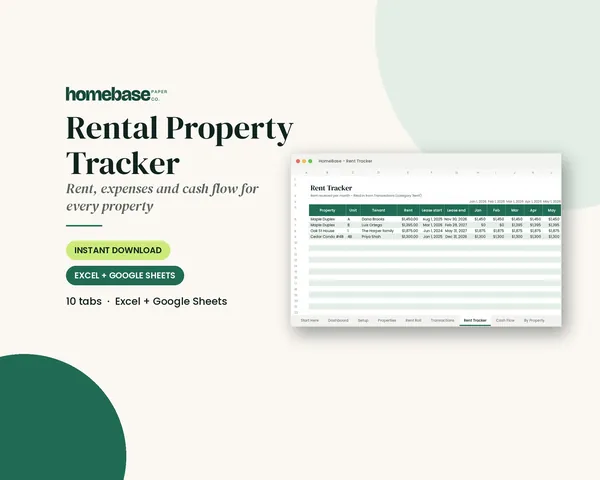
Rental Property Tracker
Log rent and expenses once - see who has paid each month, cash flow per property and category totals for tax time.
 Save 57%
Bundles
Ultimate Budget Bundle
All 6 spreadsheets + both printable planners - for less than half the price of buying them separately.
Passive income is money that keeps arriving after the main work or investment is done, such as interest, dividends, rent or royalties from something you created once. The honest truth is that almost no passive income is truly hands-off: every idea below needs money upfront, work upfront, or both. This list sorts 30 passive income ideas by what they really take, so you can pick the ones that fit your savings, skills and time.
Before you start, give your income goals a home in your budget. Our Annual Budget Spreadsheet tracks every income source month by month, next to your spending.
The full list: 30 passive income ideas in 6 groups
1. Savings that earn interest (low risk, needs cash)
- High-yield savings account
- Certificates of deposit (CDs) and a CD ladder
- Money market accounts
- U.S. Treasury bills and savings bonds
2. Investing (needs cash, carries risk)
- Dividend-paying stocks or dividend index funds
- Broad index funds held for the long term
- Bond funds
- Real estate investment trusts (REITs)
- Employer retirement plan contributions, especially with a match
3. Digital products (needs work upfront, little cash)
- Printables, planners and checklists
- Spreadsheet templates
- Ebooks and guides
- Online courses on a skill you know well
- Stock photos, video clips or design assets
- Print-on-demand designs for shirts, mugs and totes
4. Content that earns over time (needs lots of work upfront)
- A blog that earns from ads or affiliate links
- A YouTube channel
- A podcast with sponsors
- An email newsletter with paid subscribers
- A niche website that reviews or compares products
5. Renting out what you own (needs an asset)
- A spare room or basement apartment
- A rental property
- A parking space or garage
- Storage space
- Your car, through a car-sharing service
- Tools, camera gear or party equipment
6. Ownership and royalties (needs an idea or capital)
- Royalties from a book, music or a design
- Licensing a photo or pattern
- A silent share in a friend's small business (with a written agreement)
- Vending machines or laundry machines
What each idea really takes
| Group | Upfront money | Upfront work | Ongoing work | Risk |
|---|---|---|---|---|
| Savings that earn interest | Your savings | Very little | Very little | Low, if FDIC- or NCUA-insured |
| Investing | Money you won't need for years | Learning the basics | Low | Market ups and downs |
| Digital products | Low | High | Low to medium | Your time if it doesn't sell |
| Content | Low | Very high | Medium | Months or years of unpaid work |
| Renting what you own | You must own the asset | Medium | Medium to high | Damage, vacancy, repairs |
| Ownership and royalties | Varies | Varies | Varies | Higher; get agreements in writing |
Deposits at FDIC-insured banks are protected up to $250,000 per depositor, per bank, per ownership category, according to the FDIC. Investments are not insured and can lose value.
How to choose your first passive income idea
- Cover the basics first. Build a starter emergency fund and pay down high-interest debt. A credit card at 20% costs more than most investments reliably earn.
- Pick by what you have more of. Have savings but little time? Start in groups 1 and 2. Have time and a skill but little cash? Start in groups 3 and 4.
- Start with one stream. Spreading yourself across five ideas usually means none of them get finished.
- Set a realistic timeline. Interest starts this month. A blog, a channel or a product shop usually takes many months to earn anything meaningful.
- Decide what the income is for. Reinvest it, put it toward a goal, or use it to pay down debt. Name the goal before the money arrives.
- Track it monthly. Write down what each stream earned and what it cost so you know which ones are worth keeping.
The math: how much you need for a monthly income
For investment and savings income, the amount you need depends on the yield. Here's what it takes to earn $1,000 a month, or $12,000 a year, before taxes:
| Yearly yield | Amount needed for $1,000 a month |
|---|---|
| 3% | About $400,000 |
| 4% | About $300,000 |
| 5% | About $240,000 |
That's why most people build passive income slowly alongside a paycheck. Small steps still count: a $5,000 emergency fund earning 4% brings in about $200 a year that it wouldn't earn in a checking account paying nothing. Our compound interest calculator shows how regular deposits grow over time.
A smaller goal: $500 a month
If $1,000 a month feels far away, the same math works for a smaller target. Earning $500 a month is $6,000 a year, before taxes.
| Yearly yield | Amount needed for $500 a month |
|---|---|
| 3% | About $200,000 |
| 4% | About $150,000 |
| 5% | About $120,000 |
Digital products or content can reach a smaller goal with less cash, but they take work first. A realistic plan is to build an emergency fund first, then add one low-risk stream from the list above and put the earnings into the next one. Our guide to starting to invest covers the basics, and our side hustle ideas cover income that starts faster but is not passive.
How to fund passive income from your budget
Passive income usually starts with money you deliberately set aside each month. These tools help you find that money and keep it working:
- Find the money: list every expense with our budget categories list, then use a method from our budgeting methods guide, such as paying yourself first.
- Give each goal its own fund: the Sinking Funds Tracker ($4.99) splits goals like "investing fund" or "rental down payment" into monthly amounts.
- If you rent out property: the Rental Property Tracker ($11.99) logs rent, expenses and repairs by unit. Our guide to tracking rental income and expenses shows how to set it up.
- To see the whole picture: the Ultimate Budget Bundle ($19.99) includes our core budgeting spreadsheets and printables in one download.
Want active income first? Our list of side hustle ideas covers 50 ways to earn extra money now, and many people use that income to fund the savings and investments above.
Passive income red flags
- Guaranteed returns. Real investments don't guarantee high returns. The SEC's investor alerts describe common schemes.
- Expensive courses that promise a system. Paying hundreds of dollars to learn "passive income" is often the business model itself.
- Income from recruiting. If money comes mostly from signing up others, it's not passive income; it's a warning sign.
- Pressure to decide today. Legitimate opportunities don't disappear if you take a week to research them.
This page is general information, not financial, tax or investment advice. For decisions about investing or taxes, talk to a licensed professional.
Looking for something more hands-on? Our list of apps to earn money shows which ones actually pay.
Annual Budget Spreadsheet
See exactly where your money goes every month - without complicated software.
$6.99 · Instant download. Print at home or fill it in on screen. Or browse the full Budget & Money collection.
Frequently asked questions
What is passive income? Passive income is money that keeps coming in after the main work or investment is done, without you trading hours for it each week. Interest on savings, dividends, rent and royalties are common examples. Almost none of it is truly hands-off: it either takes money upfront, like savings or investments, or a lot of work upfront, like creating a product, and most kinds need some ongoing attention.
What is the easiest passive income to start? The easiest passive income to start is interest on savings, because it needs no special skill and little risk. Moving your emergency fund to a high-yield savings account or certificate of deposit at an FDIC-insured bank or NCUA-insured credit union earns interest while the money stays available for its real job. The returns are modest, but it's a real, low-risk first step.
How can I make passive income with no money? You can build passive income with little or no money by putting in work upfront instead of cash: creating digital products like printables, templates or an ebook, writing a blog or making videos that earn ad or affiliate income, or licensing photos or designs. Expect months of work before meaningful income, and be wary of anyone selling a course or kit that promises fast passive income.
How much money do I need to make $1,000 a month in passive income? How much you need for $1,000 a month depends entirely on the return. At a 4% yearly yield, you'd need about $300,000 invested to earn $12,000 a year, or about $1,000 a month, before taxes. At 5%, it's about $240,000. That math is why most people build passive income slowly, alongside a job, rather than living on it right away.
Is passive income taxable? Yes, passive income is generally taxable. Interest and most dividends are reported to the IRS, rental income is reported with its deductible expenses, and income from selling digital products or affiliate links is usually self-employment income. Keep records of everything you earn and spend, set aside money for taxes, and ask a tax professional when you add a new income type.
Are passive income ideas a scam? Passive income itself isn't a scam, but many offers that use the phrase are. Be very careful with anything that promises guaranteed returns, fast money, or income from recruiting other people, and with courses that cost hundreds of dollars to teach you a passive income system. The FTC warns about business opportunity and investment scams that use exactly this language.
Is rental property really passive income? Rental property is only partly passive. Tenants pay rent each month, but someone has to find tenants, handle repairs, collect rent and keep records, and a vacancy or big repair can wipe out a year of profit. Hiring a property manager makes it more passive but costs a share of the rent. Our Rental Property Tracker ($11.99) logs rent, expenses and repairs for each unit.
Should I pay off debt or build passive income first? Most people are better off paying off high-interest debt before chasing passive income. A credit card charging 20% or more costs far more than most investments reliably earn, so every dollar of that debt you pay off is a guaranteed return. Build a small emergency fund, clear high-interest debt, then put money toward income-producing savings and investments.
How do I track passive income streams? Track each passive income stream on its own line: what it earned this month, what it cost, and the running total for the year. A yearly budget spreadsheet with an income section works well. Our Annual Budget Spreadsheet ($6.99) tracks income from every source month by month next to your spending, so you can see what each stream actually adds.
How much money do I need to make $500 a month in passive income? To make $500 a month, or $6,000 a year, from interest or dividends you would need about $200,000 at a 3% yield, $150,000 at 4% or $120,000 at 5%, before taxes. Digital products and content can reach $500 with less cash, but they need work upfront.
What is the easiest passive income to start with? The easiest passive income to start with is interest on savings, such as a high-yield savings account or a CD, because it needs cash but no extra work. The amounts are small at first, so many people pair it with one low-cash idea, like a digital product, to grow faster.
Free printable
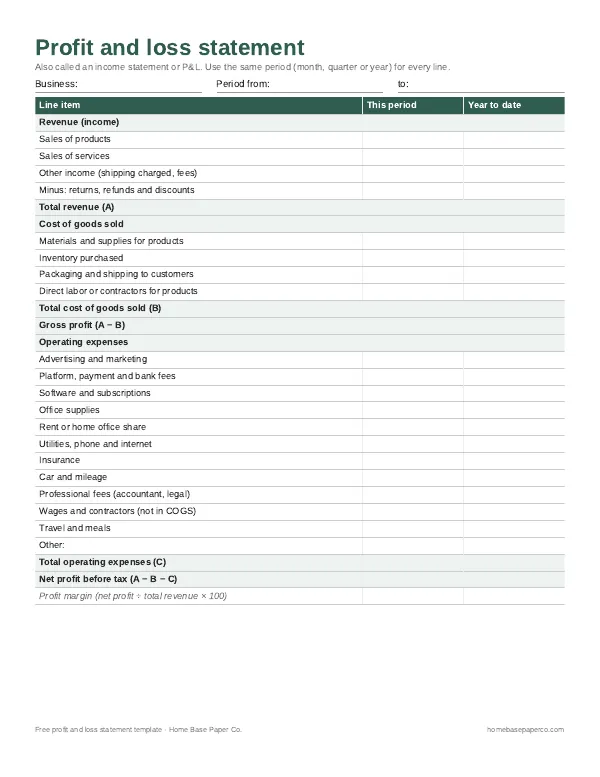
Know your real profit: get the free P&L template
A printable profit and loss statement that walks through revenue, costs and expenses line by line for any month, quarter or year. You'll also get our weekly HomeBase email with simple small business paperwork and money tips.
Sources
- FDIC fdic.gov
- Investor alerts investor.gov