

The short answer: the main budgeting methods are 50/30/20, zero-based budgeting, the cash envelope system, pay yourself first, 70/20/10, paycheck budgeting, kakeibo and the 80/20 budget.
- 50/30/20: about 10 minutes a week, good for beginners
- Zero-based: about 30 minutes a week, for control and tight months
- Pay yourself first: about 5 minutes a week, for people who hate tracking
- Choose in 3 questions: steady income, time you'll give it, where money leaks
- Free tool: try the 50/30/20 split on your own pay with the free budget calculator
- Next step: Plan it with the Zero-Based Budget Spreadsheet ($6.99).
The main budgeting methods are 50/30/20, zero-based budgeting, the cash envelope system, pay yourself first, 70/20/10, paycheck budgeting, kakeibo and the 80/20 budget. Each one tracks the same two things, money in and money out, but they ask for different amounts of time and detail. The best method is the one that matches your income, your habits and how much attention you can give it each week. The table and quiz below help you pick in a few minutes.
As the oldest of three, I was the one who kept the family plan straight, and I learned that the fanciest system loses to the one you'll actually open. Our Zero-Based Budget Spreadsheet ($6.99) and Annual Budget Spreadsheet ($6.99) work with most of the methods below.
8 budgeting methods compared
| Method | How it works | Time per week | Best for |
|---|---|---|---|
| 50/30/20 | About 50% needs, 30% wants, 20% savings and debt | 10 minutes | Beginners and steady incomes |
| Zero-based | Every dollar gets a job until nothing is left to assign | 30 minutes | Control and tight months |
| Cash envelope | Cash split into labeled envelopes by category | 20 minutes | Overspending on groceries or fun |
| Pay yourself first | Savings move out on payday, then you spend the rest | 5 minutes | People who hate tracking |
| 70/20/10 | About 70% living costs, 20% savings, 10% debt or giving | 10 minutes | Debt payoff with simple math |
| Paycheck budget | Plan each paycheck against the bills due before the next one | 15 minutes per payday | Biweekly pay and timing gaps |
| Kakeibo | A Japanese journaling budget with reflection questions | 20 minutes | Mindful spenders who like writing |
| 80/20 | Save 20% first, spend 80% freely | 5 minutes | A lighter take on pay yourself first |
Percentages are starting points. High rent, childcare or medical costs can push needs well past 50%, and that is normal.
Pros and cons of each budgeting method
| Method | Biggest advantage | Biggest drawback |
|---|---|---|
| 50/30/20 | Three buckets, easy to start | Percentages may not fit high rent or childcare |
| Zero-based | Every dollar has a job | Takes the most weekly time |
| Cash envelope | Hard spending limits | Cash is awkward for online bills |
| Pay yourself first | Savings happen automatically | Does not control overspending by itself |
| 70/20/10 | Simple math, room for debt payoff | Little room if living costs top 70% |
| Paycheck budget | Matches bills to pay dates | One plan per paycheck to maintain |
| Kakeibo | Builds awareness of habits | Needs writing and reflection each month |
| 80/20 | Almost no tracking | Easy to overspend the 80% |
Example: the same paycheck under three methods
These are arithmetic illustrations, not recommendations. Take a household with $4,000 a month in take-home pay:
- 50/30/20: $2,000 for needs, $1,200 for wants and $800 for savings and debt payoff.
- 70/20/10: $2,800 for living costs, $800 for savings and $400 for debt payoff or giving.
- Zero-based: list every bill and goal until the planned total is $4,000, so income minus plans equals $0. A $1,500 rent, $600 groceries, $400 transportation, $500 other bills, $600 savings, $200 debt and $200 fun adds to $4,000.
Swap in your own number. For a longer look at the splits, see budget percentages by category.
The methods in plain words
- 50/30/20. Investopedia's overview explains the split of after-tax income into needs, wants and savings. Read our full 50/30/20 budget guide.
- Zero-based budgeting. Income minus every planned dollar equals zero. See the zero-based budget guide.
- Cash envelope system. Once an envelope is empty, that category is done for the month. See the cash envelope system.
- Pay yourself first. Automate savings on payday so saving happens before spending. See pay yourself first.
- 70/20/10. A simpler split that puts more toward living costs. See the 70/20/10 budget.
- Paycheck budgeting. Assign each check to the bills due before the next one. See our paycheck budget planner.
- Kakeibo. Write down income, spending and goals, then reflect at month's end. See kakeibo.
- 80/20. Move 20% to savings and let the rest cover everything else without category tracking.
Affiliate links: we may earn a small commission. As an Amazon Associate we earn from qualifying purchases. Details.
For the cash envelope version, use a cash envelope wallet with tabbed envelopes for category cash and Paper Mate InkJoy gel pens to update your tracker when you spend. Start with supplies you already have.
How to choose a budgeting method in 3 questions
- Is your income steady? Yes: 50/30/20 or 70/20/10. No: zero-based or paycheck budgeting.
- How much time will you give it? Under 10 minutes a week: pay yourself first or 80/20. More: zero-based or kakeibo.
- Where does money leak? Groceries, takeout or shopping: cash envelopes for those categories. Bills hitting before payday: paycheck budgeting.
Steps that work with every method
The CFPB's budgeting guide lays out four steps that come before any method: list where your money comes from, log where it goes, write down every bill and its due date, then build a working budget. It also suggests updating your budget when your job or spending habits change.
- Add up monthly take-home pay from every source.
- Track one month of spending by category.
- List bills with due dates.
- Pick a method and set your categories. For more on this topic, see our budgeting basics hub.
- Review weekly for the first month, then adjust.
Our budget categories list helps with step 4.
Combining budgeting methods
If your pay changes month to month, start with our guide to budgeting with irregular income.
You don't have to pick only one. Some pairings that work well together:
- Pay yourself first plus zero-based: savings leave first, then every remaining dollar gets a job.
- 50/30/20 plus envelopes: use the split for the big picture and cash only for the "wants" category.
- Paycheck budget plus sinking funds: each check covers its bills and adds a little to holiday and car funds.
Budgeting methods for families and the holidays
Family budgets have more moving parts: school costs, activities, birthdays and a big December. Whatever method you choose, give irregular costs their own line. A sinking fund for the holidays, set up in the spring, turns a stressful month into a planned one. If two adults share the money, pick a method you can both explain in one sentence, and hold a short money check-in once a week.
Common budgeting method mistakes
- Picking the most detailed method on day one, then quitting in week two.
- Copying someone else's percentages without checking your real bills.
- Forgetting irregular costs like car registration, school fees and the holidays. A sinking fund spreads them across the year.
- Judging a method after one month instead of three.
Budget tools for any method
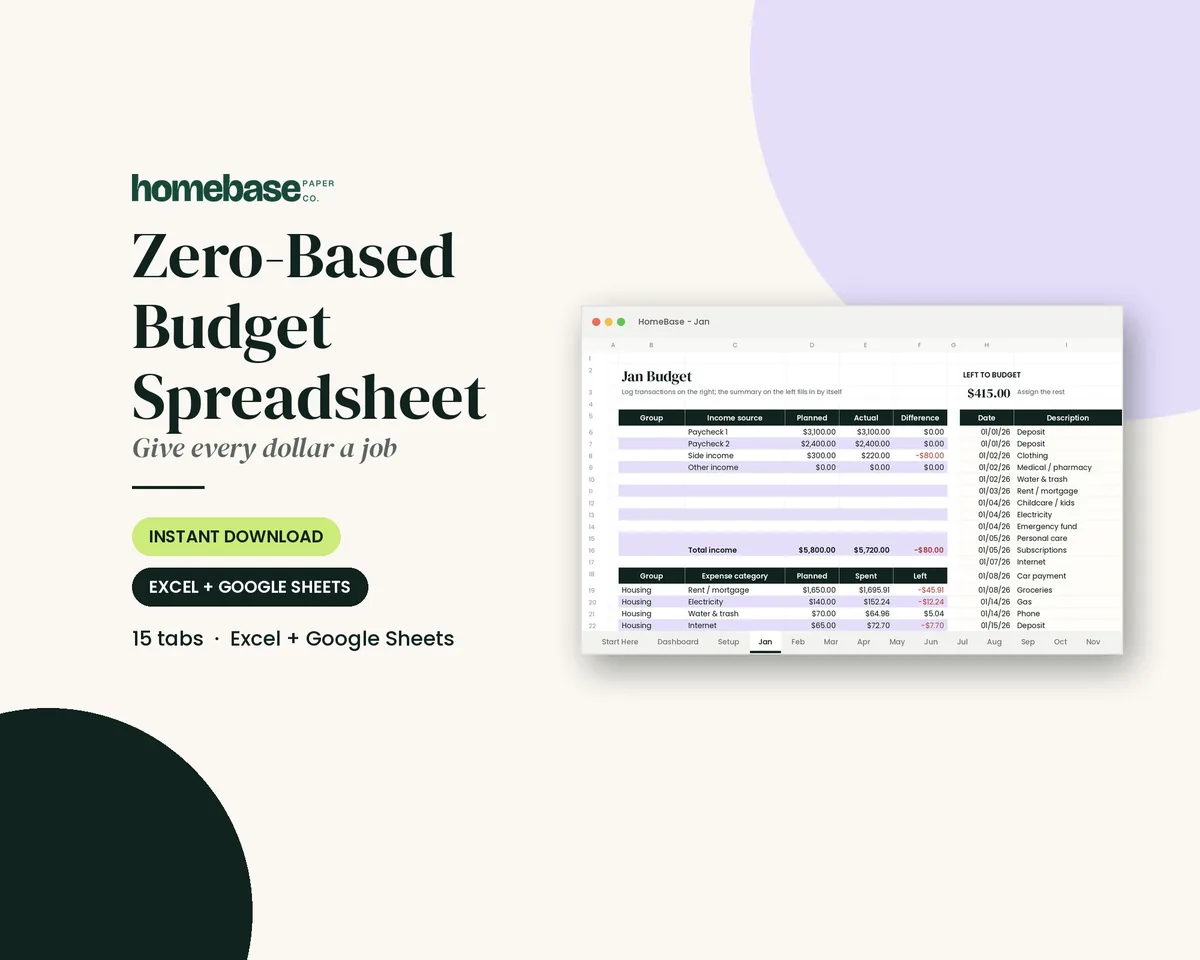
- Zero-Based Budget Spreadsheet ($6.99): shows what is left to assign until you reach zero.
- Annual Budget Spreadsheet ($6.99): twelve months in one file for 50/30/20, 70/20/10 or your own split.
- Paycheck Budget Spreadsheet ($5.99): plans each check against the bills due before the next one.
- Budget Planner Printable ($5.99): paper pages for envelope, kakeibo-style or any method.
- Ultimate Budget Bundle ($19.99, $46.42 if bought separately): eight budget tools in one bundle.
Browse every budget spreadsheet in the shop. Our free Holiday Budget Starter Kit is three US Letter pages we email you after you join our list. To match a method to a layout, see our roundup of the best free budget templates.
See also
New to budgeting? Start with our budget definition guide, which explains what a budget is with simple examples.
Make it easier
Tools for this

Spreadsheets
Zero-Based Budget Spreadsheet
The 'Left to budget' counter turns green when every dollar has a job.

Spreadsheets
Annual Budget Spreadsheet
See exactly where your money goes every month - without complicated software.

Spreadsheets
Paycheck Budget Spreadsheet
Enter your bills once. The sheet tells you which paycheck pays each one, all year.
Frequently asked questions
What are the main budgeting methods? The most common budgeting methods are the 50/30/20 rule, zero-based budgeting, the cash envelope system, pay yourself first, the 70/20/10 rule, paycheck budgeting and kakeibo. They all track income and spending; they differ in how much detail they ask of you.
Which budgeting method is best for beginners? The 50/30/20 rule is usually the easiest place to start because it uses only three buckets. Once you know your numbers, many people move to zero-based budgeting for more control. An Annual Budget Spreadsheet works with either one and does the math for you.
What are the pros and cons of different budgeting methods? Simple methods like 50/30/20 and pay yourself first take little time but give less control, while zero-based budgeting and envelopes give more control but need more weekly attention. Choose the trade-off you can keep up for at least three months.
What is the most effective budgeting method? The most effective budgeting method is the one you will keep using. Zero-based budgeting gives the most control, envelopes give the strongest spending limits and pay yourself first takes the least effort. Match the method to your income, habits and goals.
What is zero-based budgeting? Zero-based budgeting gives every dollar of income a job until income minus planned spending, saving and debt payments equals zero. A Zero-Based Budget Spreadsheet shows the amount left to assign so you can see when you have reached zero.
What is the 50/30/20 budget method? The 50/30/20 method splits after-tax income into about 50% for needs, 30% for wants and 20% for savings and debt payoff. It is a guideline, not a rule, so many households adjust the percentages to fit high rent or childcare costs.
Which budgeting method works with irregular income? Zero-based and paycheck budgeting both work well with irregular income because you plan with the money you actually have. Budget from your lowest typical month, and send extra income in good months to savings or a buffer.
Can I combine budgeting methods? Yes, and many people do. A common mix is pay yourself first for savings, zero-based planning for bills and cash envelopes for groceries or fun money. Start with one method, then add a second only to fix a specific problem.
How do I choose a budgeting method? Ask three questions: how steady is my income, how much time will I spend each week and where does my money leak? Steady income and little time point to 50/30/20, while overspending points to envelopes and tight months point to paycheck budgeting.
Do budgeting methods work on paper? Every budgeting method works on paper. Some people stick with a budget longer when they write it by hand. A Budget Planner Printable gives you monthly pages for any method, and the spreadsheets suit people who prefer automatic totals.
How often should I change my budgeting method? Give any method at least two or three months before judging it. The first month is mostly learning your real numbers. Switch only when a method keeps failing for the same reason, not after one hard month.
What does the 50/30/20 rule look like on $4,000 a month? On $4,000 of monthly take-home pay, the 50/30/20 rule gives about $2,000 to needs, $1,200 to wants and $800 to savings and debt payoff. Use your after-tax income, and adjust the split if housing costs more than half.
More from HomeBase
You may also like

Spreadsheets
Bill Tracker Spreadsheet
Bills due in 3 days or less light up red, so nothing slips through.

Spreadsheets
Sinking Funds Tracker
It does the math: how much to set aside each month to hit every goal on time.

Spreadsheets
Debt Payoff Planner
Pick snowball or avalanche, add any extra payment, and get your debt-free month instantly.
 Starter pick
 Club
Monthly club
Money Club
Anyone who wants a clear plan for the month's bills, holiday spending and savings.
Free printable
Give every dollar a job: get the free monthly budget template
A printable zero-based monthly budget: income, bills, everyday spending and savings on one page, with a planned vs. actual column. You'll also get our weekly HomeBase email with simple budgeting and bill-paying tips.

Sources
- Budgeting: How to create a budget and stick with it (CFPB) consumerfinance.gov
- What Is the 50/30/20 Budget Rule? (Investopedia) investopedia.com