

The short answer: kakeibo is a Japanese budgeting method: write down every purchase by hand, sort it into one of four categories and reflect on it at the end of the month.
- The word means "household ledger"
- Categories: needs, wants, culture and extra
- Formula: income − fixed costs − savings goal = money to spend
- A worked example and a free printable
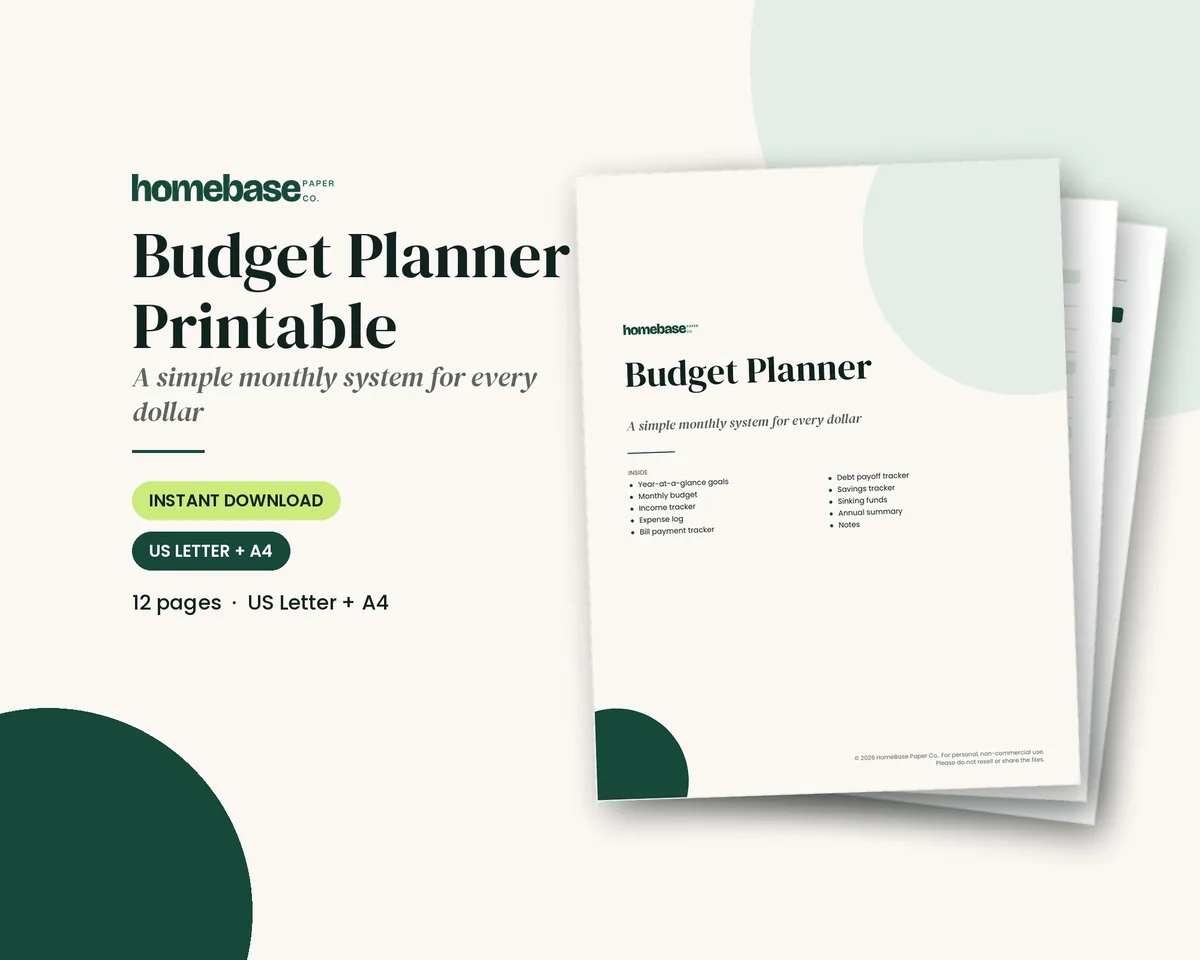
- Next step: Get the free kakeibo printable (we email it to you); want more? The Budget Planner Printable is $5.99.
Kakeibo is a Japanese budgeting method built on a simple idea: write down every purchase by hand, sort it into one of four categories, and reflect on it at the end of the month. The word means "household ledger," and it's been used in Japan for more than a century. It's not a spreadsheet full of formulas. It's a notebook, a pen and a few honest questions. Below you'll learn how kakeibo works step by step, see a worked example, and get a free kakeibo printable you can use this month.
Where kakeibo comes from
Kakeibo is generally credited to journalist Hani Motoko, who published a household account book in 1904 so readers could manage their household money. The idea caught on, and household ledgers like it have been used in Japan ever since. In recent years kakeibo has become popular around the world as people look for a calmer, more mindful way to manage spending.
Why writing it down works
Most of us think we know where our money goes. We usually don't. University of Illinois Extension's money management lesson teaches that tracking spending by memory is ineffective and calls tracking expenses an essential money management skill. The CFPB's spending tracker takes the same approach: write down what you spend, then look for patterns.
Kakeibo adds two things. First, you write by hand, which slows you down just enough to notice each purchase. Second, you review your choices on purpose, using the same questions every month.
The four kakeibo questions
At the heart of kakeibo are four questions you answer every month:
- How much money do I have? Your income for the month.
- How much do I want to save? Your savings goal, decided before you spend.
- How much am I spending? What you actually spent, tracked as you go.
- How can I improve? What you'll do differently next month.
Many kakeibo users add: What purchases am I glad I made? What would I skip next time?
The four kakeibo categories
Instead of 20 budget lines, kakeibo uses just four:
| Category | What goes in it | Examples |
|---|---|---|
| Needs | Things you need to live and work | Groceries, transit, gas, medicine, utilities |
| Wants | Things you enjoy but could skip | Takeout, coffee out, clothes, streaming |
| Culture | Things that enrich your mind or life | Books, classes, museum tickets, concerts |
| Extra | Unplanned or one-off costs | Car repairs, gifts, a broken appliance |
Fixed costs such as rent, insurance and loan payments are usually taken out at the start of the month, so the four categories track what's left. If you'd like a longer list of budget lines to sort from, our budget categories list shows how each common expense fits.
How to do kakeibo, step by step
Step 1: Start the month
On the first day of the month, write down:
- Your take-home income for the month
- Your fixed costs (rent or mortgage, insurance, phone, subscriptions, minimum debt payments)
- Your savings goal
Then do the kakeibo math:
Income − fixed costs − savings goal = money to spend
Divide that by the number of weeks in the month to get a weekly spending limit.
Step 2: Write down every purchase
Each day, write what you bought, how much it cost and which category it belongs in. Do it the same time each day, such as after dinner, so it becomes a habit. Keep receipts in an envelope or snap a photo if you can't write it down right away.
Step 3: Total each week
At the end of each week, total each category and compare it with your weekly limit. If you went over, look at which category grew and adjust the following week.
Step 4: Review the month
On the last day of the month, total everything and answer the questions. How much did you spend? Did you hit your savings goal? Which purchases were worth it, and which would you skip? Write one or two specific changes for next month.
Step 5: Start again
Carry what you learned into next month's plan. The real power of kakeibo is the repetition: a few months in, you'll know your patterns.
A kakeibo example
Here's a month for someone bringing home $3,600:
| Line | Amount |
|---|---|
| Take-home income | $3,600 |
| Fixed costs (rent, utilities, phone, insurance, car payment) | −$2,150 |
| Savings goal | −$400 |
| Money to spend | $1,050 |
| Weekly limit (4 weeks) | about $262 |
Week one might look like this: needs $148 (groceries, gas), wants $72 (two takeout meals, a shirt), culture $18 (a used book) and extra $35 (a birthday gift). That's $273, a little over the limit. At the weekly review, she notices takeout is the biggest want and plans one fewer order next week. At month-end, she's saved $380 against a $400 goal, and she knows exactly where the extra $20 went.
Tips for sticking with kakeibo
- Keep it in one place. One notebook or printable, kept where you'll see it every day.
- Don't judge, just record. The point is awareness. Write down everything, even the purchases you're not proud of.
- Pay yourself first. Move your savings goal to a separate account on payday, so it's gone before you spend. Our guide to pay yourself first explains how.
- Use the culture category on purpose. It's there to remind you that spending on things that matter to you is okay.
- Plan for the extras. If "extra" is big every month, those costs aren't really surprises. Set aside money for them in sinking funds.
- Review together. Couples can keep one ledger and do the month-end review together.
Kakeibo vs. other budgeting methods
Kakeibo sits somewhere between a free-form spending log and a detailed budget. A zero-based budget gives every dollar a job in advance across many categories. The 50/30/20 budget splits income into needs, wants and savings by percentage. Kakeibo keeps the categories broad and puts the effort into daily recording and monthly reflection. Many people combine them: plan with a zero-based budget, then track daily spending kakeibo-style. For a side-by-side look at the options, see our guide to budgeting methods.
Kakeibo compared with 50/30/20 and zero-based budgeting
| Kakeibo | 50/30/20 | Zero-based | |
|---|---|---|---|
| What you decide up front | Savings goal for the month | Three percentages | A job for every dollar |
| Categories | Four broad groups | Three | As many as you need |
| Main effort | Daily writing and a month-end review | Setting the split once | Planning before each month |
| Best for | Building awareness of habits | A quick, simple rule | Tight or irregular budgets |
Kakeibo is the easiest of the three to start, because the only setup is deciding how much to save. If you want a rule to go with it, the guide to sticking to a budget shows how to keep any method going past the first month.
Common kakeibo mistakes
- Skipping small purchases. A $4 coffee feels too small to write down, but small buys are often where the money goes. Record everything.
- Setting the savings goal after spending. The goal comes first, on day one. Whatever is left is what you spend.
- Using too many categories. Four is the point. If you split "wants" into ten sub-lines, you're back to a regular budget and the habit gets harder.
- Skipping the review. Writing purchases down without reflecting is just a log. The month-end questions are where the change happens.
- Quitting after a bad week. Overspending one week isn't failure. It's information for next week's plan.
Can you do kakeibo in an app or spreadsheet?
You can, and some people prefer it. The trade-off is that typing or tapping is faster and easier to ignore than writing by hand. A good middle path is to plan the month and do the math in a spreadsheet, then record daily spending on paper. If you go digital, keep the same four categories and still set aside time for the month-end questions.
Get the free kakeibo printable
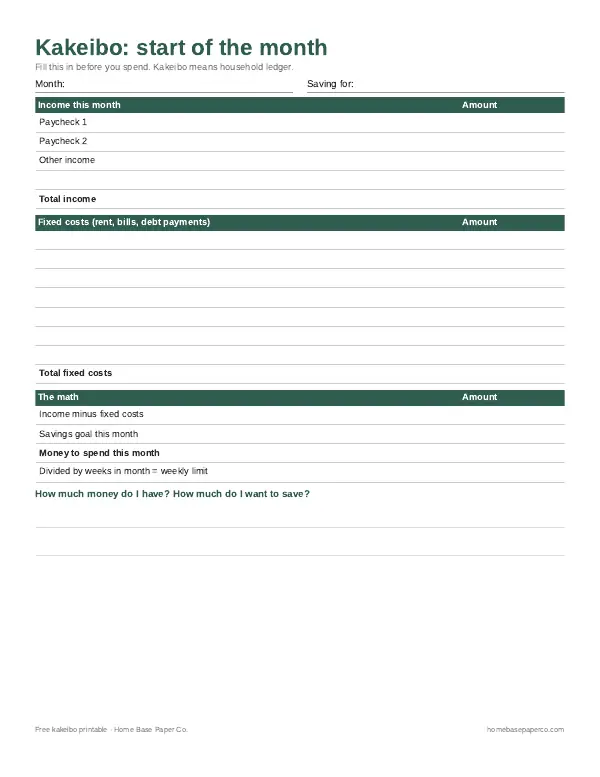
Our free 3-page kakeibo printable follows the method above. Page one is your start-of-month plan with income, fixed costs, a savings goal and the math for your weekly limit. Page two has two weekly tables with columns for needs, wants, culture and extra. Page three is the end-of-month review with category totals and the reflection questions. Print page two twice for a full month.
Take it further
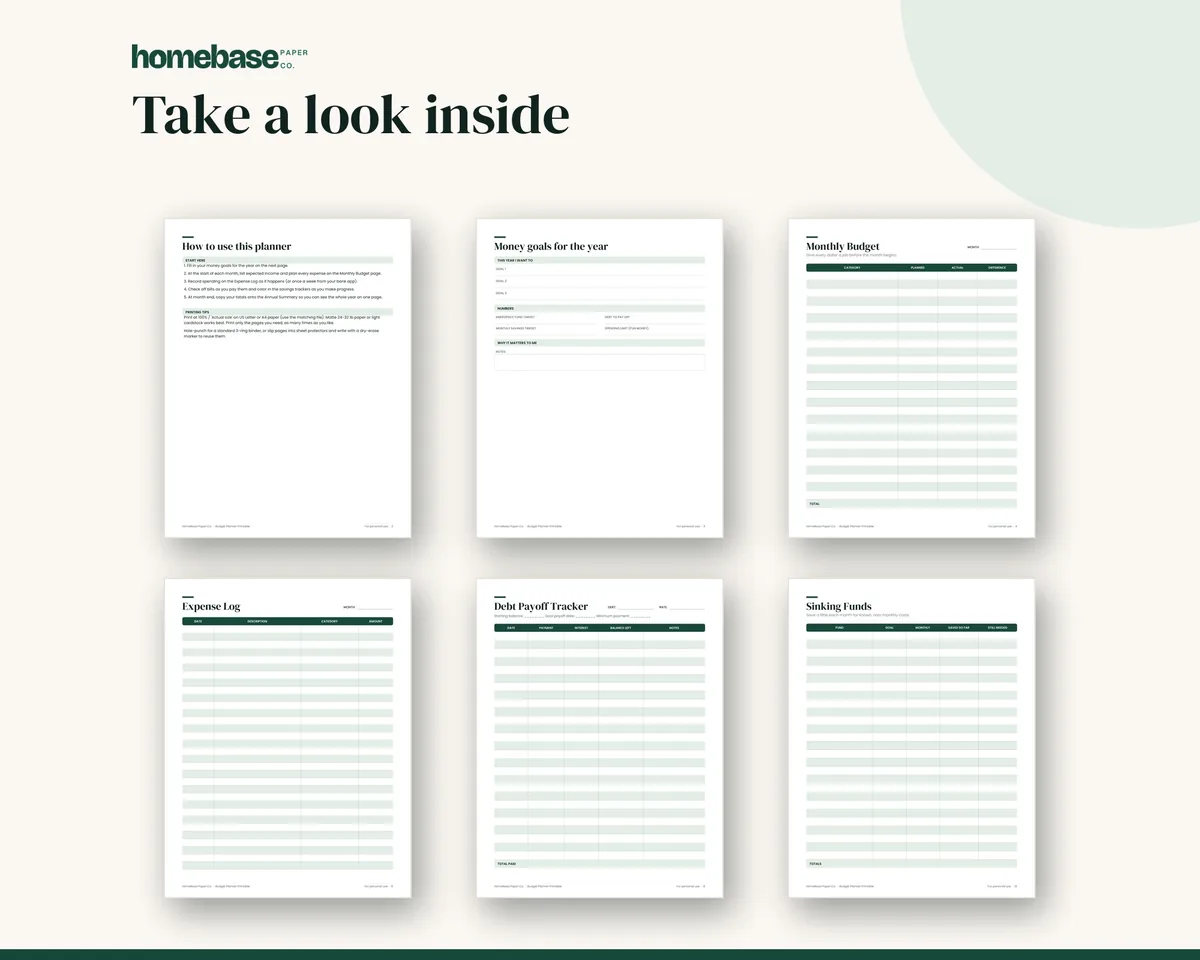
Once kakeibo shows you where your money goes, the next step is planning it. Our Budget Planner Printable ($5.99) gives you 12 undated pages, including a Monthly Budget, Income Tracker, Expense Log, Bill Payment Tracker, Savings Tracker and Sinking Funds page, in US Letter and A4. It's a natural fit if you love paper.
If you'd rather let formulas do the math, the Zero-Based Budget Spreadsheet ($6.99) turns its "Left to budget" counter green when every dollar has a job. For the "extra" category, the Sinking Funds Tracker ($4.99) tracks up to 20 goals with the monthly amount needed for each date and progress bars. The Ultimate Budget Bundle ($19.99) includes six budgeting spreadsheets plus the budget planner and bill tracker printables, $46.42 if bought separately.
Start this month
Print the free kakeibo pages, write your income and savings goal at the top, and record your first purchase today. In four weeks, you'll have the clearest picture of your spending you've ever had.
Want a simpler daily log to start with? See our guide to keeping a spending tracker on paper or in a spreadsheet.
Make it easier
Tools for this

Printables
Budget Planner Printable
Twelve undated pages you can print every month: budget, bills, spending, savings and debt.

Spreadsheets
Zero-Based Budget Spreadsheet
The 'Left to budget' counter turns green when every dollar has a job.

Spreadsheets
Sinking Funds Tracker
It does the math: how much to set aside each month to hit every goal on time.
Frequently asked questions
What is kakeibo? Kakeibo is a Japanese budgeting method that uses a handwritten household ledger. The word means household account book. You set a savings goal at the start of each month, write down every purchase in one of four categories, and review what you spent at the end of the month.
How do you pronounce kakeibo? Kakeibo is pronounced kah-kay-boh, with three short, even syllables. The word combines kakei, meaning household finances, and bo, meaning book or ledger.
What are the four kakeibo categories? The four kakeibo categories are needs (housing, groceries, transport, utilities), wants (eating out, shopping, entertainment), culture (books, classes, museums, things that enrich you) and extra or unexpected (repairs, gifts, medical bills and anything you did not plan for).
What are the kakeibo questions? The kakeibo questions are: How much money do I have? How much do I want to save? How much am I spending? How can I improve? Many people add two more at month end: What purchases am I glad I made, and what would I skip next time?
Does kakeibo have to be handwritten? No, but kakeibo is traditionally handwritten, and that is part of why it works: writing each purchase by hand makes you notice it. You can use an app or spreadsheet, but many people find the pen-and-paper habit is what changes their spending.
How is kakeibo different from a regular budget? Kakeibo is different from a regular budget because it focuses on awareness more than detailed limits. You use only four broad categories, track by hand every day or week, and spend more time reflecting on your choices. A regular budget usually sets a specific amount for many categories.
Who invented kakeibo? Kakeibo is generally credited to Hani Motoko, a Japanese journalist who published a household account book in 1904. The method has been used in Japan ever since and has spread worldwide in recent years.
How do I start kakeibo? To start kakeibo, write your monthly income at the top of a page, subtract fixed costs, decide how much to save, and divide what is left by the weeks in the month. Then record every purchase under needs, wants, culture or extra, and total each week.
Can kakeibo help me save money? Yes, kakeibo can help you save money because you choose a savings goal before you spend, and the daily habit of writing purchases down helps you catch spending you would otherwise forget. The end-of-month questions turn what you learned into a plan for next month.
Is there a free kakeibo printable? Yes, there is a free kakeibo printable on this page. It is a 3-page PDF with a start-of-month page, weekly spending tables for the four categories and an end-of-month reflection page. Print the weekly page twice to cover a whole month.
What do I do with leftover money in kakeibo? With leftover money in kakeibo, you add it to your savings at the end of the month, put it toward a goal or debt, or carry it forward. Comparing what you planned to save with what you actually saved is one of the key reflection steps.
Can couples or families use kakeibo? Yes, couples and families can use kakeibo together. Keep one shared ledger, have each person add purchases daily, and do the end-of-month review together. Talking through the reflection questions helps everyone agree on what spending is worth it.
Is kakeibo good for beginners? Yes, kakeibo is a good method for beginners because the only setup is choosing a monthly savings goal, then writing down each purchase and reviewing the month. It needs a notebook or the free kakeibo printable and a few minutes a day, with no percentages or complicated categories.
More from HomeBase
You may also like

Spreadsheets
Bill Tracker Spreadsheet
Bills due in 3 days or less light up red, so nothing slips through.

Spreadsheets
Paycheck Budget Spreadsheet
Enter your bills once. The sheet tells you which paycheck pays each one, all year.

Spreadsheets
Annual Budget Spreadsheet
See exactly where your money goes every month - without complicated software.

Spreadsheets
Debt Payoff Planner
Pick snowball or avalanche, add any extra payment, and get your debt-free month instantly.
 Club
Monthly club
Money Club
Anyone who wants a clear plan for the month's bills, holiday spending and savings.
Free printable
Try kakeibo, the Japanese way to spend on purpose
A start-of-month page, weekly tables and a month-end review. You'll also get our weekly HomeBase email with simple budgeting and bill-paying tips.
Sources
- University of Illinois Extension: Tracking spending extension.illinois.edu
- CFPB: Your Money, Your Goals spending tracker (PDF) files.consumerfinance.gov