

The short answer: to stick to a budget, build it from what you really spent over the last few months, give every irregular cost and a little fun money its own line, automate bills and savings and check your numbers for 15 minutes once a week.
- Overspent? Move money from another category instead of quitting
- Irregular costs: a sinking fund for each known cost
- Too strict? A named fun-money line you're allowed to spend
- Bills and paychecks don't line up? Match each bill to a paycheck
- Next step: Plan it with the Zero-Based Budget Spreadsheet ($6.99).
To stick to a budget, build it from what you really spent over the last few months, give every irregular cost and a little fun money its own line, automate the bills and savings, and check your numbers for 15 minutes once a week. When you overspend, move money from another category instead of quitting. Most budgets don't fail because people lack willpower. They fail because the plan didn't match real life, so the fix is a better system, not more guilt.
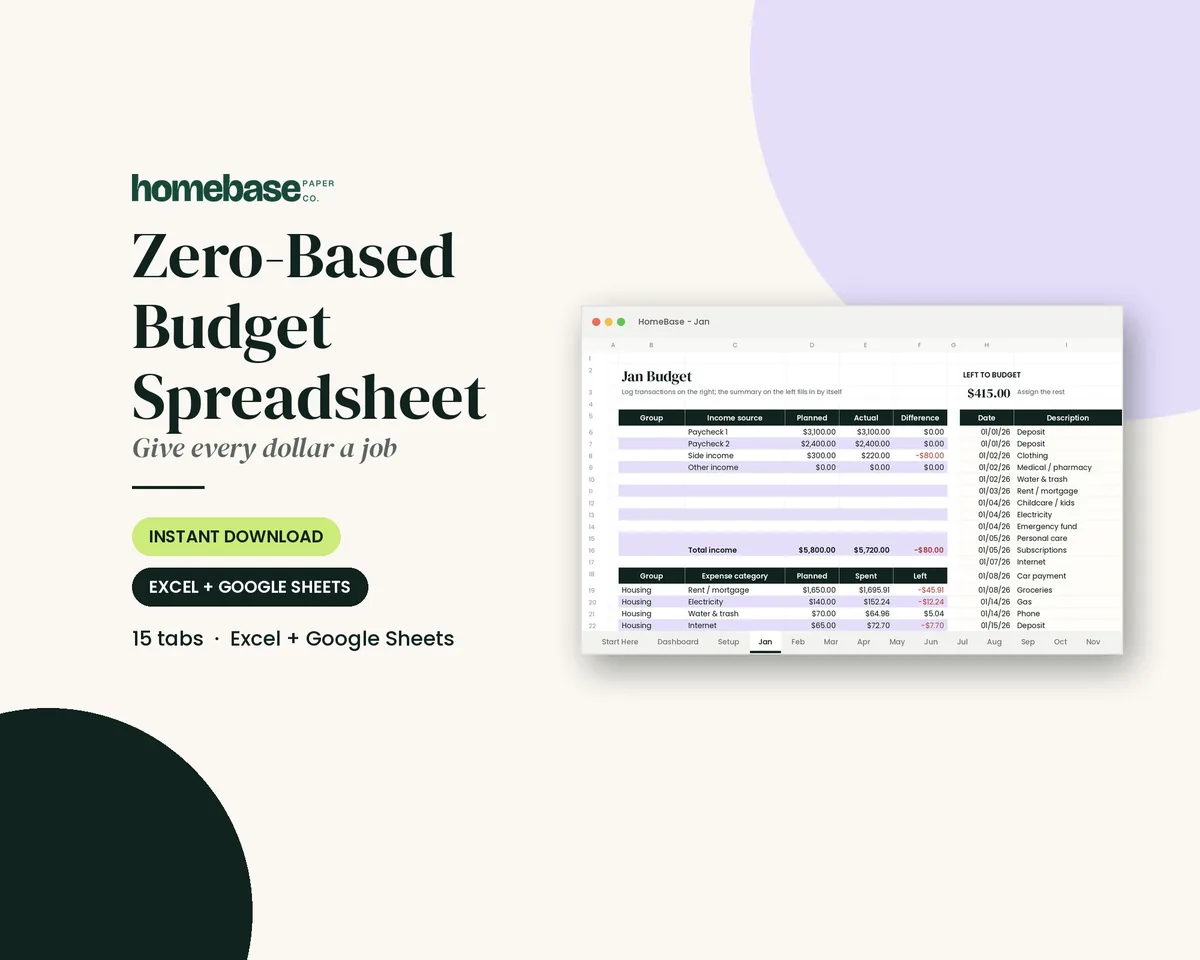
Our Zero-Based Budget Spreadsheet makes the weekly check-in quick: planned vs. spent vs. left columns and a 'Left to budget' counter show where each month stands.
This guide is about keeping a budget going once you have one. If you haven't made your first budget yet, start with our guide on how to make a budget, then come back here to make it stick. Every dollar amount below is an example to show the math, so swap in your own numbers.
Why can't I stick to a budget?
If you keep starting over, you're not bad with money. Your budget is probably missing something. Here are the most common reasons budgets fall apart, and the fix for each one.
If you like writing by hand, a budget planner book keeps a full year in one place.
| Why the budget breaks | What it looks like | The fix |
|---|---|---|
| The numbers were guesses | Groceries run over every single month | Rebuild from three months of real spending |
| Irregular costs aren't in it | Car repairs, gifts and annual fees wreck the month | Sinking funds for each known cost |
| It's too strict | A spending binge after two good weeks | A named fun-money line you're allowed to spend |
| Bills and paychecks don't line up | Short right before payday | Match each bill to a paycheck or move due dates |
| You only look at it monthly | You find the problem after the money is gone | A 15-minute weekly check-in |
| One slip feels like failure | You stop tracking after the first overspend | Move money between lines and keep going |
| No goal behind it | "Why bother?" by week three | One clear goal you can see on the page |
| Nobody else is on board | Your partner or family spends from a different plan | A short family money meeting |
Most people recognize two or three rows. Start there.
How to stick to a budget in 10 steps
1. Rebuild the budget from real numbers
A budget built on hopes is the fastest one to break. Pull your bank and card statements from the last three months and total what you actually spent in each category. If groceries averaged $720, a $500 grocery line will fail by the third week, and that failure will make the whole budget feel pointless.
Set each line at your real average first, then trim one or two lines by an amount you can actually hit. Small cuts you keep beat big cuts you abandon.
2. Add the costs your budget forgot
Most "surprise" expenses aren't surprises. Car registration, back-to-school shopping, birthdays, holidays, insurance premiums and annual subscriptions all come around on a schedule. When they aren't in the budget, they land on a credit card and make it look like the budget failed.
List every cost that doesn't happen monthly, estimate the yearly total, and divide by 12. Save that amount each month in a sinking fund. Keep a separate emergency fund for the truly unplanned. The Consumer Financial Protection Bureau's guide to building an emergency fund points out that even a small amount set aside can help you recover more quickly from an unexpected bill.
Also add a small buffer line, a cushion for the little things you couldn't predict. It keeps one forgotten co-pay from knocking everything over.
3. Give yourself a fun-money line
A budget with zero room for enjoyment usually ends in a splurge. Give each adult in the house a set amount of personal spending money each month that needs no explanation and no guilt. Give it a name that means something to you so it feels like a reward, not a loophole.
It can be small. It just has to exist, so a coffee with a friend isn't "breaking the budget."
4. Automate the must-pay items
Every decision you don't have to make is one you can't get wrong. Set up automatic payments for fixed bills and an automatic transfer to savings on payday. The CFPB says that setting up recurring transfers is often one of the easiest ways to save consistently, and it also suggests watching your balance so an automatic transaction doesn't cause an overdraft.
If you're nervous about autopay, start with savings only. Even a small transfer on payday means savings happens first instead of "if there's anything left." Our guide to paying yourself first walks through how to set that up.
5. Match your bills to your paychecks
Some budgets break because of timing, not totals. If rent and the car payment both come out before your second paycheck, you can be short for a week even when the month adds up. The CFPB notes that you may be able to work with landlords, utility companies and card issuers to adjust due dates.
Write each bill next to the paycheck that will cover it. If you're paid every two weeks, our biweekly budget template guide shows how to split bills across paychecks and plan for the months with a third paycheck. If your pay changes from month to month, see how to budget with irregular income.
If every paycheck feels spoken for before it arrives, see our guide to living paycheck to paycheck.
6. Make tracking take five minutes or less
You can't stick to a plan you can't see. The CFPB's budgeting advice is to create a tool that works for you, whether that's a daily journal or saving your receipts. The best tool is the one you'll actually open.
Pick one place to track and keep it simple:
- Spreadsheet: type in purchases and let the formulas show what's left in each category.
- Paper planner: write purchases on an expense log and total them weekly.
- Cash envelopes: for one or two problem categories, use cash so you can see it shrink. Our cash envelope system guide explains how.
Log purchases at the same time every day, like after dinner. It's far easier than rebuilding a month from memory.
7. Hold a 15-minute weekly check-in
A weekly check-in is the habit that keeps a budget alive. Monthly reviews catch problems after the money is gone; a weekly one catches them while you can still fix them. Put it on the calendar like an appointment, same day and time each week.
Use the same short agenda each time:
- Log any purchases you missed.
- Check what's left in each category.
- Flag any line that's more than half spent before the middle of the month.
- Look at the next seven days: bills, birthdays, school costs, trips.
- Move money now if a line is going to run short.
There's a fill-in version of this checklist below.
8. Put a pause between you and unplanned buys
Not every overspend is a big decision. Many are small, quick ones. MyMoney.gov suggests setting maximum amounts you plan to spend each week or month, then sticking with that plan, and warns against letting a sale or coupon talk you into something that isn't in it.
A simple rule helps: anything unplanned over a set amount waits 48 hours. Keep a shopping list for every store trip and unsubscribe from store emails you don't need. If impulse buys are your biggest leak, our full guide to stopping impulse buying has more habits that work.
9. When you overspend, move money and keep going
This is the step that separates budgets that last from budgets that get abandoned. You will overspend sometimes. A budget is a plan, not a pass-or-fail test. When a line runs over, cover it from another line that month instead of giving up.
The order to pull from:
- Your buffer line.
- A flexible line with money left, like dining out or entertainment.
- Your fun money.
- As a last resort, pause an extra savings or debt goal for that month (but keep paying minimums).
Then ask one question: was this a one-time event, or is the line simply too low? If it happens two months in a row, raise the line and lower something else.
10. Review monthly, reset and celebrate
At the end of each month, compare planned and actual spending for every line, adjust next month's numbers, and pick one thing to improve. The CFPB recommends celebrating your successes when you're sticking with a savings habit, and the same goes for a budget. Notice what worked.
Keep one goal visible at the top of your budget page, such as an emergency fund target or a debt payoff date. A goal gives every "no" a reason. Our guide on how to set financial goals can help you choose one.
A weekly budget check-in template
Copy this into a notebook or spreadsheet and fill it in each week.
| Check-in item | This week |
|---|---|
| Date of check-in | |
| Purchases logged (yes / caught up) | |
| Categories over 50% spent before mid-month | |
| Bills due in the next 7 days | |
| Irregular costs coming up (birthdays, school, car) | |
| Money moved between lines (from → to, amount) | |
| Sinking fund deposits made | |
| One win this week | |
| One thing to watch next week |
Worked example: fixing a grocery overspend mid-month
Here's how the "move money and keep going" rule works in practice. These numbers are examples only.
At the week-two check-in, the grocery line is planned at $600 but $420 is already spent. At that pace, it'll finish the month around $840, which is $240 over.
| Step | What happens | Grocery line | Other lines |
|---|---|---|---|
| Week 2 check-in | $420 of $600 spent, on pace for $840 | $180 left | |
| Plan meals from the pantry | Cut the expected overage to $120 | Needs $120 more | |
| Pull from buffer | Move $50 from the $50 buffer | +$50 | Buffer $0 |
| Pull from dining out | Move $70 from the $150 dining-out line | +$70 | Dining out $80 |
| End of month | Groceries land at $720, fully covered | $0 over | Savings untouched |
The budget still balances, nothing went on a credit card, and savings stayed on track. At the monthly review, if groceries ran over two months in a row, raise the grocery line to its real average and lower another line to match. For more ways to stretch the food budget, see our guide to grocery shopping on a budget.
A planner makes a budget easier to keep; this guide shows how to choose a budget planner and use it weekly.
Paper or spreadsheet: which helps you stick to it?
If phone reminders help you more than paper, see our roundup of the best budgeting apps.
If writing by hand helps, try kakeibo, a Japanese budgeting journal with four categories. Our guide includes a free printable.
| Spreadsheet | Paper planner | |
|---|---|---|
| Best for | People who want the math done for them | People who remember what they write down |
| Shows what's left | Automatically, as you type | When you total the page |
| Works on the go | Yes, in Google Sheets on your phone | When the binder is with you |
| Weekly check-in | Fast, with planned vs. spent side by side | Calm, screen-free money time |
| Watch out for | Forgetting to open the file | Math mistakes and skipped totals |
Many households use both: a spreadsheet for the numbers and a printed page on the fridge so everyone can see the goal. Our printable vs. spreadsheet comparison goes deeper.
How to stick to a budget as a family
A budget is easier to keep when everyone is working from the same plan. The CFPB suggests developing a support system, much like you would for an exercise routine, with people who will do a budget with you or listen when it's hard.
Our family budgeting guide collects every guide for keeping a household budget on track.
- Hold a short monthly money meeting. Our family budget meeting agenda keeps it to a few minutes.
- Agree on a spending limit that needs a check-in first, so nobody is surprised by a big purchase.
- Give each person their own fun money so small choices don't turn into arguments.
- Share wins together, like hitting a savings goal or finishing a month on plan.
If you're combining money with a partner, our guide on how to budget as a couple covers joint and separate accounts. If you want free, unbiased lessons to work through together, the FDIC's Money Smart program offers free financial education.
Staying on budget through the holidays
The holiday season is when many budgets break, because gifts, travel and food all pile up at once. Treat the holidays as their own sinking fund, set a per-person gift limit, and plan the season on paper before you shop. Our free Holiday Budget Starter Kit is 3 US Letter pages, emailed after you join our list, and our holiday budget guide walks through the full plan.
Why I plan this way
I'm Malaysia. I grew up in Detroit as the oldest of three, and I was the one my family leaned on for guidance and for keeping everyone coordinated. That taught me that a plan only works if people can see it, follow it and adjust it when life happens. That's how I think about a budget: not a rulebook you pass or fail, but a plan you check in on and keep improving.
Stick to your budget with the Zero-Based Budget Spreadsheet
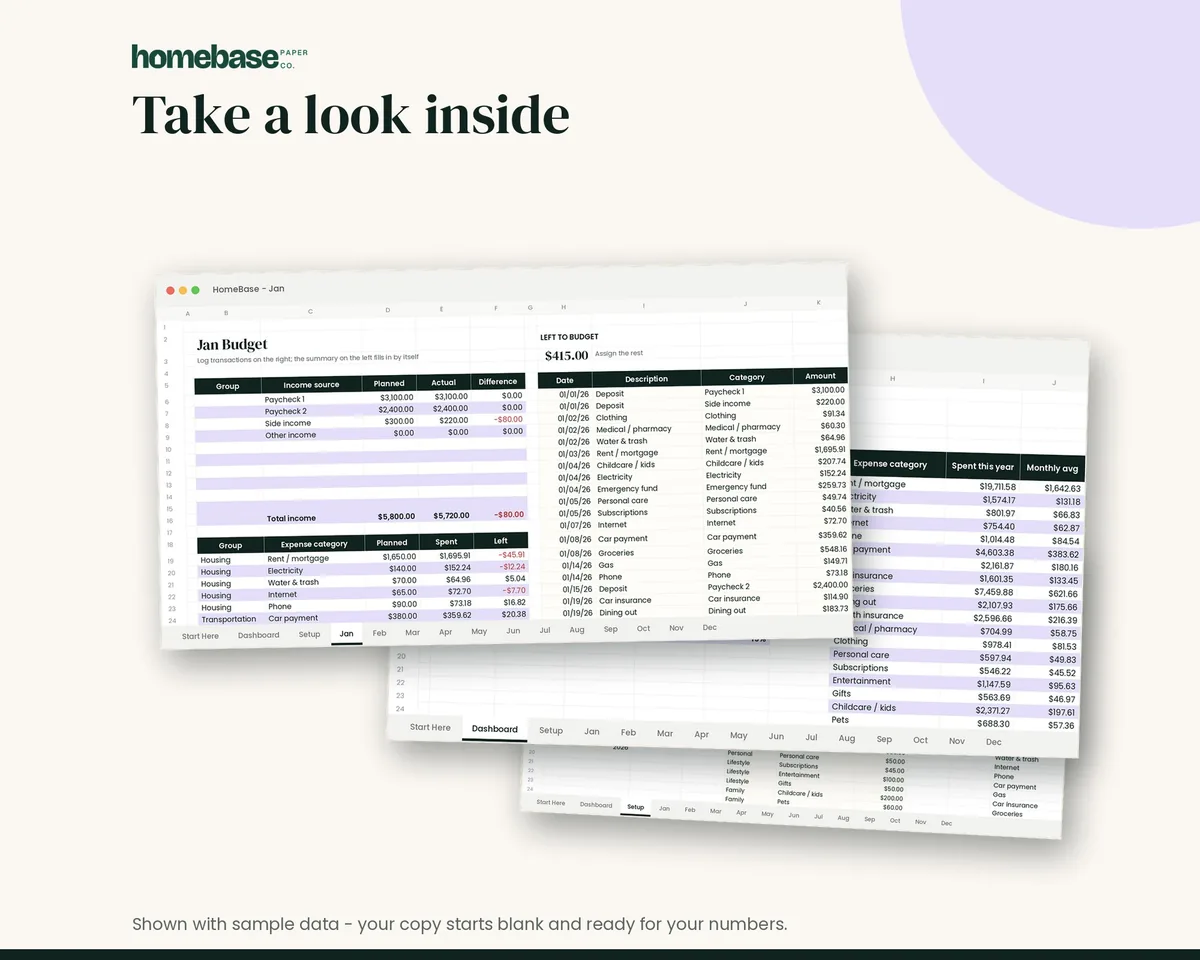
The Zero-Based Budget Spreadsheet ($6.99) makes the weekly check-in fast. It works in Excel and Google Sheets and includes:
- a "Left to budget" counter on every month that turns green when every dollar has a job
- planned vs. spent vs. left for every category, so you see an overspend coming
- a transaction log with dropdowns and 12 monthly tabs
- a year dashboard with a chart for your monthly review
Prefer paper? The Budget Planner Printable ($5.99) has undated monthly budget, expense log, bill payment and sinking fund pages you can print every month. To cover irregular costs, the Sinking Funds Tracker ($4.99) sets a monthly amount for each savings goal.
Want the whole system? The Ultimate Budget Bundle ($19.99, $46.42 if bought separately) includes all three of those plus the annual budget, paycheck budget, debt payoff and bill tracker tools. Browse every template in Spreadsheets, the paper versions in Printables, or see all sets in Bundles.
Want more small habits to try? Our budgeting tips page has 50 ideas, a 10-tip starter week and a 15-minute weekly check-in.
Make it easier
Tools for this

Spreadsheets
Zero-Based Budget Spreadsheet
The 'Left to budget' counter turns green when every dollar has a job.

Printables
Budget Planner Printable
Twelve undated pages you can print every month: budget, bills, spending, savings and debt.
 Save 57%
Bundles
Ultimate Budget Bundle
All 6 spreadsheets + both printable planners - for less than half the price of buying them separately.
Frequently asked questions
How do you stick to a budget? Build the budget from your real spending, give irregular costs and fun money their own lines, automate bills and savings, and check in for 15 minutes every week. The Zero-Based Budget Spreadsheet ($6.99) shows planned vs. spent vs. left for every category, so the weekly check-in takes minutes.
Why can't I stick to a budget? Most budgets fail because the plan doesn't match real life, not because of willpower. The usual causes are guessed numbers, missing irregular costs, no fun money, bills that don't line up with paychecks and only looking at the budget once a month. Fix the one or two causes that sound like you first.
What are the best ways to stick to your budget? The habits that work best are a weekly check-in, automatic bill payments and savings transfers, sinking funds for irregular costs, a small buffer line, guilt-free fun money and moving money between lines when you overspend instead of quitting.
How do I stay on budget every month? Hold a short weekly check-in, flag any category that's more than half spent before mid-month and move money early. The Budget Planner Printable ($5.99) has undated monthly budget and expense log pages you can reuse every month.
What should I do if I go over my budget? Cover the overspend from another line in the same month instead of giving up. Pull from your buffer first, then a flexible line like dining out, then fun money. If the same line runs over two months in a row, raise it and lower something else.
How often should I check my budget? Check it once a week for about 15 minutes and review it fully once a month. Weekly check-ins catch problems while you can still fix them; the monthly review is for adjusting next month's numbers.
How do I stick to a budget with irregular expenses? List every cost that doesn't happen monthly, like car registration, gifts and annual fees, total them for the year and divide by 12. The Sinking Funds Tracker ($4.99) sets a monthly savings amount for each goal so those costs stop wrecking your budget.
Is a budget spreadsheet or a paper planner better for sticking to a budget? Both work; pick the one you'll actually open. The Zero-Based Budget Spreadsheet ($6.99) does the math for you in Excel or Google Sheets, while the Budget Planner Printable ($5.99) suits people who remember what they write down.
How much fun money should I put in my budget? Put a small, set amount of fun money per adult per month in your budget, sized to what you can afford after bills, savings and debt minimums. There's no single right amount. What matters most is that the line exists, so small treats don't feel like breaking the budget; the Zero-Based Budget Spreadsheet lets you set fun money up as its own category.
How do I stop overspending on groceries? Set the grocery line at your real three-month average, plan meals from what you already have, shop with a list and check the line at your weekly check-in. If it's running high mid-month, move money from a flexible line and adjust your meal plan.
How do couples stick to a budget together? Work from one shared plan, hold a short monthly money meeting, agree on a purchase amount that needs a check-in first and give each person their own fun money. That keeps small choices from turning into arguments.
Does automating bills help you stick to a budget? Yes, automating bills helps you stick to a budget. Automatic bill payments and savings transfers remove decisions you could get wrong. The CFPB says recurring transfers are often one of the easiest ways to save consistently; just watch your balance so autopay doesn't cause an overdraft.
How long does it take to get used to a budget? It usually takes a few months of adjusting before a budget feels natural, because your first numbers are estimates. Expect to change some lines after each monthly review; a budget that changes with your life is one you can keep.
What is the best budget method for sticking to a budget? The best method is the one that fits how you think about money. Zero-based budgeting gives every dollar a job, which makes overspending visible fast. The Ultimate Budget Bundle ($19.99, $46.42 if bought separately) includes zero-based, paycheck and annual budget spreadsheets so you can try more than one.
More from HomeBase
You may also like

Spreadsheets
Bill Tracker Spreadsheet
Bills due in 3 days or less light up red, so nothing slips through.

Spreadsheets
Paycheck Budget Spreadsheet
Enter your bills once. The sheet tells you which paycheck pays each one, all year.

Spreadsheets
Annual Budget Spreadsheet
See exactly where your money goes every month - without complicated software.

Spreadsheets
Debt Payoff Planner
Pick snowball or avalanche, add any extra payment, and get your debt-free month instantly.
 Club
Monthly club
Money Club
Anyone who wants a clear plan for the month's bills, holiday spending and savings.
Free printable
Give every dollar a job: get the free monthly budget template
A printable zero-based monthly budget: income, bills, everyday spending and savings on one page, with a planned vs. actual column. You'll also get our weekly HomeBase email with simple budgeting and bill-paying tips.

Sources
- Guide to building an emergency fund consumerfinance.gov
- Create a tool that works for you consumerfinance.gov
- Setting maximum amounts you plan to spend mymoney.gov
- Money Smart program fdic.gov