The short answer: bookkeeping is the routine recording of every financial transaction in your business: each sale, each purchase, each bill paid.
- Shows whether you're making money
- Finds deductions at tax time
- Two systems: single-entry and double-entry
- Records to keep and how long to keep them
- Free download: start with the free small business expense spreadsheet for Excel or Google Sheets (we email it to you)
- Next step: Plan it with the Business Income & Expense Tracker ($7.99).
What is bookkeeping? Bookkeeping is the routine recording of every financial transaction in your business: each sale, each purchase, each bill paid. It's how you know whether you're making money, how you find deductions at tax time and how you prove your numbers if anyone asks. You don't need an accounting degree to do it. This guide explains bookkeeping in plain English, the two main systems, the records to keep, how long to keep them and a simple way to get started.
What is bookkeeping? The three parts
IRS Publication 583 explains that your recordkeeping system should include a summary of your business transactions, and that business transactions are ordinarily summarized in books called journals and ledgers. Those books are built from supporting documents like receipts, invoices and deposit slips.
Put simply, bookkeeping has three parts:
- Capture every transaction and the document that proves it.
- Record it in your books, whether a notebook, spreadsheet or software.
- Organize and check the records, so the totals are right and easy to find.
Why bookkeeping matters
IRS Publication 583 lists the reasons to keep good records:
| Reason | What it means for you |
|---|---|
| Monitor the progress of your business | See whether sales are growing and which months are slow |
| Prepare your financial statements | Build an income statement and a balance sheet |
| Identify the source of receipts | Separate business from personal money, and taxable from nontaxable income |
| Keep track of deductible expenses | You may forget expenses unless you record them when they happen |
| Prepare your tax returns | Your records must support the income, expenses and credits you report |
| Support items on tax returns | A complete set of records speeds up any IRS examination |
Bookkeeping vs. accounting
The two words are often used together, but they're different jobs:
| Bookkeeping | Accounting | |
|---|---|---|
| Focus | Recording and organizing transactions | Interpreting the records |
| Timing | Daily, weekly and monthly | Monthly, quarterly and yearly |
| Typical tasks | Logging sales and expenses, filing receipts, reconciling the bank account | Preparing financial statements, tax planning, analysis |
| Who does it | Often the owner or a bookkeeper | Often an accountant |
Good bookkeeping is what makes accounting possible. An accountant can only work with the records you keep.
The IRS doesn't require one system
The IRS page on what records to keep says you may choose any recordkeeping system suited to your business that clearly shows your income and expenses. Your books must show your gross income, deductions and credits. If you use software or another electronic system, the same requirements that apply to paper books also apply to electronic records.
Single-entry vs. double-entry bookkeeping
IRS Publication 583 says you must decide between two systems.
Single-entry bookkeeping is the simplest to maintain. It's based on the income statement (profit or loss) and records the flow of income and expenses with a daily summary of cash receipts and monthly summaries of receipts and disbursements. The IRS says it can be a simple and practical system if you're starting a small business.
Double-entry bookkeeping uses journals and ledgers. Transactions are first entered in a journal and then posted to ledger accounts for income, expenses, assets, liabilities and net worth. Each account has a left side for debits and a right side for credits, and every transaction is recorded as a debit in one account and a credit in another. Total debits must equal total credits. If they don't, there's an error to find and fix. The IRS says double-entry has built-in checks and balances to assure accuracy and control.
Here's the IRS's example of a double-entry journal entry for paying October rent:
| Date | Description of entry | Debit | Credit |
|---|---|---|---|
| Oct. 5 | Rent expense | 780.00 | |
| Cash | 780.00 |
Which system should you use?
The IRS doesn't pick one for you. Here's how the two compare, based on Publication 583:
| Single-entry | Double-entry | |
|---|---|---|
| Built on | The income statement (profit or loss) | Journals and ledgers |
| Records | Daily and monthly summaries of receipts and disbursements | Every transaction as a debit in one account and a credit in another |
| Strength | Simplest to maintain | Built-in checks and balances for accuracy and control |
| Good fit | A small business that is just starting | A business that wants self-balancing books |
The Georgia Department of Revenue's basic accounting manual explains that the double-entry system gets its name because every business transaction has at least two effects on the accounting equation. It does not mean each transaction is recorded twice. Making debits and credits equal keeps the equation in balance and gives you a way to verify the math in your records.
Key bookkeeping terms
For how cash in and cash out fit into a statement, see our cash flow statement example with a free template.
| Term | Meaning |
|---|---|
| Journal | A book where you record each business transaction from your supporting documents (IRS) |
| Ledger | A book that contains the totals from all your journals, organized into accounts (IRS) |
| General ledger | The record of every account and its running balance |
| Debit and credit | The left and right sides of each account in double-entry bookkeeping |
| Assets | Property a business owns |
| Liabilities | Debts of a business |
| Net worth (owner's equity) | Assets minus liabilities |
| Reconciliation | Matching your books to your bank statement |
| Chart of accounts | A numerical listing of the names of all the accounts a business uses (Georgia Department of Revenue) |
The Georgia Department of Revenue manual describes the accounting equation, Assets = Liabilities + Owner's Equity, as the basic framework for recording the effects of transactions in companies of all sizes. Our guide to the general ledger explains journals, ledgers and posting in more detail.
What records to keep
The IRS says purchases, sales, payroll and other transactions generate supporting documents, including:
- Sales slips
- Paid bills
- Invoices
- Receipts
- Deposit slips
- Canceled checks
Keep them orderly and in a safe place. The IRS suggests organizing them by year and by type of income or expense. For gross receipts, it lists cash register tapes, deposit information, receipt books, invoices and Forms 1099-MISC. For a full list by tax category, see our tax documents checklist.
Use a separate business bank account
IRS Publication 583 recommends opening a business checking account so business and personal funds stay separate, and the IRS notes that for most small businesses, the business checking account is the main source for entries in the books. It makes bookkeeping far easier: nearly every transaction shows up in one statement.
Publication 583 also says to reconcile your checking account each month. Reconciling verifies how much money you have, makes sure your books reflect all bank charges and the correct balance, and catches errors in your bank statement, checkbook or books.
How long to keep records
The IRS guidance on how long to keep records depends on the situation:
| Situation | Keep records for |
|---|---|
| Most cases | 3 years |
| You underreported income by more than 25% of gross income | 6 years |
| A loss from worthless securities or bad debt deduction | 7 years |
| Employment tax records | At least 4 years after the tax is due or paid |
| You did not file a return | Indefinitely |
| Property | Until the limitations period expires for the year you dispose of it |
A simple bookkeeping routine
| How often | Task |
|---|---|
| Every transaction | Save the receipt or invoice |
| Daily (or as often as you can) | Enter income and expenses with dates, amounts and categories, and deposit receipts |
| Monthly | Reconcile the business checking account and review profit and loss |
| Quarterly | Review totals and set aside money for taxes |
| Yearly | Close the books, gather tax documents and file records by year |
Good bookkeeping habits from the IRS
IRS Publication 583 says recordkeeping is most effective when you follow a few good practices. Record expenses when they occur, so nothing slips through the cracks. Identify the source of every receipt you record, so you can show which deposits were business income, which were personal funds and which were loans. The IRS even suggests using a checkbook with enough space to note the source of each deposit. And it says that, generally, it is best to record transactions on a daily basis.
Publication 583 also says you should deposit all daily receipts in your business checking account, and that the business checkbook is your basic source of information for recording business expenses. When all money flows through one account, your bank statement becomes a second record that backs up your books.
What a small business bookkeeping system looks like
Publication 583 walks through a sample recordkeeping system for a small business. It's useful as a model because it shows how ordinary bookkeeping pieces fit together:
- Daily summary of cash receipts. Total each day's sales and other money received.
- Monthly summary of cash receipts. Roll the daily totals into one monthly figure.
- Check disbursements journal. Record each check written from the business account, with frequent expenses in their own columns.
- Employee compensation record. Track pay for each employee, if you have any.
- Annual summary. Total the year's receipts and expenses for your tax return.
- Depreciation worksheet. Track business assets that are depreciated over time.
- Bank reconciliation. Match your books to the bank statement each month.
You don't need every piece on day one. A freelancer with no employees might only need the receipts summary, an expense log, an annual summary and a monthly bank reconciliation. The point is that every number on your tax return can be traced back through your books to a receipt, invoice or deposit slip.
Getting started with a spreadsheet
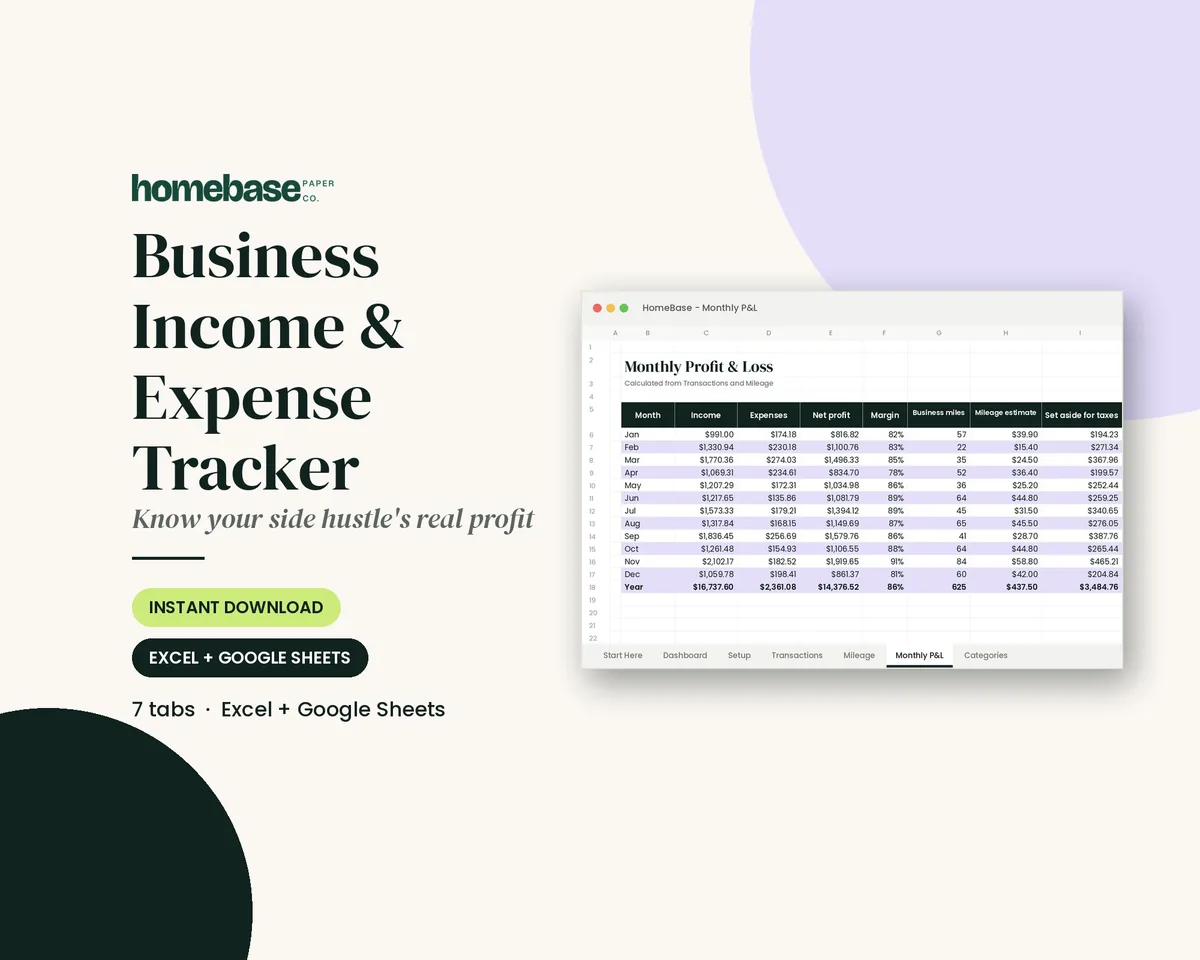
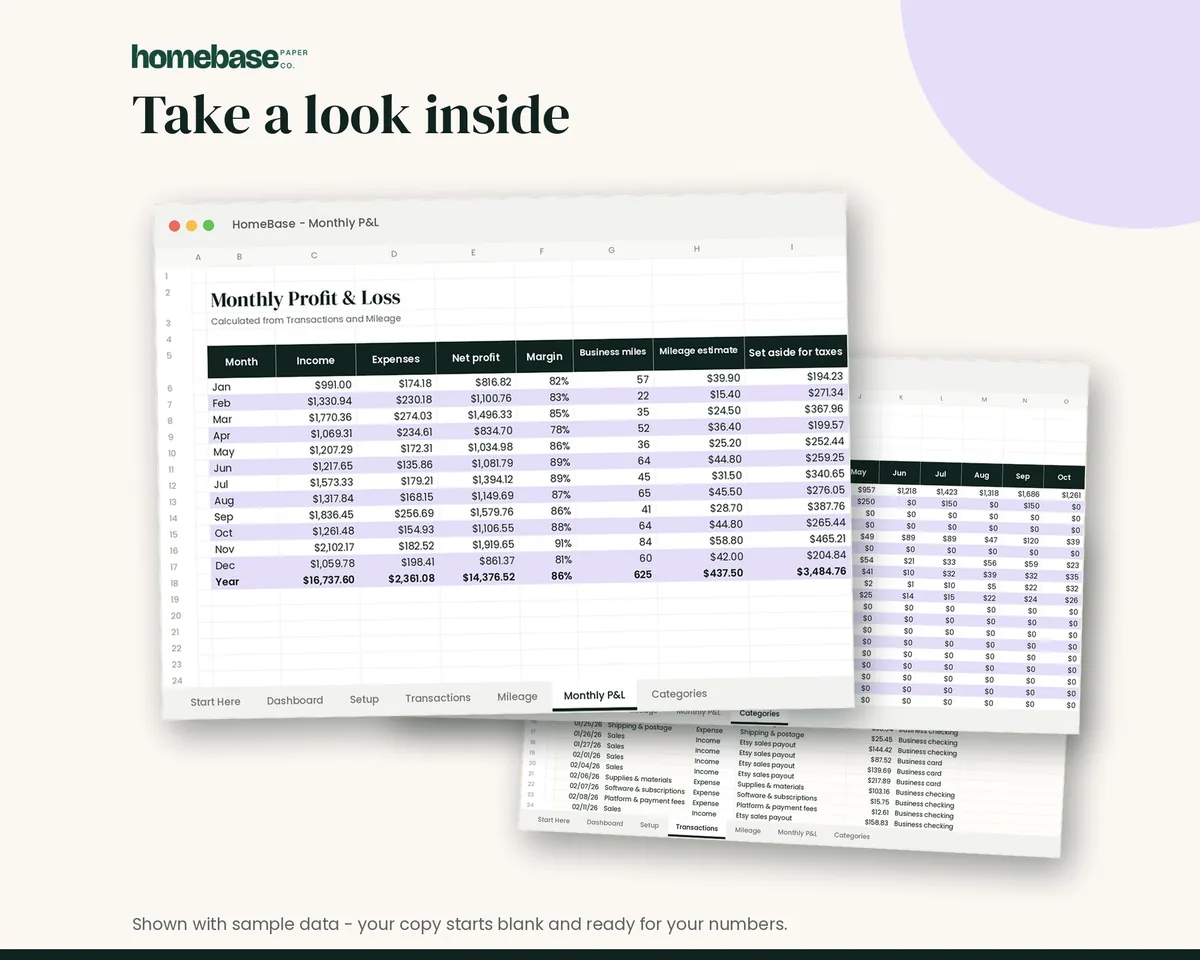
For many sole proprietors and side businesses, a single-entry spreadsheet is the easiest way to start. Our Business Income & Expense Tracker ($7.99, for Excel and Google Sheets) is built for exactly that. It has an income and expense log with a category dropdown, a monthly profit and loss summary, category totals, a mileage log, a tax set-aside estimate, a dashboard and a Start Here PDF that walks you through setup. It's a single-entry tracker, not a double-entry accounting system, so if your business needs full journals and ledgers, accounting software or an accountant is the better fit.
For more, see our small business expense tracker Excel template, our small business tax deduction checklist and our guide to keeping a mileage log for taxes.
A bookkeeping example: why bank balance is not profit
Consider a simplified cash-basis example with no other transactions, taxes or adjustments. The business starts the month with $100 already in its bank account. During the month it receives $800 from customers and pays $200 for ordinary operating supplies used in the business.
| Entry | Cash coming in | Cash going out | What it tells you |
|---|---|---|---|
| Opening bank balance | — | — | $100 carried from the earlier period |
| Customer payments received | $800 | — | Revenue received during this example month |
| Operating supplies paid | — | $200 | Expense in this simplified illustration |
| Closing bank balance | — | — | $100 + $800 − $200 = $700 |
The month's simplified income less expense is $800 − $200 = $600, not the $700 left in the bank. The opening $100 was already there. Borrowing, owner contributions, repayments and unpaid bills can create further differences between cash movements and profit, so a bank balance alone is not a financial statement. Actual accounting and tax treatment depends on the transaction and accounting method.
Keep the supporting invoice, receipt or payment record with the corresponding entry. The IRS recordkeeping guidance explains that source documents support the entries in the books. A downloaded bank transaction can tell you money moved, but you may still need the document showing what the purchase was for.
A monthly bookkeeping close you can repeat
Collect before categorizing. Put bank statements, card statements, receipts, customer invoices and payment-provider reports in one period's folder. Use a consistent filename that helps you trace an entry back to its document. Do not discard the original record merely because you entered a total in a spreadsheet.
Resolve duplicates and transfers. A transfer between two business accounts can appear on both bank feeds. Check the accounts involved before calling both sides new income or a new expense. Record payment-processing fees in a way that lets you trace gross customer payments to the net deposit, rather than losing the difference in an unexplained total.
Reconcile and review exceptions. Compare the recorded account balance with the statement for the same date. Investigate missing transactions, duplicate entries, bank fees and payments that have not cleared. Keep a short exceptions list so the next person working on the books knows what remains unresolved.
Save the period and hand off questions. After reviewing the period, save the reports and supporting files with a backup. Give your accountant the unresolved items and the explanations, not just a screenshot of the balance. The SBA's finance guidance emphasizes organized financial records as part of managing a business.
Your next step
This week, open a separate business checking account if you don't have one, and start logging every sale and expense with its date, amount, category and receipt. At the end of the month, reconcile the account against your log. That single habit covers most of what bookkeeping is.
Make it easier
Tools for this
Spreadsheets
Business Income & Expense Tracker
Log sales, expenses and business miles - see your monthly profit, category totals for tax time and how much to set aside.
Frequently asked questions
What is bookkeeping? Bookkeeping is the routine recording of a business's financial transactions, such as sales, purchases and payments, so you always know what came in and what went out. The IRS describes it as keeping a summary of your business transactions, usually in books called journals and ledgers, backed by supporting documents like receipts and invoices.
What is bookkeeping in simple terms? In simple terms, bookkeeping is writing down every dollar your business earns and spends, keeping the receipts that prove it, and organizing it so you can see your profit and file your taxes. It can be done in a notebook, a spreadsheet or accounting software.
What is the difference between bookkeeping and accounting? Bookkeeping is the day-to-day recording and organizing of transactions. Accounting builds on those records to prepare financial statements, analyze how the business is doing and plan taxes. A bookkeeper keeps the journals and ledgers accurate; an accountant interprets them. Many small business owners do their own bookkeeping and hire an accountant at tax time.
What are the two types of bookkeeping? The two types are single-entry and double-entry bookkeeping. IRS Publication 583 says single-entry is the simplest to maintain and records the flow of income and expenses, while double-entry uses journals and ledgers and records every transaction as a debit in one account and a credit in another, which builds in checks and balances.
Is single-entry bookkeeping enough for a small business? Single-entry bookkeeping is often enough for a small business. IRS Publication 583 says single-entry can be a simple and practical system if you are starting a small business. The IRS adds that double-entry may suit some businesses better because its built-in checks and balances help assure accuracy and control.
Does the IRS require a specific bookkeeping system? No, the IRS doesn't require a specific bookkeeping system. The IRS says you may choose any recordkeeping system suited to your business that clearly shows your income and expenses. Your books must show your gross income, deductions and credits, and electronic records must meet the same requirements as paper ones.
What records should a small business keep? A small business should keep supporting documents for every transaction, including sales slips, paid bills, invoices, receipts, deposit slips and canceled checks. The IRS says to keep them orderly and in a safe place, organized by year and type of income or expense, because they support the entries in your books and on your tax return.
How long should you keep business records? Generally keep business records for 3 years from when you filed the return. The IRS lists exceptions: 6 years if you underreported income by more than 25%, 7 years for a loss from worthless securities or bad debt, at least 4 years for employment tax records, and indefinitely if you did not file a return.
Do I need a separate bank account for my business? A separate bank account for your business is strongly recommended. IRS Publication 583 suggests opening a business checking account so business funds are kept separate from personal ones, and the IRS notes that for most small businesses, the business checking account is the main source for entries in the books.
How often should you do bookkeeping? Record transactions daily if you can, since IRS Publication 583 says it is generally best to record transactions on a daily basis, and reconcile your business checking account every month, as IRS Publication 583 recommends. Regular entries mean you won't forget deductible expenses, which the IRS warns can happen if you don't record them when they occur.
Can I do my own bookkeeping? Yes, you can do your own bookkeeping. Many small business owners do their own bookkeeping with a spreadsheet or software. IRS Publication 583 says accounting software packages require very little knowledge of bookkeeping. What matters most is recording every transaction, keeping the supporting documents and reconciling your bank account monthly.
What is a simple way to start bookkeeping? Start by opening a separate business checking account, then log every sale and expense with its date, amount, category and receipt. A spreadsheet like the Business Income & Expense Tracker ($7.99) gives you a transaction log with category dropdowns, a monthly profit and loss summary, a mileage log and a tax set-aside estimate in Excel or Google Sheets.
Is the money in my business bank account the same as profit? A business bank balance is not the same as profit. The balance can include money carried from earlier periods, borrowing or owner contributions, while profit compares income with the relevant expenses for a period. Keep the accounting method and the type of each transaction clear when reviewing your records.
What should I check at a monthly bookkeeping close? A monthly bookkeeping close should check recorded transactions against source documents and account statements, resolve duplicates and transfers, reconcile balances and list unresolved items for follow-up. Save the period’s reports and supporting files together so later reviews can trace each entry.
More from HomeBase
You may also like

Printables
Budget Planner Printable
Twelve undated pages you can print every month: budget, bills, spending, savings and debt.

Spreadsheets
Bill Tracker Spreadsheet
Bills due in 3 days or less light up red, so nothing slips through.

Spreadsheets
Sinking Funds Tracker
It does the math: how much to set aside each month to hit every goal on time.

Spreadsheets
Paycheck Budget Spreadsheet
Enter your bills once. The sheet tells you which paycheck pays each one, all year.
 Club
Monthly club
Money Club
Anyone who wants a clear plan for the month's bills, holiday spending and savings.
Free printable
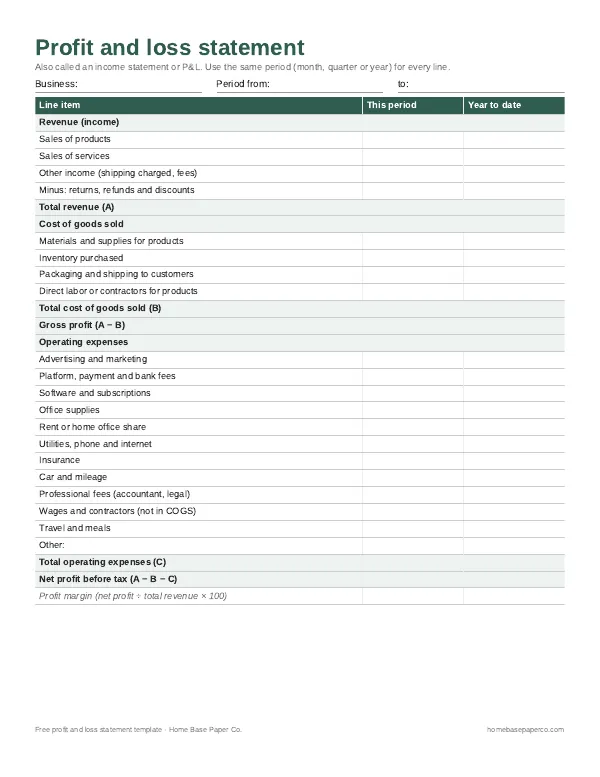
Know your real profit: get the free P&L template
A printable profit and loss statement that walks through revenue, costs and expenses line by line for any month, quarter or year. You'll also get our weekly HomeBase email with simple small business paperwork and money tips.