

The short answer: To create a family budget, add up reliable take-home income, list household expenses, plan for irregular costs and assign money to savings and shared priorities. Put paydays and bill dates on one calendar, then review actual spending together each week.
A family budget answers three practical questions: what money is available, what must it cover, and who will keep the plan updated? You can start with a notebook or spreadsheet. The important part is building one shared picture of household money, even when adults keep separate accounts.
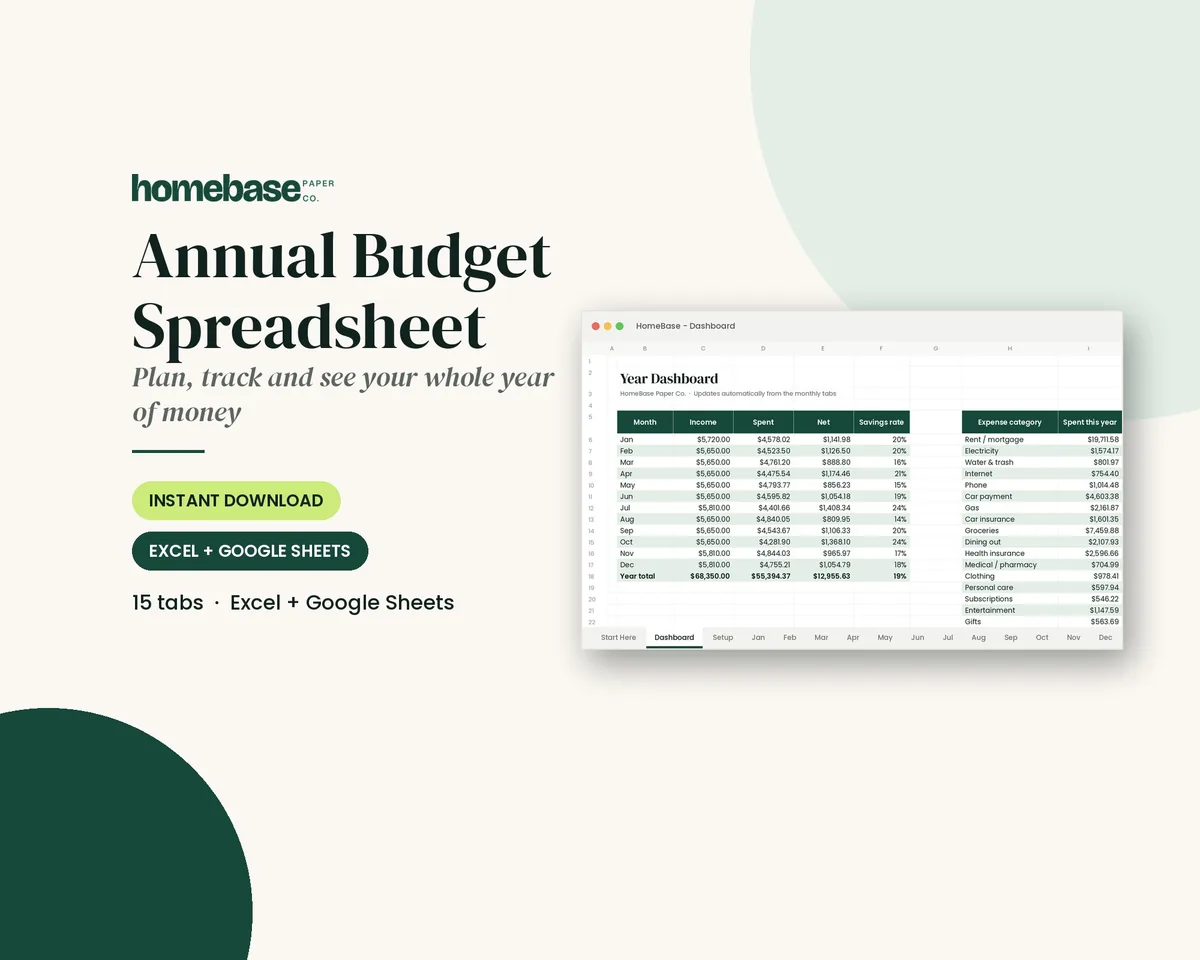
For a ready-made place to record the numbers, the Annual Budget Spreadsheet costs $6.99. Browse Spreadsheets if you prefer a digital format, or use the Budget Planner Printable ($5.99) for paper planning.
How to create a family budget in seven steps
1. Gather the records before setting limits
Collect recent pay statements, bank transactions, credit-card statements and recurring bills. Include cash purchases and charges paid from a second account. Looking at several months helps you notice expenses that do not appear every month.
Record what happened before deciding what should change. A grocery target based on hope will hide the same shortfall next month. If the household spent more than expected, that is useful information for the next plan, not a reason to leave purchases out.
The CFPB recommends examining actual spending and less frequent expenses, including seasonal costs, medical expenses and support for relatives. Its guidance also recommends checking whether the money left in the account matches what the budget predicts.
2. Count income you can reasonably use
Write down take-home pay after payroll deductions. Include other dependable household income, but keep uncertain overtime, possible gifts and unconfirmed reimbursements out of the base plan. Restricted benefits belong only against expenses they can cover.
For two adults with separate finances, decide whether the shared budget covers the entire household or only joint expenses. If one person transfers money into a bills account, count the original income once. Moving it between your own accounts does not create additional income.
For variable earnings, build essential commitments around a conservative amount and make a separate plan for higher-income months. Read budgeting with irregular income for that situation. Keep business income and the money available after business costs and taxes distinct.
3. List essentials and minimum commitments
Start with housing, basic utilities, groceries, essential transport, childcare needed for work, insurance, health needs and required debt payments. Use actual bill amounts where available. Separate fixed bills from flexible spending so you know which changes can take effect immediately.
Do not count a payroll deduction again as a bill paid from take-home money. Likewise, if you record grocery purchases on a credit card as food spending, the later payment of those same purchases is a transfer rather than a second food expense. Payments toward an older card balance need their own debt allocation.
Our budget categories list can help you spot missing lines. You do not need to use every category. Combine small categories when extra detail makes the budget harder to maintain.
4. Give upcoming costs a monthly place
School supplies, annual insurance, birthdays and vehicle registration can feel unexpected when they are missing from the plan. Write the amount needed, the due date and any savings already available. Divide the remaining amount by the number of contributions left before the bill.
For example, a hypothetical $480 bill due after four monthly contributions needs $120 a month if nothing is saved yet. If $160 is already reserved, the remaining $320 requires $80 per contribution. This is example math, not an estimate of a real family's insurance or registration bill.
Keep these planned funds separate in your records from emergency savings. A known annual expense should not quietly consume the reserve intended for a genuinely unexpected disruption.
5. Choose shared goals and affordable personal money
Agree on one or two priorities for the coming month. Examples include building a small cash cushion, catching up a bill or saving for a family visit. Give the goal a dollar amount and a date instead of a vague promise to save whatever is left.
The CFPB recommends setting a specific savings goal. Treat the transfer as a planned use of money and record it once. A savings allocation still has to fit after essentials and current commitments.
If the budget allows personal spending, agree on the amounts and what each allowance covers. The amounts can be equal or reflect an arrangement both adults accept. Set a threshold for discussing a purchase before it happens, especially when a purchase affects a shared bill.
6. Check the monthly total and the payday calendar
Subtract all planned spending, savings and debt payments from reliable income. A negative result means the plan needs a change. Review optional spending, timing and commitments; do not make the numbers balance by leaving out a necessary expense.
Next, place the actual deposits and bill dates on a calendar. Reserve enough from the current paycheck to cover obligations before the following deposit. If due dates cluster, ask providers whether a different payment date is available and confirm any consequences before changing it.
The Paycheck Budget Spreadsheet ($5.99) is another option when pay periods are the way you organize money. You can also use the existing budget calculator to check broad totals before recording a detailed plan.
7. Review spending and make one useful adjustment
Choose a brief weekly check-in. Record uncategorized purchases, compare available balances with upcoming bills and decide whether any category needs money moved into it. Identify the category funding a change so the same dollars are not promised twice.
At month-end, compare planned and actual amounts. Keep realistic estimates, change the lines that were wrong and account for the next month's specific events. The separate family budget meeting guide provides an agenda for that conversation; this guide focuses on building the underlying budget.
A worked monthly family budget
The following is a fictional household example with $5,000 in monthly take-home income. These amounts demonstrate a complete allocation; they are not local price estimates, averages or recommended spending targets.
| Planned use | Example amount |
|---|---|
| Housing | $1,500 |
| Utilities and communications | $350 |
| Groceries and household supplies | $650 |
| Transportation | $450 |
| Childcare and school costs | $500 |
| Health and insurance paid from take-home money | $250 |
| Minimum debt payments | $200 |
| Planned irregular expenses | $300 |
| Emergency savings | $250 |
| Personal spending and family activities | $350 |
| Unassigned cash buffer | $200 |
| Total | $5,000 |
The total matches income, but it still needs a timing check. Suppose $2,500 arrives on the first and another $2,500 on the fifteenth. Rent alone uses $1,500 of the first deposit. The family must list other bills due before the fifteenth before treating the remaining $1,000 as available for flexible spending.
Now suppose groceries finish $80 above plan. One possible correction is to move $80 from the unassigned buffer, leaving $120 there. Another is to reduce an optional activity before paying for it. The useful habit is recording the tradeoff immediately, then using the new grocery total when planning the next month.
Adjust the plan for your household
One income: Make sure the person handling daily purchases can see category balances and upcoming bills. A single earner does not remove the need for shared access or a second person who knows where records are kept.
Different incomes: Agree on how to divide joint contributions. A proportional split can be one option, but the budget must also recognize unpaid caregiving and each person's remaining obligations. Revisit the arrangement after a change in hours, leave or childcare.
Tight cash flow: Concentrate first on essential needs and the bills due before the next deposit. A percentage rule is a comparison tool, not a requirement that overrides rent or necessary medication. The low-income budgeting guide covers making a plan when there is little room to move.
Food spending that keeps drifting: Choose meals from ingredients already available, then make a list around the remaining gaps. Our meal-planning-on-a-budget guide connects the grocery line to practical shopping decisions without assuming a universal food cost.
Your first-week checklist
Pick the next month, collect statements, enter dependable deposits and record the bills you already know. Add two or three irregular costs that are approaching. Choose one shared goal, then test the dates on your calendar. Set the first review before closing the notebook or spreadsheet.
A workable family budget becomes more accurate through use. You do not need perfect estimates on the first day; you need complete records, a realistic allocation and a clear way to make the next decision together.
Make it easier
Tools for this

Spreadsheets
Annual Budget Spreadsheet
See exactly where your money goes every month - without complicated software.

Printables
Budget Planner Printable
Twelve undated pages you can print every month: budget, bills, spending, savings and debt.

Spreadsheets
Paycheck Budget Spreadsheet
Enter your bills once. The sheet tells you which paycheck pays each one, all year.
Frequently asked questions
How do I create a family budget for the first time? Create a family budget by listing reliable take-home income, recording actual household expenses, setting aside money for upcoming costs and assigning the remaining money to shared goals. Then check that bills can be paid on their due dates. Start with one month and revise the estimates using actual transactions.
What should a family budget include? A family budget should include housing, utilities, food, transportation, childcare, insurance, health costs, debt payments, savings and irregular expenses. Add personal spending and family activities when there is room. Use the costs your household actually pays; a family without childcare does not need an artificial childcare allocation.
How do we budget with different paydays? Budget with different paydays by writing every expected deposit and bill on the same calendar. Reserve money from the earlier paycheck for bills due before the next one. A positive monthly total does not guarantee that the account has enough cash on the day rent is due.
Should children see the family budget? Children can take part in age-appropriate family budget choices, such as choosing between two affordable activities or saving toward a shared outing. Adults should keep responsibility for bills and financial stress. Children do not need account passwords, debt details or responsibility for solving a household shortfall.
Which HomeBase planner can I use for a family budget? The HomeBase Annual Budget Spreadsheet ($6.99) tracks planned and actual household spending across 12 months. The Budget Planner Printable ($5.99) offers a paper option. Choose the format the adults responsible for the budget can consistently access and update.
What if our family expenses exceed our income? When family expenses exceed reliable income, write down the size of the shortfall, protect essential needs and review adjustable expenses and payment arrangements. Contact bill providers before missing payments when possible. Do not count a possible bonus or a new loan as a permanent fix for a recurring gap.
More from HomeBase
You may also like

Spreadsheets
Bill Tracker Spreadsheet
Bills due in 3 days or less light up red, so nothing slips through.

Spreadsheets
Sinking Funds Tracker
It does the math: how much to set aside each month to hit every goal on time.

Spreadsheets
Zero-Based Budget Spreadsheet
The 'Left to budget' counter turns green when every dollar has a job.
 Save 57%
Bundles
Ultimate Budget Bundle
All 6 spreadsheets + both printable planners - for less than half the price of buying them separately.
 Club
Monthly club
Money Club
Anyone who wants a clear plan for the month's bills, holiday spending and savings.
Free printable
Give every dollar a job: get the free monthly budget template
A printable zero-based monthly budget: income, bills, everyday spending and savings on one page, with a planned vs. actual column. You'll also get our weekly HomeBase email with simple budgeting and bill-paying tips.

Sources
- CFPB: Creating and sticking to a budget consumerfinance.gov
- CFPB: Assess your spending consumerfinance.gov