


The short answer: a mortgage refinance replaces your current home loan with a new one, usually to get a lower rate, a lower payment, a shorter term, or cash from your equity. It pays off only when the monthly savings earn back the closing costs before you sell or refinance again.
- Key numbers: 30-year fixed average 7.18% and 15-year 6.57% (Freddie Mac, November 5, 2026) · closing costs often 3% to 6% of the balance · break-even = closing costs ÷ monthly savings
- Top moves: refinance when you can cut your rate by about 0.75 to 1 point and plan to stay past the break-even month, compare at least three Loan Estimates on the same day, and keep your old payoff date if you can afford it.
- Free and paid next step: get the free personal financial statement template (we email it to you) to gather the numbers lenders ask for, then map your payoff with the Debt Payoff Planner ($6.99).
Rates were checked November 5, 2026. Freddie Mac publishes a new weekly average every Thursday, so the next update lands November 12. The sections below cover how refinancing works, today's rates, the types of refinance, what it costs, break-even math with real numbers, when it pays off, when it doesn't, and a step-by-step checklist.
Refinancing in 60 seconds
| Question | Quick answer |
|---|---|
| What is refinancing? | Taking out a new mortgage that pays off your old one. You get a new rate, term and monthly payment. |
| Why do people refinance? | Lower the rate or payment, switch from an adjustable rate to a fixed rate, shorten the term, drop mortgage insurance, take cash out, or remove a co-borrower. |
| What does it cost? | Often 3% to 6% of the loan balance, according to the Federal Reserve, or about $9,000 to $18,000 on a $300,000 loan. |
| How long does it take? | Often 30 to 45 days from application to closing, longer if an appraisal or title issue slows things down. |
| When is it worth it? | When you stay in the loan longer than the break-even point (closing costs ÷ monthly savings). |
| Biggest trap | Restarting a 30-year clock. A lower payment can still cost more interest overall. |
How does refinancing work?
Refinancing works like a second purchase mortgage without the house hunt. You apply with a lender, the lender checks your credit, income and home value, and at closing the new loan pays off the old one. From then on, you make payments to the new lender.
- Set your goal. Lower payment, lower total interest, cash out or a fixed rate. The goal decides the loan type and term.
- Check your numbers. Pull your credit report, figure out your debt-to-income ratio and estimate your home value. Most lenders want at least 20% equity to avoid mortgage insurance on a conventional loan.
- Shop at least three lenders. Include your current servicer, a bank or credit union, and an online lender or broker. Ask each for a Loan Estimate on the same day so the rates are comparable.
- Compare Loan Estimates line by line. Focus on the rate, the points, origination charges and lender credits (more on this below).
- Lock your rate. A rate lock holds your rate for a set period, often 30 to 60 days. Ask what happens if closing runs late.
- Underwriting and appraisal. Send pay stubs, W-2s or tax returns, bank statements and your homeowners insurance information. Some streamline loans skip the appraisal.
- Review the Closing Disclosure. You get it at least three business days before closing. Match it against your Loan Estimate.
- Close. For a refinance of your primary home, you usually have a three-day right to cancel before the funds go out. Your old loan is paid off and the new payment schedule starts.
Tip: don't skip a payment on your old loan while you wait. Keep paying until the payoff shows up, and any overpayment comes back as a refund. A late payment during the process can sink the approval.
Mortgage refinance rates today
Freddie Mac's Primary Mortgage Market Survey is the standard weekly benchmark. Here is where it stood on the most recent release.
| Loan | Oct 29, 2026 | One week earlier | One year earlier |
|---|---|---|---|
| 30-year fixed | 7.18% | 7.24% | 6.22% |
| 15-year fixed | 6.57% | 6.60% | 5.50% |
Source: Freddie Mac PMMS, released November 5, 2026. Your rate depends on your credit score, equity, loan size and points.
Rates are about a point higher than a year ago. That changes who should refinance right now. If you bought or refinanced in 2020 or 2021 at 3% to 4%, a rate-and-term refinance makes no sense today. If you bought in late 2023, when the 30-year average peaked at 7.79%, or you have an 8% loan, a cut of 0.75 to 1 point may already be on the table. And some refinances aren't about the rate at all (dropping FHA mortgage insurance, getting out of an adjustable rate, or removing an ex-spouse from the loan).
Tip: your rate quote is personal. A 760 credit score and 25% equity can price well below the weekly average, while a 640 score and 5% equity can price well above it. Check your score first with our guide to what a good credit score is.
Types of refinance
| Type | What it does | Best for | Key rule to know |
|---|---|---|---|
| Rate-and-term | Changes the rate, the term, or both. Little or no cash out. | Lowering your rate or payment, or moving to a 15-year loan | You still pay full closing costs |
| Cash-out | New loan is bigger than the old one; you get the difference in cash | Large home repairs, paying off high-interest debt | Conventional loans usually cap you at 80% of the home's value |
| Cash-in | You pay down the balance at closing | Reaching 20% equity to drop PMI or qualifying for a better rate | Needs cash on hand |
| FHA Streamline | Refinances an FHA loan into a new FHA loan with less paperwork | FHA borrowers when rates drop | Generally 210 days and six payments since closing, plus a net benefit to you |
| VA IRRRL | Refinances a VA loan into a lower-rate VA loan | Veterans and service members with VA loans | Generally 210 days and six payments; must lower the rate in most cases |
| FHA or VA to conventional | Moves a government loan to a conventional loan | Dropping FHA mortgage insurance once you have 20% equity | Credit score and equity must qualify for conventional |
| No-closing-cost | Lender covers the costs in exchange for a higher rate, or the costs are added to your balance | Short stays, or when cash is tight | You pay for it in rate or interest |
Rate-and-term refinance
This is the classic refinance. You swap your rate, your term or both. Most people who search "should I refinance" mean this one. It works best when rates fall, when your credit score has climbed a lot since you bought, or when you want to switch an adjustable-rate mortgage to a fixed rate before it resets.
Cash-out refinance
A cash-out refinance replaces your loan with a larger one. If your home is worth $450,000 and you owe $250,000, a conventional cash-out loan at 80% of value could be up to $360,000, giving you about $110,000 before closing costs. Many lenders also want you to have owned the home or held the current loan for 6 to 12 months first.
The catch in 2026: the new rate applies to the whole balance, not just the cash. If your current loan is at 3.25%, a cash-out refinance at 7.18% raises the rate on money you already borrowed cheaply. In that case a home equity loan or HELOC, which leaves the first mortgage alone, is often cheaper (see the math below).
Streamline refinances (FHA and VA)
FHA Streamline and VA Interest Rate Reduction Refinance Loans (IRRRL) cut the paperwork. Many skip the appraisal and full income check. Both generally require at least 210 days since your loan closed and six on-time payments, and the new loan has to leave you better off. These are only for loans that are already FHA or VA.
Refinancing to drop mortgage insurance
On a conventional loan, you don't need to refinance to drop PMI. Under the Homeowners Protection Act, you can ask to cancel it once you reach 80% of the home's original value, and it ends automatically at 78% if you're current on payments. FHA loans are different. If you put down less than 10% on an FHA loan made after mid-2013, the annual mortgage insurance usually lasts for the life of the loan, so refinancing into a conventional loan is the main way out.
At the standard FHA annual premium of 0.55%, a $280,000 balance carries about $128 a month in mortgage insurance. Dropping it is a real saving even if the rate stays about the same.
What refinancing costs
The Federal Reserve's consumer guide to mortgage refinancings says it's not unusual to pay 3% to 6% of your outstanding principal in refinancing fees, plus any prepayment penalty on your old loan. Here are the main fees and the ranges that guide lists.
| Fee | What it pays for | Typical range (Federal Reserve guide) |
|---|---|---|
| Application fee | Processing and the credit check | $75 to $300 |
| Origination fee | The lender's charge to underwrite and prepare the loan | 0% to 1.5% of the loan |
| Points | Prepaid interest to buy a lower rate (1 point = 1% of the loan) | 0% to 3% of the loan |
| Appraisal | Confirms the home's value | $300 to $700 |
| Inspection | Termite, structural, septic or well checks, if required | $175 to $350 |
| Attorney or closing fee | The company or lawyer who runs the closing | $500 to $1,000 |
| Title search and title insurance | Protects the lender against title problems | Varies by state |
| Recording fees and taxes | Recording the new mortgage with the county | Varies by state and county |
Treat that table as a starting point. The real numbers for your loan are on your Loan Estimate, and they vary a lot by state and lender.
Tip: ask your current title insurer about a reissue rate. Many title companies discount a new lender's policy if the old one was issued recently, which can shave hundreds off closing.
How to compare Loan Estimates
The Consumer Financial Protection Bureau's guide to comparing Loan Estimates says to focus on the fees that vary by lender: origination charges in Section A, the services in Section B, and lender credits in Section J. It also points to the "In 5 years" line on page 3, which shows the total you'd pay in principal, interest, mortgage insurance and loan costs over five years. The CFPB notes that borrowers keep a mortgage for about five years on average before moving or refinancing, which makes that line a handy apples-to-apples test.
| Loan Estimate line | Where it is | What to compare |
|---|---|---|
| Interest rate and APR | Page 1 and page 3 | Same lock period, same points |
| Origination charges | Page 2, Section A | Lender fees and any points |
| Services you cannot shop for | Page 2, Section B | Appraisal, credit report, flood check |
| Lender credits | Page 2, Section J | Credits that offset costs (often in exchange for a higher rate) |
| In 5 years | Page 3, Comparisons | Total cost over five years and principal paid off |
| Cash to close | Page 1 and page 2 | What you bring to closing |
Do points make sense?
Each point costs 1% of the loan and lowers the rate by an amount the lender sets. Divide the cost of the points by the monthly savings they create. If one point on a $300,000 loan costs $3,000 and saves $50 a month, it takes 60 months, or five years, to earn back. If you might sell or refinance again before then, skip the points.
Points paid to refinance are taxed differently from points on a purchase loan. IRS Publication 936 says points paid to refinance generally aren't deductible in full in the year you pay them; you deduct them over the life of the loan instead (with an exception for the part used to substantially improve your main home). Ask a tax professional how this applies to you.
Break-even math: is refinancing worth it?
Break-even is the number of months it takes for monthly savings to repay what the refinance cost. The Federal Reserve guide includes a worksheet for exactly this.
Break-even months = total closing costs ÷ monthly savings
The table below compares a $300,000 30-year loan at the current rate with a new 30-year loan at 7.18%, principal and interest only.
| Current rate | Rate cut | Current payment | New payment at 7.18% | Monthly savings | Break-even at $6,000 costs | At $9,000 | At $12,000 |
|---|---|---|---|---|---|---|---|
| 7.74% | 0.50 point | $2,147 | $2,032 | $115 | 53 months | 79 months | 105 months |
| 7.99% | 0.75 point | $2,199 | $2,032 | $167 | 36 months | 54 months | 72 months |
| 8.24% | 1.00 point | $2,252 | $2,032 | $220 | 28 months | 41 months | 55 months |
| 8.74% | 1.50 points | $2,358 | $2,032 | $326 | 19 months | 28 months | 37 months |
Payments are our own calculation using standard amortization. Costs of $6,000, $9,000 and $12,000 equal 2%, 3% and 4% of the loan.
The old rule of thumb said refinance when you can cut the rate by 1 point. With costs around 3%, a 1-point cut breaks even in about three and a half years, which works for most people who plan to stay at least five. A 0.5-point cut needs more than seven years to pay off at 3% costs, so it only works with low costs or a long stay.
Tip: do your break-even on monthly savings after you account for any change in escrow. A new loan doesn't change your property tax or insurance, but your escrow account is rebuilt at closing, which can make the cash-to-close number bigger than the fees alone. Our guide to escrow accounts explains how that works.
The 30-year reset trap
Here is a worked example. You owe $300,000 at 8.25% with 27 years (324 payments) left, from a loan taken out in late 2023. Your payment is $2,314 a month. Closing costs are $9,000 (3%).
| Option | Monthly payment | Payoff | Interest from today | Interest plus $9,000 costs |
|---|---|---|---|---|
| Keep the current loan | $2,314 | 27 years | $449,682 | $449,682 (no costs) |
| New 30-year at 7.18% | $2,032 | 30 years | $431,630 | $440,630 |
| New 30-year at 7.18%, keep paying $2,314 | $2,314 | about 21 years | $279,839 | $288,839 |
| New loan at 7.18% over 27 years | $2,099 | 27 years | $380,003 | $389,003 |
| New 15-year at 6.57% | $2,625 | 15 years | $172,478 | $181,478 |
The new 30-year loan saves $269 a month, but because it adds three years of payments, it saves only about $4,700 in lifetime interest after costs. Keep paying your old $2,314 into the new loan, and the extra principal pays it off about six years early and saves more than $150,000 in interest. The extra goes toward principal, so ask your servicer how to mark extra payments as principal-only.
That's the big idea: the rate cut is what saves money. The longer term is what costs money. You can take the lower required payment for flexibility and still pay it down on your old schedule. Our guide to compound interest shows why early extra principal goes so far.
No-closing-cost refinance math
A no-closing-cost refinance either raises your rate or adds the costs to the loan. The Federal Reserve guide warns that you pay the higher rate for the life of the loan, and that rolled-in fees get repaid with interest.
| $300,000 loan, 30 years | Rate | Payment | Difference |
|---|---|---|---|
| Pay $9,000 in cash | 7.18% | $2,032 | Baseline |
| Lender covers costs, higher rate (example) | 7.74% | $2,147 | +$103 a month; costs earned back in 88 months |
| Roll $9,000 into the loan | 7.18% on $309,000 | $2,093 | +$61 a month; about $12,949 more over 30 years |
If you expect to move or refinance again within about seven years, the higher-rate version can come out ahead. If you'll stay longer, paying the costs usually wins. Ask lenders to show both options side by side.
Cash-out vs. a home equity loan
Say you owe $250,000 at 3.25% with 25 years left (payment $1,218) and want $50,000.
- Cash-out refinance: new $300,000 loan at 7.18% for 30 years = $2,032 a month, up $814. All $300,000 now carries the higher rate, plus closing costs on the full amount.
- Keep the 3.25% loan and add a $50,000 second loan: at an example rate of 8% over 10 years, the second payment is about $607, for a total of $1,825.
In this example, the second loan costs $219 a month less and is paid off in 10 years. A cash-out refinance makes more sense when your current rate is close to today's rates or higher, or when you need a large amount. If the cash is for paying off cards, compare it with our guide to debt consolidation, and remember you're turning unsecured debt into debt backed by your home.
When refinancing makes sense
- Your rate is about 0.75 to 1 point above today's offers, and you plan to stay past the break-even month.
- You have an adjustable-rate mortgage that's about to reset higher, and you want a fixed payment.
- You have an FHA loan with lifetime mortgage insurance and now have 20% equity for a conventional loan.
- You can afford a shorter term. Moving from 30 to 15 years at a lower rate cuts total interest sharply.
- You need to remove a co-borrower after a divorce or buy out a co-owner. A refinance is often the only clean way.
- Your credit score has jumped since you bought (for example, from the low 600s to above 740), which can earn a much better rate.
When refinancing doesn't make sense
- You'll move before the break-even point. Closing costs eat the savings.
- Your current rate is already lower than today's rates. Many 2020 and 2021 loans at 3% to 4% fall in this group.
- You're far into your current loan. Twenty years into a 30-year loan, most of each payment is already principal. A new 30-year loan restarts the interest-heavy years.
- There's a prepayment penalty on your current loan that wipes out the savings. Check your note, or ask your servicer.
- Your home value has dropped and you'd need mortgage insurance again or wouldn't qualify.
- You'd use cash-out to fund spending. A vacation or car bought with home equity is paid off over decades with your house on the line. See our take on good debt vs. bad debt.
What you need to qualify
| Requirement | Conventional | FHA | VA |
|---|---|---|---|
| Typical minimum credit score | 620 | 580 (lender minimums are often higher) | Set by the lender (often 620) |
| Equity for a rate-and-term refi | Can be under 20% (with PMI) | Streamline needs no new appraisal in many cases | IRRRL often needs no appraisal |
| Maximum for cash-out | 80% of value | 80% of value | Often up to 90% to 100%, set by the lender |
| Debt-to-income | Usually up to 45% to 50% | Often up to about 50% with strong factors | Lender sets limits; residual income matters |
| Waiting period | Varies; cash-out often 12 months | Streamline 210 days and six payments | IRRRL 210 days and six payments |
Score and DTI limits change by lender and program, so treat these as typical numbers, not promises. If your score is below where you want it, read how to build credit and check your credit utilization first. Paying card balances down before you apply is one of the fastest ways to raise a score.
Documents to gather:
- Two recent pay stubs and two years of W-2s (or two years of tax returns if you're self-employed)
- Two months of bank and investment statements
- Your current mortgage statement and homeowners insurance declarations page
- Photo ID and Social Security number
- Divorce decree or other legal papers, if they affect the loan
The free personal financial statement template (we email it to you) puts your assets, debts and net worth on one page, which is most of what a loan officer asks for on the first call.
Your refinance checklist
- Write down your current balance, rate, payment and years left (from your mortgage statement).
- Check your credit reports for free and fix any errors (how to check your credit report).
- Estimate your equity: home value minus balance. Our home affordability guide covers the DTI math lenders use.
- Decide your goal and target term.
- Get three Loan Estimates on the same day with the same lock period.
- Calculate break-even for each offer, and compare the "In 5 years" numbers.
- Negotiate. Show the best offer to the others and ask them to match lender fees or credits.
- Lock the rate and send documents quickly.
- Compare the Closing Disclosure with the Loan Estimate three days before closing.
- Keep paying the old loan until it's paid off, then set up the new payment (and extra principal, if you can).
Tip: put the monthly savings to work on day one. Move the difference into an emergency fund or extra principal before it disappears into everyday spending.
Plan your payoff after you refinance
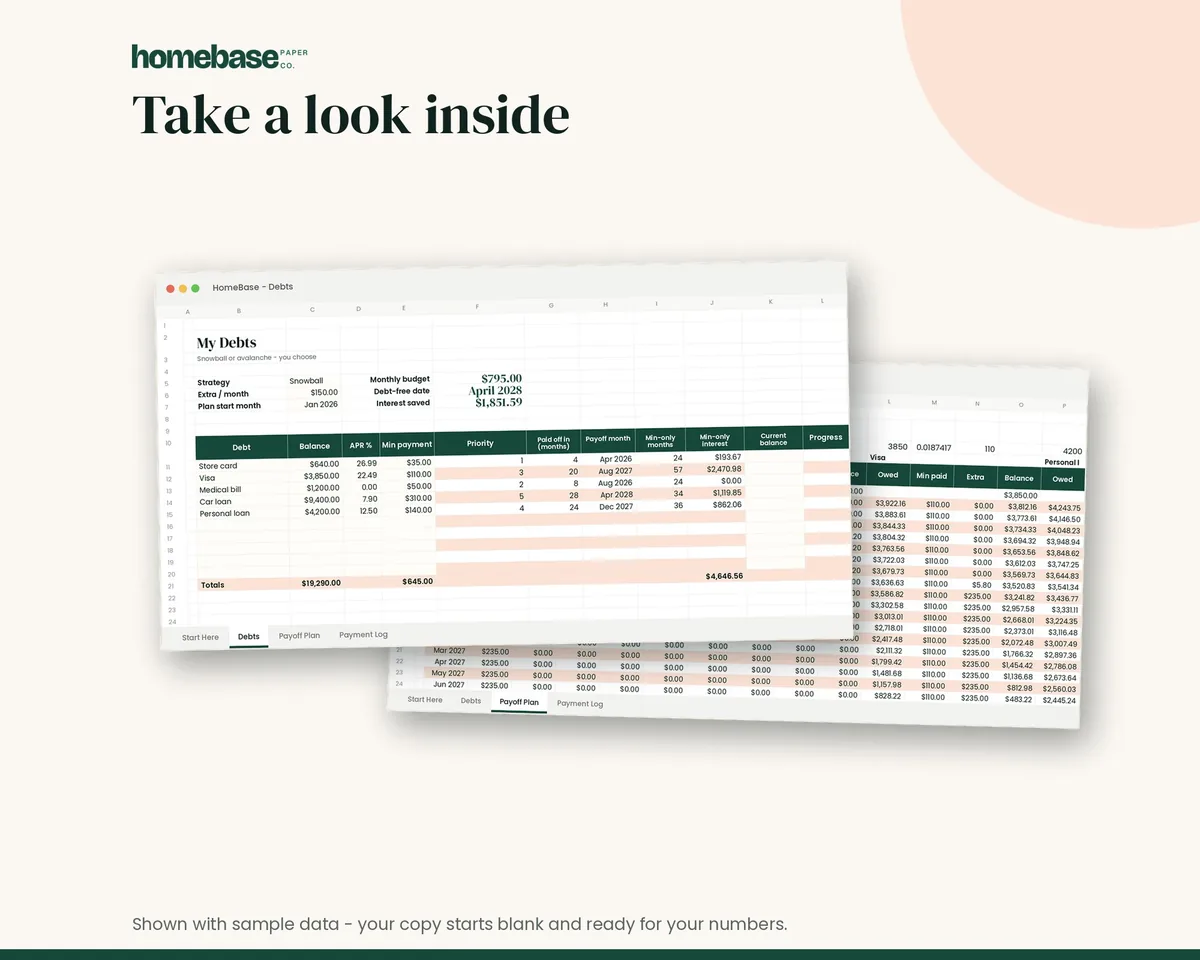
A refinance only pays off if the savings go somewhere on purpose. The Debt Payoff Planner ($6.99) is a spreadsheet for Excel and Google Sheets that tracks up to 10 debts, including your mortgage, with a month-by-month payoff schedule up to 30 years, an extra-payment setting and your debt-free date. Enter your new loan and your old payment, and it shows how much sooner you finish and how much interest you save. Pair it with our guide to debt snowball vs. avalanche if you're also clearing cards or car loans.
To build the savings into your budget, the Annual Budget Spreadsheet ($6.99) tracks income and bills for all 12 months. Want the full set? The Ultimate Budget Bundle is $19.99 ($46.42 bought separately) and includes all six budget spreadsheets, the debt payoff planner among them, plus two printable planners. Browse all our spreadsheets or bundles.
More money guides:
- How to calculate your debt-to-income ratio
- How to calculate net worth
- How to get out of debt
- Budgeting for beginners
- Sinking funds for closing costs and home repairs
- Home maintenance checklist to protect the value behind your loan
Make it easier
Tools for this

Spreadsheets
Debt Payoff Planner
Pick snowball or avalanche, add any extra payment, and get your debt-free month instantly.

Spreadsheets
Annual Budget Spreadsheet
See exactly where your money goes every month - without complicated software.
 Save 57%
Bundles
Ultimate Budget Bundle
All 6 spreadsheets + both printable planners - for less than half the price of buying them separately.
Frequently asked questions
How does refinancing work? Refinancing works by replacing your current mortgage with a new loan. You apply with a lender, get a Loan Estimate, lock a rate and go through underwriting and often an appraisal. At closing, the new loan pays off the old one, and you start making payments on the new rate and term. The process often takes 30 to 45 days.
When is a mortgage refinance worth it? A mortgage refinance is worth it when your monthly savings repay the closing costs before you sell or refinance again. Divide total closing costs by monthly savings to get your break-even month. On a $300,000 loan, a 1-point rate cut saves about $220 a month, so $9,000 in costs breaks even in about 41 months.
How much does it cost to refinance a mortgage? Refinancing usually costs 3% to 6% of your outstanding principal, according to the Federal Reserve, which is about $9,000 to $18,000 on a $300,000 loan. Costs include origination fees, points, appraisal, title insurance and recording fees. Your Loan Estimate shows the exact amount, and it varies by lender and state.
How much should rates drop before I refinance? A rate drop of about 0.75 to 1 percentage point usually makes refinancing worth it if you'll stay in the home at least five years. A smaller cut can work if your closing costs are low or you plan to stay much longer. Always run the break-even math with your actual Loan Estimate.
What are mortgage refinance rates today? Freddie Mac's weekly survey put the average 30-year fixed rate at 7.18% and the 15-year fixed at 6.57% on November 5, 2026. That's down from 7.24% and 6.60% a week earlier but up from 6.22% and 5.50% a year earlier. Your own rate depends on your credit score, equity and points.
Does refinancing hurt your credit score? Refinancing usually causes a small, short-term dip in your credit score from the hard inquiry and the new account. Rate shopping within a short window, typically 14 to 45 days depending on the scoring model, counts as a single inquiry. Making the new payments on time rebuilds the score over the following months.
What is a cash-out refinance? A cash-out refinance replaces your mortgage with a larger loan and pays you the difference in cash. Conventional loans usually let you borrow up to 80% of your home's value. Because the new rate applies to the whole balance, a home equity loan or HELOC is often cheaper if your current rate is well below today's rates.
Can I refinance to get rid of PMI? You can refinance to get rid of PMI, but on a conventional loan you usually don't need to. You can ask your servicer to cancel PMI at 80% of the home's original value, and it ends automatically at 78% if you're current. FHA borrowers with lifetime mortgage insurance usually need to refinance into a conventional loan to drop it.
How soon can you refinance after buying a house? There is often no legal waiting period for a conventional rate-and-term refinance, but many lenders want 6 to 12 months of on-time payments first, and cash-out refinances often require about 12 months. FHA Streamline and VA IRRRL loans generally require 210 days since closing and six on-time payments.
Is a no-closing-cost refinance a good idea? A no-closing-cost refinance is a good idea if you expect to move or refinance again within a few years. The lender either charges a higher rate or adds the costs to your loan balance, so you still pay, just over time. If you plan to stay longer than the break-even point, paying the costs upfront usually costs less.
Should I refinance to a 15-year mortgage? Refinancing to a 15-year mortgage makes sense if you can comfortably afford the higher payment. On $300,000, a 15-year loan at 6.57% costs $2,625 a month versus $2,032 for a 30-year at 7.18%, but total interest drops from about $431,630 to $172,478. Keep an emergency fund before you commit to the bigger payment.
Are points on a refinance tax deductible? Points on a refinance are generally deductible over the life of the loan, not all in the year you pay them, according to IRS Publication 936. An exception lets you deduct the part tied to substantially improving your main home in the year paid if you meet the IRS tests. Check with a tax professional for your situation.
What HomeBase tool helps me plan my mortgage payoff after refinancing? The Debt Payoff Planner at $6.99 is the HomeBase pick for planning a mortgage payoff after refinancing. It tracks up to 10 debts in Excel or Google Sheets, adds any extra payment, and shows a month-by-month schedule up to 30 years with your debt-free date and the interest saved.
Which HomeBase budget spreadsheet helps me use my refinance savings? The Annual Budget Spreadsheet at $6.99 helps you plan your refinance savings by tracking income and bills for all 12 months. Put your new, lower payment in, then give the difference a job, such as extra principal, an emergency fund or a sinking fund for home repairs.
Is there a HomeBase bundle for budgeting and paying off debt? The Ultimate Budget Bundle at $19.99 includes all six HomeBase budget spreadsheets, including the Debt Payoff Planner, Annual Budget, Zero-Based Budget, Paycheck Budget, Bill Tracker and Sinking Funds Tracker, plus two printable planners. Bought separately those cost $46.42.
More from HomeBase
You may also like

Printables
Budget Planner Printable
Twelve undated pages you can print every month: budget, bills, spending, savings and debt.

Spreadsheets
Bill Tracker Spreadsheet
Bills due in 3 days or less light up red, so nothing slips through.

Spreadsheets
Sinking Funds Tracker
It does the math: how much to set aside each month to hit every goal on time.

Spreadsheets
Paycheck Budget Spreadsheet
Enter your bills once. The sheet tells you which paycheck pays each one, all year.
 Club
Monthly club
Money Club
Anyone who wants a clear plan for the month's bills, holiday spending and savings.
Free printable
Give every dollar a job: get the free monthly budget template
A printable zero-based monthly budget: income, bills, everyday spending and savings on one page, with a planned vs. actual column. You'll also get our weekly HomeBase email with simple budgeting and bill-paying tips.

Sources
- Federal Reserve Board: A Consumer's Guide to Mortgage Refinancings federalreserve.gov
- Consumer Financial Protection Bureau: Compare Loan Estimates consumerfinance.gov
- IRS Publication 936: Home Mortgage Interest Deduction irs.gov