

The short answer: to plan a trip, start with your budget and dates, then pick a destination that fits both. Book transportation and lodging first, check IDs and documents and plan a loose day-by-day itinerary.
- When: two to six months ahead gives the best choice of prices and places
- Start saving right away: divide the total by the months left
- Last two weeks: money, packing and home prep
- Traveling as a group? Agree on the budget before the destination
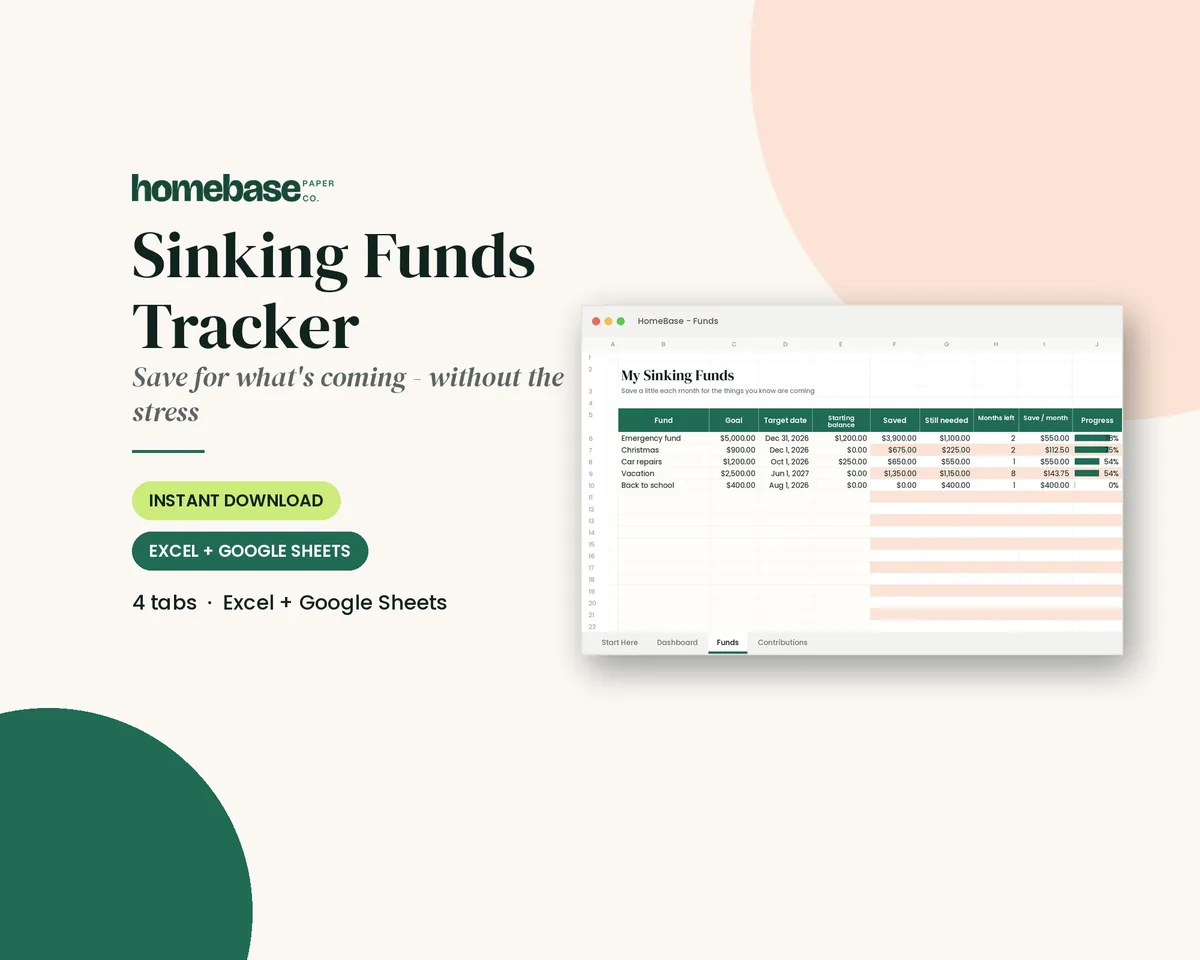
- Next step: Plan it with the Sinking Funds Tracker ($4.99).
To plan a trip, start with your budget and dates, then pick a destination that fits both. Book the big pieces first (transportation and lodging), check IDs and travel documents, plan a loose day-by-day itinerary, then handle money, packing and home prep in the last two weeks. For most trips, starting two to six months ahead gives you the best choice of prices and places to stay.
The Sinking Funds Tracker ($4.99) turns your trip total into a monthly savings amount and shows your progress, so you pay for the vacation before you leave instead of after. Browse all of our Spreadsheets for more budget tools.
This guide walks through how to plan a trip step by step, with a trip planning checklist and timeline, a sample budget, a starter version for a quick weekend getaway and answers to common questions. Every dollar figure below is an example, so swap in your own. To keep everything in one place, set up a trip planner with your dates, bookings and budget.
How to plan a trip step by step: the 12 steps
| Step | When | What to do |
|---|---|---|
| 1. Set your budget | 3 to 6 months out | Pick one total you can pay in cash |
| 2. Choose dates | 3 to 6 months out | Check work, school and family calendars |
| 3. Pick the destination | 3 to 6 months out | Match the place to your budget and season |
| 4. Start saving | Right away | Divide the total by the months left |
| 5. Check IDs and documents | 3 months out | Passport, REAL ID, visas, health needs |
| 6. Book transportation | 2 to 4 months out | Flights, train, rental car or road trip plan |
| 7. Book lodging | 2 to 4 months out | Hotel, rental or stay with family |
| 8. Plan the itinerary | 1 to 2 months out | One or two big things a day |
| 9. Reserve the musts | 1 month out | Tours, tickets, dinners that sell out |
| 10. Plan money on the road | 2 weeks out | Cards, cash, daily spending limit |
| 11. Pack and prep the house | 1 week out | Packing list, mail, plants, pets |
| 12. Final check | 1 to 2 days out | Confirmations, check-in, chargers |
Step 1: Set your trip budget first
The budget comes first because it decides everything else: where you go, how long you stay and how you get there. Pick one total and split it into categories.
| Category | Example share | Example on a $2,000 trip |
|---|---|---|
| Transportation | 30% | $600 |
| Lodging | 30% | $600 |
| Food | 20% | $400 |
| Activities and tickets | 10% | $200 |
| Extras and buffer | 10% | $200 |
Don't skip the buffer. Bag fees, parking, tips, resort fees and a forgotten phone charger add up quickly. Our vacation budget guide has a full category list and ways to estimate each line.
Step 2: Choose your dates
Pick two or three possible date ranges instead of one. Flexible dates make it easier to find lower prices on flights and lodging. Traveling just before or after peak season, or flying midweek, is often cheaper than holiday weekends. Check paid time off, school calendars and any events at your destination that could raise prices.
Step 3: Pick a destination that fits
Make a short list of three places and compare them on four things:
- Total cost: getting there, staying there and eating there.
- Travel time: a long trip there eats into short vacations.
- Season: weather, crowds and what's open that time of year.
- Fit: what everyone in your group actually wants to do.
If money is tight, look at places you can drive to. Our budget travel tips cover ways to cut costs without cutting the fun.
Step 4: Start saving with a trip sinking fund
Divide your trip total by the number of months until you leave. A $2,000 trip six months away is about $334 a month, or about $167 a paycheck if you're paid twice a month. Set up an automatic transfer into a separate savings account so the money is set aside before you can spend it. Our sinking funds guide explains how this works for trips, holidays and other planned costs.
Step 5: Check IDs, passports and health needs
This step sneaks up on people, so do it early.
- Domestic flights: TSA began REAL ID enforcement on May 7, 2025, so check that your driver's license is REAL ID compliant or bring another acceptable ID such as a passport. Travelers without an acceptable ID must pay a $45 TSA ConfirmID fee.
- International trips: check that every passport is valid and won't expire soon, and look up the State Department's current passport processing times before you book. Some countries also need visas or have entry rules.
- Health: the CDC's Travelers' Health destination pages list vaccines and health notices by country, and the CDC recommends all travelers be fully vaccinated against measles before any international trip. Rules can change, so check again close to your trip.
Step 6: Book transportation
Compare the full cost, not just the ticket price. For flights, add bag fees, seat fees and airport parking or rides. For a road trip, estimate gas, tolls, parking and one extra night if the drive is long. Book refundable or changeable options when the price difference is small.
Step 7: Book lodging
Choose where to stay based on location first, then price. A cheaper place far from everything can cost more in rides and time. Read the cancellation policy and check for added fees like cleaning, resort or parking fees before you pay. A kitchen or free breakfast can lower your food budget.
Step 8: Plan a loose itinerary
Plan one or two main things each day and leave open time around them. Group nearby sights on the same day so you're not crossing town twice. Add travel days to the plan so you don't overbook the day you arrive. Our free travel itinerary template has a simple day-by-day layout.
Step 9: Reserve the things that sell out
Popular tours, timed-entry tickets, shows and special dinners can sell out weeks ahead. Book these about a month out, save every confirmation in one place and add each one to your itinerary with the time and address.
Step 10: Plan your money on the road
- Set a daily spending limit for food and extras, and track it each night.
- Call your bank or turn on travel notices so your card isn't blocked.
- Bring a small amount of cash for tips and places that don't take cards.
- Keep one backup card separate from your wallet.
- For trips abroad, check your card's foreign transaction fees before you go.
Step 11: Pack and prep the house
Make a packing list a week out and pack two days early. The TSA liquids rule lets you carry liquids, gels and creams in containers of 3.4 ounces (100 milliliters) or less, all in one quart-size bag, with exemptions for medications and baby food. Our packing list and the sudoku packing method help you pack light.
Before you leave, hold or forward the mail, water the plants, arrange pet care, take out the trash, set the thermostat and unplug small appliances.
Step 12: Do a final check
One or two days before you leave, confirm every booking, check in online, download tickets and maps, charge devices and share your itinerary with someone at home.
Trip planning checklist
Copy this vacation planning checklist into your planner or notes.
Planning (3 to 6 months out)
- Set the total trip budget and split it by category
- Pick two or three date options
- Shortlist and choose a destination
- Open a trip savings fund and set an automatic transfer
- Check passports, REAL ID and visa needs
Booking (1 to 4 months out)
- Book flights, train or rental car
- Book lodging and read the cancellation policy
- Make a day-by-day itinerary
- Reserve tours, tickets and special dinners
- Look into travel insurance for big or nonrefundable trips
Before you go (1 to 2 weeks out)
- Set a daily spending limit
- Turn on travel notices with your bank
- Make a packing list and pack early
- Arrange pet care, mail and plant care
- Refill prescriptions
Day before
- Confirm every reservation
- Check in online and download boarding passes
- Charge phones, chargers and power banks
- Share your itinerary with a friend or relative
How far in advance should you plan a trip?
| Trip type | Start planning | Book the big pieces |
|---|---|---|
| Weekend getaway | 2 to 4 weeks | 1 to 3 weeks out |
| Domestic vacation | 2 to 4 months | 1 to 3 months out |
| Holiday travel | 4 to 6 months | 2 to 4 months out |
| International trip | 6 to 12 months | 3 to 6 months out |
These are common planning ranges, not rules. Busy seasons and popular places fill up faster, so start earlier if your dates are fixed. If you're planning a holiday trip, our holiday travel budget for families covers the extra costs of traveling in December. Our free Holiday Budget Starter Kit can help you fit holiday travel into the rest of your season's spending.
How to plan a trip with family or friends
Group trips need a few extra steps up front so money doesn't get awkward later. For more on this topic, see our travel planning hub.
- Agree on the budget before the destination. Ask everyone for a comfortable total first, then pick places that fit the lowest number.
- Pick one planner and one money person. One person books, another tracks who paid what.
- Decide how to split costs. Shared costs like lodging, gas and groceries can be split evenly, while meals out and activities can be pay-your-own.
- Set deposit dates. Collect each person's share before you book anything nonrefundable.
- Share one itinerary. Put times, addresses and confirmation numbers in one shared note so nobody has to ask twice.
- Plan some free time. Not everyone has to do everything together.
Starter version: plan a weekend getaway in one evening
Short on time? Here's a quick way to plan a two-night trip.
- Set the total. For example, $500 for two nights.
- Pick a place within a few hours' drive.
- Book one place to stay with free cancellation.
- Plan one big thing for each day, like a hike, a museum or a favorite restaurant.
- Set a daily food budget and plan one picnic or grocery-store meal.
- Pack from a short list: clothes for three days, toiletries, chargers, ID and snacks.
Common trip planning mistakes
- Booking before setting a budget. Fix: decide the total first.
- Forgetting the small costs. Fix: add a 10% buffer.
- Overpacking the itinerary. Fix: one or two big things a day.
- Waiting on passports. Fix: check expiration dates the day you start planning.
- Paying with credit you can't pay off. Fix: save with a sinking fund before you go.
Plan every trip in your yearly budget
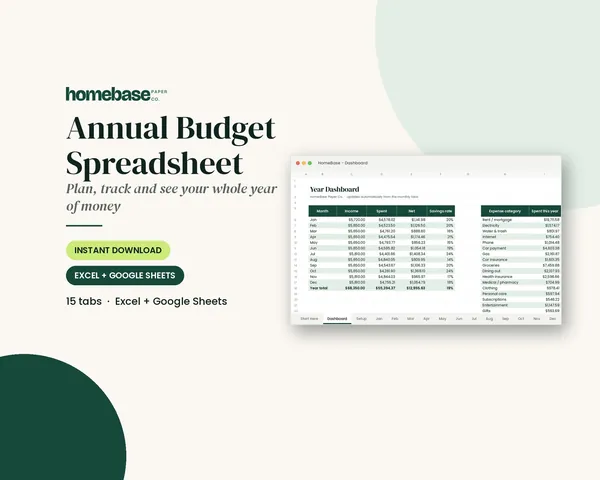
If you take more than one trip a year, plan them all at once. The Annual Budget Spreadsheet ($6.99) shows your full year on one page, so you can see when each trip lands and how much to set aside each month. For a full set of money tools, the Ultimate Budget Bundle is $19.99 (reg. $46.42 bought separately) and includes the Sinking Funds Tracker, the Annual Budget Spreadsheet and six more budget tools. See all of our Bundles.
Make it easier
Tools for this
Spreadsheets
Sinking Funds Tracker
It does the math: how much to set aside each month to hit every goal on time.
Spreadsheets
Annual Budget Spreadsheet
See exactly where your money goes every month - without complicated software.
 Save 57%
Bundles
Ultimate Budget Bundle
All 6 spreadsheets + both printable planners - for less than half the price of buying them separately.
Frequently asked questions
How do you plan a trip step by step? Plan a trip in 12 steps: set your budget, choose dates, pick a destination, start saving, check IDs and documents, book transportation, book lodging, plan a loose itinerary, reserve things that sell out, plan your travel money, pack and prep the house, then do a final check one or two days before you leave.
What is the first thing to do when planning a trip? The first thing to do when planning a trip is set your budget. Your total decides where you can go, how long you can stay and how you'll get there. Once you know the number, split it into transportation, lodging, food, activities and a buffer for extras.
How far in advance should you plan a trip? Most trips go best with two to six months of planning. A weekend getaway can come together in two to four weeks, a domestic vacation in two to four months, holiday travel in four to six months and an international trip in six to twelve months. Start earlier if your dates are fixed or it's a busy season.
How do I plan a vacation on a budget? Plan a vacation on a budget by setting the total first, being flexible on dates, choosing a place you can drive to or reach cheaply, and booking lodging with a kitchen. The Sinking Funds Tracker helps by splitting the trip cost into monthly savings, so you pay in cash before you go.
How much should I budget for a trip? Budget for a trip by adding up transportation, lodging, food, activities and a 10% buffer. As an example, a $2,000 trip might break down to $600 for travel, $600 for lodging, $400 for food, $200 for activities and $200 for extras. Your own numbers will depend on where you go and for how long.
How do I save money for a trip? The easiest way to save for a trip is a sinking fund. Divide the trip total by the months until you leave and transfer that amount automatically each month. The Sinking Funds Tracker ($4.99) shows how much to save each month and how close you are to your goal.
What should be on a trip planning checklist? A trip planning checklist should cover your budget, dates, destination, savings plan, IDs and passports, transportation, lodging, itinerary, reservations, travel money, packing, house prep and final confirmations. Group the tasks by when they're due so nothing is left for the last day.
Do I need a REAL ID to fly in the US? You need a REAL ID compliant license or another acceptable ID, such as a passport, to fly in the US. TSA began REAL ID enforcement on May 7, 2025, and says travelers without an acceptable ID must pay a $45 fee. Check your ID well before your trip.
When should I check my passport before an international trip? Check your passport the day you start planning an international trip. Look at the expiration date, since some countries require it to be valid for months after you arrive, and look up current State Department processing times if you need to apply or renew.
How many activities should I plan per day on vacation? Plan one or two main activities per day on vacation and leave open time around them. Group nearby sights on the same day, keep arrival and departure days light, and leave room for rest, meals and things you find along the way.
What liquids can I bring in a carry-on? You can bring liquids, gels, creams and aerosols in containers of 3.4 ounces (100 milliliters) or less, packed together in one quart-size bag, under the TSA liquids rule. Medications and baby food are exempt. Larger containers go in checked bags.
Should I book flights or a hotel first? Book whichever piece is harder to change or more limited first. For most trips that's the flight, since prices and schedules shift more. If you're going somewhere with few places to stay or a big event, book lodging first with free cancellation, then book the flight.
How do I plan more than one trip a year? Plan more than one trip a year by putting every trip in your yearly budget at once. The Annual Budget Spreadsheet ($6.99) shows the whole year on one page, so you can see when each trip lands and set aside the right amount each month.
What is the best tool to budget for a vacation? The Sinking Funds Tracker ($4.99) is a simple tool to budget for a vacation because it turns your trip total into monthly savings and tracks progress. For a full set of tools, the Ultimate Budget Bundle ($19.99, reg. $46.42) adds the Annual Budget Spreadsheet and six more budget tools.
Free printable
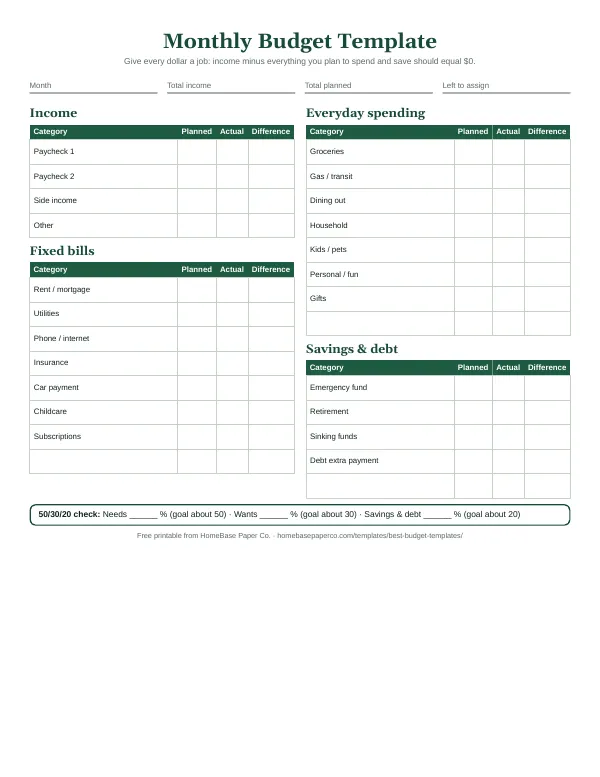
Give every dollar a job: get the free monthly budget template
A printable zero-based monthly budget: income, bills, everyday spending and savings on one page, with a planned vs. actual column. You'll also get our weekly HomeBase email with simple budgeting and bill-paying tips.
Sources
- TSA: REAL ID tsa.gov
- TSA: TSA ConfirmID tsa.gov
- CDC Travelers' Health: Destinations wwwnc.cdc.gov
- TSA: Liquids, Aerosols, and Gels Rule tsa.gov