

The short answer: a savings bond is a loan to the U.S. government that pays you interest. You buy it for $25 or more, it grows for up to 30 years, and you can cash it after 12 months.
- Two types, both sold only online through TreasuryDirect
- Yearly limit: $10,000 per person per series
- Cash before 5 years and you lose the last 3 months of interest
- No state or local income tax; federal tax is due on the interest
- Next step: Plan it with the 100 Envelope Savings Challenge ($3.99).
A savings bond is a loan to the U.S. government that pays you interest. You buy it for $25 or more, it grows for up to 30 years, and you can cash it after 12 months. Today there are two types, Series EE and Series I, and both are sold only online through TreasuryDirect. Below is how savings bonds work, current rates from TreasuryDirect's I bond page, how I bonds compare with EE bonds, and when a savings bond makes sense for a family budget.
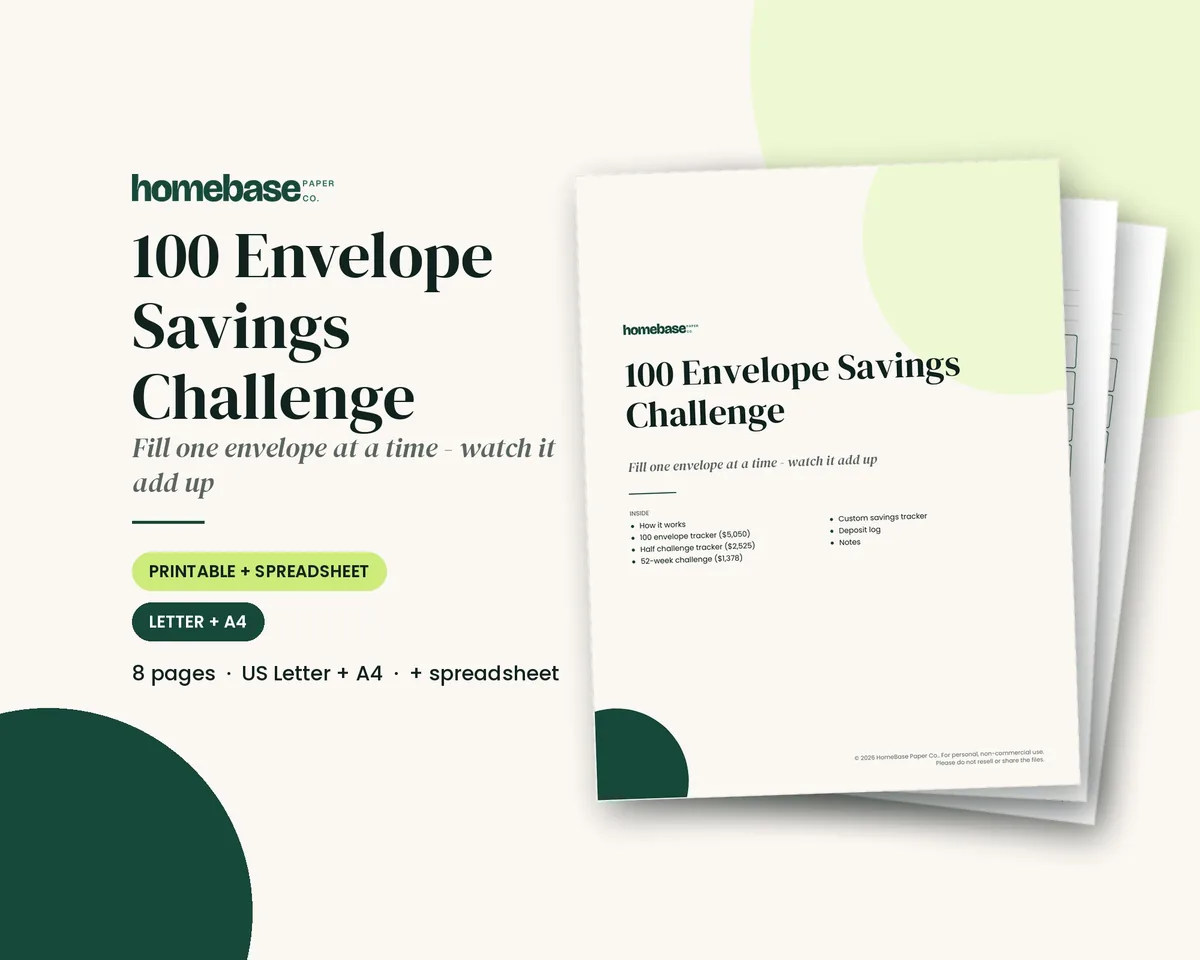
Savings bonds work best for money you can leave alone. If you are still building the cash to buy one, a simple challenge helps. Our 100 Envelope Savings Challenge ($3.99) includes the 100 envelope chart, a half version, a 52-week challenge and a spreadsheet.
What is a savings bond, in plain terms
When you buy a savings bond, you lend money to the federal government. In return, Treasury adds interest to the bond's value every six months. You do not get interest checks in the mail. Instead, the interest builds up inside the bond, and you get it all when you cash the bond. Because the bond is backed by the U.S. government, it is one of the safest places to keep savings, though not the fastest-growing.
Key facts that apply to both types:
| Feature | EE and I bonds |
|---|---|
| Where to buy | Online in a TreasuryDirect account |
| Minimum purchase | $25, then any amount to the penny |
| Yearly limit | $10,000 per person per series, per calendar year |
| Earliest you can cash | After 12 months |
| Early cash-out penalty | Lose the last 3 months of interest if cashed before 5 years |
| How long it earns | 30 years |
| How interest is added | Compounded twice a year |
| Taxes | Federal income tax yes; state and local income tax no |
I bonds vs EE bonds
The biggest difference is how the rate is set.
| I bonds | EE bonds | |
|---|---|---|
| Rate type | Fixed rate plus an inflation rate that resets every 6 months | Fixed rate for the life of the bond |
| Rate for bonds issued Nov 1, 2026 to Apr 30, 2027 | 5.51% composite (includes a 1.40% fixed rate and a 2.04% six-month inflation rate) | 2.90% fixed |
| Rate for bonds issued May 1 to Oct 31, 2026 | 4.26% composite (includes a 0.90% fixed rate) | 2.40% fixed |
| Special feature | Rate rises when inflation rises | Guaranteed to double in value at 20 years |
| Best for | Protecting savings from inflation | Savers who will hold for 20 years |
TreasuryDirect posted the November 1, 2026 rates above; they apply to bonds issued through April 30, 2027, and the next reset is May 1, 2027. Rates change on May 1 and November 1 each year, so check TreasuryDirect's EE bond page and the I bond page for the current numbers before you buy. The EE doubling guarantee is worth noticing: a bond held for 20 years is worth twice what you paid, which works out to about 3.5% a year, even though the stated rate is lower.
How to buy a savings bond
- Open a TreasuryDirect account. You need a Social Security number, a U.S. address, a checking or savings account and an email address.
- Choose the series. Pick I bonds for inflation protection or EE bonds for a long hold.
- Choose the amount. Anything from $25 up to the yearly limit. You can set up a recurring purchase from your bank account.
- Pick the owner. Buy for yourself, or buy a gift bond for someone else using their Social Security number.
- Keep a record. Write the purchase date, amount and series in your savings tracker so you know when the 12-month and 5-year marks arrive.
TreasuryDirect's buy a bond page walks through each step. The account is free; there are no fees to buy or cash.
How to cash a savings bond
Electronic bonds are cashed in TreasuryDirect, and the money goes to your linked bank account. Paper bonds can be cashed at many banks or through Treasury. TreasuryDirect's cashing page lists the options. Before you cash, check these three points:
- Has it been 12 months? You cannot cash before then.
- Has it been 5 years? If not, the last 3 months of interest are taken off.
- Is it past 30 years? If so, it has stopped earning and should be cashed.
Old paper bonds often turn up when sorting a parent's papers. A home inventory binder or an emergency binder is a good place to list them so they are not lost.
How savings bond interest adds up: an example
Here is a simple example using the EE bond's 20-year guarantee. Say you buy a $1,000 EE bond for a newborn:
| Bond age | What happens |
|---|---|
| 12 months | The bond can be cashed for the first time, but the last 3 months of interest come off |
| 5 years | No more penalty; the bond is worth $1,000 plus 5 years of interest |
| 20 years | Treasury guarantees the bond is worth at least $2,000 |
| 20 to 30 years | It keeps earning interest at its rate |
| 30 years | The bond stops earning; cash it |
For an I bond, the value depends on inflation, so nobody can promise the 20-year value up front. What is known is that the fixed part of the rate stays for the life of the bond, and the inflation part resets every six months. If inflation is high, the bond earns more; if prices fall, the composite rate cannot drop below zero.
To estimate a yearly bond habit, decide on a monthly amount and add it to your budget like any bill. $50 a month is $600 a year in bonds, well under the yearly limit, and a recurring purchase in TreasuryDirect can buy it automatically.
Savings bonds and taxes, step by step
Savings bond taxes are simpler than they sound:
- No state or local income tax. Bond interest is exempt at the state and local level.
- Federal tax is due on the interest. Most people wait and report it the year they cash the bond or it reaches 30 years.
- You can report yearly instead. Some families choose this for a child's bond, since a child's small yearly interest may owe little or no tax.
- Education exclusion. If you pay qualified higher education costs in the same year you cash, some or all of the interest may be excluded, subject to income limits and IRS rules.
- You get a 1099-INT. When you cash a bond, Treasury reports the interest, and the form is in your TreasuryDirect account.
When a savings bond fits your budget
Savings bonds are a good match for some goals and a poor match for others.
| Goal | Savings bond? | Why |
|---|---|---|
| Emergency fund | No | You cannot touch the money for 12 months |
| A goal 1 to 5 years away | Maybe | I bonds can work; you may give up 3 months of interest |
| A child's future or a long-term gift | Yes | Safe, simple and low minimum |
| Saving for college | Often | Interest may be tax-free for qualified education costs |
| Beating inflation with very low risk | Yes, I bonds | The rate follows inflation |
| Growing money for retirement | Usually not | Stocks and retirement accounts have higher long-term growth potential |
A common plan is to build an emergency fund in a regular or high-yield savings account first, then put extra long-term savings into I bonds. Our guide to sinking funds shows how to split savings by goal, and the emergency fund tracker helps with the first step.
Savings bonds for kids
A savings bond is a classic gift for a new baby, a birthday or a graduation. Electronic gift bonds are bought in your own TreasuryDirect account and delivered to the child's account later. A parent can open a minor linked account for a child under their own TreasuryDirect login. Because the money is locked for at least a year, it teaches patience. Show the child the value each birthday so they can watch it grow.
Common savings bond mistakes
- Using bond money as an emergency fund. The 12-month lock means it is not there when you need it.
- Cashing just before the 5-year mark. Waiting a few more months can save 3 months of interest.
- Forgetting old paper bonds. Bonds stop earning at 30 years. Check any old bonds you hold.
- Ignoring taxes. You owe federal tax on the interest when you cash, unless you report it yearly or qualify for the education exclusion.
- Buying more than the limit. The $10,000 yearly limit is per series, per person.
Track your bonds with the rest of your savings
Bonds are easy to forget because they do not show up in your bank app. Keep them on the same list as your other goals:
- Sinking Funds Tracker ($4.99): up to 20 savings goals with progress bars and a deposit log. Add a line for each bond with its purchase date.
- Annual Budget Spreadsheet ($6.99): plan a monthly bond purchase as a line in your budget, with planned vs actual for all 12 months.
- Ultimate Budget Bundle ($19.99, $46.42 if the items are bought separately): the budget, debt and savings spreadsheets together.
A savings bond will not make you rich, but it is safe, simple and a good home for money you can leave alone for a while.
Make it easier
Tools for this
 Starter pick
Printables
100 Envelope Savings Challenge
Classic, half and 52-week challenges to print, plus a spreadsheet that tracks every envelope and tells you how much to save each week.

Spreadsheets
Sinking Funds Tracker
It does the math: how much to set aside each month to hit every goal on time.

Spreadsheets
Annual Budget Spreadsheet
See exactly where your money goes every month - without complicated software.
Frequently asked questions
What is a savings bond? A savings bond is a loan you make to the U.S. government. You buy the bond, the Treasury pays you interest, and you get your money plus interest back when you cash it. Today there are two kinds: Series EE bonds with a fixed rate and Series I bonds with a rate tied to inflation.
How do savings bonds work? You buy a savings bond in an online TreasuryDirect account for $25 or more. Interest is added to the bond's value twice a year, and the bond earns interest for 30 years. You can cash it after 12 months, but if you cash it before 5 years you lose the last 3 months of interest.
What is an I bond? An I bond is a savings bond whose rate combines a fixed rate and an inflation rate that resets every six months. For I bonds issued from May 1 to October 31, 2026, TreasuryDirect lists a 4.26% composite rate, including a 0.90% fixed rate. New rates are announced each May 1 and November 1.
What is the difference between I bonds and EE bonds? EE bonds earn a fixed rate, and Treasury guarantees an EE bond will double in value if you hold it for 20 years. I bonds earn a rate that moves with inflation. EE bonds suit long-term savers who will hold for 20 years; I bonds suit savers who want protection from inflation.
How much can I buy in savings bonds each year? Each person can buy up to $10,000 in electronic EE bonds and $10,000 in electronic I bonds per calendar year, counted by Social Security number. The minimum purchase is $25, and you can buy in any amount to the penny above that.
Can I still buy paper savings bonds? No, you can't still buy paper savings bonds. Treasury stopped selling paper savings bonds, and new EE and I bonds are electronic only, bought through TreasuryDirect. If you already hold paper bonds, they still earn interest until they reach final maturity at 30 years and can be cashed at many banks or through TreasuryDirect.
When can I cash a savings bond? You can cash an EE or I bond after you have held it for 12 months. If you cash it before 5 years, you give up the last 3 months of interest. After 5 years there is no penalty, and after 30 years the bond stops earning interest, so there is no reason to keep it.
Are savings bonds taxed? Yes, savings bond interest is subject to federal income tax but not state or local income tax. You can report the interest each year or wait until you cash the bond. If you use the money for qualified higher education costs, you may be able to exclude the interest from federal tax.
Are savings bonds a good investment? Yes for safety, but not for growth: savings bonds are very safe because they are backed by the U.S. government, but they are not built for growth. They work best for money you will not need for at least a year, such as a long-term savings goal or a gift for a child, rather than an emergency fund you might need tomorrow.
Can I give a savings bond as a gift? Yes, you can give a savings bond as a gift. You can buy an electronic savings bond in TreasuryDirect as a gift for someone else, using their Social Security number. The bond stays in your gift box until you deliver it to the recipient's own TreasuryDirect account. Gift bonds count toward the recipient's yearly limit when delivered.
How much is a $100 savings bond worth? A $100 savings bond is worth whatever TreasuryDirect's savings bond calculator shows for its series and issue date, because its value depends on the series, the issue date and the interest it has earned. Older paper EE bonds were sold at half their face value, so a $100 paper bond may have cost $50. TreasuryDirect's calculator shows the current value of paper bonds by series and date.
Is a savings bond better than a high-yield savings account? A savings bond and a high-yield savings account do different jobs, so one isn't simply better than the other. A high-yield savings account lets you withdraw any time and is right for emergency money. A savings bond locks your money for at least 12 months and penalizes withdrawals before 5 years, but an I bond's rate follows inflation. Many savers keep both.
More from HomeBase
You may also like

Printables
Budget Planner Printable
Twelve undated pages you can print every month: budget, bills, spending, savings and debt.

Spreadsheets
Bill Tracker Spreadsheet
Bills due in 3 days or less light up red, so nothing slips through.

Spreadsheets
Paycheck Budget Spreadsheet
Enter your bills once. The sheet tells you which paycheck pays each one, all year.

Spreadsheets
Zero-Based Budget Spreadsheet
The 'Left to budget' counter turns green when every dollar has a job.
 Club
Monthly club
Money Club
Anyone who wants a clear plan for the month's bills, holiday spending and savings.
Free printable
Give every dollar a job: get the free monthly budget template
A printable zero-based monthly budget: income, bills, everyday spending and savings on one page, with a planned vs. actual column. You'll also get our weekly HomeBase email with simple budgeting and bill-paying tips.

Sources
- I bonds (TreasuryDirect) treasurydirect.gov
- EE bonds (TreasuryDirect) treasurydirect.gov
- Cashing a bond (TreasuryDirect) treasurydirect.gov
- Buy a bond (TreasuryDirect) treasurydirect.gov