

The short answer: A budget is a plan for how you'll use your money over a set period, usually a month. You list the income you expect, then decide ahead of time how much goes to bills, everyday spending, savings and debt. Put simply, a budget tells your money where to go before you spend it. Below you'll find the full definition, the four parts every budget has, the common types, a worked example and a quick-start version you can fill in today.
Our picks for budget definition

Printables
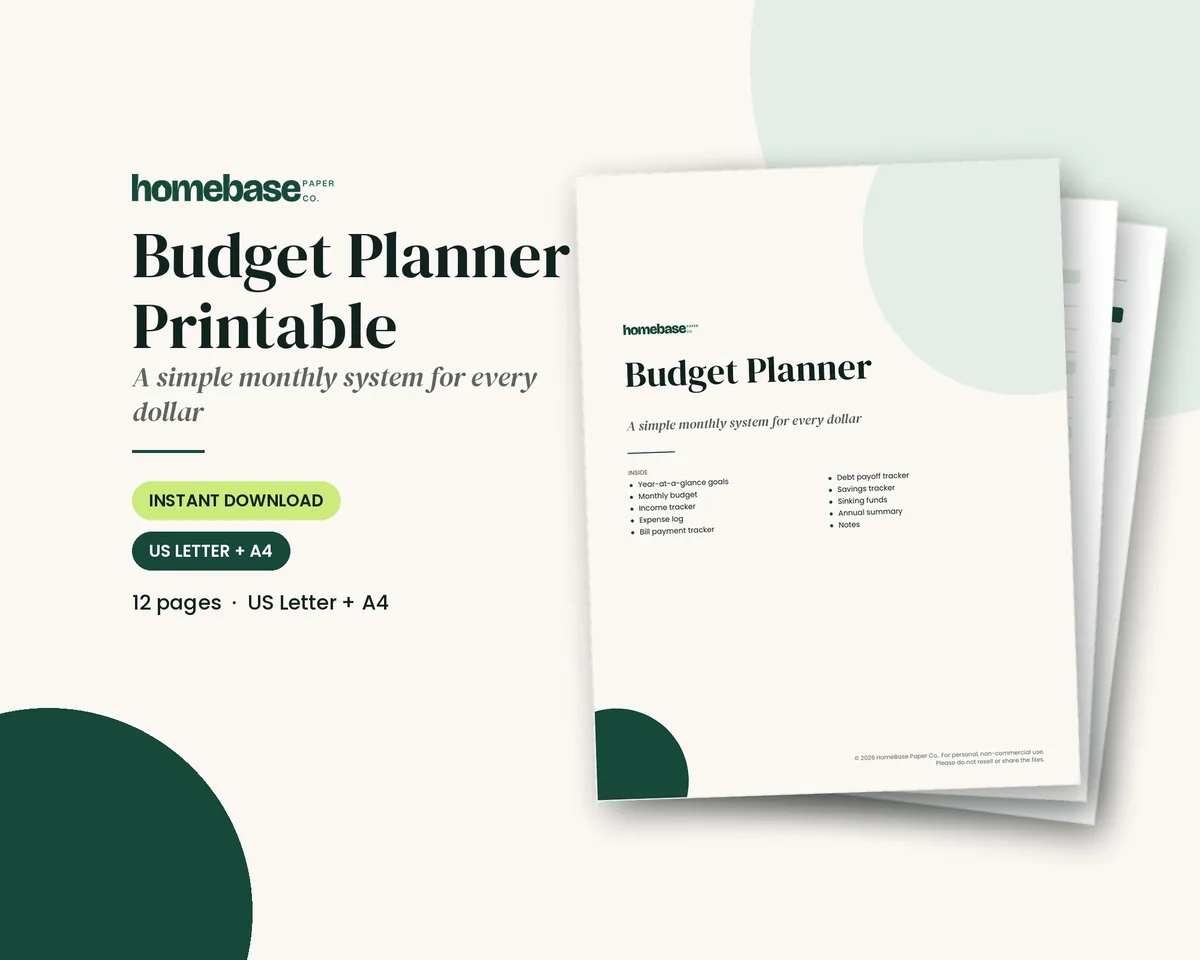
Budget Planner Printable
Twelve undated pages you can print every month: budget, bills, spending, savings and debt.

Spreadsheets
Zero-Based Budget Spreadsheet
The 'Left to budget' counter turns green when every dollar has a job.
 Save 57%
Bundles
Ultimate Budget Bundle
All 6 spreadsheets + both printable planners - for less than half the price of buying them separately.
As the oldest of three, I was the one who kept everyone coordinated, and a budget is the same idea applied to money: one plan everyone can follow.
Budget definition in plain English
| Term | Plain-English meaning |
|---|---|
| Budget | A written plan for income and spending over a period of time |
| Income | Money coming in, usually take-home pay after taxes |
| Expenses | Money going out for needs, wants, bills and debt |
| Surplus | Money left after planned spending |
| Deficit | Planned spending that's more than income |
| Balanced budget | Income and planned outflows are equal |
The Consumer Financial Protection Bureau has a plain guide to creating a budget and sticking with it, and the same word applies to households, businesses and even the federal budget process.
Why a budget matters
Without a plan, money tends to go to whatever shows up first: the next bill, the next sale or the next takeout night. A budget flips that order. You decide your priorities once a month, then let small daily choices follow the plan instead of guessing.
The 4 parts of every budget
- Income. Your expected take-home pay plus any other regular money, like child support or side income.
- Fixed expenses. Costs that stay about the same each month, such as rent or mortgage, insurance, car payments and subscriptions.
- Variable expenses. Costs that change, such as groceries, gas, utilities, eating out and gifts.
- Savings and debt payments. Money set aside for emergencies, goals and sinking funds, plus extra payments on debt.
Income minus the other three should equal zero (balanced) or a small surplus you assign on purpose.
A budget example
Here's an example monthly budget for $3,000 of take-home pay.
| Category | Planned |
|---|---|
| Housing | $1,200 |
| Groceries | $450 |
| Transportation | $250 |
| Utilities and phone | $300 |
| Savings | $300 |
| Debt payments | $200 |
| Personal and household | $200 |
| Fun and eating out | $100 |
| Total | $3,000 |
These numbers are only an example; your categories and amounts will be different. The budget calculator can help you test your own.
Common types of budgets
| Budget type | How it works | Good for |
|---|---|---|
| Zero-based budget | Every dollar of income is assigned a job | Detail-minded planners |
| 50/30/20 budget | 50% needs, 30% wants, 20% savings and debt | A simple starting rule |
| Envelope budget | Cash or digital envelopes per category | Overspenders on groceries or fun |
| Pay-yourself-first | Savings come out first, the rest is flexible | Savers who hate tracking |
| Paycheck budget | A plan for each paycheck instead of the month | Biweekly or irregular pay |
For a deeper comparison, see our guide to budgeting methods.
Budget vs. related terms
- Budget vs. spending tracker: the budget is the plan; tracking is the record of what happened. University of Illinois Extension explains how tracking spending shows where a plan needs to change.
- Budget vs. financial plan: a financial plan covers long-term goals like retirement; a budget is the month-to-month tool that funds it.
- Budget vs. forecast: a budget is a target; a forecast is a prediction.
Quick-start budget (do it in 20 minutes)
- Write your monthly take-home pay at the top.
- List your fixed bills and their amounts.
- Estimate your variable costs from last month's bank statement.
- Choose an amount for savings, even if it's small.
- Subtract everything from income. Adjust until the result is zero or a small surplus.
- Check in once a week and fix the plan when real life changes it.
When you're ready to go further, our budgeting for beginners guide walks through a full first month.
Tools to build your first budget
- Budget Planner Printable, $5.99. Fill in income, bills, spending and savings by hand each month.
- Zero-Based Budget Spreadsheet, $6.99. Assign every dollar and let the formulas show what's left.
- Ultimate Budget Bundle, $19.99. Our budget spreadsheets and printables together.
Browse all our Spreadsheets or see every bundle.
More budgeting guides
Make the monthly budget a 20-minute job
Twelve undated pages you can print every month: budget, bills, spending, savings and debt.
$5.99 · Instant download. Print at home or fill it in on screen. Or browse the full Budget & Money collection.
Frequently asked questions
What is the simple definition of a budget? A budget is a plan for how you'll use your money over a set period, usually a month, by listing the income you expect and deciding ahead of time how much goes to spending, bills, saving and debt. It's a spending plan written before the money is spent, not a record of what already happened.
What is a budget in personal finance? In personal finance, a budget is a monthly plan that matches your take-home pay to your expenses and goals. It shows where every dollar is meant to go, so you can pay bills on time, save on purpose and avoid running short before payday.
What are the main parts of a budget? Every budget has four parts: income, fixed expenses, variable expenses, and savings and debt payments. Income is what comes in; the other three decide where it goes. Subtract planned spending from income to see whether you have money left over or a shortfall.
What is the purpose of a budget? The purpose of a budget is to make sure your money goes to what matters most to you before it disappears into small purchases. It helps you cover essentials, build savings, pay down debt and see problems early enough to fix them.
What's the difference between a budget and a forecast? A budget is a target you set for how money should be spent, while a forecast is an estimate of what will probably happen. Businesses often use both; at home, a budget is the plan and your monthly review shows how close you came.
What are the different types of budgets? Common personal budget types include zero-based, the 50/30/20 rule, envelope (cash), pay-yourself-first and paycheck-to-paycheck budgets. Businesses and governments also use operating, capital and cash budgets. The best type is the one you'll actually keep.
What is an example of a budget? A simple example: with $3,000 of monthly take-home pay, you might plan $1,200 for housing, $450 for groceries, $250 for transportation, $300 for utilities and phone, $300 for savings, $200 for debt and $300 for everything else. The numbers add up to $3,000, so every dollar has a job.
What does it mean to be over budget? Being over budget means you spent more in a category, or overall, than you planned. When it happens, move money from another category, cut back for the rest of the month or adjust next month's plan so it reflects real costs.
What is a balanced budget? A balanced budget is one where planned spending, saving and debt payments equal your income, with nothing left unassigned and no shortfall. A surplus means income is higher than planned spending; a deficit means spending is higher.
How often should a budget be made? Most households make a new budget every month, because bills, paydays and seasonal costs change. Weekly check-ins of 10 to 15 minutes help you catch overspending early.
What is the easiest way to start a budget? The easiest way to start is with a ready-made template that already lists the common categories. The Budget Planner Printable ($5.99) from HomeBase Paper Co. walks you through income, bills, spending and savings on paper, and the Zero-Based Budget Spreadsheet ($6.99) does the math for you.
Is a budget the same as tracking spending? No, a budget is not the same as tracking spending. A budget is your plan for the month, and tracking spending is the record of what you actually spent. You need both: tracking shows whether the plan is working and where to adjust it.
Free printable
Give every dollar a job: get the free monthly budget template
A printable zero-based monthly budget: income, bills, everyday spending and savings on one page, with a planned vs. actual column. You'll also get our weekly HomeBase email with simple budgeting and bill-paying tips.

Sources
- CFPB: Budgeting, how to create a budget and stick with it consumerfinance.gov
- USA.gov: Federal budget process usa.gov
- University of Illinois Extension: Tracking spending extension.illinois.edu