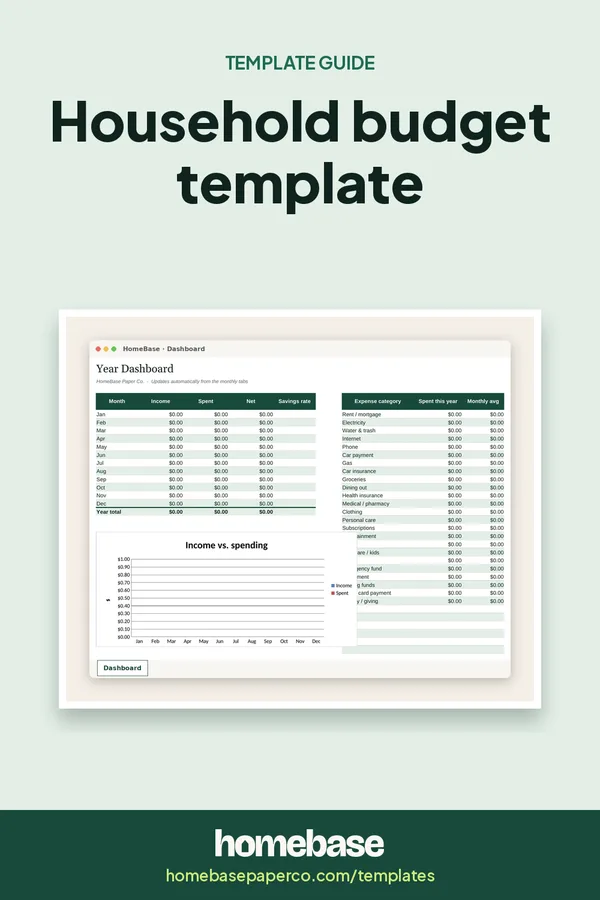
The short answer: A household budget template is one plan for all the money under your roof: every paycheck that comes in, every shared bill, each person's spending money and what the house is saving for. The best one is simple enough for the whole household to read in two minutes, with a planned column and an actual column on every line so you can see where the month drifted.
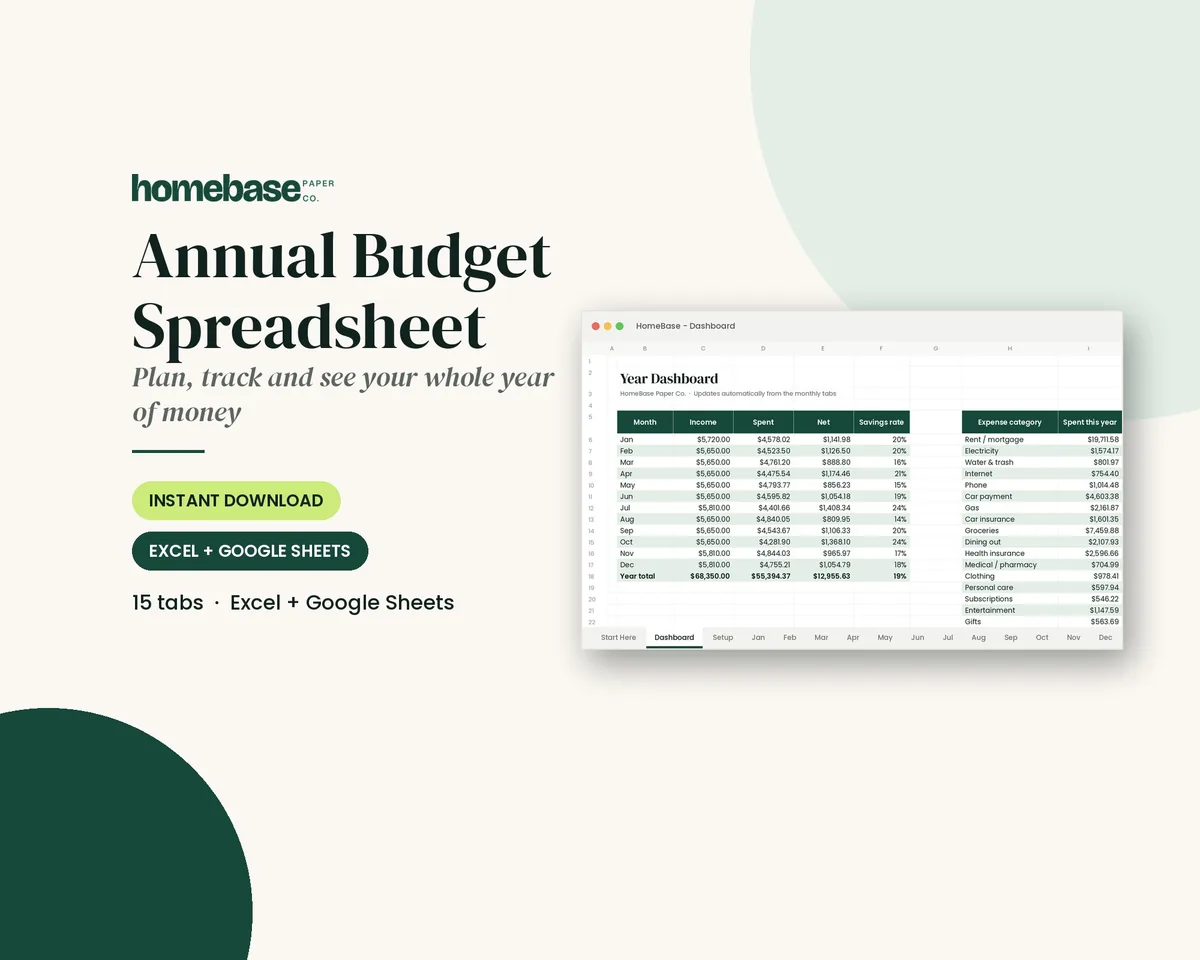
If you want one ready tonight, the Annual Budget Spreadsheet ($6.99, Excel and Google Sheets) and the Budget Planner Printable ($5.99, PDF) both work. Below is how to set up either one for a real household.
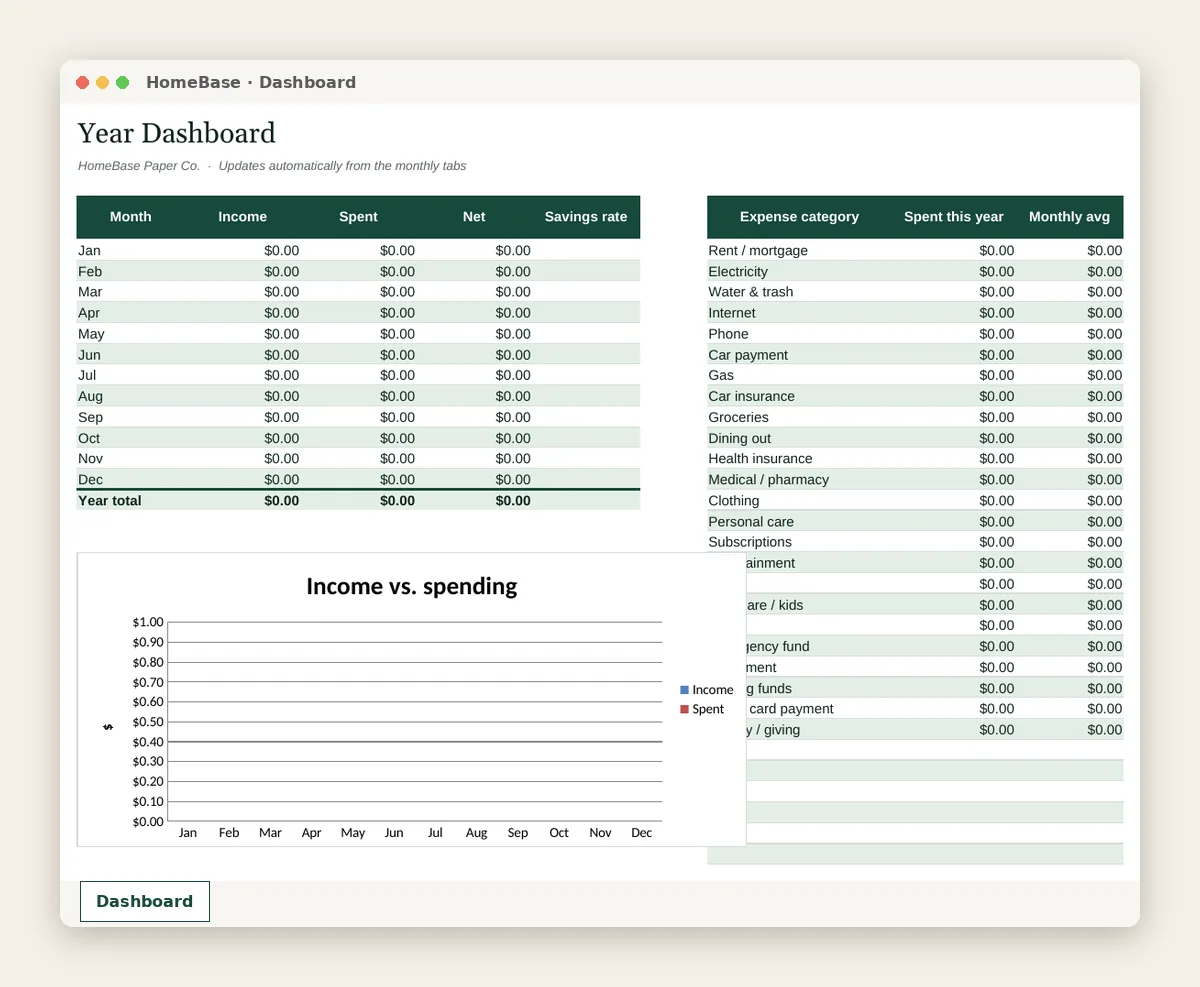
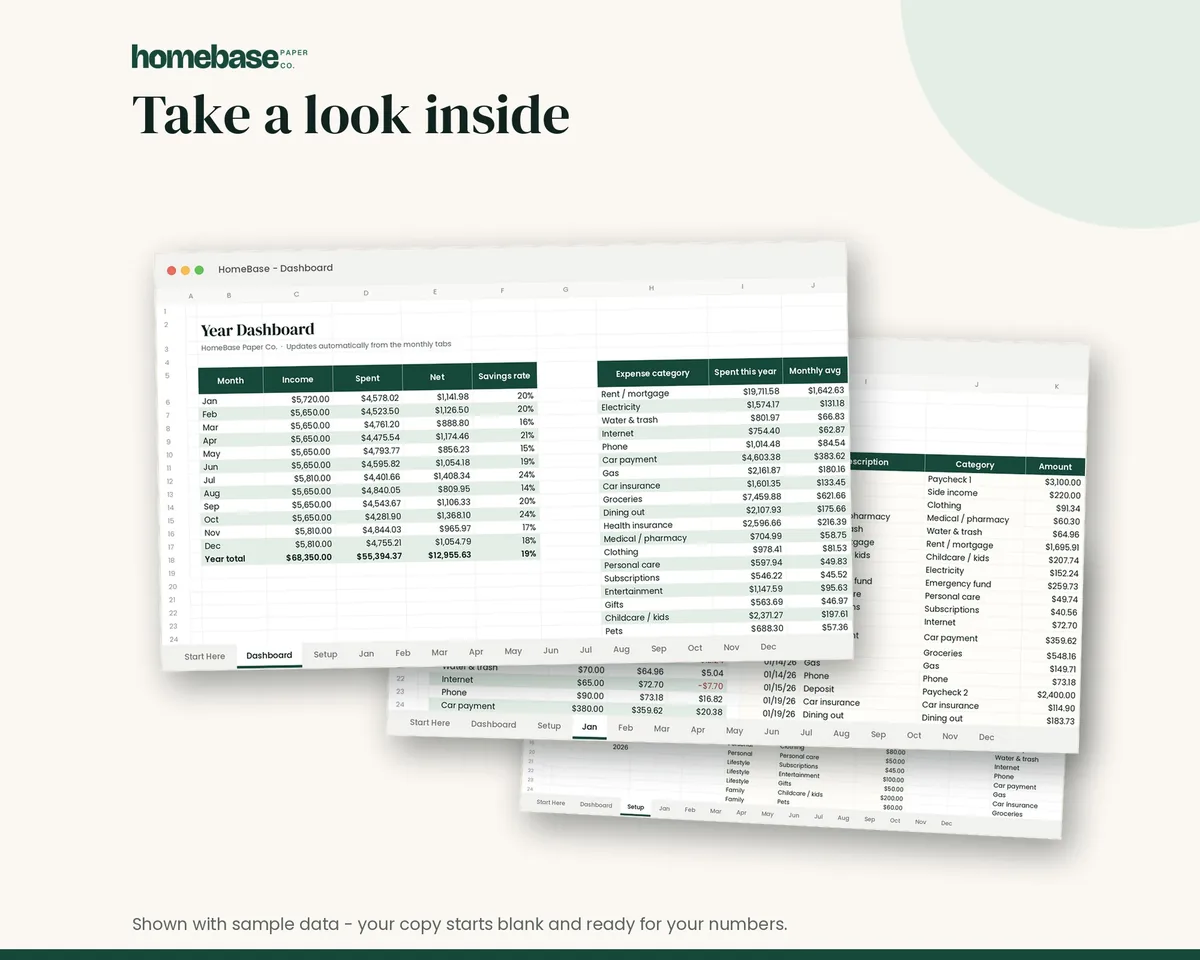
What's included in the Annual Budget Spreadsheet
- Start Here guide
- Setup tab: your categories & plan
- 12 monthly tabs (Jan-Dec)
- Transaction log with category dropdowns
- Planned vs. actual by category
- Over-budget alerts in red
- Year dashboard + chart
- Works in Excel & Google Sheets
Spreadsheet (Excel + Google Sheets), $6.99. Instant download; nothing is shipped. See every page on the product page.
Who it's for
- Couples with two incomes who want one shared plan instead of two private ones.
- Families with kids, where school, activities and childcare change month to month.
- Roommates, adult children at home and multigenerational homes that need a clear record of who pays what.
- Single parents running the whole house on one income who need every bill in one place.
- Anyone budgeting alone, too: it works as a personal budget template if you simply leave the extra income lines empty.
How to set up your household budget template, step by step
- Pick one format for the whole house. A spreadsheet adds everything up and can be shared in Google Sheets, so both adults see the same numbers. A printable sits on the fridge or in a binder where everyone can see it. Not sure which? Compare them in printable vs. spreadsheet budget planners.
- Gather two months of statements. Bank, credit card and any payment apps. You're looking for every recurring bill and the real amounts you spend on food, gas and kids.
- List every income source on its own line. Use take-home pay, not gross. If one income varies, plan on your lowest typical month (see budgeting with irregular income).
- List shared bills once, with the due date and who pays. This is where many household budgets go wrong. Write the payer's name next to each bill.
- Add kids, dependents and each adult's personal money. Agree on the personal amounts out loud, so nobody has to guess.
- Fund savings before fun. The emergency fund, car, holidays, birthdays and annual bills each get a monthly amount.
- Balance the plan. Income minus everything you've assigned should equal zero. If it's negative, lower some lines now, not at the end of the month.
- Track actual spending once a week. Ten minutes on the same evening each week. In the spreadsheet, the transaction log fills in the actual column and a line turns red when it's over plan.
- Hold a short monthly money meeting. Review planned vs. actual, decide what to do with anything left and set next month's plan. Our family budget meeting guide has a simple agenda, and how to budget as a couple covers the harder conversations.
What makes a household budget different
A personal budget answers one question: where does my money go? A household budget has to answer three more: who pays for what, which costs are shared, and how the household decides when plans change. That's why a household template needs a few lines a solo budget can skip:
- Income from more than one person or source. Two paychecks, a side job, child support, a pension or an adult child chipping in for groceries each belong on their own line, so you can see what each one covers.
- A shared bills section. Rent or mortgage, utilities, internet, insurance and groceries are paid once for everyone. List them once, not on each person's sheet.
- Personal spending lines. Give each adult a fixed amount of no-questions-asked money. It heads off a lot of budget arguments before they start.
- Kids and dependents. School lunches, activities, childcare, diapers, allowance and the costs of caring for a parent get their own group, because they change with the seasons.
- Savings the whole house shares. An emergency fund, car repairs, holidays and the next big purchase are easier to cover as monthly sinking funds than as surprises.
Household budget categories by household type
Start with the standard groups (income, housing, utilities, food, transportation, insurance, debt, savings, personal, kids, giving and fun), then adjust them for the people you live with. Our budget categories list has the full set. These are the lines different households most often forget:
| Household | Add these lines | Watch out for |
|---|---|---|
| Couple with two incomes | Transfer to a joint bills account, each person's fun money | Paying for the same subscription twice |
| Family with young kids | Childcare, diapers and formula, kids' clothes, birthday parties | Back-to-school and holiday months |
| Family with teens | Sports fees, phones, car insurance for a new driver, allowance | Activity costs that all arrive at once |
| Single parent | Child support in or out, backup childcare, school fees | One income covering everything; keep a cash buffer |
| Roommates or adult kids at home | Each person's share of rent and utilities, shared groceries | No clear rule for when someone is short |
| Multigenerational home | Care costs, prescriptions, a parent's contribution | Mixing a parent's money with household money without a record |
A worked household budget example
The numbers below are an EXAMPLE only, made up to show how the template works. They aren't averages, targets or advice. Use your own take-home pay and bills.
EXAMPLE household: two working adults and two school-age kids, paid on different schedules.
| Line (EXAMPLE) | Planned | Actual | Difference |
|---|---|---|---|
| Income: Adult 1 take-home | $3,200 | $3,200 | $0 |
| Income: Adult 2 take-home | $2,400 | $2,550 | +$150 |
| Total income | $5,600 | $5,750 | +$150 |
| Rent | $1,650 | $1,650 | $0 |
| Utilities and internet | $310 | $342 | −$32 |
| Groceries and household supplies | $900 | $968 | −$68 |
| Transportation (gas, insurance, upkeep) | $520 | $495 | +$25 |
| Kids (school, activities, clothes) | $350 | $410 | −$60 |
| Debt payments | $400 | $400 | $0 |
| Personal money ($125 per adult) | $250 | $250 | $0 |
| Savings and sinking funds | $820 | $820 | $0 |
| Giving, fun and everything else | $400 | $365 | +$35 |
| Total spent or saved | $5,600 | $5,700 | |
| Left over | $0 | $50 |
What this EXAMPLE shows: the plan was balanced, with planned income minus planned spending equal to zero (the zero-based budget approach). During the month, groceries and kids' costs ran over, the second paycheck came in higher, and the household ended with $50 left. At the monthly check-in they'd decide together where that $50 goes, then raise the grocery line or trim another one for next month instead of hoping it won't happen again.
Using it as a personal budget template
If it's just you, the same template works as a personal budget template. Use one income line, skip the "who pays" column and the kids group, and keep everything else: fixed bills, groceries, transportation, a personal spending line, savings and sinking funds. The planned and actual columns matter even more when you're the only one checking. If you later move in with a partner or roommate, you add a second income line instead of starting over.
Tips for keeping a household on budget together
- Keep one source of truth. One budget, not one per person. A shared Google Sheet or a single printed copy in a household binder works.
- Name an owner for every bill. Shared responsibility easily turns into nobody's responsibility.
- Plan in round numbers. Plan $900 for groceries, not $887.42. Precision belongs in the actual column.
- Let kids see part of it. Older kids can track their own activity or allowance line.
- Plan the expensive months early. Back to school, the holidays and insurance renewals belong in sinking funds months ahead.
- Keep the meeting short and kind. The goal is a plan for next month, not a review of who overspent.
Common household budget mistakes
- Budgeting with gross pay. Taxes, insurance and retirement contributions come out first. Plan on what lands in the bank.
- Forgetting annual and irregular bills. Car registration, school fees, gifts and memberships can wreck an otherwise good month. Divide each one by 12 and save for it monthly.
- Counting the same bill twice. When two people each track "their" bills, shared costs often show up on both lists.
- Leaving no personal money. A budget with zero room for small personal spending tends to get abandoned by the second month.
- Skipping the actual column. A plan without tracking is a wish list. Even a weekly ten-minute update keeps it honest.
- Changing the template every month. Pick one layout and keep it for at least three months so you can compare month to month. If you're brand new to this, start with budgeting for beginners.
Which HomeBase template fits your household
- Annual Budget Spreadsheet ($6.99): Excel and Google Sheets, 12 monthly tabs, a transaction log with category dropdowns, planned vs. actual by category, over-budget alerts in red and a year dashboard. Best for households that want the math done for them in one shared file.
- Budget Planner Printable ($5.99): a 12-page PDF in US Letter and A4 with Monthly Budget, Income Tracker, Expense Log, Bill Payment Tracker, Debt Payoff Tracker, Savings Tracker and Sinking Funds pages. Best for a fridge or binder budget everyone can see.
- Ultimate Budget Bundle ($19.99, or $46.42 if you bought the items separately): all six HomeBase budget spreadsheets plus both printable planners, for households that also want zero-based, paycheck, debt payoff, bill and sinking funds views.
Every HomeBase template is an organizing tool for your own numbers, not financial advice. Browse all of our templates, track a month first with the spending tracker guide, start with our monthly budget worksheet guide, or see the full budgeting shop.
Before choosing a paid workbook, compare the free PDF and spreadsheet options in our budget template guide. The free two-page printable is emailed after signup and gives the household a monthly plan plus an expense tracker.
Ready to use
Household budget templates you can use tonight

Spreadsheets
Annual Budget Spreadsheet
See exactly where your money goes every month - without complicated software.

Printables
Budget Planner Printable
Twelve undated pages you can print every month: budget, bills, spending, savings and debt.
 Save 57%
Bundles
Ultimate Budget Bundle
All 6 spreadsheets + both printable planners - for less than half the price of buying them separately.
Frequently asked questions
What is a household budget template? A household budget template is a ready-made layout for planning the money of everyone who lives in your home. It has lines for each income, the shared bills, food, transportation, kids and dependents, each adult's personal money and the savings the house is building, with a planned column and an actual column so you can compare what you meant to spend with what really happened. You fill in your own numbers; the template gives you the structure so nothing gets forgotten.
What should a household budget template include? At minimum: every income source on its own line, a shared bills section with due dates and who pays each one, groceries and household supplies, transportation, insurance, debt payments, a kids or dependents group, personal spending money for each adult, savings and sinking funds for irregular costs, and giving and fun. A good template also has planned and actual columns, a running total of what's left to assign, and room for a short note about what changed this month.
Is there a household budget template for Excel? Yes, the HomeBase Annual Budget Spreadsheet ($6.99) is a household budget template for Excel, an .xlsx file that opens in Microsoft Excel and in Google Sheets. It has a setup tab for your categories, 12 monthly tabs, a transaction log with category dropdowns, planned vs. actual by category, over-budget alerts in red and a year dashboard with a chart. You type into the cream cells and the formulas do the totals.
Can my partner and I use the same household budget template? Yes, and we'd recommend it. Upload the Annual Budget Spreadsheet to Google Drive, open it with Google Sheets and share it with your partner so you're both looking at the same numbers. If you prefer paper, print the Budget Planner Printable once and keep it on the fridge or in a binder where both of you can update it. One shared budget beats two private ones.
Is a printable or a spreadsheet household budget better? A spreadsheet is better for doing the math and sharing between two phones, and a printable is better for keeping the budget visible to everyone at home. A spreadsheet adds everything up, flags overspending and is easy to share between two phones. A printable is visible to everyone, works without a screen and is easier for kids to follow. Many households plan in the spreadsheet and keep a printed monthly page on the fridge. The Ultimate Budget Bundle ($19.99) includes both formats if you'd rather not choose.
How do I budget for a household with two incomes? List each take-home paycheck on its own line, with the dates it arrives. Then decide how shared bills get paid: some couples pool everything into one account, some each pay a share into a joint bills account, and some split specific bills. Write the payer's name next to every shared bill in the template, give each adult a fixed amount of personal money, and balance the plan so total income minus everything assigned equals zero.
How do we split household bills fairly? There's no single right answer. The two common approaches are a 50/50 split and a proportional split, where each person pays the same percentage of their income. As an EXAMPLE only: if one person takes home $3,000 and the other $2,000, a proportional split would have them cover 60% and 40% of shared bills. Whatever you choose, write it in the template so nobody has to remember the deal.
How much should a household spend on groceries? The best grocery budget for your household is your own recent average, because spending varies a lot with household size, location, diet and how often you cook. The most reliable number is your own: add up two months of grocery and household-supply spending from your statements and use that average as your first planned amount, then adjust after a month of tracking. If you want an outside reference point, the USDA publishes monthly food plans at several cost levels. Our guide to grocery shopping on a budget has ideas for bringing the number down.
What's the difference between a household budget and a family budget? A household budget and a family budget overlap almost completely; the difference is who shares the costs. A family budget usually means parents and kids. A household budget covers anyone sharing the home's costs, which can include roommates, adult children, a partner who isn't on the lease or a parent who lives with you. The template is the same; a household budget just pays more attention to who contributes what.
How often should we update our household budget? Plan the month once before it starts, record actual spending once a week (ten minutes on the same evening works for most families) and hold a short check-in at the end of the month to review planned vs. actual and set next month's numbers. Daily tracking is optional; weekly is enough for most households to catch problems early.
How do I include kids in the household budget? Give kids their own group in the template: school costs, activities, clothes, childcare and allowance. Older kids can track their own line or allowance, which teaches them how a plan works and makes 'not this month' easier to hear. The HomeBase Kids Chore Chart printable includes an allowance tracker if you link chores to money.
What if our household income changes from month to month? Plan on your lowest typical month, not your best one. Fund the essentials first, then savings, then everything else. When a bigger month comes in, assign the extra on purpose, often to an emergency fund or a sinking fund that smooths out the lean months. Our guide to budgeting with irregular income walks through it step by step.
Can I use the household budget template every year? Yes, you can use the household budget template every year. The Budget Planner Printable is undated, so you can print fresh pages any month of any year. The Annual Budget Spreadsheet has 12 monthly tabs from January to December; keep your filled-in file as a record and start a clean copy of the original download each new year.
Can I print the household budget pages on A4 paper? Yes, you can print the household budget pages on A4 paper. The Budget Planner Printable comes as two PDFs, one in US Letter and one in A4, so a household outside the US can print it without scaling. For a fridge budget, print the Monthly Budget and Bill Payment Tracker pages each month and keep the Annual Summary in a binder so you can compare months side by side.
How quickly can we start using the household budget template? You can start using the household budget template the same evening. After checkout you get a download button, plus an email with the same link, so either adult can download the Annual Budget Spreadsheet or the printable again later. Upload the spreadsheet to Google Drive and share it with your partner, and you're both looking at the same file within a few minutes. Nothing is shipped.
What if the spreadsheet won't open on our computer? Email us within 14 days of your order. If a file won't open, is missing pages or isn't what the product page described, we'll fix it or send a replacement, and refund you in full if we can't make it work. If you can't get the spreadsheet working in Excel or Google Sheets, we'll walk you through it. Downloads aren't refundable for a change of mind, which is why the product page shows every tab first. See our refund policy for the details.
Will the template tell us how much to spend on each category? No, the household budget template won't tell you how much to spend on each category. It shows your household's own numbers clearly, but it doesn't decide anything for you. You choose the planned amounts, and the worked example on this page is made up for illustration only. For decisions about debt, taxes, insurance or investing, talk to a qualified professional.
Free printable
Get organized for the new year: get the free 2027 planner
A 16-page printable 2027 planner with a year-at-a-glance page and monthly calendars with US holidays marked. You'll also get our weekly HomeBase email with simple planning and home organization tips.