

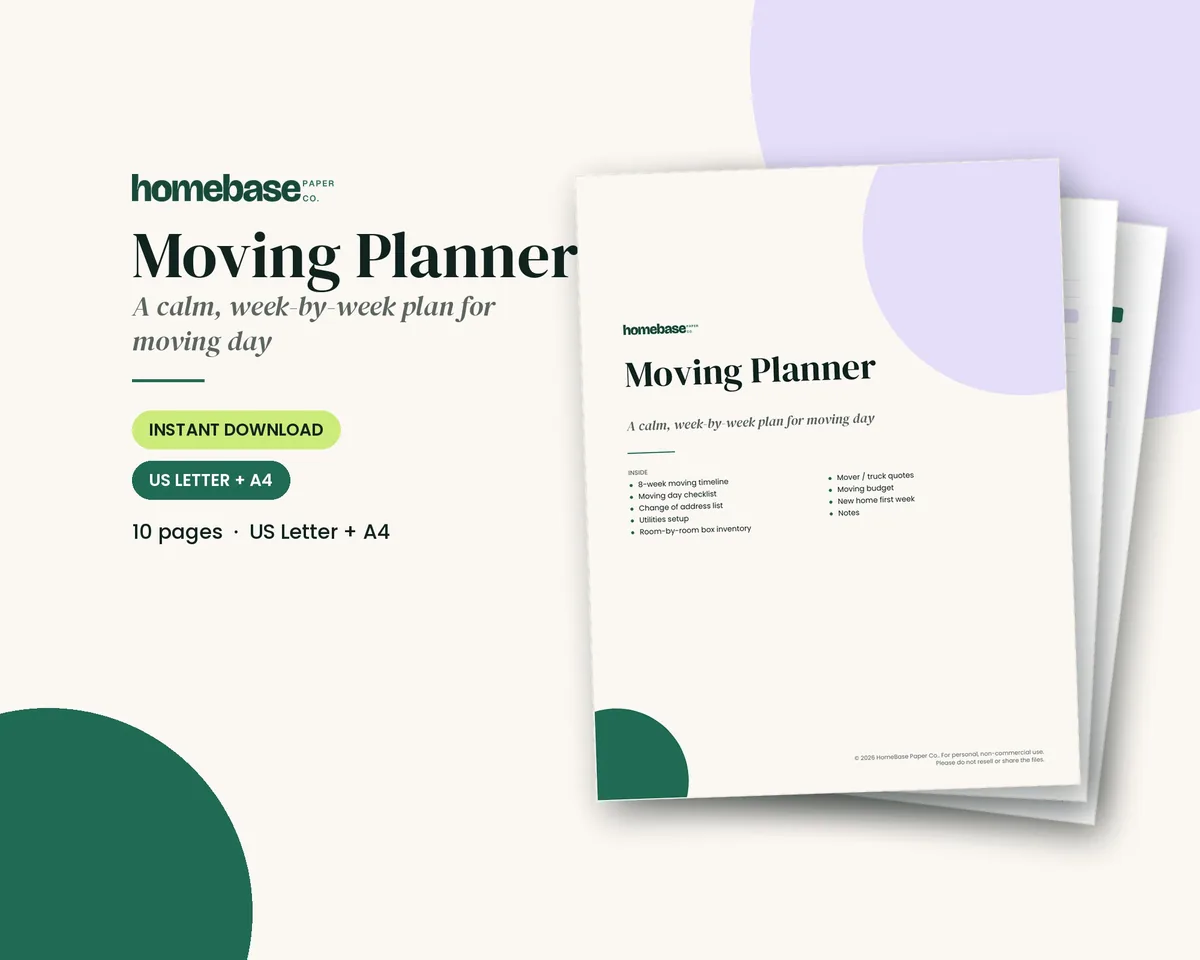
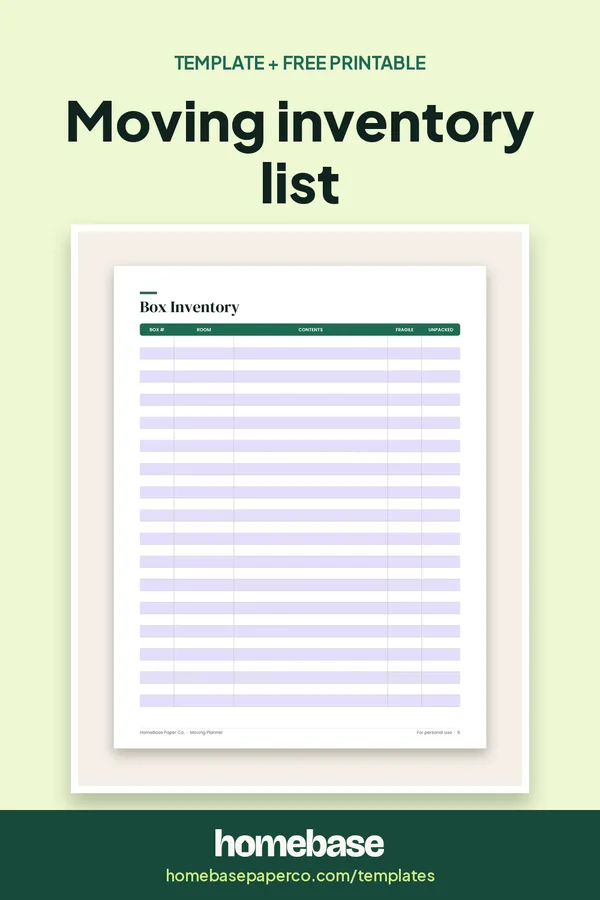
The short answer: A moving inventory list is a numbered record of every box you pack: the box number, the room it's going to, what's inside, whether it's fragile and whether it's been unpacked yet. It takes about ten seconds per box while you pack, and it saves hours of searching later. If you'd like a ready-made page, the Box Inventory in our Moving Planner ($5.99, printable PDF) has exactly those five columns.
Below is how to set one up, a sample, and how to use it on loading and delivery day.
What's included in the Moving Planner
- Move details
- Moving Timeline
- Change of Address
- Utilities Setup
- Box Inventory
- Mover & Truck Quotes
- Moving Budget
- First Week in the New Home
- Notes
Printable PDF, $5.99. Instant download; nothing is shipped. See every page on the product page.
Who it's for
- Families packing a whole house, where 60 or more boxes can blur together by the second week.
- Anyone hiring movers, especially for a move to another state, who wants their own record to compare with the mover's inventory.
- DIY movers with a rental truck and friends helping, so helpers know which room each box goes to.
- People moving into storage first, who need to find one box months later without opening twenty.
- Renters and first-time movers who want moving day to feel organized instead of chaotic.
How to make a moving inventory list, step by step
- Print the list before you tape the first box. Start the inventory with the very first box you pack. Trying to rebuild it afterwards from memory never works. Keep the pages on a clipboard with a marker and a pen.
- Give every box a number. Write the same number on the box (top and two sides) and on the next line of the list. Numbers are faster to check than descriptions, and they don't give away what's inside.
- Write the destination room, not the room it came from. Movers and helpers unload by room in the new home, so write where the box is going: Kitchen, Bedroom 2, Garage.
- List the contents in a few words. Enough to find things later: "spices, measuring cups, baking pans" beats "kitchen stuff." For electronics, note cables and remotes.
- Flag fragile boxes. Tick the Fragile column and write FRAGILE on the box itself. Put the heaviest fragile items near the bottom of the box with padding.
- Mark your open-first boxes. Give the boxes you'll need on night one a star or a different color so they're loaded last and unpacked first. Our moving checklist has a full list for that box.
- Count boxes at loading and at delivery. Check each number off as it goes on the truck, then again as it comes off. If you hired movers, compare your count with the mover's inventory before you sign it.
- Tick Unpacked as you go. The Unpacked column shows what's left at a glance, and it tells you which room still has work waiting.
Why a moving inventory list is worth the effort
By the second week of packing, most families can't remember which box has the can opener, and by moving day the stack in the garage all looks the same. A simple numbered list fixes three problems at once:
- Nothing quietly goes missing. If you count 64 boxes onto the truck, you know to look for 64 at the other end. A missing number shows up immediately, not three weeks later when you need the winter coats.
- Unpacking goes in the right order. Every box lands in the room where it belongs, and the open-first boxes are easy to spot.
- You have your own record. For an interstate move, the mover is required to prepare an inventory of your shipment, and the federal rule says the inventory must identify every carton and give you a signed copy at loading. Having your own list makes it much easier to check theirs.
The five columns every moving inventory needs
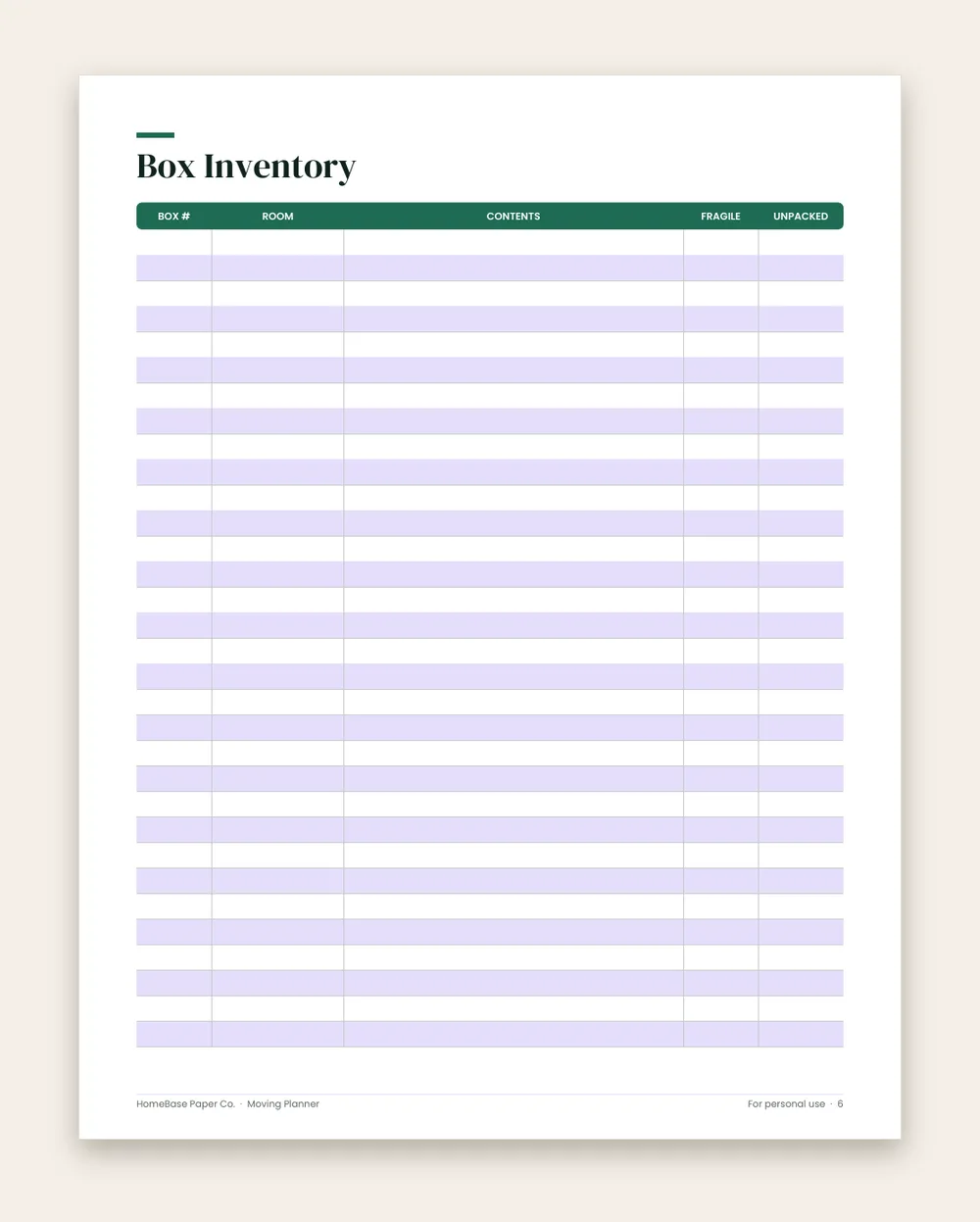
You can add more, but these five do almost all of the work. They're the columns on our printable Box Inventory page.
| Column | What to write | Why it matters |
|---|---|---|
| Box # | A running number: 1, 2, 3... | Fast to count at loading and delivery |
| Room | The room it's going to in the new home | Movers and helpers unload by room |
| Contents | A few specific words: "baking pans, mixer, spices" | You can find things without opening boxes |
| Fragile | A tick if anything inside can break | Fragile boxes get loaded and stacked carefully |
| Unpacked | A tick once the box is empty | Shows how much is left in each room |
Keep a short second section for large unboxed items such as furniture, the TV, a bike or the grill. Give those letters instead of numbers (A, B, C) and note their condition before the move.
A sample moving inventory list
The rows below are an EXAMPLE only, made up to show how the list reads once it's filled in.
| Box # | Room | Contents | Fragile | Unpacked |
|---|---|---|---|---|
| 1 | Primary bedroom | Off-season sweaters, scarves | ||
| 2 | Living room | Books, board games | ||
| 3 | Kitchen | Wine glasses, mugs (wrapped) | ✓ | |
| 4 | Kitchen (open first) | Pan, 4 plates, cutlery, dish soap, towels | ||
| 5 | Bathroom (open first) | Toilet paper, shower curtain, hand soap | ||
| 6 | Office | Printer cables, router, labeled chargers | ✓ | |
| 7 | Kids' room | Bedding, nightlight, favorite stuffed animals | ||
| A | Living room | Sofa (small scratch on left arm) |
Notice that box 4 and box 5 are marked "open first." Those boxes go on the truck last so they come off first.
How to label boxes so they match the list
The list only works if the boxes match it. A few habits make that easy:
- Write the number in three places: the top and two opposite sides. In a stack, you'll almost always see one of them.
- Write the destination room on the box in large letters. Some families use a different colored tape or sticker for each room; if you do, write the color at the top of the list so helpers know the code.
- Keep detailed contents off the outside. The room and number are enough for routing. The detailed contents live on your list, so a box with electronics or jewelry doesn't announce itself.
- Write FRAGILE on the box itself as well as ticking the column, and pack the heaviest fragile items at the bottom with plenty of padding.
- Never reuse a number. If you repack a box, give it a new number and cross the old line out.
Using the inventory on moving day
Moving day is when the list earns its place. Keep it on a clipboard, not buried in a box.
- At loading: tick each box number as it goes onto the truck. If you're using movers, walk through the inventory with them. The federal inventory rule says the mover must give you the chance to watch and check the inventory as it's written, so read it carefully before you sign.
- Before the truck leaves: write the total count at the top of your list and compare it with the mover's paperwork. Take one last walk through the empty home.
- At delivery: tick each number again as it comes off the truck and goes into a room. If anything is missing or damaged, note it on the mover's inventory before you sign. The same rule says the mover must let you check, at delivery, that the same articles are arriving and in what condition, so a written note made then is your best record of a problem.
- Afterwards: keep your list together with the bill of lading until any questions about the move are settled.
This page isn't legal advice. If you have a dispute with a mover about lost or damaged belongings, talk to the mover first and, if needed, a qualified professional.
Moving inventory vs. home inventory for insurance
These two lists are easy to mix up, and they do different jobs:
- A moving inventory tracks boxes: number, room, rough contents. It's temporary and gets thrown away once everything is unpacked and settled.
- A home inventory records your valuable belongings for insurance: brand, model, serial number, purchase price and photos. It's permanent and gets updated over the years.
A move is a great time to start or refresh a home inventory, because every cupboard is open anyway. Our guide to a printable home inventory list for insurance explains what to record, and the Home Inventory Printable & Spreadsheet ($5.49) has room-by-room pages for it. Before a long-distance move, it's also worth reading the federal rule on mover liability, which explains Full Value Protection (replacement value) and the lower released-rate coverage that applies only if you waive full value in writing.
Mistakes that make a moving inventory useless
- Starting halfway through. If boxes 1 to 30 were never written down, the count at delivery means nothing. Start with the first box, even weeks before the move.
- Vague contents. "Misc" and "kitchen stuff" will have you opening ten boxes to find one spatula. Three specific words are enough.
- Writing the room the box came from. The movers don't care where it was; they need to know where it's going.
- Keeping the list in a box. Keep it on a clipboard or in your bag, with a photo of each page on your phone as a backup.
- Skipping the delivery count. The list only protects you if you check it at the other end before anyone signs.
Put it with the rest of your move
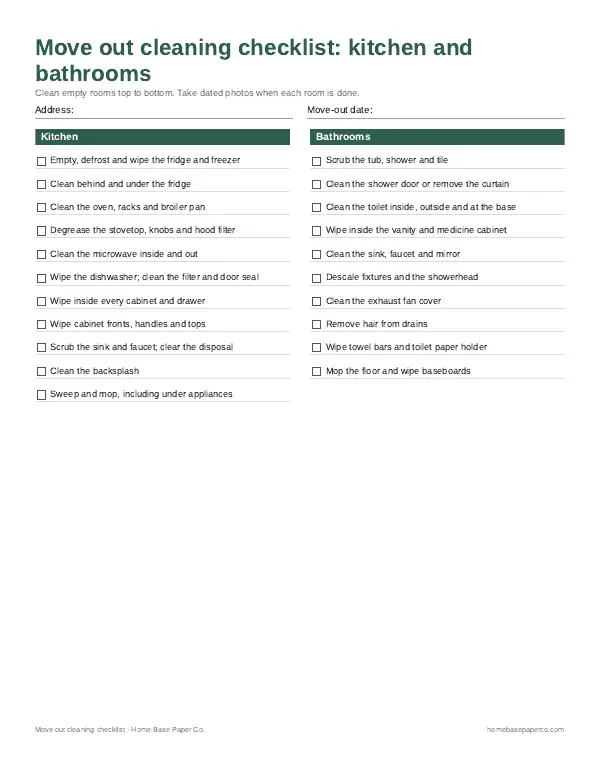
A box inventory is one page of a bigger plan. Our 8-week moving checklist covers booking movers, changing your address and what to pack in the open-first box, and the free move out cleaning checklist covers the last day in the old place. The Moving Planner keeps all of it in one printable: the timeline, change of address, utilities setup, box inventory, mover quotes, a moving budget and a first-week list for the new home. If you're also setting up the new home's routines, the Home Management Bundle includes the Moving Planner along with the household binder, cleaning schedule, home maintenance log, home inventory and password log.
Ready to use
Moving printables with the box inventory inside
Printables
Home Inventory
Printable pages and a spreadsheet that totals the value of every room.
 Save 48%
Bundles
Home Management Bundle
Household binder, maintenance log, moving planner, cleaning schedule, home inventory and password log.
Frequently asked questions
What is a moving inventory list? A moving inventory list is a numbered record of every box and large item you're moving. Each line has the box number, the room it's going to, a short description of what's inside, whether it's fragile and a checkbox for when it's unpacked. It lets you count boxes at loading and delivery, find things quickly in the new home and notice right away if something is missing.
What should a moving inventory list include? A moving inventory list should include, at minimum, a box number, the destination room, a short contents description, a fragile flag and an unpacked checkbox. Many families add a column or note for open-first boxes, and a separate short list for large unboxed items such as furniture, a TV or a bike. If you're using movers, keep a note of the total box count and the date you counted it.
How do I number moving boxes? Use one running sequence for the whole house (1, 2, 3...) rather than restarting for each room. Write the number large on the top and on two sides of the box so it's visible in a stack, and write it on the next line of your list at the same moment. Some families add a room letter, such as K14 for kitchen box 14, which works well if you keep the same rule all the way through.
Should I write the contents on the outside of the box? Write the room and the number on the outside, and keep the detailed contents on your list. That way the box is easy to route, but anyone looking at the truck can't see which box has the laptop or the jewelry. Keep valuables, medications and important papers with you rather than on the truck.
Do movers make their own inventory? Movers make their own inventory for interstate moves, because federal rules require the mover to prepare an itemized inventory of your shipment before or at loading, note any existing damage and have both of you sign each page. Your own list is still useful: it lets you compare counts, check the mover's condition notes and spot a missing box at delivery. For local moves within one state, the rules vary, so ask your mover what paperwork they provide.
What do I do if a box is missing or damaged at delivery? Check each box off your list as it comes off the truck. If one is missing or damaged, write it on the mover's inventory or delivery receipt before you sign, take photos, and keep your own list and the bill of lading together. The FMCSA's guidance for interstate moves says to note damage or missing items on the inventory before signing. For questions about a claim, contact your mover and, if needed, a qualified professional.
Is a moving inventory the same as a home inventory for insurance? No, though they work well together. A moving inventory tracks boxes so nothing gets lost in the move. A home inventory for insurance records your valuable belongings with brands, serial numbers, values and photos so you can file a claim after a loss. Many families update their home inventory right before a move, because everything is out of the cupboards anyway.
How many boxes does a typical move take? There's no reliable single number of boxes for a typical move, because it depends on the size of the home, how much you declutter first and how you pack. The easiest way to estimate is to pack one room completely, count the boxes and multiply by the rooms with a similar amount of stuff. Your inventory list will give you the exact count for next time.
Should I make a moving inventory on paper or in a spreadsheet? Paper is usually faster during packing because it sits on a clipboard next to the tape gun and doesn't need a charged phone with clean hands. A spreadsheet is handy if you want to search for an item later or share the list with a partner. Many families pack with paper and type the list up once the boxes are numbered.
What is an open-first box? It's the box (or two) you'll want on the first night in the new home: sheets, towels, toilet paper, phone chargers, basic tools, a few dishes, snacks, medications and the kids' favorite things. Mark it clearly, load it last so it comes off first, and give it its own symbol on the inventory list. Our moving checklist has the full list.
How do I keep track of furniture and large items? Give large unboxed items their own short section with a letter instead of a number (A for the sofa, B for the dresser) and note the condition: "scratch on left arm" or "glass top packed separately." Put screws and hardware in a labeled bag taped to the piece, and record it on the list.
When should I start the moving inventory list? Start it the day you pack the first box, even if that's weeks before the move. Begin with things you won't need until after the move, such as off-season clothes, books and decorations, so the early pages of the list fill up with low-priority boxes.
Can I use the moving inventory list for a storage unit? Yes, you can use the moving inventory list for a storage unit. It's even more useful there, because you may not open the boxes for months. Keep a copy at home, note which boxes went to storage, and consider a simple map of where each number sits in the unit, so you can find box 37 without unloading the front row.
What's included in the HomeBase Moving Planner? The Moving Planner ($5.99) is a 10-page printable PDF in US Letter and A4. It includes Move details, a Moving Timeline, Change of Address, Utilities Setup, the Box Inventory page shown on this page, Mover & Truck Quotes, a Moving Budget, First Week in the New Home and Notes. Print as many Box Inventory pages as you need. It's also part of the Home Management Bundle ($16.99).
How quickly can I start using it? You can start using the Moving Planner's Box Inventory right away. After checkout you get a download button, plus an email with the same link, so you can print the Box Inventory tonight and number your first boxes. Nothing is shipped.
What if the file won't open or print? Email us within 14 days of your order. If a file won't open, is missing pages or isn't what the product page described, we'll fix it or send a replacement, and refund you in full if we can't make it work. Downloads aren't refundable for a change of mind, which is why the product page shows the pages first. See our refund policy for the details.
Free printable
Move out clean and get your deposit back
Kitchen, bathrooms, every room, a final walkthrough and move-in notes. You'll also get our weekly HomeBase email with simple cleaning routines and chore ideas the whole family can help with.
Sources
- Federal rule law.cornell.edu
- Mover liability law.cornell.edu