

The short answer: to budget with irregular income, stop budgeting from your average month and start budgeting from your worst one. Pay yourself a steady monthly salary from a holding account.
- Find your baseline month: the bare costs you must cover
- Deposit every client payment, tip or commission into a separate holding account
- Taxes first: 25% to 30% of each good month to a tax account
- Buffer: 10% to 20% until you have one month saved
- Next step: Plan it with the Zero-Based Budget Spreadsheet ($6.99).
Knowing how to budget with irregular income comes down to one shift: stop budgeting from your average month and start budgeting from your worst one. Freelancers, gig workers, commission salespeople, seasonal workers and small business owners all face the same problem, which is a $7,000 month followed by a $1,800 month. The plan below turns that into a steady monthly salary you pay yourself, with taxes and slow months handled before they become emergencies.
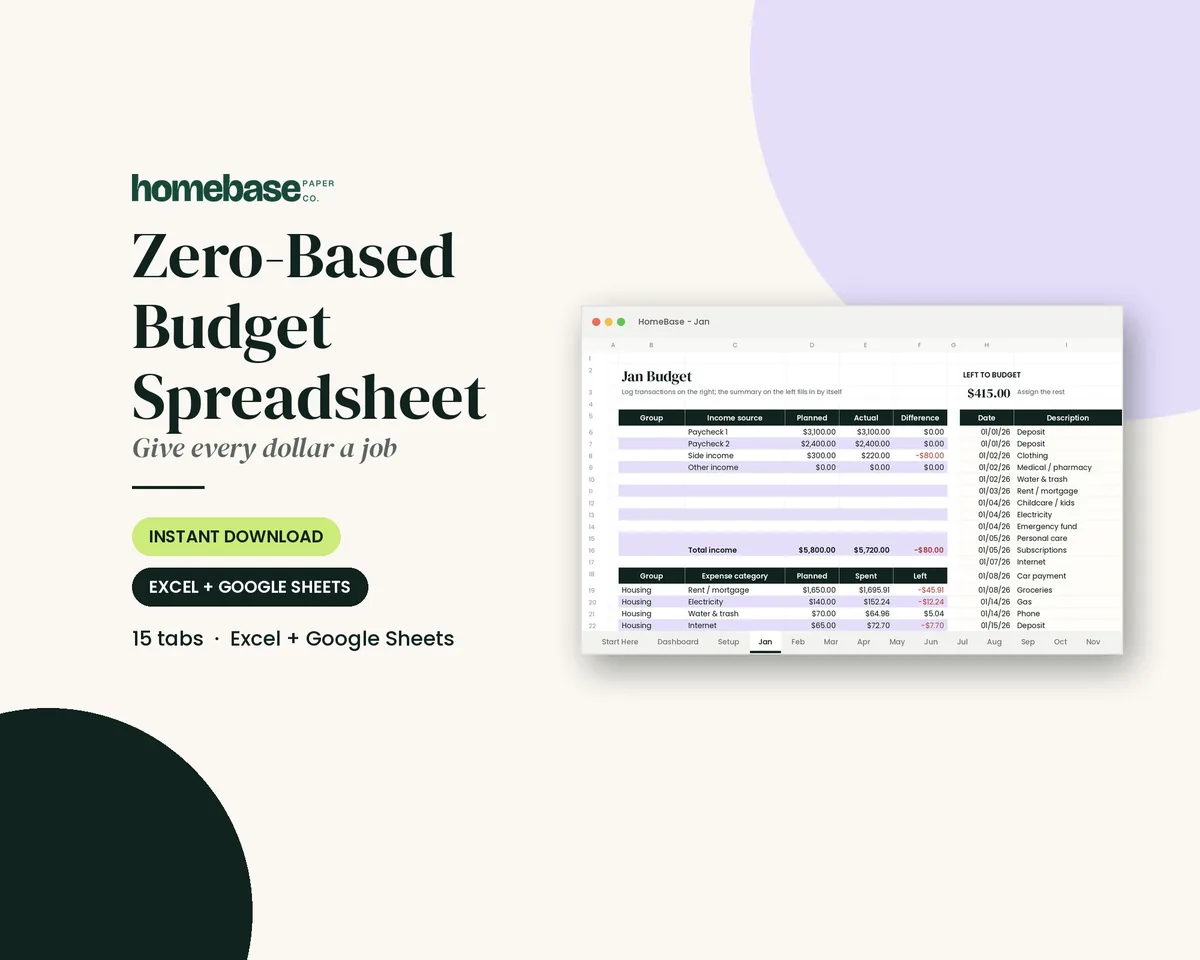
Our Zero-Based Budget Spreadsheet fits this method: the 'Left to budget' counter on each monthly tab shows when every dollar of your steady salary has a job.
Why normal budgets break with irregular income
A standard budget assumes the same paycheck twice a month. With irregular income, that assumption fails in two ways. In good months, extra money disappears into upgrades because it feels like a raise. In slow months, there's nothing left for basic bills, so they land on a credit card. The fix is to separate earning from spending, so your household sees the same income every month.
Step 1: Find your baseline month
Your baseline is what your household must spend in a lean month. List only the essentials:
Your baseline is the least disposable income you can count on in a month. Our guide explains how disposable income is calculated and how to budget it.
| Baseline expense | Monthly amount |
|---|---|
| Rent or mortgage | $ |
| Utilities and phone | $ |
| Groceries (basic) | $ |
| Insurance | $ |
| Transportation | $ |
| Child care | $ |
| Minimum debt payments | $ |
| Baseline total | $ |
Now look at the last 12 months of income and find your lowest month that wasn't a true outlier. If your baseline is lower than that number, good. If it's higher, the first job is cutting the baseline, because no budgeting trick fixes a gap that big.
If you're adding a second income stream to smooth out lean months, see our side hustle ideas for 50 options sorted by startup cost.
Step 2: Open a holding account
Every payment you earn goes into one account first. Then, once a month, you pay yourself a fixed salary from it into your regular checking.
A small business expense spreadsheet template makes the monthly totals easy.
- Open a separate account for income only. Don't attach a debit card to it.
- Deposit every client payment, tip or commission into it, no exceptions.
- Pick your monthly salary. Start with your baseline plus a small amount for flexible spending.
- Transfer that salary on the same date every month, like the first.
- Leave the rest for taxes, the buffer and goals.
This one change makes the rest of the budget look like a normal household budget, because it is one.
Step 3: Set aside taxes from every payment
If you're self-employed, nobody withholds tax for you. The IRS notes that the self-employment tax rate is 15.3%, covering Social Security and Medicare, and that's before income tax. Many freelancers move 25% to 30% of each payment into a separate tax savings account the day it arrives. If you're looking to add income, see how to make money online for legit ways to earn from home.
You'll usually owe quarterly estimated taxes too. The IRS explains that you can pay weekly or monthly if that's easier, as long as enough is paid by the end of each quarter. A tax account that grows with every payment makes those deadlines boring, which is what you want. A tax professional can help you set the right percentage. Our guide to quarterly tax due dates and math walks through the calculation.
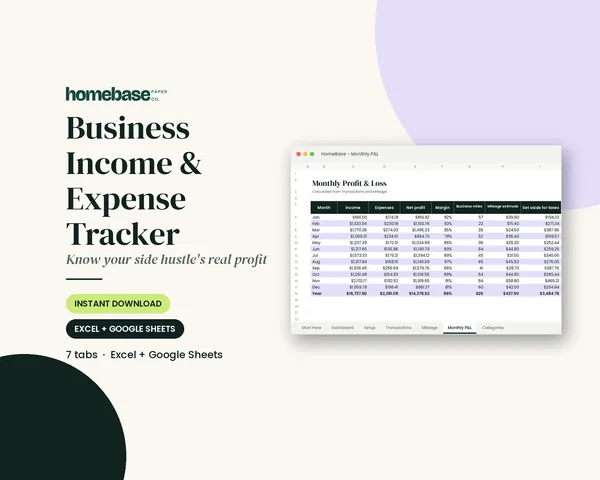
The Business Income & Expense Tracker ($7.99) shows monthly profit and how much to set aside, which is handy if you're also tracking deductible expenses for tax time.
Step 4: Build a one-month buffer
The buffer is the money that lets you pay yourself in a slow month. Your first goal is one month of baseline expenses sitting in the holding account, on top of your tax money.
The CFPB's emergency fund guide suggests setting a specific amount and a regular way to contribute. With irregular income, the most reliable approach is a percentage of every payment, for example 10%, until the buffer is full.
Once you have one month, keep going toward three to six months in a separate emergency fund. Our emergency fund tracker page has a simple way to chart it.
Step 5: Split every good month by percentage
When a big payment comes in, decide its split before you see it:
| Use | Example share |
|---|---|
| Tax account | 25% to 30% |
| Buffer (until full) | 10% to 20% |
| Sinking funds for known costs | 10% |
| Debt above the minimum or goals | The rest |
Sinking funds matter more with irregular income, because annual bills, car repairs and holidays can't be covered by "next month's" money. The Sinking Funds Tracker ($4.99) shows each fund's balance so a good month can top up the right ones.
Step 6: Give each month's salary a job
Once your salary is steady, you can use any normal budgeting method on it. A zero-based budget works especially well because you only budget money you already have. The Zero-Based Budget Spreadsheet ($6.99) walks you through giving every dollar of that salary a job at the start of the month.
If you'd rather keep it simpler, the 50/30/20 budget or paying yourself first also work once the salary is steady.
An example: one freelancer's three months
Say a freelance designer has a $3,200 baseline and pays herself a $3,500 salary. In September she earns $7,000: 25% ($1,750) goes to the tax account, $3,500 becomes October's salary and $1,750 starts the buffer. October brings only $3,000. After $750 for taxes, the remaining $2,250 covers most of November's salary, and the buffer covers the other $1,250. In November a $6,000 project lands: $1,500 goes to taxes, $3,500 funds December's salary and $1,000 goes back toward the buffer. Her household saw $3,500 every single month.
Mistakes to avoid
- Budgeting from your best month. Plan from the low end and treat the rest as a bonus.
- Mixing tax money with spending money. Keep a separate account so it's never "available."
- Raising your salary too fast. Wait until the buffer is full and you've had three steady months.
- Skipping the review. Once a quarter, compare income with your baseline and adjust.
Budgeting with irregular income takes about two months to set up and then runs quietly. The payoff is a household that doesn't feel the slow months, even when your business does. If the holidays are next, see how to set a Christmas budget by income, or browse all our budgeting guides.
If some of your income comes from apps to earn money, budget it from your baseline month like any other uneven pay.
Make it easier
Tools for this

Spreadsheets
Zero-Based Budget Spreadsheet
The 'Left to budget' counter turns green when every dollar has a job.
Spreadsheets
Business Income & Expense Tracker
Log sales, expenses and business miles - see your monthly profit, category totals for tax time and how much to set aside.

Spreadsheets
Sinking Funds Tracker
It does the math: how much to set aside each month to hit every goal on time.
Frequently asked questions
How do you budget with irregular income? To budget with irregular income, build the plan on your lowest typical month, deposit every payment into a holding account and pay yourself the same amount each month from it. Extra money from good months goes to taxes, a buffer and goals, in that order.
What is a baseline budget? A baseline budget is the bare-minimum monthly cost of your household: housing, utilities, groceries, insurance, transportation and minimum debt payments. When you budget with irregular income, the baseline is the number your lowest month must be able to cover.
How much should I keep in a buffer with irregular income? A good goal for irregular income is a buffer of one month of baseline expenses in your holding account, growing toward three to six months in a separate emergency fund. Start with one month; it alone turns a slow month into a non-event.
How much should freelancers set aside for taxes? Freelancers often set aside 25% to 30% of each payment for taxes, but the right number depends on your income and state. Self-employment tax alone is 15.3% per the IRS, before income tax, so a separate tax account protects you at quarterly deadlines.
When are quarterly estimated taxes due? Quarterly estimated taxes are generally due in April, June, September and January for the prior year's income. The IRS lists the exact dates each year on its estimated taxes page, and you can also pay more often if that's easier with irregular income.
Should I use percentages or dollar amounts with irregular income? Percentages work better than fixed dollar amounts when you budget with irregular income, because they shrink in slow months and grow in good ones. Set percentages for taxes, savings and giving, and fixed dollar amounts only for your baseline bills.
What is a holding account? A holding account is a separate checking or savings account where every irregular payment lands first. You then pay yourself a steady monthly salary from it, so your household budget sees the same income every month even when your earnings jump around.
Can I use a zero-based budget with irregular income? Yes, you can use a zero-based budget with irregular income. A zero-based budget works well with irregular income if you only budget money you've already received. Give every dollar in the holding account a job at the start of the month, starting with baseline bills, then taxes and the buffer.
How do I budget with commission or tips? Budget with commission or tips by treating your base pay as the baseline and every commission check or tip as extra. Split the extra by percentage between taxes if needed, the buffer and goals, and never plan fixed bills around money you haven't earned yet.
What do I do in a month with no income? In a month with no income, pay your baseline from the buffer in your holding account and pause extra goals. That's exactly what the buffer is for, and rebuilding it becomes the first job of the next good month.
More from HomeBase
You may also like

Printables
Budget Planner Printable
Twelve undated pages you can print every month: budget, bills, spending, savings and debt.

Spreadsheets
Bill Tracker Spreadsheet
Bills due in 3 days or less light up red, so nothing slips through.

Spreadsheets
Paycheck Budget Spreadsheet
Enter your bills once. The sheet tells you which paycheck pays each one, all year.
 Save 57%
Bundles
Ultimate Budget Bundle
All 6 spreadsheets + both printable planners - for less than half the price of buying them separately.
 Club
Monthly club
Money Club
Anyone who wants a clear plan for the month's bills, holiday spending and savings.
Free printable
Give every dollar a job: get the free monthly budget template
A printable zero-based monthly budget: income, bills, everyday spending and savings on one page, with a planned vs. actual column. You'll also get our weekly HomeBase email with simple budgeting and bill-paying tips.

Sources
- Estimated taxes (IRS) irs.gov
- Self-employment tax: Social Security and Medicare taxes (IRS) irs.gov
- An essential guide to building an emergency fund (CFPB) consumerfinance.gov